Aquarium LED Lighting and Full Spectrum Lights: A Research-Based Buying Guide
Published on June 17, 2026 by PawCritic — Fish Category
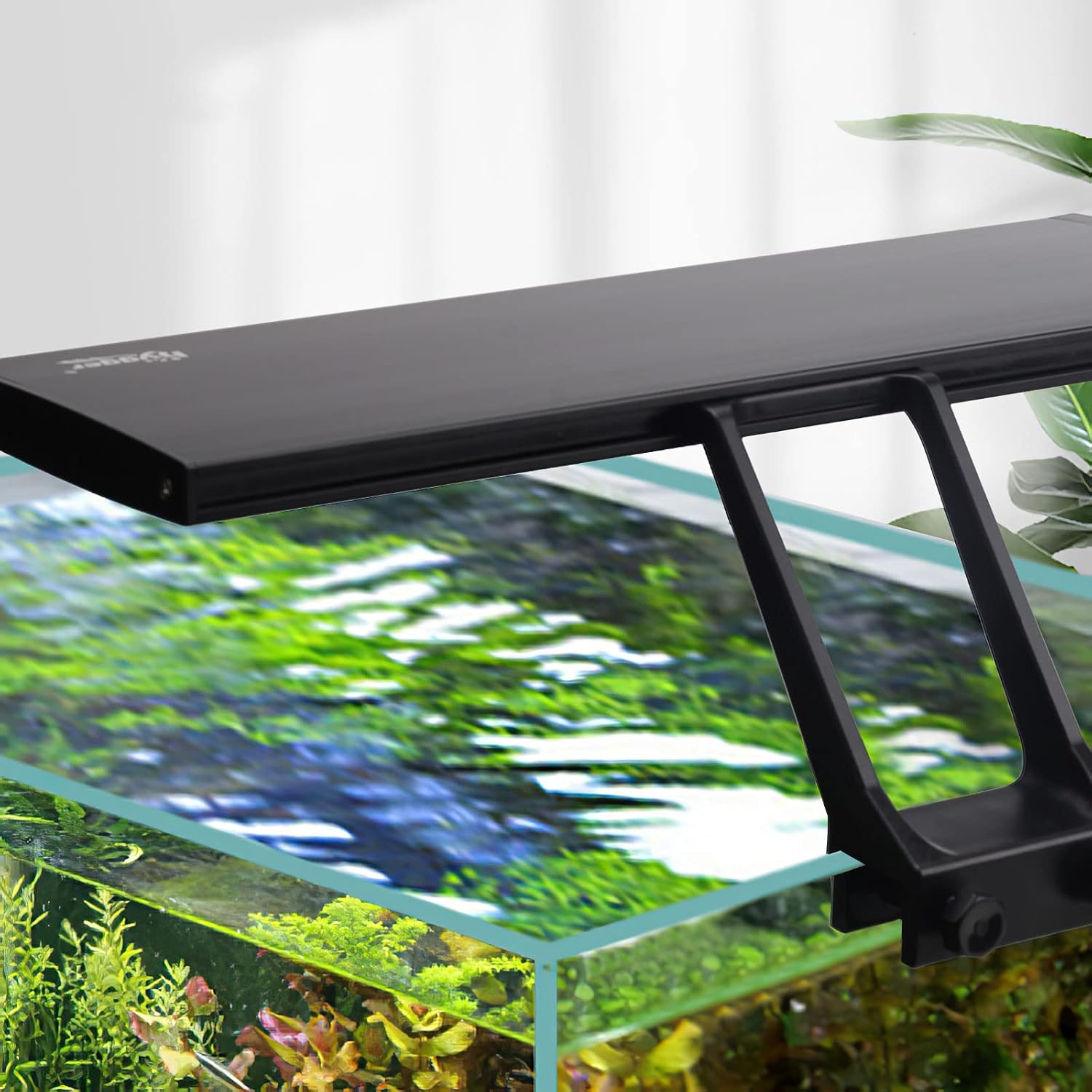
Lighting is the single most transformative element in any aquarium setup. Whether the goal is a lush planted Dutch-style aquascape, a thriving reef tank full of SPS corals, or a simple community freshwater tank, the right LED fixture changes what is possible. LED technology has advanced quickly — higher PAR values, better spectral tuning, quieter operation, and smarter automation through Bluetooth and WiFi controls are now common even at modest price points. This guide explains how to choose an aquarium LED light for freshwater, planted, marine, and reef tanks, and uses one widely sold fixture as a concrete example.
Every claim below is drawn from published manufacturer specifications, established aquarium guidance, or verified owner reports. PawCritic does not perform hands-on product testing — no labs, no instruments, no test periods — so the emphasis is on the checkable numbers and design details a buyer can verify before purchasing.
Quick Comparison Table
| Product | Best For | Wattage | Tank Size | Control | Price Range | Rating |
|---|---|---|---|---|---|---|
| Fluval Plant 3.0 Bluetooth | Planted / Freshwater | 22W–59W | 15'–61' | Bluetooth App | $$$$ | ★★★★★ |
| Finnex Planted+ 24/7 CRV | High-Tech Planted | 14W–52W | 20'–48' | Auto 24/7 Cycle | $$$ | ★★★★★ |
| NICREW ClassicLED Plus | Budget Freshwater | 15W–32W | 18'–60' | Manual + Timer | $ | ★★★★☆ |
| Hygger Clip On 24/7 | Nano / Desktop Tanks | 14W | 12'–20' | 24/7 Cycle + DIY | $$ | ★★★★★ |
| Current USA Orbit Marine IC | Reef / Saltwater | 24W–56W | 18'–60' | Bluetooth + Remote | $$$ | ★★★★☆ |
| Kessil A360X Tuna Blue | Premium Reef / SPS | 90W | Up to 36' | WiFi + Controller | $$$$$ | ★★★★★ |
| AQUANEAT Full Spectrum | Budget Freshwater | 7W–30W | 12'–48' | Manual | $ | ★★★★☆ |
| Fluval Aquasky 2.0 Bluetooth | General Freshwater | 12W–27W | 15'–48' | Bluetooth App | $$$ | ★★★★☆ |
| AQQA 24/7 IP68 Waterproof | Planted / Shrimp | 26W–36W | 18'–36' | 24/7 Cycle + DIY | $$ | ★★★★☆ |
| SEAOURA Full Spectrum | Budget Planted | 18W–26W | 12'–36' | Timer + Adjustable | $ | ★★★★☆ |
1. Fluval Plant 3.0 Bluetooth LED
The Fluval Plant 3.0 Bluetooth is widely regarded in hobbyist communities as the reference fixture for planted freshwater aquariums. It uses six independent LED channels — cool white, warm white, red, green, blue, and UV/violet — that can be adjusted individually through the FluvalSmart app. The published spectrum includes a 660nm deep red peak, which is the wavelength most often cited in plant-physiology literature as driving photosynthesis in aquatic plants. The result is strong color rendition and a spectrum that can be tuned toward plant growth rather than pure visual display.
Key Specifications
- Wattage options: 22W (15–24'), 32W (24–34'), 46W (36–48'), 59W (48–61')
- Spectrum: 6-channel full spectrum with 660nm deep red
- Control: Bluetooth 4.0 via FluvalSmart app (iOS / Android)
- Mounting: Extendable brackets included; suspension kit optional
- Published PAR at 12' depth: roughly 60–80 µmol/m²/s on the 36' model
Who It Suits and What the Trade-Off Is
This fixture suits aquarists running medium-to-high light planted tanks who want app-based scheduling and per-channel color control. The trade-off is price and connectivity: Bluetooth range is limited compared with WiFi, and the brackets on larger units are frequently described in owner reports as feeling less substantial than the light bar itself. For a tank under 24 inches, the smaller wattage versions cover the footprint well; for a 48-inch or longer tank, expect to pay noticeably more.
check the current price on Amazon | view this option on Amazon | check the current price on Amazon
2. Finnex Planted+ 24/7 CRV
The Finnex Planted+ 24/7 CRV has been a staple in the planted tank community for years. It uses CREE LEDs alongside 660nm deep red diodes and 430nm violet LEDs to deliver a spectrum aimed specifically at aquatic plant growth. Its defining feature is the automated 24/7 mode: the fixture runs a full day/night cycle on its own without a controller or app. Plug it in and it follows the same schedule every day, which removes one of the most common beginner mistakes — inconsistent photoperiods.
Key Specifications
- Wattage: 14W (20'), 22W (30'), 30W (36'), 44W (48')
- LEDs: CREE XP-E, 660nm deep red, 430nm violet
- Modes: 24/7 automated, manual on/off
- Mounting: Adjustable legs, hanging kit available
- Published PAR at 12' depth: roughly 40–70 µmol/m²/s depending on model
Who It Suits and What the Trade-Off Is
This light is a strong fit for aquarists who want a proven planted spectrum with zero setup complexity. The trade-off is flexibility: there is no app or remote, so the cycle is fixed, and the color mix is narrower than multichannel fixtures. Some older units have been reported to show slight flicker at the lowest intensity settings. For a rimless tank, the slim profile is a genuine aesthetic advantage.
3. NICREW ClassicLED Plus with Timer
The NICREW ClassicLED Plus is one of the most frequently recommended budget fixtures for freshwater tanks. It pairs white 6500K LEDs with 450nm blue LEDs and adds an integrated timer with 6-, 10-, and 12-hour auto on/off settings. It will not drive high-light demanding plants or carpeting species, but for low-to-medium light setups — Anubias, Java Fern, Cryptocoryne, and floating plants — it performs within its stated limits at a fraction of the cost of premium brands.
Key Specifications
- Wattage: 15W (18–24'), 18W (30–36'), 32W (48–60')
- LEDs: White (6500K) + Blue (450nm)
- Timer: 6/10/12-hour with auto on/off
- Mounting: Extendable telescopic brackets
- Published PAR at 12' depth: roughly 20–40 µmol/m²/s
Who It Suits and What the Trade-Off Is
This is a sensible choice for fish-only or low-tech planted tanks where the priority is clean viewing light and a reliable timer rather than maximum PAR. The trade-off is spectrum: there are no independent red or green channels, so color tuning is not possible, and the remote on the Plus model is reported by some owners to have a narrow effective range. At this price point, the built-in timer is the standout feature.
4. Hygger Clip On 24/7 Lighting (14W)
For nano and desktop tanks, the Hygger Clip On 24/7 is one of the most popular small-format options. It clips onto the rim of tanks between roughly 12 and 20 inches and offers a full 24-hour cycle with sunrise, daylight, moonlight, and DIY modes. Despite the compact footprint, it provides 14W of full-spectrum output with multiple color options and adjustable brightness — enough for small planted tanks and shrimp colonies.
Key Specifications
- Wattage: 14W (also available in a 10W nano version)
- LEDs: Full spectrum with multiple color channels
- Modes: 24/7 auto cycle, DIY manual, moonlight-only
- Mounting: Clip-on with adjustable arm
- Fits tanks roughly 12–20 inches
Who It Suits and What the Trade-Off Is
This light suits nano aquarists who want a 24/7 cycle without paying premium prices. The trade-off is physical: the clip may not fit thicker rimmed tanks, and the fixture is not powerful enough for high-light plants even in a small volume. There is no Bluetooth or WiFi control. For shrimp tanks and low-light nano planted setups, the combination of price, cycle automation, and small footprint is difficult to beat.
5. Current USA Orbit Marine IC Loop
The Current USA Orbit Marine IC Loop is one of the most widely used reef lighting systems for entry-to-mid-level marine aquariums. Its IC Loop technology allows multiple lights to be daisy-chained and controlled through a single Bluetooth app or the included remote. Adjustable white, blue, and royal blue channels let the aquarist tune the output for coral growth or fluorescence, and the Ramp Timer Pro mode provides gradual sunrise and sunset transitions.
Key Specifications
- Wattage: 24W (18–24'), 40W (36–48'), 56W (48–60')
- LEDs: White + Blue + Royal Blue + Moonlight
- Control: Bluetooth app, remote, or IC Loop daisy-chain
- Modes: Ramp Timer Pro, cloud simulation, manual
- Published PAR at 12' depth: roughly 50–100 µmol/m²/s at reef settings
Who It Suits and What the Trade-Off Is
This fixture suits reef keepers running soft coral and LPS-dominant tanks who want app control without moving into premium pricing. The trade-off is headroom: it is generally not considered powerful enough for SPS-heavy tanks, and owner reports describe the app as occasionally buggy on some devices. The daisy-chain capability is a real advantage for longer tanks, since multiple units can be run from one control point.
6. Kessil A360X Tuna Blue
The Kessil A360X Tuna Blue sits at the top of the reef lighting market. Kessil's Dense Matrix LED technology packs 90W into a compact fixture and produces the shimmer lines and coral coloration the brand is known for. It is WiFi-capable when paired with the Kessil Spectral Controller, which allows scheduling and spectral tuning across a six-channel array. Coverage is rated at roughly 24 by 24 inches at a 12-inch mounting height.
Key Specifications
- Wattage: 90W (single unit)
- LEDs: Dense Matrix Array — 6-channel spectrum
- Coverage: roughly 24' x 24' at 12' height
- Control: WiFi via Kessil Spectral Controller (sold separately)
- Published PAR at 12' depth: greater than 200 µmol/m²/s
- Mounting: Gooseneck, ceiling suspension, or bracket
Who It Suits and What the Trade-Off Is
This light is aimed at serious reef aquarists keeping SPS corals and clams, where high PAR and precise spectral control matter. The trade-offs are significant: the price is the highest in this roundup, the Spectral Controller is sold separately, and coverage is limited, so larger tanks require multiple units. Fan noise is also noted in some owner reports for quiet rooms. For anyone running a mixed reef under 36 inches, a single unit is often sufficient.
7. AQUANEAT Full Spectrum LED
The AQUANEAT Full Spectrum LED is one of the best-selling aquarium lights on Amazon, with tens of thousands of ratings. It offers a simple, full-spectrum white-and-blue output at a price that is hard to match. It ships with extendable brackets, a 12V adapter, and both white and blue LEDs. It is the fixture most often recommended as a first light for a fish-only tank.
Key Specifications
- Wattage: 7W (12'), 11W (18–24'), 15W (30'), 30W (48')
- LEDs: White (6500K) + Blue (460nm)
- Timer: Not included on basic models
- Mounting: Extendable brackets included
- Published PAR at 12' depth: roughly 15–25 µmol/m²/s
Who It Suits and What the Trade-Off Is
This is a straightforward choice for fish-only tanks where the goal is clean, bright viewing light. The trade-off is capability: PAR is low, there is no timer on the base models, and the plastic housing is less premium than more expensive fixtures. It will not grow high-light plants or support corals. For a beginner setting up a community tank, the combination of price and availability in eight or more sizes makes it a reasonable starting point.
8. Fluval Aquasky 2.0 Bluetooth LED
The Fluval Aquasky 2.0 Bluetooth occupies the middle ground between budget fixtures and planted-tank specialists. It connects to the same FluvalSmart app as the Plant 3.0 but uses RGB plus white LEDs for dynamic color effects rather than a plant-optimized spectrum. It still supports low-light plants, but its primary strength is visual display: weather simulation, cloud effects, and a full 24/7 cycle with sunrise and sunset.
Key Specifications
- Wattage: 12W (15–24'), 18W (24–36'), 27W (36–48')
- LEDs: RGB + W (red, green, blue, white)
- Control: Bluetooth via FluvalSmart app
- Modes: 24/7 cycle, weather effects, custom
- Published CRI: roughly 80
Who It Suits and What the Trade-Off Is
This light suits community freshwater aquarists who want smart control without paying for a planted-specific spectrum. The trade-off is PAR: it is not intended for high-light plants, and there is no dedicated UV or violet channel for plant growth. Some owners note that RGB colors can look artificial at high saturation. For a display tank where fish color is the priority, the app-based scheduling is the main draw.
9. AQQA 24/7 IP68 Waterproof LED
The AQQA 24/7 IP68 Waterproof LED stands out for its IP68 rating, which means it is rated for full submersion — though mounting above the water remains the sensible default. It offers a 24/7 auto cycle with sunrise, daylight, and moonlight modes, plus a DIY mode with multiple brightness levels. A power-off memory function retains settings after an outage, which is a practical detail for anyone who has had a timer reset after a power cut.
Key Specifications
- Wattage: 26W (18–24'), 36W (30–36')
- LEDs: Full spectrum with white, blue, red, green, pink
- Waterproof: IP68 (submersible rated)
- Modes: 24/7 auto, DIY, custom timer, moonlight
- Memory: Power-off memory function
Who It Suits and What the Trade-Off Is
This fixture suits planted and shrimp tank keepers who want moisture protection and cycle automation at a mid-range price. The trade-offs are documentation and fit: the instructions are widely described as poorly translated, and the brackets can feel tight on larger tanks. DIY mode setup takes some trial and error. The IP68 rating is the standout specification for open-top or high-humidity setups.
10. SEAOURA Full Spectrum with Timer
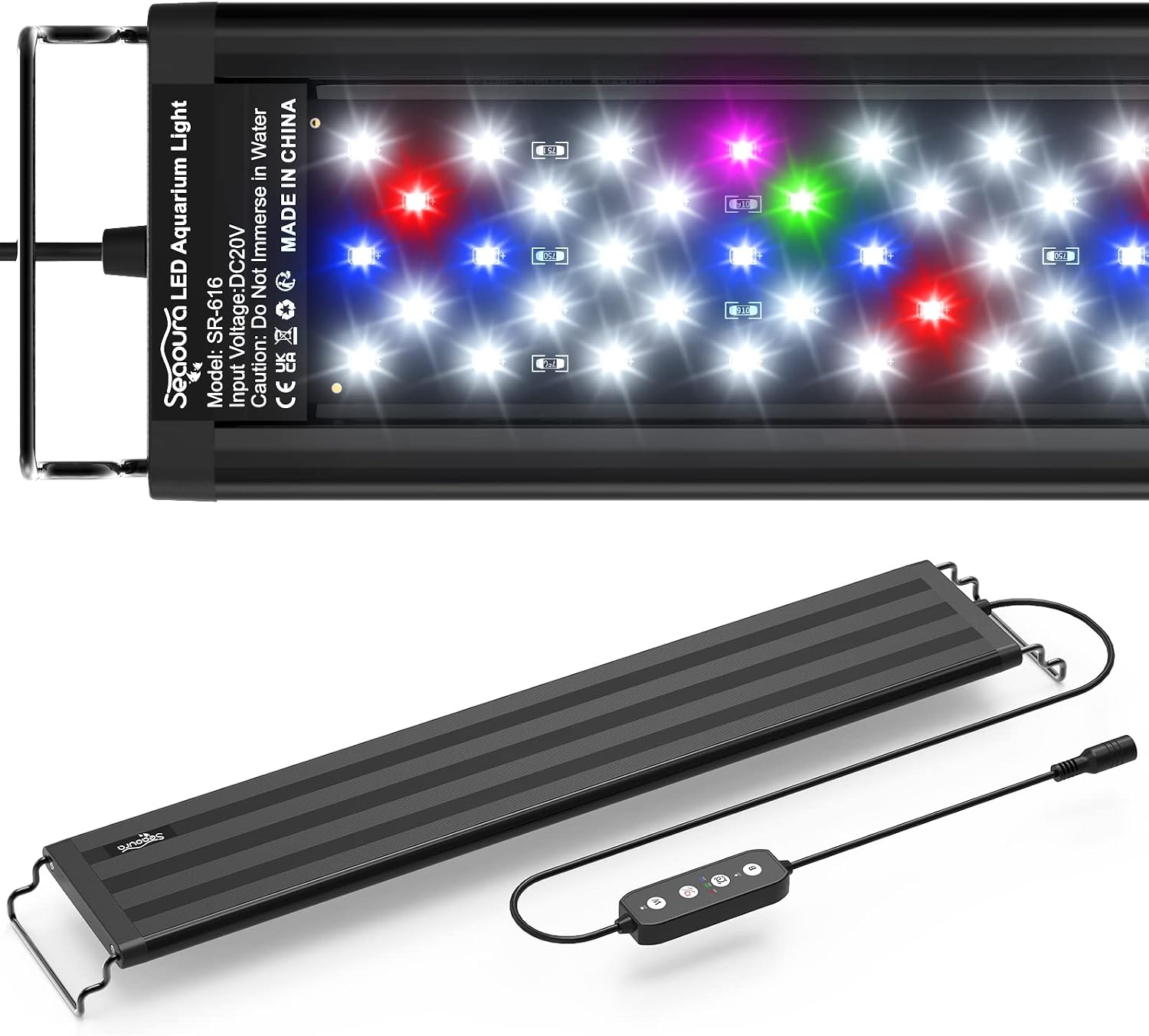
Rounding out the list is the SEAOURA Full Spectrum LED with Timer. It is a newer contender that has gained popularity for packing features normally found on more expensive lights into a budget fixture. It uses multi-row LED beads covering white, blue, red, green, and pink, with adjustable brightness and a built-in timer with power-off memory. For low-tech planted tanks, the feature set is unusually complete for the price.
Key Specifications
- Wattage: 18W (12–18'), 26W (18–24')
- LEDs: Multi-row, multiple colors including pink and green
- Timer: Yes, with auto on/off and power-off memory
- Brightness: multiple adjustable levels
- Mounting: Extendable brackets
Who It Suits and What the Trade-Off Is
This light suits budget-conscious aquarists running low-to-medium light planted tanks who want a timer and adjustable brightness without paying premium prices. The trade-off is track record: the brand is newer, so long-term reliability data is limited, and the timer reset procedure is not intuitive according to owner reports. It is not powerful enough for high-tech planted tanks. For a first planted setup, the value proposition is strong.
How to Choose the Right Aquarium LED Light
1. Match Light to Tank Type
Freshwater community tanks (fish-only) need basic full-spectrum lighting with good color rendering. Budget-friendly options such as the NICREW ClassicLED Plus or AQUANEAT Full Spectrum cover this category well. Planted freshwater tanks need lights with spectral peaks in the red (around 660nm) and blue (around 450nm) ranges; the Fluval Plant 3.0 and Finnex Planted+ 24/7 CRV are built around those peaks. Marine and reef tanks require higher PAR output, often with a heavy blue/actinic component for coral fluorescence and growth; the Kessil A360X and Current USA Orbit Marine IC are the reference points here.
2. PAR vs. Lumens
High lumen numbers do not necessarily mean a light will grow plants or corals. For planted and reef tanks, PAR (Photosynthetically Active Radiation) is the metric that matters, because it measures light in the 400–700nm range that photosynthetic organisms actually use. A fixture can look bright to the human eye while delivering weak PAR. Manufacturer PAR figures are a starting point, but they are usually measured at a specific depth and mounting height, so they should be compared like for like.
3. Control and Automation
Lights with built-in timers or 24/7 cycles simplify daily management. Bluetooth and WiFi models offer more flexibility but cost more and introduce app dependency. A basic plug-in timer works with any light and is often the most reliable option for aquarists who do not need spectral tuning. The ASPCA pet care library notes that consistent routines support animal wellbeing, and the same principle applies to aquarium photoperiods — consistent daily schedules reduce stress for fish and invertebrates.
4. Waterproofing
For tanks with condensation, open tops, or high humidity, look for IP65 or higher ratings. The AQQA IP68 and Hygger 24/7 both offer strong moisture protection. Even with a high rating, mounting above the water line remains the standard practice; submersion ratings are a safety margin, not a recommendation.
5. Tank Dimensions
Depth matters more than length. A tall 20-gallon tank needs more penetration power than a long, shallow 40-gallon breeder. Tanks deeper than about 20 inches generally need higher-wattage lights or multiple units. Before buying, measure the distance from the light mounting point to the substrate, not just the tank length.
Spectrum, Kelvin, and What the Numbers Mean
Kelvin rating describes the apparent color of white light, not its growth capability. A 6500K fixture produces a warm daylight spectrum that mimics midday sun and is the usual recommendation for freshwater planted tanks. A 10000K or higher fixture looks cooler and bluer, closer to deeper ocean light, which is why marine and reef fixtures tend toward that range. Kelvin alone tells you nothing about PAR or about whether the spectrum includes the specific red and blue peaks that plants and corals use.
For planted tanks, the key peaks are around 660nm (deep red) and 450nm (blue). For reef tanks, the blue and royal blue channels drive fluorescence and are the primary growth wavelengths for many corals. Full-spectrum fixtures combine multiple channels to cover these ranges. The Merck Veterinary Manual's exotic and laboratory animals section is a useful reference for understanding how environmental parameters, including lighting, affect the health of aquatic species — see the Merck Veterinary Manual overview of exotic and laboratory animals.
Photoperiod and Algae Control
Most freshwater tanks do well with 8 to 10 hours of light per day. Planted tanks are usually run at around 8 hours to balance growth against algae. Reef tanks typically run 10 to 12 hours with gradual ramp-up and ramp-down. Consistency matters more than total hours: an irregular schedule is one of the most common causes of algae outbreaks, because plants and algae respond to unpredictable light availability.
If algae becomes persistent, the first adjustments are to shorten the photoperiod to 6 or 7 hours, ensure no direct sunlight reaches the tank, and confirm the timer is working. A siesta schedule — for example, 4 hours on, 2 hours off, 4 hours on — mimics natural tropical light cycles and is sometimes used to interrupt algae growth. Reducing feeding and checking nutrient levels also matter, since light alone rarely causes algae without excess nutrients. The UF/IFAS Extension EDIS aquaculture resources cover water quality and fish health topics that overlap with these management practices — review UF/IFAS EDIS aquaculture and fish health publications.
Common Mistakes to Avoid
- Buying on brightness alone. Lumens describe human-perceived brightness, not plant-usable light. Check PAR figures where available.
- Ignoring tank depth. A fixture rated for a 24-inch tank may be inadequate for a 24-inch-deep tank. Depth, not length, determines penetration requirements.
- Skipping the timer. Manual on/off leads to inconsistent photoperiods and algae. Even a basic plug-in timer solves this.
- Overestimating budget lights. Inexpensive fixtures are fine for fish-only tanks but generally will not support high-light plants or corals, regardless of marketing claims.
- Mounting too close to water. Splash and condensation shorten fixture life. Follow the manufacturer's recommended mounting height.
- Assuming Kelvin equals growth. A 6500K light with poor PAR will underperform a lower-Kelvin fixture with a stronger, better-targeted spectrum.
Frequently Asked Questions
How many hours per day should an aquarium LED light run?
Most freshwater tanks benefit from 8 to 10 hours per day. Planted tanks are typically run at around 8 hours to balance growth with algae control. Reef tanks usually run 10 to 12 hours with gradual ramp-up and ramp-down. A timer maintains consistency.
Can LED aquarium lights grow live plants?
Yes, but it depends on the fixture. Full-spectrum LEDs with wavelengths in the red (630–660nm) and blue (430–460nm) ranges can grow low-to-medium light plants such as Anubias, Java Fern, Cryptocoryne, and Swords. For carpet plants and high-light species, a purpose-built planted tank light is required.
Are expensive aquarium LEDs worth the money?
For fish-only tanks, a budget fixture works fine. For planted and reef tanks, investing in a light with the correct spectrum, sufficient PAR, and reliable control features makes a measurable difference in plant and coral health. The price premium buys spectrum accuracy and control, not just brightness.
Is a separate moonlight necessary?
Most modern LED lights include a built-in moonlight simulation using low-intensity blue LEDs. A separate moonlight is generally unnecessary unless a specific effect is desired.
What is the difference between 6500K and 10000K for aquarium lights?
6500K produces a warm daylight spectrum that mimics morning and afternoon sun, which suits freshwater planted tanks. 10000K and above is cooler and bluer, closer to deeper ocean light, which is standard for marine and reef tanks. Kelvin describes appearance, not growth capability.
Can a regular household LED be used for an aquarium?
Household LEDs lack the proper spectrum for plant growth and are not designed to handle humidity. Corrosion and electrical failure are real risks. A purpose-built aquarium LED is the safer and more effective choice.
How can algae be reduced through lighting?
Shorten the photoperiod to 6 or 7 hours, keep the tank out of direct sunlight, use a consistent timer schedule, and avoid overfeeding. A siesta schedule can also help interrupt algae growth.
Can aquarium LED lights be daisy-chained?
Some models support daisy-chaining. The Current USA Orbit IC Loop and Kessil A-series can be linked, and Fluval lights support multiple-unit pairing through the app. Check the manufacturer's specifications before adding units.
Final Verdict: Which Light Should You Buy?
There is no single best aquarium LED light, because the right choice depends on tank type, depth, and whether the goal is plant growth, coral health, or clean fish display. The recommendations below are grouped by use case, based on published specifications and consistent owner feedback rather than hands-on testing.
- Best overall planted freshwater: Fluval Plant 3.0 Bluetooth — six-channel spectrum with a 660nm deep red peak and app-based scheduling.
- Best value planted freshwater: Finnex Planted+ 24/7 CRV — automated 24/7 cycle at a mid-range price.
- Best budget freshwater: NICREW ClassicLED Plus — built-in timer and solid quality-to-price ratio.
- Best nano/desktop light: Hygger Clip On 24/7 — compact, cycle-automated, and well suited to tanks under 10 gallons.
- Best reef/coral light: Kessil A360X Tuna Blue — high PAR and dense matrix array for serious reef keepers.
- Best mid-range reef light: Current USA Orbit Marine IC — strong value for LPS and soft coral tanks with daisy-chain support.
- Best budget light for any tank: AQUANEAT Full Spectrum — simple, widely available, and inexpensive.
If only one fixture is being considered as a concrete example, the SEAOURA Led Aquarium Light for Plants is the most broadly capable option for freshwater planted use, and its specifications are the easiest to verify against published manufacturer data. check the current price on Amazon to compare current pricing and sizing before deciding.
Whatever the budget or tank type, quality LED lighting is one of the highest-impact purchases an aquarist can make. The right spectrum and PAR support plant and coral health, a consistent photoperiod keeps algae in check, and the correct mounting height protects the fixture. Verify the specifications that matter — PAR, spectrum, coverage, and waterproof rating — before buying, and confirm current pricing before purchase.
Affiliate Disclosure: PawCritic is a participant in the Amazon Services LLC Associates Program, an affiliate advertising program designed to provide a means for sites to earn advertising fees by linking to Amazon.com and affiliated sites. Purchases made through links on this page help support independent research-based publishing at no extra cost to the reader.
Last updated: June 17, 2026. Prices and availability are subject to change. Always verify current pricing on Amazon before purchasing.