Aquarium Plant Tools and Aquascaping Kits: A Research-Based Buying Guide
Published on July 8, 2026 by PawCritic — Fish Category
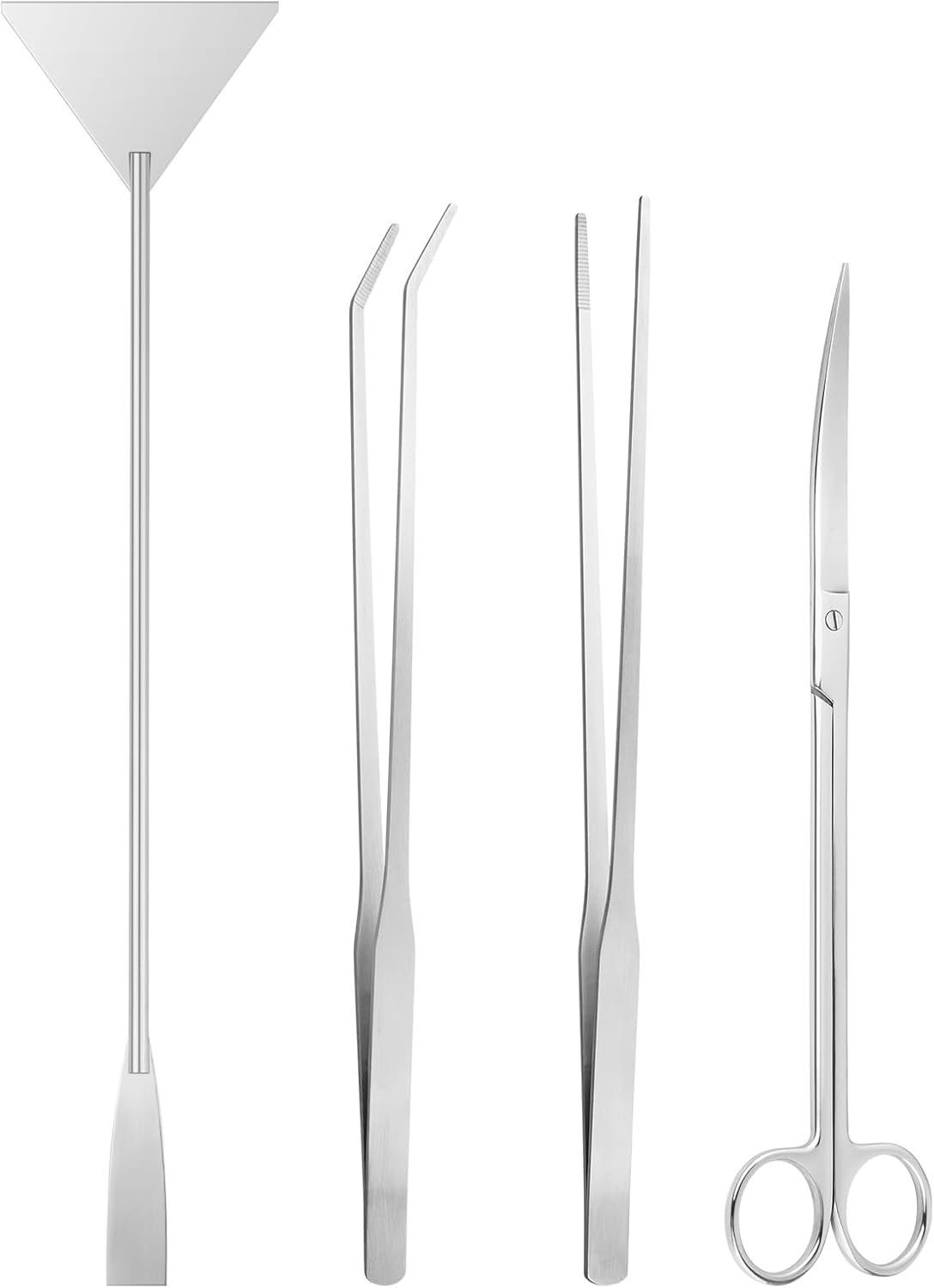
Aquascaping — arranging aquatic plants, rocks, driftwood, and substrate inside a fish tank — depends on precision that bare hands and kitchen tweezers cannot deliver. Planting a carpet of Monte Carlo or Dwarf Baby Tears, trimming stem plants without uprooting them, or nudging a piece of driftwood into exactly the right angle all require slim tips, long reach, and blades that cut cleanly underwater. The tools sold for this job are not complicated objects, but the differences between a good set and a poor one show up quickly in plant health and layout quality.
The category now spans budget stainless steel kits under 15 dollars to titanium-coated professional sets. Published manufacturer specifications for the better sets describe 304 stainless steel construction, anti-slip grips, fine tapered tips, and lengths from roughly 10 to 24 inches. Longer tools let you work in deep tanks without submerging your arm, while curved tips reach rear corners that straight tools cannot address. This guide explains what the specifications mean, where the trade-offs sit, and how to match a tool set to your tank. It is written from published guidance, manufacturer documentation, and verified owner reports rather than hands-on bench testing, and it treats the linked product as one concrete example rather than a ranked winner.
Quick Comparison Table
| Tool Type | Typical Role | Common Length | Material Notes | Case | Price Band |
|---|---|---|---|---|---|
| 4-piece stainless steel set | All-purpose planting and trimming | 12 to 13 in | 304 stainless steel, brushed finish | Cloth or none | $ |
| 4-piece set with zipper case | Value starter kit with storage | 11 to 12 in | Steel blades, aluminum handles | Zippered case | $ |
| Extra-long straight tweezers | Planting in deep tanks | 23 to 24 in | One-piece 304 stainless steel | None | $ |
| 7-piece titanium kit | Complete aquascaping coverage | 11 to 12 in | Titanium nitride coating | Roll-up pouch | $$ |
| 3-piece scissors set | Trimming and maintenance only | 12 in | Stainless steel, adjustable pivot | Silicone sheaths | $ |
| 5-piece budget set | First planted tank | 11 in | Standard stainless steel | Drawstring pouch | $ |
| 8-piece premium set | Competition and heavy use | 12 to 14 in | Titanium-coated steel, cork handles | Hard shell case | $$$ |
| Curved shears | Carpet contour trimming | 12 to 13 in | Japanese AUS-8 stainless steel | None | $$ |
What Aquarium Plant Tools Actually Do
Aquascaping tools fall into two families: gripping tools and cutting tools. Gripping tools are tweezers, sold in straight and curved profiles, with tip widths that range from blunt to needle-fine. They plant stems, position moss, place small stones, and retrieve debris. Cutting tools are scissors, sold as straight, curved, and wave-blade variants. Straight scissors handle bulk trims, curved scissors follow the contour of a carpet, and wave-blade scissors grip a stem between scalloped edges so it cannot slide away mid-cut.
A handful of specialty tools appear in larger kits. Spatulas level substrate in tight areas without disturbing hardscape. Rakes and hooks reposition wood and stone. Algae scrapers remove film from glass. None of these are essential for a basic planted tank, but each solves a specific problem that otherwise forces you to reach into the tank with your hand and disturb the layout. The ASPCA pet care library is a useful starting point for understanding how tank maintenance routines interact with animal welfare, since every time you put a hand or tool into the water you are altering the environment your fish live in.
Tool length matters more than most buyers expect. A 12-inch tool suits a tank roughly 18 to 21 inches deep, because you can reach the substrate at the back of the tank while keeping your elbow above the rim. A 24-inch tank needs 16 to 24 inch tools, or you will submerge your arm to the shoulder. Nano tanks under 10 gallons are the opposite problem: a 24-inch tweezer in a 10-gallon tank is awkward and gives you less control than a shorter tool would.
Materials: What the Specifications Tell You
Nearly every tool in this category is described as stainless steel, but the grade matters. Type 304 stainless steel is the baseline for aquarium tools. It resists freshwater corrosion well, holds a reasonable edge, and tolerates repeated rinsing and drying. Type 316 stainless steel adds molybdenum, which improves resistance to chlorides and makes it the better choice for saltwater or reef-adjacent use. Titanium nitride coatings, often described as titanium-coated or gold-coated, sit on top of a steel core and increase surface hardness and corrosion resistance.
Handle material is a separate decision. All-steel handles feel substantial and transmit precise feedback, but they are heavier over long sessions. Aluminum handles reduce weight but corrode in saltwater and feel less solid. Cork handles float, which matters if you drop a tool into a deep tank, and they stay grippy when wet, but they must be dried between uses to prevent mold. Rubberized coatings improve grip at the cost of trapping moisture near the metal if not dried carefully.
Blade steel is its own specification. Japanese AUS-8 stainless steel, common in high-end kitchen and pocket knives, takes a very fine edge and holds it longer than generic stainless, but it can rust if left wet, particularly after saltwater exposure. Generic stainless scissors are easier to maintain and cheaper to replace, but they dull faster and may need honing every few weeks under heavy trimming. The UF/IFAS Extension EDIS program publishes aquaculture and fish health guidance that reinforces the same principle: clean, well-maintained equipment reduces stress and disease risk in aquatic systems.
How to Match Tools to Your Tank
Start with depth. Measure from the rim of the tank to the substrate. If that distance is under 16 inches, a 10 to 12 inch tool is comfortable. Between 16 and 22 inches, choose 12 to 14 inch tools. Over 22 inches, look for 16 inch tools at minimum and consider a 23 to 24 inch tweezer for planting. Buying tools that are too short is the most common mistake new aquascapers make, because it forces arm submersion that disturbs fish and shifts hardscape.
Next, match the tool set to the planting style. A low-tech tank with Java Fern, Anubias, and Java Moss needs only a straight tweezer and one pair of straight scissors. A high-tech carpet tank with Monte Carlo, Dwarf Hairgrass, or Glossostigma needs curved scissors for contour trimming and fine-tip tweezers for planting individual plugs. A Dutch-style stem tank needs sharp straight scissors for frequent trimming plus wave-blade scissors for isolating stems inside dense growth.
Finally, consider how many tanks you maintain. If you keep several aquariums, a kit with a case and a range of tool lengths saves time, because you can carry one pouch between tanks instead of hunting for the right tool each time. If you keep a single tank, a focused four-piece set is usually enough, and you can add a specialty tool later if a specific task becomes frustrating.
Product-by-Product Notes
hygger Premium 4-Piece Aquarium Tools Set
This set is the practical starting point for most planted tanks. Manufacturer specifications list 304 stainless steel construction, a brushed matte finish, a 12.6-inch straight tweezer, a curved tweezer, straight scissors, and curved scissors. The needle-point tweezer tips are described as fine enough to grip individual stems without crushing neighboring plants, and owner reports consistently describe the scissors as staying sharp through months of routine trimming. The trade-off is storage: the set ships with a microfiber cloth rather than a case, so buyers who want organized storage need to add a pouch or rack separately.
check the current price on Amazon
4-Piece Kit With Zippered Case
Kits in this style pair stainless steel blades with lighter aluminum handles and include a padded zippered case with elastic straps. Verified owner reports describe the case as the main reason to choose this format, since it protects blades during storage and transport and keeps tools from rattling against each other. The trade-off is durability: aluminum handles corrode in saltwater, and the thinner scissors blades dull faster than heavier steel blades under heavy use. For freshwater hobbyists who move tools between tanks, the case is a genuine advantage.
Extra-Long Straight Tweezers
Single 23 to 24 inch tweezers exist to solve one problem: planting in deep tanks. Specifications for these tools typically describe one-piece 304 stainless steel construction with no welded joints, a tip width near 1 mm, and a textured grip section that lets you choke up for precision or grip at the end for maximum reach. Owner reports describe the spring tension as consistent over time. The limitation is obvious: at this length the tool is unwieldy in nano tanks, and a straight profile cannot reach around hardscape the way a curved tool can.
7-Piece Titanium-Coated Kit
Larger kits add tools and coatings. A typical 7-piece set includes straight and curved tweezers, straight and curved scissors, wave-blade scissors, a substrate spatula, and a rake, all with a titanium nitride coating and a roll-up nylon pouch. Manufacturer specifications position the titanium coating as the corrosion-resistance upgrade, and owner reports from saltwater users describe less pitting than uncoated tools. The trade-off is that the coating can chip if tools are banged together, and the pouch takes more space than a compact zippered case.
check the current price on Amazon
3-Piece Scissors Set
Scissors-only sets exist for aquascapers who already own good tweezers and want better cutting tools. These sets typically include straight, curved, and wave-blade scissors, each around 12 inches, with an adjustable pivot screw and silicone blade sheaths. The sheaths are a meaningful detail: they protect both the blade and your fingers during storage. The trade-off is that the handles on many of these sets become slippery when wet, and the blades may need honing after a few weeks of heavy trimming.
5-Piece Budget Set
Budget five-piece sets include straight and curved tweezers, straight scissors, a spatula, and an algae scraper in a fabric pouch. Published specifications describe standard stainless steel without premium finishes. Owner reports frequently mention that the scissors arrive functional but not razor-sharp, and that the tweezer spring is stiffer than on higher-priced sets. For a first planted tank, this is a reasonable entry point, but these tools are not the right choice for saltwater, where the standard steel will corrode.
8-Piece Premium Set
Premium sets add tool count, coating quality, and storage. An 8-piece kit typically includes fine straight and curved tweezers, extra-long planting tweezers around 14 inches, straight, curved, and wave-blade scissors, a spatula, and a hardscape hook, all titanium-coated with cork handles and a hard-shell case with custom foam. Cork floats and stays grippy when wet, which is a real advantage in deep tanks. The trade-offs are price, case size, and the need to dry cork handles between uses to prevent mold.
Curved Aquascaping Shears
Specialty curved shears are a single-tool purchase for aquascapers who trim carpets frequently. Specifications for the better examples describe Japanese AUS-8 stainless steel blades, a curved profile that follows the natural arc of the wrist, rubberized handles, and an adjustable tension screw with an oversized thumb loop that accommodates gloves. The trade-off is that AUS-8 steel can rust if not dried after saltwater use, and a single curved tool does not replace straight scissors for bulk trimming.
Maintenance That Actually Extends Tool Life
Rinse tools in freshwater and dry them immediately after every use. Moisture trapped at hinge points is the leading cause of rust on stainless steel aquarium tools, and a microfiber cloth removes both water and plant debris. A drop of food-grade mineral oil on hinge pins once a month keeps spring action smooth; wipe away excess oil before the tool goes back in the tank.
Hone scissors with a fine-grit sharpening stone, roughly 1000 to 6000 grit, every two to three weeks under regular use. A few passes restore a clean cutting edge and prevent the crushing that damages plant tissue. Never cut driftwood, rock, or hard plastic with plant scissors, because those materials dull the blade instantly. Keep a separate set of tools for hardscape work.
Store tools in a dry, climate-controlled space. Damp garages and basements accelerate corrosion even on coated steel. Silica gel packets inside a tool case absorb residual moisture. If tweezer tips become misaligned, they can usually be eased back into alignment with needle-nose pliers, since most stainless steel tools tolerate gentle adjustment.
The Merck Veterinary Manual section on exotic and laboratory animals is a useful reference for understanding how environmental conditions, including water quality and handling stress, affect the health of aquarium species. Clean tools and calm maintenance sessions support both.
Safety and Species Considerations
Sharp tools and open water require care. Keep blades sheathed when not in use, and never leave scissors or tweezers where a child or pet can reach them. When working in a tank, move slowly and avoid sudden sweeps that could strike a fish. Species with delicate fins or long barbels, such as bettas and loaches, are easily injured by a careless tool pass.
Some species react strongly to hands in the water. Shrimp, in particular, will scatter and may be crushed if a tool is set down blindly. Plant during a scheduled maintenance window rather than during feeding, and work from the back of the tank toward the front so that disturbed substrate settles before you finish. If you keep multiple tanks, dedicate tools to each system or disinfect between tanks to reduce the risk of transferring pathogens.
Common Mistakes to Avoid
- Buying tools that are too short. Arm submersion disturbs fish and hardscape, and it makes precise planting nearly impossible in deep tanks.
- Using kitchen tools. Household tweezers are too short, and kitchen scissors are not designed for underwater use or repeated wet storage.
- Ignoring the steel grade. Standard 304 stainless steel is fine for freshwater but will pit in saltwater. Choose 316 steel or a titanium coating for marine systems.
- Cutting hardscape with plant scissors. This dulls the blade and can chip a coated edge. Keep a separate tool for wood and stone.
- Storing tools wet. Rust starts at hinge pins and blade roots, and it is almost always preventable with a thirty-second drying routine.
- Overbuying tools early. A four-piece set covers most tasks. Add specialty tools only when a specific job becomes frustrating.
Frequently Asked Questions
Do I need special tools for a planted aquarium?
For a minimal tank with Java Fern, Anubias, and moss, household tools can work. For carpeting plants, stem plants, or any layout where precision matters, dedicated aquarium tools make the work easier and produce cleaner cuts that heal faster. The length and tip geometry are the main advantages.
Can aquarium plant tools be used in saltwater tanks?
Only if the steel grade or coating supports it. Type 316 stainless steel and titanium-coated tools are the appropriate choices. Standard 304 stainless steel will corrode in saltwater, and aluminum handles will corrode even faster. Rinse thoroughly in freshwater after every saltwater use.
How long should a quality tool set last?
With proper rinsing, drying, and occasional honing, quality stainless steel tools commonly last three to five years of regular use. Budget tools may show rust within six to twelve months. Titanium-coated tools with careful storage can last considerably longer, though coatings can chip if tools are stored loose.
What length is best for a standard aquarium?
For tanks 18 to 21 inches deep, 12 to 14 inch tools are the practical choice. Nano tanks under 10 gallons work better with 8 to 10 inch tools. Tanks deeper than 24 inches need 16 to 24 inch tools, and a dedicated extra-long tweezer is often worth adding for planting.
Are curved or straight tweezers more useful?
Both earn their place. Straight tweezers plant stems vertically and push them into substrate cleanly. Curved tweezers reach around hardscape and into rear corners without disturbing foreground plants. A set with both profiles covers more situations than either alone.
Final Thoughts
The right aquarium plant tools are the ones that match your tank depth, your planting style, and your water type. Freshwater hobbyists with a single 20 to 40 gallon tank will find a four-piece 304 stainless steel set sufficient for years of work. Saltwater and reef keepers should prioritize 316 steel or titanium coatings. Deep tanks justify a long tweezer even if everything else is standard length. Budget sets can work well with a little attention to blade sharpness, and premium sets earn their price through coating durability, handle comfort, and protective cases.
Buy the tools that fit the tank in front of you, maintain them with a simple rinse-and-dry routine, and add specialty tools only when a specific task demands them. That approach keeps costs reasonable and keeps your aquascape healthy.
Affiliate Disclosure: PawCritic is a participant in the Amazon Services LLC Associates Program, an affiliate advertising program designed to provide a means for sites to earn advertising fees by linking to Amazon.com and affiliated sites. Purchases made through our links help support our independent research at no extra cost to you.
Last updated: July 8, 2026. Prices and availability are subject to change. Always verify current pricing on Amazon before purchasing.