Why Water Conditioners Matter in Every Aquarium
Tap water is formulated for human consumption, not for fish, and the gap between those two standards is wider than most new aquarists expect. Municipal water systems disinfect with chlorine or, increasingly, chloramine; aging plumbing can contribute copper, zinc, lead, and iron; and some source water carries ammonia from agricultural runoff. Fish breathe that water through their gills continuously, so a substance that is harmless to a person drinking a glass of tap water can be lethal to a fish submerged in it. Published guidance on fish health, including the Merck Veterinary Manual's exotic and laboratory animal references, consistently identifies water quality as the single most important environmental factor in fish health, and untreated tap water is one of the most common causes of rapid fish loss after water changes.
A water conditioner is the chemical line of defense between your fish and the disinfectants in your supply. It is not optional equipment. Even a water change performed with the best intentions can kill fish within 24 to 48 hours if the incoming water is not treated, because chlorine and chloramine attack gill tissue directly. That said, conditioners are not interchangeable miracle potions either: different formulas address different threats, dosing accuracy matters, and overdosing some products can deplete dissolved oxygen or produce misleading test readings. Understanding what is actually in your tap water, and what each type of conditioner does about it, is the difference between guessing and keeping fish properly.
Understanding What Is in Your Tap Water
Before choosing a conditioner, find out what your water actually contains. Your local utility publishes an annual water quality report (the Consumer Confidence Report, required in the United States) that states whether it uses chlorine or chloramine and lists measured contaminant levels. A liquid test kit for ammonia, pH, and hardness adds a second layer of verification at the tap itself. The four contaminants that matter most to aquarists are summarized below.
- Chlorine: A volatile gas dissolved under pressure. It dissipates naturally, evaporating within roughly 24 hours if water is left standing in an open container, and faster with vigorous aeration. It is toxic to fish gills, causing redness, rapid breathing, and death at high concentrations. Almost all municipal systems use chlorine at some stage of treatment.
- Chloramine: A compound of chlorine and ammonia used because it persists longer in distribution pipes, which is better for public health but worse for fish. It does not evaporate and must be neutralized chemically. Many utilities have switched from chlorine to chloramine over the past two decades, so the treatment that worked for an older fishkeeper's water may quietly fail today.
- Heavy metals: Copper, zinc, lead, and iron leach from old pipes, soldered joints, and brass fixtures. These are most problematic in older homes with copper plumbing and in buildings where water sits stagnant in pipes overnight. They are toxic to fish at surprisingly low concentrations, causing gill inflammation, neurological damage, and organ failure. Good conditioners include a chelating agent that binds these metals into biologically unavailable forms.
- Ammonia: Occasionally present in source water, particularly in well water near agricultural areas. It is highly toxic to fish even at concentrations around 1 ppm, and it also enters the aquarium constantly through fish waste and decaying organic matter, which is why the nitrogen cycle matters as much as the conditioner.
It is also worth restating a point that animal welfare organizations emphasize: conditioning is only one half of preparation. The ASPCA pet care guidance on aquatic animals and similar welfare sources advise that a new aquarium be fully cycled, meaning colonized by nitrifying bacteria that convert ammonia to nitrite and then to relatively safe nitrate, before fish are added. A conditioner protects fish from the tap; a cycled filter protects them from themselves.
aquarium water conditioners
What a Water Conditioner Actually Does
Dechlorinators work through simple, well-understood chemistry. The classic active ingredient, sodium thiosulfate, reacts with dissolved chlorine and converts it into harmless chloride salts. That reaction is fast, which is why a basic dechlorinator can be added directly to a bucket or tank during a water change with no waiting period. Chloramine is harder: because it is a chlorine-ammonia bond, neutralizing the chlorine portion releases free ammonia into the water. Higher-end conditioners handle this by also binding that liberated ammonia into a non-toxic complex for roughly 24 to 48 hours, giving the biological filter time to process it. Some products instead convert ammonia into ammonium, which is far less toxic to fish and can be consumed by bacteria and plants.
Understanding that mechanism explains most of the practical differences between products on the shelf. A bargain sodium thiosulfate conditioner that treats chloramine will still leave the ammonia component behind, which matters enormously in a new or cycling tank and much less in a mature, heavily filtered one. A product that binds ammonia will interfere with certain ammonia test reagents, producing a positive reading that does not reflect actual free ammonia. None of these behaviors are defects; they are consequences of the chemistry, and knowing them lets you match the product to your situation rather than paying for features your water does not require.
How to Choose: A Practical Framework
Choice in this category should be driven by three questions. First, does your water contain chlorine or chloramine? Your utility's water quality report answers this definitively. Chloramine users need a conditioner explicitly labeled for chloramine and should strongly prefer one that also handles the ammonia released when the bond is broken. Second, does your source water contain ammonia or heavy metals? Well owners and rural aquarists should test for ammonia; older homes should assume some metal content and choose a conditioner with a metal chelator. Third, how much water do you treat? Concentration varies enormously between products, and per-treatment cost differences of tenfold or more follow directly from it.
Dosing economy deserves special attention because it changes the real price of a bottle. A concentrated conditioner dosed at 1 ml per 40 liters (roughly 10 gallons) treats several thousand gallons from a single 500 ml bottle, working out to a cent or two per water change. A dilute product dosed at 5 ml per 20 liters uses ten times as much per change and costs correspondingly more over a year, even if the sticker price is lower. Divide the treated-gallon figure on the label by the price to compare products honestly.
Sizing and Dosing Correctly
Dose for the volume of new water you are adding, not the total tank volume, in most situations. If you are changing 25 liters out of a 200-liter tank, you condition 25 liters. The exception is filling a new tank or an emergency where the entire volume is untreated, in which case you dose for the full volume. Measure with a syringe or a graduated dosing cup rather than the bottle cap, which is rarely calibrated precisely and makes consistent dosing difficult at small volumes. For small tanks and betta bowls, even a drop too much or too little matters proportionally more than in a large aquarium, so a 1 ml syringe is a worthwhile two-dollar investment.
Safety Considerations
Conditioners have a wide safety margin when dosed correctly, but they are chemicals and deserve respect. Keep them out of reach of children and pets, avoid skin and eye contact, and never mix different conditioners in the same bucket in an attempt to combine their features. Overdosing is the most common misuse: many manufacturers state that their concentrated dechlorinators can be safely dosed at several times the label rate in emergencies such as a chlorine spike or a chloramine-heavy fill, but routine overdosing wastes money, can temporarily reduce dissolved oxygen, and in aloe-containing products can cloud the water. If you find yourself constantly overdosing to compensate for poor source water, the better fix is a test kit and a conversation with your utility, or filtration of the source water itself.
A Concrete Example: Seachem Prime
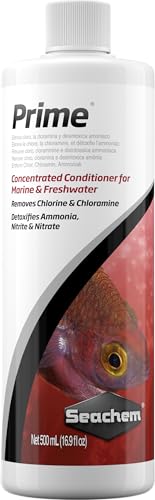
Rather than a ranked list, it is more useful to walk through one widely used product as a worked example of everything above. Seachem Prime is a concentrated liquid conditioner dosed at 1 ml per 40 liters (about 10 gallons) per the manufacturer's specifications, and it addresses three threats in one step: it neutralizes chlorine, breaks the chloramine bond, and binds the resulting ammonia into a non-toxic complex for roughly 24 to 48 hours while the biological filter catches up. It also includes agents that detoxify nitrite and nitrate at higher doses, according to the manufacturer's dosing directions, and heavy metals are bound as well.
The concentration is the practical selling point: per the label, a 500 ml bottle treats approximately 19,000 liters (about 5,000 gallons), which works out to roughly a penny or two per water change and a bottle that lasts most hobbyists a year or more. The manufacturer's directions also permit up to five times the standard dose in emergencies, which is useful during fish-in cycling or after an ammonia spike, though it should remain an emergency measure rather than a habit. Owner reports, which are consistent across thousands of reviews on retail platforms, describe it as reliable for chloramine-heavy municipal water and note two honest quirks: a distinct sulfur-like smell that alarms new users but is harmless, and false positive ammonia readings on some liquid test kits, because the bound ammonia still triggers certain reagents. Neither indicates a problem with the water.
Who is it for? Essentially any freshwater aquarist who wants chlorine, chloramine, and ammonia coverage from one small bottle, and saltwater aquarists will find it usable too, though reef keepers often prefer amine-free formulations that will not interfere with protein skimmers. The trade-offs are minor: the measuring cap is imprecise at small doses, so a syringe helps, and if your water contains only chlorine with no chloramine, ammonia, or metals, a cheaper plain dechlorinator would serve you equally well. If you want to see current pricing and label details, check the current price on Amazon.
Alternatives Worth Knowing About
Even with a single go-to product, understanding the category alternatives helps you recognize when your needs diverge from the mainstream case. A plain sodium thiosulfate dechlorinator, such as API Tap Water Conditioner, suits established tanks on chlorine-only water where nothing extra is needed; its trade-off is no ammonia binding, which matters during cycling or chloramine breakdown. Aloe-based conditioners such as API Stress Coat add a slime-coat supplement that supports fish recovering from transport, netting, illness, or fin damage; the trade-off is lower concentration and no ammonia binding. Powder concentrates, such as Seachem Safe, offer the same chemistry as the liquid example above in a dry form that treats enormous volumes, suited to breeders and fish rooms, with the trade-off of a pre-dissolving step and easy overdosing if measured carelessly. Amine-free formulas, such as Fritz Complete, suit reef aquarists running protein skimmers, UV sterilizers, or ozone, where standard amines can cause foaming problems. Bacterial starter products, such as Seachem Stability, are not conditioners at all but live nitrifying bacteria that accelerate cycling; they pair well with an ammonia-binding conditioner but never replace one. For anyone wanting to compare pricing across the whole shelf, including the concentrated liquid example discussed above, you can view this option on Amazon.
Maintenance and Routine Use
Conditioning becomes a small ritual within every water change, and the habit is simple: fill your bucket or Python-style hose, dose for the new water volume, and ensure the treated water mixes into the tank. Temperature matching matters as much as chemistry; incoming water within a degree or two of tank temperature avoids thermal shock, which stresses fish independently of any chemical issue. Store the bottle capped, away from sunlight and temperature extremes, and note the purchase date, because dechlorinators do slowly degrade over years. Check that water quality report from your utility annually, since treatment methods change, and retest your tap whenever your fish's behavior suggests something in the source water has shifted.
Regular testing closes the loop. A liquid test kit for ammonia, nitrite, and nitrate lets you verify that the conditioner and the biological filter are doing their jobs, and research-based extension resources on aquaculture and fish health from UF/IFAS Extension explain the nitrogen cycle and water quality parameters in the depth that serious aquarists eventually want. Paper test strips are convenient but less precise; liquid kits cost a little more and repay it in reliability.
Common Mistakes to Avoid
- Assuming 'letting water sit' is enough: This works only for chlorine-only water with no ammonia and no heavy metals. Chloramine persists for weeks in standing water, and metals never evaporate. Given that conditioning costs about a cent per water change, aging water as a treatment strategy is risk without reward.
- Dosing for tank volume during partial changes: Dosing the full tank volume every week wastes product and, with some formulas, unnecessarily burdens oxygen levels. Dose the replacement water.
- Panicking over false ammonia readings: Ammonia-binding conditioners trigger positive readings on some test kits. If you just conditioned the water and fish behave normally, retest after 24 hours before assuming a spike.
- Using RO/DI water with no remineralization: Reverse osmosis water needs no dechlorinator, but pure water with zero mineral content causes osmotic stress; remineralize it before it touches fish.
- Skipping conditioner for 'small' top-offs: Evaporation top-offs of pure water do not need conditioning, but any new tap water does, at any volume.
- Relying on conditioner instead of cycling: Ammonia binding lasts a day or two. It buys time during cycling; it is not a substitute for an established biological filter.
Frequently Asked Questions
Can I just let tap water sit out overnight instead of using conditioner?
Only if your utility uses chlorine rather than chloramine, your water tests negative for ammonia, and your plumbing contributes no metals. Chlorine dissipates within about a day of standing open to air; chloramine does not, and metals cannot evaporate at all. Since many water systems have switched to chloramine, verify your utility's current method before trusting this method, or simply condition every drop.
Can I overdose water conditioner?
Most manufacturers describe a safety margin of up to five times the label dose for emergencies on their concentrated products, but routine overdosing is poor practice: it wastes money, can temporarily reduce dissolved oxygen, and with aloe-based products clouds the water. Follow the label, exceed it only in genuine emergencies, and increase aeration if you do.
Do I need conditioner with RO/DI water?
No dechlorinator is needed, since reverse osmosis and deionization remove chlorine, chloramine, and metals. You do need to remineralize the water to an appropriate hardness for your species before use, because completely pure water disrupts fish osmoregulation.
aquarium water conditioners
Where to Buy
The concentrated liquid conditioner profiled above, dosed at 1 ml per 40 liters per the manufacturer's label, is the single most broadly useful example of the category for freshwater aquarists, and it is the one product from this guide that most readers will want on the shelf. You can check the current price on Amazon to confirm pricing and label details before buying. For the powder concentrate version of the same chemistry, favored by breeders and multi-tank keepers, the same retailer listing covers both formats, so you can view this option on Amazon and compare the per-gallon cost yourself.
Wrapping Up
For the great majority of freshwater aquarists, the practical formula is simple: one concentrated conditioner covering chlorine, chloramine, and ammonia, dosed accurately at every water change, backed by a cycled filter and a liquid test kit. Condition your water based on what your utility report and your own tests say it contains, dose for the volume you actually replace, and treat the conditioner as inexpensive insurance rather than a cure-all. Fish live their entire lives immersed in the chemistry you provide, and treating every drop of tap water, every single time, remains the cheapest and most reliable habit in the hobby.
Affiliate Disclosure: PawCritic.com participates in the Amazon Services LLC Associates Program. We may earn commissions from qualifying purchases at no extra cost to you.