Bird Cage Play Tops and Roof Gyms: A Research-Based Buying Guide
Published on July 18, 2026 by PawCritic — Birds Category
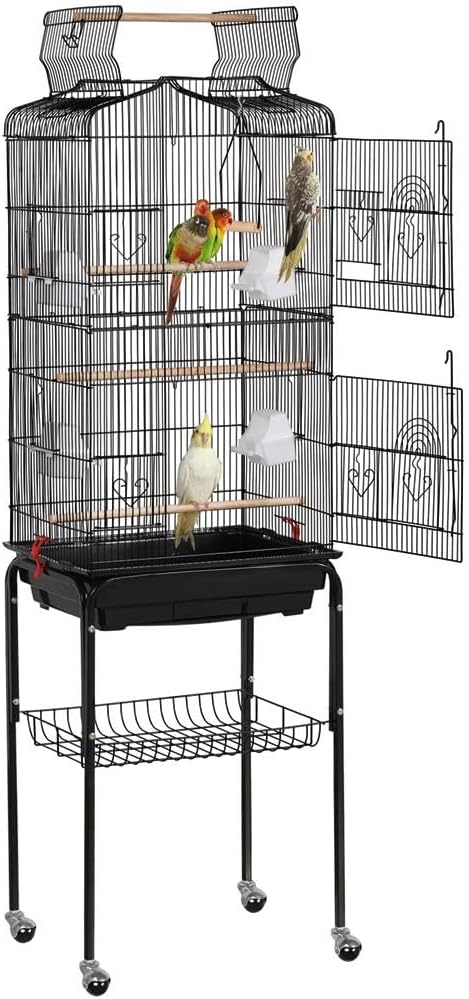
For a companion parrot, the cage is a bedroom, a dining room, and a safe zone — but it is not a whole world. Published guidance from avian veterinarians and welfare organizations consistently stresses that parrots need several hours outside the cage every day for flight, climbing, foraging, and social contact. The practical problem is floor space. A full-size play stand can occupy as much room as a small armchair, and many homes simply do not have that to spare.
A play top solves the geometry problem by building the play area onto the roof of the cage itself. Instead of competing with the sofa for floor space, the enrichment zone sits directly above the bird's sleeping quarters, connected by a ladder or open door. This guide explains what actually matters when choosing one — materials, bar spacing, perch diameter, mounting stability, tray design, and species-appropriate sizing — and uses a single widely sold integrated cage-and-play-top model as a concrete example of how those specifications look in practice.
Why an Elevated Play Area Matters for Welfare
Parrots are prey animals. In the wild, height equals safety, and most species spend the majority of their waking hours in the upper canopy rather than on the ground. A play area mounted at or above human eye level taps into that instinct. Birds tend to settle faster, vocalize less anxiously, and explore more readily when they are above the room's traffic rather than at floor level. This is one of the reasons a roof gym often gets used more consistently than a floor-standing play stand, even when the stand is larger.
The second welfare argument is foot health. Most entry-level cages ship with smooth dowel perches of a single uniform diameter. A bird that grips the same diameter at the same angle all day loads the same patches of its plantar surface continuously, and over months to years this contributes to pododermatitis — commonly called bumblefoot. The Association of Avian Veterinarians owner resources and general avian husbandry references recommend offering perches of varied diameter, texture, and orientation so the foot is exercised across different contact points. A well-designed play top is one of the easiest places to add that variety, because it usually ships with at least two perches and has attachment points for more.
Third, a play top extends territory without creating a second defended zone. Birds that feel cramped in a small cage often develop territorial aggression toward hands entering the cage. Giving the bird a legitimate extension of its home — one it can retreat to and from freely — tends to reduce that pressure rather than increase it.
What to Look For: The Specifications That Matter
Bar spacing and bird size
Bar spacing is the single most important safety specification, and it is the one buyers most often get wrong. The general rule published in avian husbandry references is that bar spacing should be narrow enough that the bird cannot pass its head between the bars, but wide enough that toes and beaks cannot become trapped. For budgerigars, parrotlets, and finches, spacing of roughly 1/2 inch is standard. Cockatiels, lovebirds, and small conures are usually housed at 1/2 to 5/8 inch. Medium birds such as Senegal parrots, quakers, and larger conures typically need 5/8 to 3/4 inch. African greys, Amazons, and cockatoos generally require 3/4 inch to 1 inch, and macaws need 1 inch or more. A play top with the wrong spacing for the species is not a minor mismatch — it is an injury risk.
Materials and coatings
Powder-coated steel and wrought iron are the standard frame materials because they resist bending and are relatively easy to wipe down. The coating matters more than the base metal: a chipped or flaking powder coat exposes bare metal that a bird can chew, and ingested metal flakes are a genuine toxicity concern. Zinc and lead are the two metals most commonly implicated in avian heavy-metal poisoning, and older or cheaply made cages are the usual sources. Stainless steel is the gold standard for bowls, quick-links, and any part the bird's beak contacts repeatedly, because it does not chip and is not a zinc source. Plastic components should be limited to parts the bird cannot easily reach or dismantle.
Perch diameter and material
Perch diameter should let the bird's foot wrap roughly two-thirds of the way around the perch, with the toes not quite touching underneath. For a budgie that means diameters around 3/8 to 1/2 inch; for a cockatiel, 1/2 to 3/4 inch; for an African grey, 1 to 1.5 inches; for a macaw, 1.5 to 2 inches or more. Natural wood branches — manzanita, dragonwood, java wood, and similar dense hardwoods — are preferred over dowels because they taper and branch, so the foot encounters a different diameter at every step. Rope perches add a soft texture but must be inspected weekly, because ingested cotton or sisal fibers can cause crop impaction.
Mounting and stability
A play top that shifts when the bird lands on it will not be used, and a play top that tips is a fall hazard. Integrated play tops that are welded or bolted into the cage frame are inherently more stable than clip-on units. Clip-on or bolt-on aftermarket tops depend entirely on the cage roof being flat, rigid, and wide enough to seat the mounting brackets. Domed, curved, or very narrow cage roofs generally will not accept a universal top safely. Before buying any add-on, measure the flat usable area of the cage roof and compare it against the manufacturer's stated footprint.
Trays and mess control
Seed hulls, pellet dust, and droppings fall. A play top with a seed-catcher tray that extends beyond the footprint of the play area will capture the majority of that debris; a play top without one will deposit it on the floor and on whatever is beneath the cage. Look for trays that slide out for emptying and that are coated or stainless rather than unfinished metal. Removable trays that can be washed in a sink are considerably easier to maintain than fixed ones.
Feeding stations
Bowls on a play top should be stainless steel, removable, and either recessed into the platform or fitted with a rim guard. Open bowls that sit proud of the surface invite birds to perch on the rim, which contaminates food with droppings. Screw-on or twist-lock bowls resist being flipped, which matters for larger parrots that test everything with their beaks.
An Example of an Integrated Cage and Play Top
The check the current price on Amazon listing is for a complete cage with a built-in play top, and it is a useful reference point because the manufacturer publishes the specifications that matter. The play section is formed by a roof panel that lifts and locks open, converting the top of the cage into an elevated platform with two perches at different heights, an angled ladder connecting the cage interior to the platform, and recessed feeding cups. A removable seed-catcher tray sits beneath the play area.
For a small-to-medium bird such as a cockatiel, green-cheeked conure, or quaker, the configuration covers the basics: two perch diameters rather than one, a ladder that provides climbing exercise, and bowls that are set into the platform rather than perched on top of it. The frame is powder-coated and the bar spacing is stated at 1/2 inch, which suits the species listed above but is too narrow for an African grey or Amazon. The trade-off is that integrated units lock the buyer into one cage and one play top together — there is no option to keep an existing cage and add only the roof section. Buyers who already own a cage they like will want to look at add-on tops instead.
Price: Check view this option on Amazon | Rating: 4.5/5
An Example of a Dedicated Play Top Cage System
The check the current price on Amazon listing is for a cage designed from the outset around its play top rather than having one added on. The roof opens from the front to create a sheltered, two-level platform. The lower level carries perches and rope ladders that are directly reachable from the cage door; the upper level is a wider platform perch that functions as an observation post. Stainless steel swing and toy hooks are fitted at several points.
This two-tier arrangement is the design feature worth copying even in a DIY setup, because it encourages climbing between levels rather than sitting in one spot. The manufacturer specifies powder-coated steel construction and 1/2-inch bar spacing, which again places it in the cockatiel and small-conure bracket rather than the large-parrot bracket. Assembly is reported by owners to be time-consuming — reviews frequently mention an hour or more with the included tools — but the resulting structure is described as solid once fully bolted together. The trade-off relative to the integrated example above is cost and assembly time in exchange for a more elaborate play layout.
Price: Check view this option on Amazon | Rating: 4.5/5
Choosing Between Integrated, Add-On, and Standalone
There are three broad ways to get a play area onto the top of a cage, and the right one depends on what you already own.
Integrated cage and play top. The play section is part of the cage's structure. This is the most stable option because the mounting is engineered rather than improvised, and it is usually the best value because one purchase covers both the enclosure and the enrichment area. The limitation is that you replace the whole cage if you want to change either part, and the play area is fixed at whatever size the manufacturer chose.
Add-on or clip-on play top. A separate gym that bolts or clips to the roof of an existing cage. This is the right choice for owners who already have a cage that meets their bird's needs. Compatibility is the catch: the mounting system generally requires a flat roof with a rigid perimeter, and the top must be rated for the bird's weight. A universal top that fits a cockatiel cage will not necessarily be safe on a macaw cage, even if the brackets physically attach.
Standalone play stand placed on top of the cage. Some play stands have flat, weighted bases that happen to sit stably on a cage roof. This is the least secure arrangement and should only be used where the base is genuinely heavy, the cage roof is genuinely flat, and the bird is supervised. It does, however, offer the most flexibility, because the stand can be moved to a table or floor when the bird is out with the family.
Sizing by Species
Play area size should relate to the bird's wingspan, not to the bird's body length. A useful rule from avian husbandry references is that the horizontal play area should be at least as wide as the fully extended wingspan, and ideally wider so the bird can turn around without clipping a perch.
- Budgerigar, parrotlet, canary, finch: wingspan roughly 10 to 12 inches. A play area 12 to 14 inches wide is workable; perch diameter 3/8 to 1/2 inch; bar spacing 1/2 inch.
- Cockatiel, lovebird, green-cheeked conure: wingspan roughly 16 to 18 inches. Play area 18 to 24 inches wide; perch diameter 1/2 to 3/4 inch; bar spacing 1/2 to 5/8 inch.
- Sun conure, quaker, Senegal, caique: wingspan roughly 18 to 22 inches. Play area 22 to 26 inches wide; perch diameter 3/4 to 1 inch; bar spacing 5/8 to 3/4 inch.
- African grey, Amazon, eclectus: wingspan roughly 20 to 24 inches. Play area 24 to 30 inches wide; perch diameter 1 to 1.5 inches; bar spacing 3/4 to 1 inch.
- Cockatoo, macaw: wingspan 30 inches and up. Play area 30 to 36 inches or more; perch diameter 1.5 to 2 inches; bar spacing 1 inch or greater.
These are minimums for a bird that will be on the play top for short supervised sessions. A bird that spends two or three hours a day on its play top benefits from considerably more room, and owners of larger parrots should treat the play top as a supplement to, not a replacement for, a full-size play stand or a bird-proofed room.
Setting Up the Play Area for Real Enrichment
A play top with nothing on it is a perch. The difference between a perch and an enrichment area is what gets attached to it and how often that changes.
Vary the perches. If the play top ships with two dowels, replace one with a natural branch of a different diameter and add a rope perch for texture contrast. Three perches of three different diameters is a reasonable minimum. Check rope perches weekly and replace them at the first sign of fraying, because loose fibers are an impaction risk if swallowed.
Rotate toys. Offer three to five toys at a time and change the selection roughly weekly. A balanced rotation includes at least one foraging toy that requires the bird to work for food, one destructible toy for shredding, one foot toy the bird can pick up and manipulate, and one noisemaker. Novelty is what sustains interest; the same four toys left in place for a month will be ignored.
Use the bowls for foraging. Scattering pellets in a shallow dish, wrapping treats in paper for shredding, or using a covered bowl that the bird must open converts a feeding station into a puzzle. Foraging is one of the few activities that reliably occupies a parrot for extended periods and reduces the repetitive pacing and feather-picking that boredom produces.
Use the height for training. A play top at eye level puts the bird at a comfortable working height for step-up practice, target training, and recall. Short sessions of five to ten minutes, several times a day, are more effective than one long session, and the play top is a natural setting because the bird is already out and already elevated.
Cleaning and Maintenance
Play tops accumulate food residue, droppings, and feather dust faster than the cage interior because the bird is active there rather than sleeping.
Daily: Remove and wash food and water bowls in hot soapy water. Wipe the platform surface and perch contact points with a bird-safe cleaner or a diluted vinegar solution. Empty and reline the catch tray.
Weekly: Scrub perches with a stiff brush to remove dried droppings and food. Inspect rope perches for fraying and wood perches for splintering. Check all fasteners, brackets, and quick-links for looseness. Wash removable plastic components.
Monthly: Disassemble removable parts and clean thoroughly. Wipe down the frame and inspect the powder coating for chips that expose bare metal — a chipped area should be repaired or the component replaced, because exposed metal on a bird cage is a potential heavy-metal exposure. Replace any toy that has been chewed to the point of exposing internal wire or hardware.
Cleaning products matter here. Many household disinfectants, and especially those containing bleach, ammonia, or phenols, leave residues that are hazardous to birds. Avian references generally recommend bird-specific disinfectants or a diluted vinegar solution followed by a clean water rinse and full drying before the bird is returned to the area.
Safety Considerations
- Supervise play top time. A play top is not a substitute for a bird-proofed room, and a bird on a play top can still reach ceiling fans, curtain cords, and open windows.
- Check the mounting before every session. Give the play top a firm, gentle shake to confirm the brackets are seated and the fasteners are tight.
- Keep the cage away from kitchens. Fumes from overheated non-stick cookware are a well-documented cause of acute respiratory failure in birds, and the risk is greater the closer the cage sits to the stove.
- Avoid placement in direct sun or in line with heating and cooling vents. Parrots overheat quickly and cannot escape a sunlit cage top the way they can move to shade outdoors.
- Confirm bar spacing and gap sizes against the bird's head width. Any gap the bird can insert its head into is a strangulation risk.
- Inspect toys for exposed wire, loose bells, and small parts that could be swallowed. Quick-links should be stainless and fully closed.
- If there are cats, dogs, or small children in the home, the play top should only be used with the bird under direct supervision and the other animals excluded from the room.
For a full list of household hazards, including plants, foods, and chemicals that are toxic to birds, the ASPCA Animal Poison Control maintains a searchable database that is worth bookmarking. General avian husbandry and disease information, including the presentation of heavy-metal toxicity and bumblefoot, is covered in the Merck Veterinary Manual section on exotic and laboratory animals.
Common Mistakes
Buying a play top that is too small for the bird. The most frequent error is choosing a play top by price rather than by wingspan. A cockatiel on a budgie-sized platform will clip its wings on the perches when it turns and will not use the space.
Ignoring bar spacing. A play top that is otherwise perfect but has 1-inch spacing is unsafe for a cockatiel, whose head can pass between the bars. Spacing must be matched to the species before anything else is considered.
Mounting on a domed roof. Clip-on tops require a flat, rigid surface. A domed cage roof will seat the brackets at an angle, and the top will rock or eventually detach.
Skipping the catch tray. Buyers sometimes choose a cheaper play top without a tray and then discover that seed hulls and droppings land on the floor and on the cage below. The tray is not a luxury feature.
Leaving the same toys in place indefinitely. A play top that never changes becomes furniture. Rotation is what keeps it interesting.
Using dowels only. Uniform dowels on a play top reproduce exactly the foot-health problem the play top was supposed to solve. Replace at least one with a natural branch.
Assuming the bird will use it immediately. Some birds take days or weeks to explore a new play top. Placing favored treats on the platform and letting the bird approach on its own schedule works better than placing the bird on the platform directly.
Frequently Asked Questions
Can any bird cage take an add-on play top?
No. The cage roof needs to be flat, rigid, and wide enough to seat the mounting brackets, and the top must be rated for the bird's weight. Domed roofs, curved roofs, and very narrow cages generally will not work. Measure the flat roof area and compare it against the manufacturer's stated footprint before ordering.
Is a play top safe for a flighted bird?
Yes, with supervision and a bird-proofed room. A flighted bird can leave the play top voluntarily, which is generally positive for welfare, but it also means ceiling fans, open windows, hot stoves, and open water must be addressed before the bird is let out.
How large should the play area be?
At minimum, as wide as the bird's fully extended wingspan; ideally wider. A cockatiel needs roughly 18 inches, an African grey roughly 22 to 24 inches, and a macaw 30 inches or more.
Will a bird use a play top with no toys on it?
Some birds will sit on it as a high perch, but most lose interest quickly. The platform is the stage; the toys, foraging opportunities, and training sessions are what make it worth using.
How do I get a nervous bird onto the play top?
Place a high-value treat where the bird can see it from inside the cage, then move the treat gradually further onto the platform over several days. Sit nearby while the bird investigates. Do not force or grab the bird; most birds will explore on their own once they feel safe.
Can two birds share a play top?
Yes, if the platform is large enough that each bird has roughly a body length of personal space. Watch for guarding behavior — some birds treat the play top as exclusive territory, and in that case separate play areas are the safer arrangement.
How do I reduce the mess?
Choose a play top with a catch tray that extends beyond the play area, place a washable mat or newspaper under and around the cage, and empty the tray daily. A small handheld vacuum makes routine cleanup quick.
Summary
A play top is one of the few bird purchases that adds meaningful living space without adding floor space, and the specifications that determine whether it works are not complicated: bar spacing matched to the species, a stable mounting on a flat roof, perches of varied diameter and material, stainless bowls that resist being perched on, and a catch tray that actually catches. The two integrated cage-and-play-top products referenced above illustrate how those specifications appear in real listings — one at a lower price point with a simpler play layout, one with a two-level platform and a longer assembly time — and either is a reasonable starting point for a small-to-medium bird, provided the buyer checks the bar spacing and footprint against their own bird and their own space.
What the play top cannot do is supply enrichment by itself. Toys in rotation, foraging opportunities, varied perches, and regular short training sessions are what turn a platform into a place the bird wants to be. Buyers who treat the play top as the beginning of the setup rather than the whole of it get the most out of it.
Affiliate Disclosure: Some of the links above are Amazon affiliate links (tag: nannan09-20). We earn a small commission at no extra cost to you. Products are selected based on published specifications, manufacturer documentation, and verified owner reports.