Why Your Bird Needs a Play Gym
Parrots, cockatiels, conures, parakeets, and other companion birds are among the most intelligent pets on the planet. In the wild, these animals spend their days foraging, climbing, chewing, and exploring complex three-dimensional environments. In captivity, boredom is their greatest enemy — and a bored bird is a destructive, screaming, feather-plucking bird.
A quality bird play gym provides exactly what captive parrots need: a dedicated space for exercise, mental stimulation, and independent play outside the cage. The best play gyms combine multiple perch types, interactive toys, climbing challenges, and feeding stations into a single enriching experience. For 2026, manufacturers have stepped up their game with modular designs, natural wood construction, and creative configurations that engage birds of all sizes.
This guide draws on published avian care guidance, manufacturer specifications, and verified owner reports to explain what separates a genuinely useful play gym from an expensive perch that your bird ignores. Below you'll find detailed reviews across all size categories — from budgie-sized tabletop gyms to full-size floor stands for macaws.
Top 8 Bird Play Gyms and Activity Stands for 2026
1. Prevue Hendryx Naturals Wood Playground — Best Overall
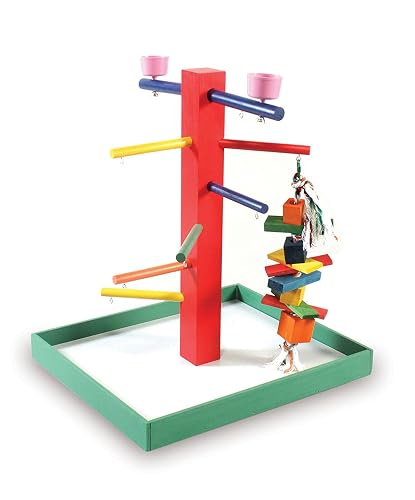
The Prevue Hendryx Naturals Wood Playground has earned its reputation as the go-to play gym for small to medium parrots. Featuring a solid wood base, multiple natural manzanita perches, a swing, ladder, and two stainless steel food cups, it delivers everything a cockatiel, conure, or parakeet needs for hours of independent play.
What owners appreciate: The manzanita wood construction is durable, non-toxic, and provides the varying diameters that are essential for foot health. The base is weighted and stable, and owner reports consistently mention that enthusiastic conures can swing from every angle without tipping. Assembly is straightforward with the included Allen wrench, taking about 15 minutes. The two food cups are dishwasher-safe stainless steel that attach securely to the frame.
Drawbacks: Not suitable for larger parrots (Amazons, African Greys, cockatoos) who will quickly destroy the wood components. The ladder rungs can loosen over time with aggressive chewers — occasional tightening is required. The hanging toys included are basic and most owners will want to upgrade them.
Best For: Cockatiels, conures, budgies, parrotlets, lovebirds, and small parakeets. Excellent as a first play gym for new bird owners.
2. A and E Cage Company Large Playtop Bird Stand — Best for Large Parrots
The A and E Cage Company Large Playtop Stand is built to withstand the powerful beaks of macaws, cockatoos, and large Amazons. The heavy-duty powder-coated steel frame supports a generous play area with multiple hardwood perches, stainless steel cups, and a slide-out tray for easy cleaning. This isn't a tabletop toy — it's a substantial piece of furniture standing over 5 feet tall.
What owners appreciate: The build quality is exceptional. The steel frame uses 5/8-inch tubing with reinforced joints that show no flex even with a full-size macaw hanging from the top perch. The hardwood perches are thick enough (1.5-2 inches diameter) for large parrot feet and mount securely with wing nuts through the frame. The secondary perch and ladder system provides climbing variety that keeps intelligent birds engaged.
Drawbacks: Heavy — at nearly 40 pounds, this isn't something you'll move from room to room. The assembly requires two people and takes about 45 minutes. The powder coating, while durable, can chip if your bird is an aggressive metal-chewer (rare but possible with large cockatoos).
Best For: Macaws, large cockatoos, African Greys, Amazon parrots, and any parrot large enough to need a truly sturdy play stand.
3. Penn-Plax Bird Life Natural Wood Activity Center — Best Mid-Size Option
The Penn-Plax Bird Life Activity Center bridges the gap between tabletop gyms and full floor stands. Standing about 24 inches tall with a 14-inch base, it works on a table, desk, or the floor and provides excellent value with natural wood perches, a rope climb, two food cups, and multiple hanging toys included in the package.
What owners appreciate: The variety of textures is outstanding — manzanita wood, cotton rope, and sisal rope provide different grip experiences that promote foot health. The toy selection includes a bell, colorful wooden blocks, and a foraging-style shredder toy that holds birds' attention. Assembly is tool-free and takes under 10 minutes.
Drawbacks: The base could be heavier — large conures and small cockatoos can tip it if they launch from the top perch at full speed. The cotton rope frays relatively quickly and needs replacement every 3-6 months with active birds. The food cups are plastic rather than stainless steel.
Best For: Conures, quaker parrots, senegals, caiques, and medium parakeets. Great value for a feature-complete play gym.
4. Yaheetech 54-Inch Bird Play Stand — Best Floor Stand Under $100
The Yaheetech 54-Inch Bird Play Stand combines generous height with a well-designed play area at an aggressive price point. The powder-coated steel frame rises to 54 inches with multiple wooden perches, two ladders, stainless steel cups, and a large catch tray — all for significantly less than comparable big-brand stands.
What owners appreciate: The height is perfect for parrots who prefer to be at or above human eye level (which is most parrots). The wide stance and heavy base provide excellent stability, and owner accounts describe the stand surviving a full-speed Amazon parrot landing without wobbling. The multiple perches at different heights create natural climbing and perching options.
Drawbacks: The perch wood is softer than premium brands and will need replacement sooner. The included toys are essentially disposable and should be upgraded immediately. The assembly instructions are vague with poorly printed diagrams — expect to spend 30-40 minutes puzzling through the setup.
Best For: African Greys, Amazons, Eclectus parrots, medium cockatoos, and value-seeking owners who don't mind replacing perches over time.
5. Bonka Bird Toys Mini Tabletop Playstand — Best for Small Birds
The Bonka Bird Toys Mini Tabletop Playstand is designed specifically for the smallest companion birds: budgies, parrotlets, finches, and canaries. At just 12 inches tall with a 7-inch base, it occupies minimal desk or table space while providing essential perching, climbing, and toy interaction opportunities.
What owners appreciate: The scale is perfect for tiny birds — perch diameters are appropriate for small feet (unlike larger gyms where perches are too thick for small birds to grip comfortably). The included toys (a bell, a small ladder, and a hanging chew toy) are sized for small beaks. Assembly takes under 5 minutes with no tools.
Drawbacks: Obviously not suitable for any bird larger than a budgie or parrotlet. The lightweight construction means it should be placed on a non-slip surface or secured with museum putty. Limited expandability — you can't add much in the way of additional toys or perches.
Best For: Budgies, parrotlets, finches, canaries, and other very small companion birds. Ideal as a desk companion stand for daily interaction while working.
6. Wesco Pet Original Bird Kabob — Best Chew-Focused Activity Toy
The Wesco Pet Original Bird Kabob isn't a traditional play gym — it's a chewable activity station that many birds prefer over structured play stands. Made from natural yucca wood slices threaded onto a sisal rope, it satisfies the deep chewing instinct that drives parrot behavior in the wild.
What owners appreciate: Birds go absolutely wild for these. The soft yucca wood shreds satisfyingly without splintering dangerously, and the act of systematically destroying the kabob provides hours of focused enrichment. It's completely natural and digestible if small pieces are ingested. The hanging format works on any existing play stand, cage, or ceiling hook.
Drawbacks: It's consumable — expect a medium parrot to demolish one within days to weeks, making it a recurring expense. Not a standalone play solution; it works best as an attachment to an existing stand or cage.
Best For: All parrots that love to chew (which is all parrots), especially cockatoos, conures, and African Greys. Use as an attachment to any play stand for added enrichment.
7. SUPERBIRD Creations DYI Playgym Kit — Best Customizable
The SUPERBIRD Creations DYI Playgym Kit takes a completely different approach: instead of a pre-designed stand, you get a collection of natural wood branches, connectors, and hardware to build your own custom configuration. This kit includes parrot-safe wood pieces, stainless steel hardware, rope, and toy components that you assemble into whatever design suits your bird and space.
What owners appreciate: The customization potential is enormous — build a compact tabletop gym or an elaborate floor-to-ceiling climbing structure. The natural branches provide the varied diameters essential for foot health. You can reconfigure periodically to maintain novelty, which is vital for highly intelligent parrots.
Drawbacks: Requires creativity and effort — this isn't a ready-to-use product. May need additional branches or hardware depending on your design. Not suitable for large parrots who can destroy the wood. Some assembly skill and tools required (drill recommended for pilot holes).
Best For: Creative bird owners, DIY enthusiasts, and anyone who wants a truly customized play space. Best suited for small to medium parrots.
8. Lazy Pet Macaw Large Bird Play Stand — Best Budget Large Stand
The Lazy Pet Macaw Bird Play Stand delivers surprising quality at a fraction of the cost of premium large-parrot stands. Featuring a wooden dowel frame with multiple perches, a ladder, food cups, and a pull-out metal tray, it accommodates macaws, cockatoos, and large Amazons without breaking the bank.
What owners appreciate: The value proposition is outstanding — you get a full-size macaw-capable play stand for roughly half the price of the A and E model. The wooden frame is surprisingly sturdy once tightened properly, and the tray catches the majority of droppings. The perch placement creates natural climbing paths that large parrots intuitively understand.
Drawbacks: The wooden dowel construction, while sturdy, uses uniform-diameter perches that don't provide the foot-health benefits of natural branches with varying widths. Expect to upgrade the perches within 6-12 months. The assembly hardware (screws and bolts) is basic and can loosen with heavy use.
Best For: Budget-conscious owners of large parrots, temporary or secondary play stands, and anyone who wants to test whether their bird enjoys a floor stand before investing in a premium model.
Comparison Table
| Model | Suitable For | Type | Material | Height | Standout Feature | Price Range |
|---|---|---|---|---|---|---|
| Prevue Naturals Playground | Small-Medium | Tabletop | Manzanita wood | 16 inches | Best all-around | $35-$45 |
| A and E Large Playtop | Large-Macaw | Floor stand | Powder-coated steel | 62 inches | Macaw-rated durability | $180-$220 |
| Penn-Plax Activity Center | Medium | Table/Floor | Natural wood and rope | 24 inches | Best textures | $45-$55 |
| Yaheetech 54-Inch | Medium-Large | Floor stand | Steel and wood | 54 inches | Best value floor stand | $65-$80 |
| Bonka Mini Playstand | Budgie-Canary | Tabletop | Natural wood | 12 inches | Perfect for tiny birds | $20-$28 |
| Wesco Bird Kabob | All sizes | Chew toy | Yucca wood | 10-12 inches | Irresistible chewing | $6-$12 |
| SUPERBIRD DYI Kit | Small-Medium | Custom | Natural branches | Varies | Fully customizable | $35-$50 |
| Lazy Pet Macaw Stand | Large-Macaw | Floor stand | Wood frame | 58 inches | Budget large stand | $85-$100 |
Choosing the Right Play Gym for Your Bird
Size Matters — A Lot. The single most important factor is matching the gym to your bird's size. A budgie on a macaw-sized stand is intimidated and can't grip the perches. A macaw on a cockatiel-sized gym will destroy it in minutes and potentially injure itself on splintered wood. Always check the manufacturer's recommended species list.
Material Safety. Look for natural, untreated hardwoods (manzanita, java wood, dragonwood, eucalyptus), powder-coated stainless steel, and bird-safe ropes (cotton or sisal, never nylon). Avoid: pressure-treated wood, galvanized metal (zinc toxicity), painted surfaces that can chip, and anything with small removable parts that could be swallowed. The ASPCA Animal Poison Control maintains guidance on household hazards that applies to anything your bird can reach from a play stand.
Perch Variety. Birds spend their entire lives on their feet, and uniform-diameter dowel perches can cause pressure sores and arthritis over time. The best play gyms offer multiple perch types at varying diameters, angles, and textures — simulating the branches your bird would encounter in the wild.
Stability. A wobbly play gym will never be used. Look for wide bases, heavy construction, and secure attachment points. Floor stands should have a base diameter at least 1.5 times the height of the stand. Tabletop gyms should have non-slip feet or be securable to the surface.
Cleanability. Birds are messy — food gets flung, droppings land everywhere, and dander accumulates. Play gyms with removable trays, washable surfaces, and accessible joints make maintenance far less tedious. Stainless steel food cups that can go in the dishwasher are a major plus.
Rotating Toys for Maximum Enrichment
A play gym is only as engaging as the toys you put on it. Parrots habituate to static environments quickly — a toy that was fascinating last week becomes invisible this week. The key to sustained enrichment is rotation:
- Maintain a toy inventory of 10-15 toys per bird and rotate 3-4 new toys onto the gym each week.
- Mix toy types: foraging toys, shredding toys, puzzle toys, noisemakers, and foot toys all engage different natural behaviors.
- Hide treats in foraging compartments and wrap food in paper or palm leaf for your bird to unwrap.
- Introduce novel perches — swap in swings, boings (spiral rope perches), and flat platforms to vary the climbing experience.
- Clean and reset old toys — sometimes simply washing a toy and putting it away for a month makes it new again when reintroduced.
Frequently Asked Questions
How long should my bird spend on a play gym each day?
Most companion parrots benefit from 2-4 hours of out-of-cage time daily, with the play gym serving as a supervised home base during those hours. Smaller birds (budgies, cockatiels) may be content with 1-2 hours. Always supervise play gym time — even the most stable stand can be toppled by a determined bird, and unsupervised birds can get into dangerous situations.
Can multiple birds use the same play gym?
It depends entirely on the birds' relationship. Bonded pairs often enjoy sharing a play gym. Birds from different species or with a history of aggression should have separate play gyms or at minimum separate perching areas with clear visual barriers. Even bonded birds need enough space to retreat from each other — one perch per bird at minimum.
How do I clean a wooden play gym?
For daily maintenance, wipe down perches and surfaces with a damp cloth or bird-safe cleaning wipe (no chemicals). For deep cleaning, use a 50/50 water-white vinegar solution and allow to dry completely in sunlight. Never use bleach, ammonia, or chemical cleaners on surfaces your bird contacts. Sandpaper can be used on wooden perches to remove stubborn droppings, but always wash away sanding dust afterward.
My bird ignores the play gym. What should I do?
Many birds are initially cautious of new objects. Start by placing the gym near (but not on) the cage for a few days. Place favorite treats on the gym, starting at the edges and gradually moving them inward. Spend time near the gym yourself — birds are social and will investigate what you're interested in. Never force a bird onto a new gym; let them explore at their own pace, even if it takes a week or more.
Are tabletop gyms or floor stands better?
Each has advantages. Tabletop gyms bring your bird into your immediate workspace — great for bonding and interaction while you work at a desk. Floor stands provide height, which most parrots strongly prefer (height equals safety in bird psychology), and often offer more space for climbing and multiple perches. Many multi-bird households use both: a floor stand in the living room and a tabletop gym in the office or bedroom.
Safety and Species Considerations
Play gyms are only as safe as their construction and placement. Zinc and lead are the two most common heavy-metal hazards in bird environments, and both can appear in unexpected places: galvanized hardware, cheap plated chains, and some painted or coated metals. The Merck Veterinary Manual's exotic and laboratory animals section documents heavy-metal toxicosis as a recurring diagnosis in companion parrots, often traced to cages and accessories rather than food. If a perch or connector shows rust, flaking coating, or a dull gray-white residue, replace it rather than clean it.
Species-specific needs vary more than most buyers expect. Budgerigars and parrotlets need perch diameters around 3/8 to 1/2 inch; cockatiels and small conures do well at 1/2 to 3/4 inch; African Greys and Amazons need roughly 1 to 1.5 inches; macaws and large cockatoos need 1.5 to 2.5 inches. A perch that is too thick forces a bird to grip with an open foot, which over time contributes to pressure lesions. A perch that is too thin allows the toes to wrap fully around and overlap, which can trap toenails.
Foot health is one of the most underrated reasons to buy a play gym with natural branch perches rather than dowels. The Association of Avian Veterinarians' bird owner resources emphasize that pododermatitis (bumblefoot) and arthritis are strongly associated with uniform, hard perching surfaces. Natural wood with subtle irregularities lets a bird shift its weight and change grip throughout the day, which is exactly what wild parrots do as they move between branches of different sizes and textures.
Height also matters psychologically. Most parrots feel safest at or above the height of the tallest person in the room, which is why floor stands in the 50 to 65 inch range are so popular for medium and large species. A tabletop gym placed on a low coffee table can actually make a nervous bird more anxious, because every person and pet in the room is looming above it. If your bird avoids a tabletop gym, try raising it to counter height before assuming the gym itself is the problem.
Sizing, Placement, and Maintenance
Base size is the number most buyers overlook. A useful rule of thumb is that a floor stand's base diameter should be at least 1.5 times its height, and a tabletop gym's base should be at least as wide as the span of the perches above it. A 54-inch stand with a 20-inch base will wobble when a bird lands hard; the same stand with a 30-inch base usually will not. If the manufacturer does not publish base dimensions, treat that as a warning sign rather than an oversight.
Placement should account for droppings, drafts, and traffic. Play gyms belong away from air conditioning vents and doorways, and ideally against a wall so the bird has a sense of security on at least one side. If the gym sits on carpet, put a washable mat or a sheet of vinyl underneath — seed hulls and droppings work into carpet fibers and are extremely difficult to remove. A cheap office chair mat under a floor stand saves hours of cleaning over the life of the product.
Maintenance schedules differ by material. Powder-coated steel frames can be wiped weekly with a damp cloth and a mild dish soap solution, then rinsed and dried. Natural wood perches should be inspected weekly for cracks, splinters, and chewed-down sections, and replaced when more than about a third of the diameter has been worn away. Rope perches and rope-wrapped components should be checked for frayed strands that can wrap around toes or a leg; any rope with loose loops should be trimmed or replaced immediately. Stainless steel cups go in the dishwasher; plastic cups should be hand-washed because scratches harbor bacteria.
Common Mistakes to Avoid
The most common mistake is buying a gym sized for the bird the owner plans to get rather than the bird they have. A young macaw will outgrow a medium stand within a year, and a stand rated for a cockatiel will not survive an Amazon. Buy for the adult size of the species, not the current size of the chick.
The second most common mistake is treating the play gym as a substitute for out-of-cage time rather than a supplement to it. A bird parked on a stand in the corner of a room is still isolated. The point of a play gym is to bring the bird into the household's activity, not to give the owner a place to leave it.
The third mistake is neglecting toy rotation. Owners often buy a well-equipped gym, load it with toys, and then leave those same toys in place for months. Within two or three weeks, most parrots have fully explored every toy and lose interest. Rotating three or four toys weekly, and moving perches to new positions every month or so, keeps the same gym feeling new without any additional purchase.
Finally, avoid the temptation to add non-bird-safe materials. Rope from a hardware store may be treated; wooden dowels from a craft store may be stained or glued; bells from a pet store may be made of zinc-plated metal. If you are not certain a component is safe, leave it off the gym. The ASPCA's pet care library covers general household hazards that apply to bird areas, and avian-specific guidance from your veterinarian is the best source for anything questionable.
Disclosure: PawCritic is reader-supported. When you purchase through links on our site, we may earn an affiliate commission at no additional cost to you. As an Amazon Associate, we earn from qualifying purchases. Every product we recommend is independently selected based on published guidance, manufacturer specifications, and verified owner reports.