Why the Right Litter Box Matters
A litter box is one of the few pieces of cat equipment that the cat uses every single day, often several times a day, and it is also the piece owners most often get wrong. The consequences are not cosmetic. Inappropriate elimination, meaning a cat urinating or defecating outside the box, is one of the most frequently cited behavioral reasons cats are surrendered to shelters, and the guidance from veterinary behavior sources is consistent: most litter box problems are box problems, not cat problems. Cornell Feline Health Center notes that litter box aversion and preferences are common triggers for house soiling, and that most cases improve when the box, the litter, and the location are matched to what the cat actually wants rather than what looks tidy in a laundry room. Cornell Feline Health Center
What cats want has not changed: a box long enough to turn around in, litter deep enough to dig and cover in, a quiet spot with a clear line of sight, and enough boxes that no cat has to wait or share. What has changed is the product landscape. Automatic self-sifting boxes have moved from novelty to mainstream, high-sided pans have largely solved the scatter problem that drove owners to install homemade shields, and stainless steel pans have emerged as a durable alternative to plastic for owners tired of replacing scratched, odor-retaining boxes every year or two. This guide covers what to look for, the trade-offs between box types, sizing for large breeds, maintenance, safety, and the mistakes that send cats outside the box.
Start With the Two Free Rules
Before spending anything, apply the two rules that cost nothing and resolve a large share of complaints. First, scoop at least once a day. A box scooped daily gets used; a box scooped weekly gets avoided, and no amount of deodorizer compensates for a full pan. Second, place the box where the cat can see approaches coming. Cats are vulnerable while eliminating and dislike being ambushed, so a covered box wedged into a dead-end corner with a single blind entrance reads as a trap rather than a bathroom. A box in an open, low-traffic area with more than one escape route is used more reliably.
What to Look For in a Cat Litter Box
Box selection comes down to a handful of measurable factors. Get these right and most behavioral problems never start.
- Length: The box should be roughly 1.5 times the length of the cat from nose to base of tail, measured while the cat stands. For an average 10-pound cat that is about 24 inches; for a large breed it can exceed 30 inches.
- Width: At least as wide as the cat is long, so the cat can turn around without stepping in waste.
- Depth and litter level: Deep enough to hold 2 to 3 inches of litter without spilling over the rim during digging. Most cats prefer a consistent 2 to 3 inch depth.
- Entry height: Low enough to step in comfortably. Senior cats, kittens, and cats with arthritis need an entry threshold under about 4 inches, or a ramp.
- Covered or open: Determined by the individual cat, not by owner preference for hiding the box.
- Material: Plastic is inexpensive and light; stainless steel resists scratching and odor absorption but costs more and is heavier.
- Cleaning access: A box that is hard to scoop gets scooped less. Flip tops, removable hoods, and wide open pans all reduce friction.
The Main Box Types and Their Trade-Offs
Open Pans
The simplest and usually the most cat-friendly design. An open pan offers full visibility, multiple escape routes, and easy access for scooping. The trade-off is litter tracking and less odor containment, which owners notice more than cats do. Open pans are the default recommendation for cats with a history of box aversion and for multi-cat households, because they remove the two most common sources of stress: a single exit and a confined, odor-trapping interior.
High-Sided Pans
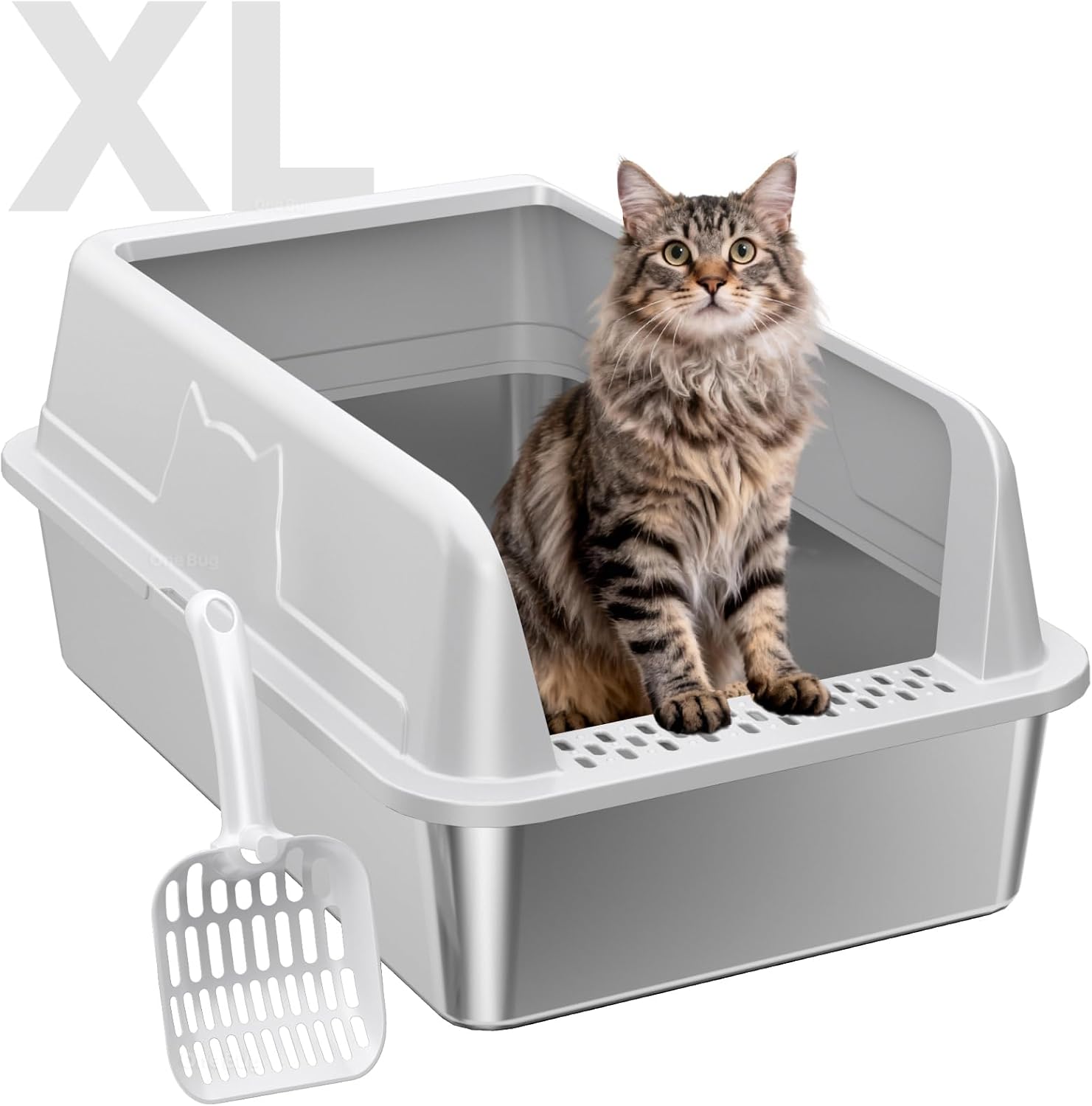
High-sided pans address the scatter problem directly. Cats that dig enthusiastically, or that urinate near the back wall, send litter over the rim of a standard pan; a pan with walls 8 to 10 inches high contains most of it. The trade-off is entry. A high wall on all sides is difficult for kittens and senior cats, so the better designs use a high back and sides with a lower front entry. Owners of kickers generally report far less floor litter with this design than with a standard pan.
Covered and Hooded Boxes
Hooded boxes contain odor and tracking and look tidier in a living space. They also concentrate ammonia inside the enclosure, reduce visibility, and leave the cat with one exit. Some cats accept hoods without complaint; others refuse them outright, and hooded boxes are overrepresented in reports of box avoidance. The practical compromise is a hooded box large enough that the cat can stand, turn, and dig without touching the walls or ceiling, with the hood removed if the cat shows any hesitation. A hood on an undersized pan is the single most common setup that sends cats to a carpeted corner.
Automatic Self-Cleaning Boxes
Automatic boxes sift waste into a sealed drawer on a timer or after each use, which keeps the litter clean between scoopings. For owners who work long hours, travel, or have a cat that refuses a soiled box, that feature can be the difference between consistent use and avoidance. The trade-offs are real: higher purchase price, a power outlet near the box, a mechanical system that requires its own cleaning routine, and a larger footprint than most pans. Automatic boxes also are not suitable for very young kittens or cats under a weight minimum specified by the manufacturer, because the sensors and rotation cycle depend on the cat being detected reliably.
A Concrete Example: What One Widely Sold Automatic Box Offers
Among automatic options, one of the most widely reviewed is a self-sifting unit that rotates to separate clumps into a carbon-filtered waste drawer and reports usage through a companion app. Manufacturer specifications list weight and litter-level sensing, a cycle that runs after the cat exits, and a waste drawer that holds roughly a week of clumps for a single cat. Verified owner reviews commonly describe the convenience as the main benefit and the price, the need for a nearby outlet, and periodic deep cleaning of the globe as the main drawbacks. It is a reasonable fit for a single-cat household with a reliable routine and a cat that is not skittish about movement; it is a poor fit for a household with a kitten under the manufacturer's weight minimum or a cat that bolts at mechanical noise. check the current price on Amazon
cat litter boxes
A Concrete Example: The Case for a Large Open Pan
At the opposite end of the price and complexity spectrum is the oversized open pan, a design that has changed very little because it works. Manufacturer specifications for the largest pans in this category list interior dimensions around 34 by 18 inches with walls roughly 8 inches high, which comfortably accommodates a cat up to about 18 pounds and holds several inches of litter without spillover. Verified owner reports frequently describe these pans as the fix for a cat that had been avoiding a smaller covered box, and note that the low front entry makes them usable by older cats. The trade-offs are no odor containment, visible litter, and a footprint that consumes real floor space. view this option on Amazon
How to Evaluate the Two Approaches
The decision is less about features than about the cat in front of you. A confident, sociable cat in a single-cat home often does well with an automatic box, and the owner gains daily convenience. A shy cat, a multi-cat home, a senior cat, or a cat with any history of avoiding the box is better served by a large open pan placed in a quiet, visible spot. Many experienced owners end up running both: an automatic unit for the household's main traffic and a plain open pan as a backup, which also satisfies the one-box-per-cat-plus-one guideline without adding a second machine to maintain.
Sizing: The Most Common Mistake
Owners routinely buy boxes that are too small, usually because the box looks proportionate to the cat and fits the intended corner. The measurement that matters is not the cat's height or the box's visual scale but whether the cat can stand at full length, turn around, and dig without its head or rear touching a wall. A cat that has to contort to use the box will often urinate over the edge or defecate just outside the entry, which owners then misread as a behavioral problem. When in doubt, size up. A box that is too large has essentially no downside; a box that is too small has many.
Large breeds deserve special mention. Maine Coons, Norwegian Forest Cats, Savannahs, and oversized domestic shorthairs can exceed 20 pounds and 36 inches in length. For these cats, a standard hooded box is functionally unusable, and even many jumbo pans are marginal. Look for interior length of at least 30 inches, an entry wide enough for a broad chest, and a hood only if the interior height allows the cat to stand fully upright. An undersized hooded box is one of the most reliable predictors of a cat eliminating elsewhere.
Litter Choice Interacts With Box Choice
The box and the litter are a system, and changing one often requires reconsidering the other. Most cats prefer a fine-grained, unscented clumping litter at a consistent depth of 2 to 3 inches. Strongly scented litters are marketed to humans, not cats; a cat's sense of smell is far more sensitive than a person's, and a heavily perfumed litter can make an otherwise acceptable box unpleasant. Sudden litter changes also trigger avoidance, so transitions should be gradual, mixing old and new over one to two weeks. Deep litter beyond about 3 inches can make it hard for a cat to find footing, while very shallow litter discourages digging and covering.
Litter type also affects cleaning frequency. Clumping litter allows waste to be removed daily and the remaining litter topped up rather than dumped, which most cats prefer because the substrate stays familiar. Non-clumping litter requires full changes more often, typically weekly, because waste cannot be separated cleanly. Whatever the type, the ASPCA's animal poison control guidance is a useful reminder that cats are sensitive to a wide range of household substances, including some essential oils and cleaning products used around the box area, so plain unscented soap and water is the safer default for routine cleaning. ASPCA Animal Poison Control
Placement, Multi-Cat Math, and Household Dynamics
The standard guidance is one box per cat plus one extra, and it exists for good reason: in a multi-cat home, a single box becomes a resource that one cat can monopolize or guard, and the cat that loses access is the one that eliminates elsewhere. The extra box also gives each cat a choice of location, which matters because cats often prefer different spots at different times of day.
Placement should follow three rules. Keep boxes away from food and water, since cats generally avoid eliminating near their food source. Avoid dead-end locations with a single exit. And avoid noisy appliances, furnaces, and doors that slam, because startling noises near the box teach a cat that the box is unsafe. For multi-story homes, at least one box per floor prevents a cat from being stranded on a level with no acceptable option, which is a frequent and easily overlooked cause of accidents.
Maintenance Schedule That Actually Prevents Problems
Box hygiene follows a predictable rhythm, and skipping steps shows up quickly in behavior.
- Daily: Scoop solids and clumps at least once, ideally twice. Top up litter to the 2 to 3 inch mark.
- Weekly: Wash the pan with mild unscented soap and warm water, rinse thoroughly, and dry before refilling. For non-clumping litter, replace all litter.
- Monthly: Inspect for scratches, cracks, and lingering odor. Clean hoods, liners, and automatic-box components according to the manufacturer's instructions, including filters.
- Every 1 to 2 years: Replace plastic pans. Plastic scratches over time and those scratches harbor odor that no amount of scrubbing removes, which is why stainless steel pans, though heavier and pricier, last far longer.
Automatic boxes add their own maintenance load rather than removing it. The waste drawer needs emptying on the manufacturer's stated interval, the globe and sensors need periodic wiping, and the litter level must be maintained within the range the sensors expect. Owners who buy an automatic box expecting zero maintenance are often disappointed; owners who understand it as a scooping replacement rather than a cleaning replacement tend to be satisfied.
Safety Notes
A few safety points are worth stating plainly. Kittens should not use automatic self-cleaning boxes until they meet the manufacturer's weight minimum, because a cat too light to trigger the sensors can be caught in the mechanism. Cats with medical conditions, recent surgery, or mobility limitations may need a low-entry box and a location close to their resting area. Litter box liners, while convenient, are disliked by many cats because claws catch in the plastic; if a liner is used, it should fit tightly and be changed before it tears. Finally, any sudden change in litter box behavior, especially straining, frequent trips, or urinating outside the box, warrants a veterinary visit before any behavioral intervention, because urinary blockages and infections are medical emergencies in cats. The Merck Veterinary Manual's cat owner reference covers the signs that require prompt veterinary attention. Merck Veterinary Manual
Common Mistakes to Avoid
- Buying a box that is too small, then treating the resulting accidents as a behavior problem.
- Using a covered box in a dead-end corner, which removes escape routes and traps odor.
- Placing the box next to food, water, or a noisy appliance.
- Falling below one box per cat plus one in a multi-cat home.
- Using strongly scented litter or scented cleaning products around the box.
- Changing litter abruptly rather than mixing over one to two weeks.
- Letting litter depth drift below 2 inches or above 3 inches.
- Keeping a scratched plastic pan for years because it still holds litter.
- Punishing a cat for accidents, which increases stress and worsens avoidance.
- Buying an automatic box for a kitten or a cat below the manufacturer's weight minimum.
If Your Cat Is Already Avoiding the Box
Before purchasing anything new, reset the basics. Add a second box in a different, quiet location. Remove any hood. Switch to an unscented clumping litter if the current litter is scented or unfamiliar. Scoop twice daily for two weeks. In many cases that combination resolves the problem without any purchase, because the original setup failed on size, location, cleanliness, or privacy rather than on features. If the behavior persists, or if it appeared suddenly in a cat with previously reliable habits, the next step is a veterinary examination rather than another box, since medical causes such as urinary tract inflammation, crystals, or infection are common and can become urgent.
For owners who do decide to replace equipment, the practical order of priority is size first, then location, then litter, then type. An oversized open pan in a good spot with unscented clumping litter at the right depth will outperform a premium automatic box in a bad spot every time. check the current price on Amazon
Frequently Asked Questions
How many litter boxes should I have?
One per cat plus one extra is the standard guideline. In a two-cat home that means three boxes, placed in at least two different locations so no cat can guard all of them.
Is a covered box better?
Only if the cat accepts it. Covered boxes contain odor and tracking but reduce visibility and escape routes, and they are a common cause of avoidance when the interior is too small. Offer an open box alongside and let the cat choose.
How often should litter be fully replaced?
With clumping litter, scoop daily and top up, replacing the full box every two to four weeks. With non-clumping litter, replace all litter weekly. Wash the pan at each full change.
Do automatic boxes work for multi-cat homes?
They can, but the waste drawer fills faster and the manufacturer's weight limits still apply per cat. Many multi-cat homes run one automatic unit plus at least one large open pan to keep options available.
When should a plastic box be replaced?
Every one to two years, or sooner if the surface is visibly scratched or retains odor after washing. Scratches trap bacteria and ammonia, and no cleaner fully removes them.
Bottom Line
For most cats, a large open pan offers the best combination of acceptance, price, and ease of cleaning, and it is the safest starting point for any household dealing with avoidance. For owners who want daily automation in a single-cat home with a confident cat, a self-sifting automatic box is a legitimate convenience, provided the cat meets the manufacturer's weight minimum and the box is maintained on schedule. In every case, buy larger than seems necessary, scoop daily, place the box where the cat can see the room, and treat any sudden change in habits as a veterinary question first. view this option on Amazon
cat litter boxes
Affiliate Disclosure: This article contains affiliate links.