If you have never used a muzzle on your dog, the idea can seem intimidating or even unfair. The reality is that a muzzle is one of the most practical safety tools a responsible dog owner can keep on hand. Whether you are visiting the veterinarian, introducing your dog to a new grooming routine, walking through a crowded area, or working through a behavioral rehabilitation plan, a correctly fitted muzzle protects everyone involved: your dog, other pets, and the people around you.
Far from being a punishment, a properly introduced muzzle reduces stress for both you and your dog. It allows you to manage situations that would otherwise be anxiety-inducing, and many dogs learn to associate the muzzle with positive experiences such as walks, high-value treats, and focused one-on-one time with their owner. Veterinary behavior guidance, including the owner resources published by the Merck Veterinary Manual, treats muzzle training as a standard part of managing fear and aggression cases, not as a last resort.
This is a research-based buying guide, not a hands-on product review. Every point below is drawn from published veterinary and training guidance, manufacturer specifications, and verified owner reports. Rather than a long ranked list, this guide explains the category itself — the styles, materials, sizing rules, and safety limits that actually determine whether a muzzle works — and then looks at two concrete examples you can examine on Amazon to see how those principles show up in real products.
Why Use a Dog Muzzle?
Dog muzzles serve a variety of practical purposes beyond simply preventing bites, and understanding those purposes is the first step in choosing the right style. The scenarios below are the ones most commonly cited by veterinarians, trainers, and grooming professionals.
- Veterinary visits: Even the friendliest dog may snap when in pain or frightened during an examination. A muzzle protects veterinary staff and lets them focus on your dog's care rather than on avoiding a bite.
- Grooming sessions: Nail trims, ear cleaning, and mat removal can be uncomfortable, and many dogs react defensively. Groomers routinely use muzzles for these procedures as a standard workplace safety practice.
- Behavioral rehabilitation: If you are working with a dog that has fear or aggression issues under a trainer's supervision, a muzzle allows training sessions to proceed safely while the dog learns new responses.
- Public transportation: Many transit authorities and rail operators require dogs to be muzzled in shared passenger spaces, so a properly fitted muzzle may be a legal requirement rather than a choice.
- Post-surgery or injury recovery: Dogs in pain may bite even their own family. A muzzle prevents injury during bandage changes, medication, and transport.
- Loose dog encounters: If an off-leash dog approaches aggressively, a muzzle on your own dog prevents a defensive bite incident from escalating into a legal and medical problem.
The AVMA's pet owner resources emphasize that management tools like muzzles work best as part of a broader plan built with your veterinarian or a qualified behavior professional. A muzzle is a safety layer, not a substitute for behavior modification, and any dog wearing one should still be supervised closely.
Types of Dog Muzzles
Before comparing any specific product, you need to understand the four main muzzle styles, because the style determines what your dog can and cannot do while wearing it. Choosing the wrong style is the single most common — and most dangerous — mistake owners make.
- Basket muzzles: Constructed from plastic, silicone, rubber, or wire, these form an open cage around the snout. The dog can pant, drink water, and take treats through the openings. Basket styles are the only appropriate choice for extended wear, warm weather, or training sessions.
- Soft muzzles: Fabric or nylon sleeves that hold the mouth closed. Because the dog cannot pant or drink, these are suitable only for short-term use such as brief veterinary procedures or nail trims — generally no more than ten to fifteen minutes at a time.
- Grooming muzzles: Often loop-style designs intended to prevent biting during specific grooming tasks. Quick to apply and remove, which groomers value, but with the same panting limitations as other closed-mouth styles.
- Anti-scavenging muzzles: Basket-style muzzles with a finer front guard that prevents the dog from scavenging food, refuse, or dangerous objects off the ground while still allowing panting and drinking.
The panting distinction matters more than most owners realize. Dogs regulate body temperature primarily through panting, and a dog prevented from panting on a warm day can overheat quickly. This is why published veterinary guidance consistently directs owners toward basket styles for anything beyond a few minutes of use, and why the price difference between a soft muzzle and a basket muzzle should never be the deciding factor.
Materials and Construction: What to Look For
Material choice affects comfort, durability, cleanability, and safety, and each common option carries real trade-offs. Thermoplastic rubber, often abbreviated TPR, is the material used in many popular basket muzzles. It is flexible enough to absorb minor impacts without cracking, rigid enough to hold its shape, and can usually be rinsed clean. The trade-off is that a determined chewer can eventually damage the strap attachments, so inspection before each use is necessary.
Wire basket muzzles, typically chrome-plated steel, offer maximum ventilation and the highest resistance to chewing. The downsides are weight — noticeable on smaller dogs — and the fact that metal can feel cold against the snout in winter. Wire muzzles also generally cost more than plastic equivalents and often require more careful sizing.
Silicone and soft polymer designs sit between the two: lighter than wire, more breathable than fabric, and often shaped to follow the contours of the dog's face. Biothane, a coated webbing material used in some premium muzzles, does not absorb moisture or odors, stays flexible in cold weather, and cleans with a wipe, which makes it attractive for dogs that wear muzzles daily in wet climates.
Finally, fabric and mesh soft muzzles are inexpensive, pack flat, and wash easily in a machine, but they are strictly short-duration tools. When evaluating any product, check the manufacturer's stated specifications for adjustability points, strap hardware, and whether the design includes a safety loop that attaches to the dog's collar so the muzzle cannot be pawed off entirely.
How to Measure Your Dog for a Muzzle
Sizing is where most muzzle purchases go wrong, and a poorly fitted muzzle can either fail to prevent a bite or rub the dog's face raw. Manufacturers publish measurement instructions, and you should follow the specific instructions for the product you are considering, but the core measurements are consistent across the category.
Measure the snout circumference at its widest point, typically just below the eyes, using a soft tape pulled snug but not tight — you should be able to slide one finger under the tape. Measure snout length from the point where the muzzle meets the forehead down to the tip of the nose. For basket styles, also measure the neck circumference behind the ears, since the head strap routes there. For brachycephalic breeds such as Bulldogs and Pugs, standard sizing charts often do not apply at all, and a custom or breed-specific design is usually required; these dogs already have compromised airways, which makes correct muzzle selection even more critical.
Once the muzzle arrives, verify the fit by hand: you should be able to slide one to two fingers between the strap and your dog's head, the basket should not press into the bridge of the nose or the corners of the mouth, and there should be enough room for the dog to open its mouth fully to pant. If the sizing chart puts your dog between sizes, most manufacturers' guidance suggests sizing up and relying on the adjustable straps rather than choosing a tight fit.
Example 1: A Basket Muzzle for General and Extended Use
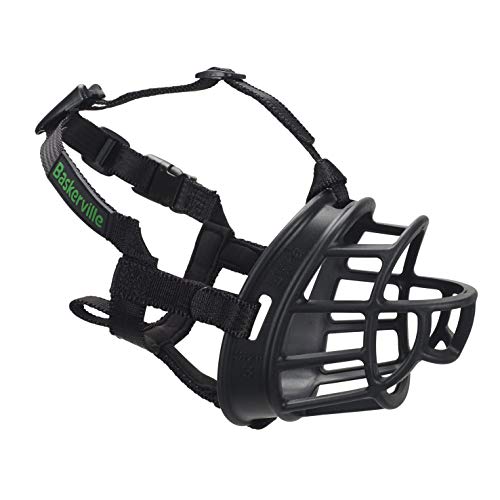
To see how these principles apply to a real product, look at the basket muzzle pictured above, the Baskerville Ultra, a long-established design made from thermoplastic rubber that can be checked at the current price on Amazon. According to the manufacturer's specifications, the design allows the dog to pant, drink, and take treats through the front opening, and it includes an adjustable head strap and neck strap plus a safety loop that attaches to the dog's collar so the muzzle cannot be slipped off easily.
This style of muzzle suits the widest range of situations: walks in public, veterinary visits, grooming appointments where the dog may need to wait, muzzle training practice at home, and travel on transit systems that require muzzles. The treat-access opening is generous enough for most training treats, which matters because a muzzle you cannot feed treats through is much harder to introduce positively. Owner reviews frequently describe successful long-term acclimation with this design, and several note that the material can be shaped with warm water for a more customized fit, a technique the manufacturer documents.
The honest trade-offs: some reviewers report the basket feels bulky on very small breeds, dogs that are strong chewers can eventually damage the strap attachment points, and the size range is wide enough that choosing among the available sizes requires careful measuring. It is also not an anti-scavenging design on its own — a dog can still lick or pick up small items through a standard basket opening, so owners of chronic scavengers may need a model with a finer front guard. For most owners looking for one general-purpose muzzle, this is the category benchmark worth examining first — you can view this option on Amazon to confirm current sizing charts and prices.
Example 2: A Soft Muzzle for Grooming and Short Procedures
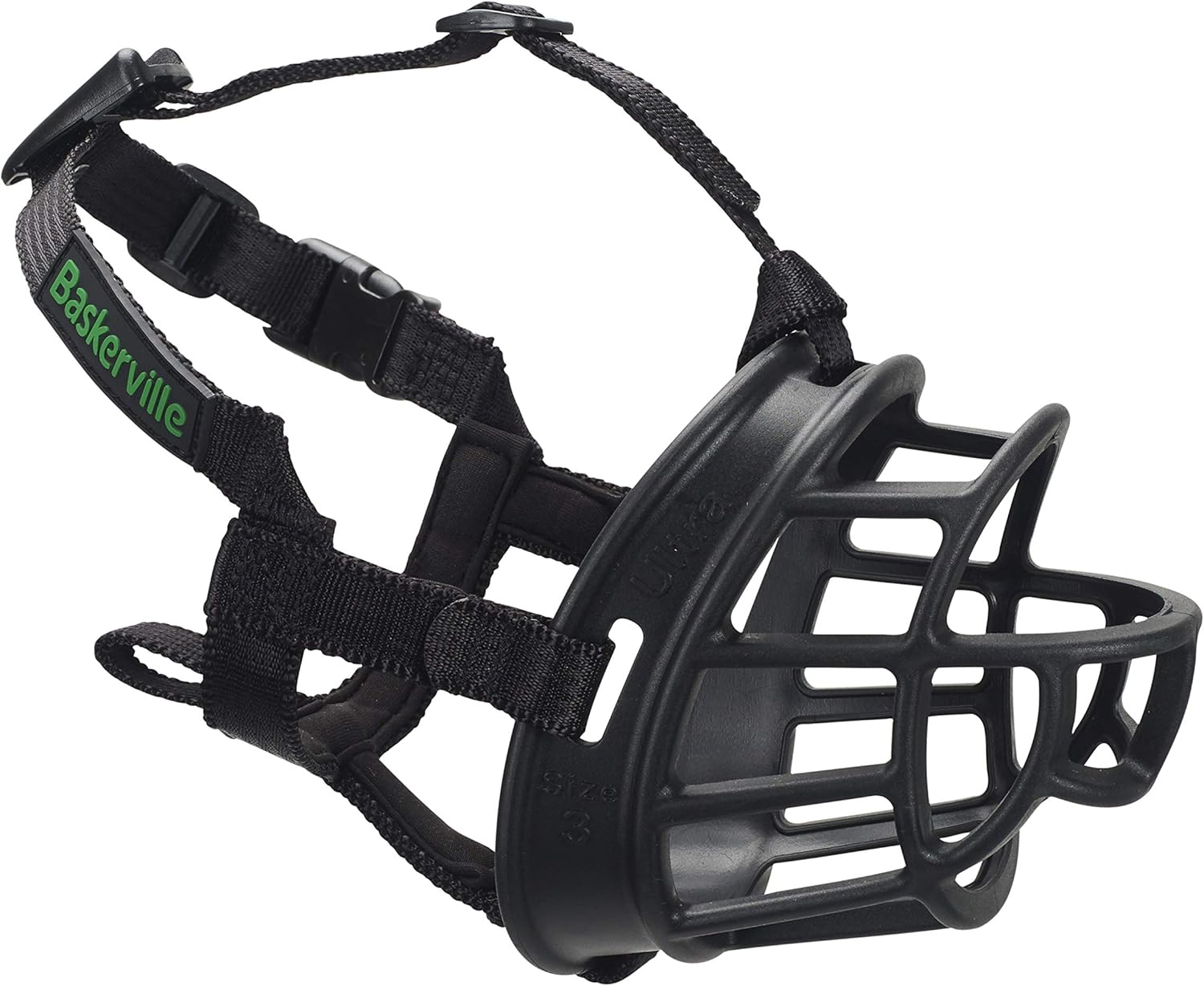
For owners whose needs are limited to nail trims, baths, or brief veterinary handling, a soft muzzle is a cheaper and lighter alternative. The example shown here is a nylon soft-muzzle design of the type used widely in grooming shops; a comparable mesh model with padded snout coverage can be viewed on Amazon here. Soft muzzles of this kind hold the mouth closed, apply pressure across the bridge of the nose, and fasten with adjustable straps behind the head, sometimes with a quick-release fastening for fast application.
The trade-off is significant and non-negotiable: because the dog cannot pant, drink, or take treats, published guidance limits soft muzzle use to roughly ten to fifteen minutes, and never in warm conditions or during exercise. Reviewers who use these products successfully treat them strictly as handling tools for calm, indoor, short procedures, and many groomers keep several sizes on hand exactly for this purpose. Padded or gel-lined versions reduce chafing on the snout, which is the most common complaint about unpadded fabric muzzles.
Who this suits: owners with an otherwise well-behaved dog who becomes defensive only during specific handling, and who need an inexpensive, packable backup to keep in the car or first-aid kit. Who it does not suit: anyone needing a muzzle for walks, training, or warm weather, and any situation where the dog would need to wear it for more than a few minutes. If your requirements extend beyond short procedures, a basket style is the correct purchase, and you can check the current price on Amazon to compare this soft option against basket alternatives before deciding.
Muzzle Safety Rules
A few safety rules apply to every muzzle regardless of style or price, and they come up repeatedly in veterinary and training literature. First, never leave a muzzled dog unattended. A dog that becomes entangled, overheats, or vomits while wearing a muzzle cannot clear its own airway, and an unattended muzzled dog is a genuine emergency risk. Second, respect the panting limit: soft muzzles in particular must come off within minutes, and even basket muzzles deserve periodic breaks on long outings. Third, check the fit each time — straps stretch, hardware loosens, and a muzzle that fit last season may no longer fit after weight change.
Fourth, inspect the muzzle regularly for damage. Cracked baskets, frayed straps, or worn fasteners can turn a safety tool into a hazard, because a muzzle that fails mid-incident provides no protection and may startle the dog. Fifth, if the muzzle is being used as part of a plan for fear or aggression, work with a qualified trainer or veterinary behaviorist; the muzzle is there to make the training safe, not to replace it. Finally, keep in mind that a muzzle does not make a dog approachable — well-meaning strangers may actually be more likely to approach a muzzled dog, so you still need to manage distance and interactions actively.
How to Introduce Your Dog to a Muzzle
Muzzle training is behavior training, and the consensus approach across training resources is gradual positive reinforcement. The goal is a dog that willingly puts its nose into the muzzle, rather than one that must be cornered and strapped.
- Start neutral: Place the muzzle on the floor with treats scattered inside and around it. Let your dog investigate and eat treats from it with no pressure and no fastening.
- Voluntary nose-in: Hold the muzzle and reward your dog for putting its nose inside, feeding treats through the front opening so the muzzle predicts food rather than restraint.
- Brief fastening: Fasten the straps for two or three seconds, remove the muzzle, and reward generously. Repeat until the fastening itself is unremarkable.
- Build duration: Gradually extend wearing time across multiple short sessions, always paired with enjoyable activities such as walks or play.
- Maintain the skill: Even if the muzzle is rarely needed, occasional short practice sessions keep the association positive and the dog comfortable.
Owners who skip these steps and force the muzzle on for the first time during a crisis usually create a lasting negative association, making every future use harder. Most training guidance suggests beginning muzzle training weeks or months before the muzzle is actually needed, precisely so the first real use is boring rather than frightening.
Common Mistakes to Avoid
Several recurring mistakes show up in owner reports and professional commentary. Using a soft muzzle for walks or warm weather is the most serious, because it prevents panting exactly when the dog needs it most. Choosing a size from breed names instead of actual measurements is another — two dogs of the same breed can have very different snouts. Expecting a muzzle to fix behavior is a third: it manages risk while training does the work. Skipping the collar safety loop on basket designs lets clever dogs back out of the muzzle. And using a muzzle as punishment, for example putting it on after misbehavior, poisons the training association and should never be done.
Care and Maintenance
Maintenance requirements follow from the material. Plastic and rubber basket muzzles can be rinsed with warm water and mild soap and dried fully before storage. Wire muzzles benefit from being dried promptly after wet outings to protect the plating. Biothane and coated webbing clean with a wipe. Fabric muzzles are often machine washable on a gentle cycle, though air drying preserves the straps and fasteners. Inspect stitching, buckles, and attachment points during each cleaning, and replace any muzzle showing cracks, fraying, or deformation rather than trying to extend its life.
Frequently Asked Questions
Can a dog drink water with a muzzle on?
Only with basket-style muzzles, which allow the mouth to open far enough to lap from a bowl. Soft muzzles hold the mouth closed and should never stay on longer than ten to fifteen minutes.
How do I measure my dog for a muzzle?
Measure snout circumference at the widest point, snout length from just below the eyes to the nose tip, and neck circumference behind the ears. Follow the specific manufacturer's chart, and for flat-faced breeds look for breed-specific designs.
Are muzzles cruel?
No. Introduced gradually and paired with rewards, most dogs accept a basket muzzle readily, and veterinary behavior guidance treats them as welfare-positive tools because they prevent situations in which a dog feels forced to bite.
How long can a dog wear a muzzle?
Basket muzzles can generally be worn for thirty to sixty minutes or more with opportunities to pant and drink; soft muzzles are limited to ten to fifteen minutes. Never leave any muzzled dog unattended.
Can a muzzle stop my dog from eating things off the ground?
An anti-scavenging basket muzzle with a fine front guard can significantly reduce scavenging on walks, but it is a management tool — training a reliable leave-it cue remains the long-term solution.
Final Verdict
For most owners, the right purchase is a well-fitted basket muzzle in the style of the Baskerville Ultra examined above: it allows panting, drinking, and treat-based training, covers vet visits, grooming, walks, and transit rules, and has a long track record in owner reports. For owners whose only need is short handling procedures such as nail trims, an inexpensive soft muzzle of the padded mesh type profiled here is a reasonable and economical choice, provided its strict time limits are respected. Whatever you buy, measure carefully, introduce the muzzle gradually with food, and treat it as one component of a safety and training plan developed with your veterinarian or trainer rather than as a standalone fix.
Disclosure: This article contains affiliate links. As an Amazon Associate, the site earns from qualifying purchases at no additional cost to you. Products are discussed based on manufacturer specifications, published veterinary guidance, and verified owner reports; no hands-on testing is performed.