Tropical Fish Food: A Buying Guide for Community Tanks
Tropical fish are not a single dietary category. A tank holding neon tetras, a bristlenose pleco, and a pair of angelfish contains a surface micro-predator, a wood-grazing omnivore, and a mid-water carnivore that will eat anything smaller than its own eye. No single food serves all three well. The practical goal is not to find the perfect flake but to assemble a small rotation that covers protein, fiber, and the sinking fraction that bottom-dwellers actually get to eat before the current carries it into the filter intake.
Commercial fish food has improved substantially over the past decade. Insect-protein formulations moved from specialty shops into mainstream retail, and several large flake brands reformulated to raise protein content and reduce cereal fillers. A keeper can now feed a genuinely complete diet from shelf-stable foods without buying supplements, provided the rotation includes more than one format. The rotation that covers most community tanks is a staple flake, a sinking pellet or wafer, and a frozen or freeze-dried protein treat offered a few times a week.
Label reading separates adequate foods from poor ones. In the United States, the Food and Drug Administration requires pet food labels, fish food included, to carry a guaranteed analysis listing minimum crude protein and crude fat percentages. That number is the fastest filter. A flake listing 45 percent crude protein is not automatically better than one listing 38 percent, but a flake that hides its protein figure behind vague language, or leads its ingredient list with wheat middlings or corn gluten meal, is telling you what it is. Ingredients are listed by weight, so the first two or three entries should be named protein sources: whole fish meal, krill, squid, insect larvae, salmon, shrimp.
Color enhancement deserves specific scrutiny. Some color foods use natural pigments, typically astaxanthin from krill or salmon, and those are legitimate. Others rely on synthetic dyes that tint the fish without improving its health, and a few simply use a red or orange dye in the flake itself so the food looks vivid in the container. The fish does not benefit. If a product promises dramatic color on a budget flake, read the ingredient panel before believing the tub.
Feeding Amounts and Frequency
The standard instruction remains correct: offer only what the fish can consume in two to three minutes, once or twice daily, and skip one day a week. Overfeeding is the most common cause of water quality failure in new tanks, and it is entirely within the keeper's control. A useful rule of thumb is that a pinch between two fingers is a full meal for a dozen small tetras. If food reaches the substrate and sits there, the portion was too large.
Fasting one day per week is not cruel. Fish in the wild do not eat on schedule, and a short fast gives the digestive tract a rest and gives the biological filter a break from processing excess nitrogen. The ASPCA pet care library and most aquarium husbandry references treat overfeeding and poor water quality as the two dominant preventable causes of illness in captive fish, and both trace back to the same habit.
Uneaten food should be removed after about five minutes. A turkey baster or a small siphon makes this quick in a bare-bottom quarantine tank, and in a planted tank the cleanup crew of snails and shrimp will handle most of it, but not a surplus. Persistent uneaten food drives ammonia and nitrite spikes, which is why a feeding problem often presents as a water chemistry problem.
What to Look For in a Tropical Food
Protein source and level matter most for growth and coloration. Omnivorous community fish generally do well on 35 to 45 percent crude protein. Herbivorous species such as silver dollars and many plecos need a lower protein, higher-fiber formulation, often sold as spirulina flake or algae wafer, because a high-protein diet over months can contribute to digestive problems and, in some species, fatty liver changes. The Merck Veterinary Manual section on exotic and laboratory animals covers species-level nutritional differences for aquarium fish and is worth reading before assuming one food fits a mixed tank.
Particle size is the second filter. A large flake is wasted on a chili rasbora; the fish cannot fit it in its mouth, and it sinks and decays. Micro pellets and crushed flake serve small-mouthed species. Conversely, a large angelfish or severum will ignore dust-fine food because it cannot capture enough per bite. Match the food to the smallest fish in the tank, then add a sinking format for the bottom layer.
Buoyancy and where the food ends up determine which fish actually eat. Flakes float until they become waterlogged, favoring surface and mid-water feeders. Sinking pellets and wafers reach catfish, loaches, and plecos. If a tank has bottom-dwellers and only floating food is offered, those fish are effectively on a partial diet. This is one of the most common and least recognized feeding mistakes in community tanks.
Food Formats Compared
| Format | Best For | Main Trade-off |
|---|---|---|
| Flake | Surface and mid-water feeders, community staples | Clouds water if overfed; loses water-soluble vitamins over time after opening |
| Pellet (sinking or floating) | Targeted feeding, less waste, larger fish | Hard pellets may be refused by small or shy fish |
| Frozen | Treats, conditioning, finicky eaters | Requires freezer space and thawing; must not be refrozen |
| Freeze-dried | Convenient protein treat | Must be soaked or it can cause bloat in gulpers |
| Live | Breeding conditioning, predatory species | Disease risk if the culture is not clean; not practical as a staple |
A Concrete Example: TetraMin Plus Tropical Flakes
fish food tropical fish
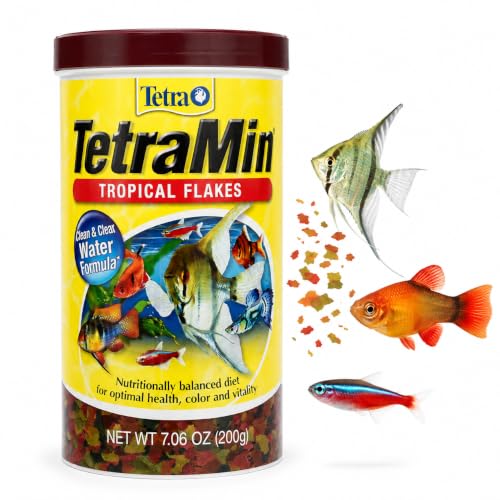
TetraMin Plus is the reference point for a general tropical flake, and it is the food most community keepers start with. It is formulated as a complete staple for a mixed tank of small to medium omnivores, and the manufacturer publishes a guaranteed analysis with crude protein in the range typical for a maintenance flake. It suits a beginner with a 20-gallon community tank who wants one reliable food to build a rotation around. Its trade-off is that as a single food it does not cover herbivores or dedicated bottom-feeders, and like any flake it degrades in quality after the tub has been open for several months, so a large container can go stale before a small tank finishes it. check the current price on Amazon.
Treat this as one concrete option rather than a ranking. The category contains many comparable flakes, and the decision factors are the same for all of them: named protein sources near the top of the ingredient list, a stated crude protein figure, a particle size matched to your smallest fish, and a container size you will finish within a few months of opening.
How a Staple Flake Fits a Rotation
A staple flake carries the bulk of the diet. Around it, a keeper adds a sinking pellet or wafer for bottom-dwellers and a protein treat twice or three times a week. This structure matters because no single format reaches every fish in a mixed tank. The flake feeds the water column, the sinking food feeds the substrate, and the treat adds the amino acid variety that supports coloration and, in breeding fish, egg production.
Rotating also hedges against a formulation change. Manufacturers reformulate, suppliers change, and a food that worked for years can shift. A fish accustomed to variety is more likely to accept a substitute than one that has eaten a single flake its entire life. Keepers who report the least trouble with picky eaters are usually the ones who introduced several foods early.
Species and Diet Categories
Herbivores and omnivores that lean plant-ward need a different balance. Plecos, silver dollars, and many livebearers benefit from spirulina-based flake or algae wafer as a regular component, not an occasional one. Without plant matter in the diet, some of these species develop digestive issues and, in the case of wood-eating plecos, may gnaw on aquarium plants or driftwood out of need rather than preference.
Carnivores and micro-predators need higher protein and often prefer moving or meaty food. Frozen bloodworms, brine shrimp, and daphnia are the standard treats. They are also useful for conditioning fish before spawning and for coaxing a new arrival to eat. Frozen foods should be thawed in a small cup of tank water and poured in, never dropped in as a frozen block, and never refrozen after thawing.
Freeze-dried foods carry one specific caution. They are light and float, and fish that gulp at the surface can swallow them dry, after which the food expands in the gut. This is a recognized cause of bloat and buoyancy problems. Soaking freeze-dried food in tank water for a minute before feeding eliminates the risk at almost no cost in convenience. The UF/IFAS Extension EDIS aquaculture and fish health resources discuss feeding practice and its relationship to water quality and fish health in more detail.
Feeding Tips
- Remove uneaten food after about five minutes.
- Soak freeze-dried food before feeding to prevent bloat.
- Match food particle size to the smallest fish in the tank.
- Include a sinking format if the tank has bottom-dwellers.
- Store food sealed, dry, and away from heat; replace flake within a few months of opening.
- Use an automatic feeder for short trips rather than asking a neighbor.
- Fast the tank one day a week.
Storage is a commonly overlooked factor. Flake food absorbs moisture and loses water-soluble vitamins, particularly vitamin C, after the container is opened. A tub kept in a humid cabinet above a warm tank degrades faster than one stored in a cool, dry cupboard. If the food smells sharply rancid or has clumped, it has spoiled and should be discarded. Writing the opening date on the lid is a simple way to track it.
Automatic feeders solve a specific problem. Well-meaning neighbors and house-sitters consistently overfeed, because the correct portion looks too small to a person who does not keep fish. A feeder set to a light schedule delivers a measured amount and removes the guesswork. Before leaving, do a partial water change and test the water so the tank begins the week in good condition. A feeder is not a substitute for maintenance, only for the daily feeding task.
Common Mistakes
The most frequent error is overfeeding, and it usually comes from a good instinct: the fish seem hungry, so the keeper feeds more. Fish will nearly always accept food, which is not a sign of hunger. The consequences show up as rising nitrate, cloudy water, algae blooms, and eventually sick fish. Correcting the portion is often enough to resolve a water quality problem that looked like something else.
A second mistake is feeding only one food. Variety is not a luxury; it is how a keeper covers the range of nutrients a mixed community needs and how they avoid the nutritional gaps of any single formulation. A third is offering only floating food in a tank with catfish or loaches. Those fish may survive on scraps, but they do not thrive, and the keeper often does not notice until the fish is thin.
A fourth is ignoring the expiration and storage question. Fish food is not indefinitely shelf-stable. Buying a large container to save money is a false economy in a small tank, because the last third of the tub is nutritionally degraded. A fifth mistake is treating food as a cure. No food fixes bad water. If fish look unwell, test ammonia, nitrite, nitrate, and pH before changing the menu, because the cause is far more often environmental than dietary.
How to Choose Without Overbuying
For a first community tank, the sensible purchase is a staple flake in a size the tank will finish in three to four months, plus a small sinking food if the tank has bottom-dwellers, plus one frozen or freeze-dried treat. That covers the diet without a shelf of half-used containers. If the tank is small, buy the smallest tub available even if the cost per gram is higher; freshness matters more than unit price at this scale.
If the tank is a species setup rather than a community, the priorities change. A tank of small rasboras and tetras does well on micro pellets and crushed flake. A tank of cichlids needs larger, often sinking pellets and a protein level matched to the species. A pleco tank needs a plant-based wafer as a staple rather than a treat. Reading the species requirements before buying food is faster than correcting a diet problem later.
The category is not complicated once the variables are clear: protein source and level, particle size, buoyancy, and freshness. A food that names real protein first, states its crude protein, fits the smallest mouth in the tank, and reaches the fish that need it will do the job. A staple flake such as TetraMin Plus is a reasonable place to start a rotation, and the rest of the diet is built around what the specific fish in the tank actually need. To look at that option directly, check the current price on Amazon, and compare the guaranteed analysis against the needs of your tank before deciding.
Whatever food you choose, the feeding routine matters as much as the label. Measured portions, a weekly fast, removal of leftovers, and a sinking food for the bottom layer prevent most of the problems keepers attribute to bad luck. Water quality is the foundation, and food is one of the two or three habits that determine it. Get the portion right, keep the food fresh, and the rest of tropical fish keeping becomes considerably more forgiving.
Affiliate Disclosure: This article contains affiliate links. If you buy through them, PawCritic may earn a commission at no extra cost to you.