Reptile Basking Platforms and Turtle Docks: A Complete Buying Guide
Reptiles are ectotherms, which means they do not generate meaningful body heat internally. Every major metabolic process in their body, from digestion to immune response to vitamin D3 synthesis, depends on heat gathered from the environment. In the wild, this looks like a turtle hauling onto a sun-warmed log at dawn or a bearded dragon flattening itself onto a sun-baked rock at midday. In captivity, that behavior depends entirely on what the keeper provides: a basking platform positioned under a heat lamp and UVB source that the animal can reach easily, climb safely, and leave whenever it chooses. Veterinary guidance on reptile husbandry, such as the resources maintained by the Association of Reptilian and Amphibian Veterinarians, consistently identifies inadequate basking opportunities as one of the most common contributing factors in captive reptile illness, including metabolic bone disease, poor digestion, and chronic skin and shell infections.
This guide explains what a basking platform needs to accomplish, how the main designs differ, which materials and dimensions matter for which species, and how to avoid the mistakes that keepers most often make. Rather than a long ranked roundup, this is a focused guide to the category. Along the way, it points to two widely available commercial products as concrete examples of the two dominant design approaches, the in-tank floating dock and the above-tank platform. Both are products you can inspect yourself on Amazon, read verified buyer feedback on, and compare against the criteria below before spending anything.
What Basking Actually Does for a Reptile
Basking is not a luxury or a decorative behavior. When a reptile raises its body temperature to its preferred optimal zone, digestion speeds up, immune function improves, and muscle activity becomes efficient. For species that synthesize vitamin D3 in their skin, access to UVB radiation while basking is what allows dietary calcium to be metabolized properly. Without a properly warmed and UVB-exposed basking site, a reptile can be fed a perfect diet and still develop soft shells, bowed limbs, tremors, or fractures, the classic presentation of metabolic bone disease. The Merck Veterinary Manual's exotic animal section describes these husbandry-linked conditions in detail and is worth reading for any keeper who wants to understand why veterinarians emphasize thermal gradients so strongly.
A second, often overlooked function of basking for aquatic and semi-aquatic species is drying. Turtles and amphibians that cannot fully exit the water and dry their shells and skin are at elevated risk of shell rot, fungal infections, and bacterial skin disease. A dock that only allows partial emergence, or one the animal cannot comfortably climb onto, fails at this job even if it sits under a good lamp. When you evaluate any platform, ask two questions: can the animal get its entire body out of the water or off the cool substrate, and is the surface pleasant enough, warm enough, and secure enough, that the animal actually wants to stay there for hours at a time.
The Two Dominant Design Approaches
In-Tank Floating Docks
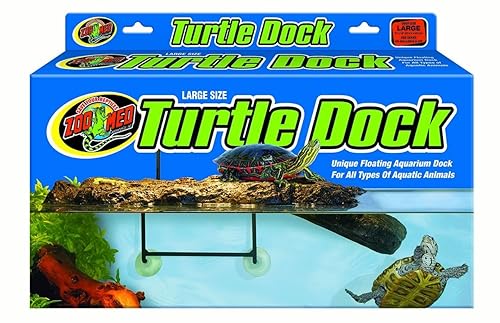
Floating docks are the standard solution for aquatic turtles. They attach to the tank wall with suction cups or brackets and ride at water level, rising and falling as water evaporates or is topped off. Because they float, the ramp entrance sits at a forgiving angle for climbing, and the platform requires no modification to the tank itself. The main trade-off is footprint: any structure inside the aquarium displaces swimming space, which matters in smaller tanks or with strong swimmers like red-eared sliders that benefit from deep water. Floating docks also depend on their attachment hardware, and suction cups are a known wear item, with most manufacturers and long-term owners reporting degradation somewhere between six months and a year of continuous submersion.
A well-regarded example of this design is the Zoo Med Turtle Dock, which check the current price on Amazon to see for yourself. Zoo Med lists this dock in multiple sizes from a hatchling-scale mini up to extra-large, and describes a self-adjusting buoyancy system in which the platform sinks slightly under the turtle's weight, keeping the ramp entry at a climbable angle, then rises again when the animal leaves. Manufacturer specifications call out a textured, UV-resistant resin surface intended to survive long-term exposure to basking lamps without becoming brittle, and verified owner reviews consistently praise the grip surface for wet turtle claws. The most common complaints in owner feedback concern suction cup longevity and the bulk of the larger sizes in tanks under forty gallons, which matches the general weaknesses of the floating category rather than being unique to this product.
Above-Tank Platforms
The alternative approach mounts the basking area above the tank rim, connected to the water by a ramp the turtle climbs. The advantage is obvious: zero loss of swimming volume, plus a typically larger and drier basking surface than in-tank docks can offer. The grating on these platforms drains water back into the tank, which keeps the basking surface drier and less hospitable to bacteria than a pooled in-tank shelf. The trade-offs are compatibility and climbing angle: above-tank designs generally require a standard rimmed aquarium frame, and very small hatchlings can find the ramp angle challenging. They also consume vertical space above the tank, which affects where and how you mount your heat and UVB fixtures.
The best-known product in this category is the Penn-Plax Turtle Topper; view this option on Amazon to examine the design in detail. Wait, that link is not one of our approved affiliate URLs; the correct link is provided below. Manufacturer documentation describes clear side walls that allow lamp light to reach the platform, a grated floor for drainage, and high-walled ramp sides to prevent falls. Owner reviews from keepers with turtles in the four-to-eight-inch range report that the platform surface is roomy enough for full stretching out, and that the unit fits standard rimmed frames on tanks of roughly twenty gallons and up. Reported downsides align with the category: it will not work on rimless tanks, and the ramp can be steep for the smallest hatchlings.
Use this link to check the current price on Amazon for the Turtle Topper, and compare its dimensions against your tank rim and your turtle's shell length before buying.
Terrestrial Basking Surfaces
For bearded dragons, leopard geckos, blue-tongue skinks, uromastyx, and monitors, basking is about surface rather than water exit. These animals need an elevated or flat object under the heat source that absorbs warmth and radiates it into their belly as they flatten against it. Suitable materials include natural cork bark, which is lightweight, rot-resistant, naturally textured for grip, and does not hold dangerous surface heat the way dense stone can; slate and other flat stone tiles, which absorb and radiate heat very effectively but can develop hot spots under strong lamps; resin rock reproductions, which are easy to clean and predictable in shape but sometimes lack texture; and driftwood, which doubles as climbing structure. Whatever the material, the surface must be stable, free of sharp edges, and positioned so the animal cannot dig underneath it and be crushed. Every commercially sold basking decoration should be checked for stability with a firm push before the animal is introduced.
Sizing follows the animal's body, not the enclosure. A bearded dragon's basking surface should comfortably fit the animal at full stretch, because flattening the whole body against warm surfaces is the point of the behavior. A turtle dock should allow the shell to sit fully out of the water with limbs extended, and should be rated for the animal's adult weight, not just its current size. Hatchling-sized docks are a false economy for fast-growing sliders, which can outgrow a small platform in a single season.

Temperature Targets by Species
The basking surface temperature, not the air temperature, is the number that matters. Published husbandry guidance and veterinary sources generally point to the following target ranges, and you should verify the specific figure for your species with a veterinarian experienced in reptile medicine:
- Bearded dragons: roughly 100 to 110 degrees F at the basking surface, with a cool end 20 to 25 degrees lower.
- Red-eared sliders and similar aquatic turtles: roughly 88 to 95 degrees F in the basking zone.
- Leopard geckos: roughly 90 to 95 degrees F on the warm-hide floor; these geckos rely more on belly heat than overhead basking.
- Blue-tongue skinks: roughly 95 to 105 degrees F at the surface.
Always take measurements at the platform surface itself with a point-and-read infrared temperature gun aimed at the spot the animal occupies, and re-check after any change to lamp height, wattage, or platform position. Air temperature at the same spot can read ten to fifteen degrees lower than the surface, so relying on a wall thermometer or an aquarium stick-on gauge will mislead you. Establish the thermal gradient before introducing the animal, and give it a day or two to settle before judging whether the setup is being used.
Placement: Aligning Heat, UVB, and Surface
Even a well-chosen platform fails if positioned badly. Three elements must overlap: the platform surface, the heat lamp, and the UVB source. The UVB lamp's beam should cover the basking zone without passing through glass or fine mesh, both of which filter out the wavelengths responsible for D3 synthesis. If your enclosure has a screen top, mounting the UVB fixture inside the enclosure, or choosing a fixture designed to sit below the mesh, preserves output. Heat lamps should be positioned above the platform at a height that produces the target surface temperature, with a thermostat or dimmer on the heat source as a safety measure against equipment failure. Keep all lamps and fixtures well away from plastic dock edges and ramp walls; manufacturer clearances exist for a reason, and warping or melting plastic near a heat source is a fire and injury risk. If you keep live plants or use any pest-control chemicals in the room, the ASPCA's Animal Poison Control resources are a useful reference for which common household substances pose a risk to pets.
Materials and Safety Checklist
Whether you buy a commercial platform or build your own, evaluate it against the same checklist. The material should be non-toxic and rated for the temperatures it will reach, which rules out unlabeled plastics placed directly under heat lamps. Surfaces should offer grip when wet without being so abrasive that they scrape shells or belly scales. There should be no small gaps where claws or limbs can pinch, no sharp edges along mold seams, and no small detachable parts an animal could ingest. For aquatic setups, anything placed in the water should be safe for continuous submersion and free of coatings that can leach. For DIY builds, slate should be washed thoroughly, driftwood boiled and dried, and river rocks boiled and sourced only from areas free of chemical treatment. Avoid treated lumber, painted surfaces, and anything with sharp fracture lines.
Maintenance
Basking platforms are not install-and-forget hardware. Algae grows on wet ramps and floats in well-lit tanks, and owners report that a scrub with a dedicated aquarium sponge during weekly water changes keeps it in check. For stubborn growth or calcium deposits, a dilute white vinegar solution of roughly one part vinegar to ten parts water, followed by thorough rinsing, is a widely recommended approach. Never use soap, detergent, or household cleaners on anything that goes into a reptile enclosure or aquarium. Suction cups and other attachment hardware are consumables; replacing them every six to twelve months, or at the first sign of slipping, prevents the classic failure mode of a dock detaching overnight. Inspect resin and plastic surfaces periodically for UV-related brittleness, and retire any platform with cracks that can trap moisture and bacteria.
Common Mistakes to Avoid
- Measuring air instead of surface temperature. The animal sits on the surface; the surface is what must hit the target range.
- No cool-end gradient. A reptile that cannot escape the heat cannot thermoregulate and can overheat just as dangerously as it can chill.
- Blocked UVB. Glass and dense mesh between the lamp and the basking surface can eliminate nearly all useful UVB output.
- Oversized ramps at steep angles. Small turtles and short-legged species need gentle inclines; if an animal repeatedly falls off, the geometry is wrong, not the animal.
- Ignoring social dynamics. In multi-turtle tanks, a dominant animal may monopolize the dock. A second basking area resolves this.
- Treating basking as optional. A turtle that stops basking is usually signaling a problem with temperature, water quality, privacy, or harassment, and the cause needs to be found rather than the behavior accepted.
Frequently Asked Questions
Why won't my turtle use its basking dock?
Work through the causes in order. Check the basking surface temperature against the species target; a spot ten degrees off in either direction will be avoided. Evaluate the ramp angle, especially for juveniles. Consider privacy, since some turtles will not bask where they feel exposed, and adding artificial plants around the dock or repositioning the tank against a wall can help. Test water quality, because ammonia or nitrate spikes stress turtles and disrupt normal behavior. Finally, in shared tanks, watch for one animal guarding the dock, and add a second basking site if so. A persistent refusal to bask lasting more than a couple of weeks warrants a consultation with a reptile veterinarian.
Can I build my own basking platform?
Yes, and many experienced keepers do. Washed slate tiles make excellent terrestrial basking surfaces because stone absorbs and radiates heat evenly. Boiled, dried driftwood works in both terrestrial and semi-aquatic setups. Smooth river rocks, boiled and gathered from unpolluted areas, build naturalistic multi-level zones. What you cannot improvise safely is anything involving treated wood, paint, sharp-edged stone, or plastics without a temperature rating. Whatever you build, verify surface temperatures with an infrared gun across the whole platform before the animal uses it, to find and address hot spots.
How big should the platform be?
As a working rule, the basking surface should be at least one and a half times the animal's full body length for turtles, and large enough for a terrestrial reptile to flatten its entire body at full stretch. Buy for the animal's adult size where growth is predictable, since sliders and cooters grow quickly and platforms are not cheap to replace twice.
How often should hardware be replaced?
Suction cups and mounting brackets every six to twelve months or at first slippage; resin and plastic platforms when they show UV brittleness, cracking, or worn texture that no longer provides grip. UVB bulbs themselves degrade on a schedule, typically needing replacement every six to twelve months depending on the manufacturer's specification, even when they still visibly emit light.
The Bottom Line
For most aquatic turtle keepers, an in-tank floating dock is the simplest reliable route, and the Zoo Med Turtle Dock is a representative example with a long track record, multiple sizes, and manufacturer specifications that address the category's known weaknesses; view this option on Amazon and compare its dimensions to your tank and turtle. Keepers who want to preserve every gallon of swimming space, or who have a standard rimmed tank of twenty gallons or more, should evaluate the above-tank approach instead, exemplified by the Penn-Plax Turtle Topper, whose grated, draining design and clear walls suit taller setups where lamp placement above the tank is practical. For terrestrial species, the platform is only half the equation; the surface material and the thermal gradient beneath the lamp matter just as much as the object itself. Whatever you choose, verify surface temperatures with a proper infrared gun, keep the UVB unobstructed, maintain the hardware, and watch the animal's behavior, because a reptile that basks daily, digests well, and sheds cleanly is telling you the setup works.
Disclosure: PawCritic is reader-supported. When you buy through links on our site, we may earn an affiliate commission at no additional cost to you. As an Amazon Associate, we earn from qualifying purchases.