The bird that wanted nothing to do with me
The first budgie I ever brought home spent nine days pressed into the far corner of her cage, facing the wall, refusing to eat whenever I was in the room. I remember sitting on the floor three feet away, barely breathing, wondering if I'd somehow adopted a bird that hated me on principle. She didn't hate me. She was terrified, and terror in a prey animal looks a lot like rejection. That distinction matters more than anything else in this article, because the number one mistake new bird owners make is taking a scared bird's fear personally and rushing to fix it.
Here's the uncomfortable truth: most bonding failures aren't caused by birds that can't be tamed. They're caused by humans who move too fast, expect too much in week one, and interpret normal prey-animal caution as a personality flaw. A parrot's ancestors survived by assuming that anything big and approaching was going to eat them. Your new bird has no way of knowing you spent two hundred dollars on him and a Saturday setting up his cage. To him, you're a predator that keeps lingering near his tree. Everything in this guide is about slowly, boringly, relentlessly proving otherwise.
Week one: do almost nothing
This is the advice nobody wants to hear and everybody needs. When you bring a new bird home, your job for the first seven to fourteen days is essentially to be furniture. Keep the cage in a room where the family spends time, but don't open the cage, don't stick your hand in, and don't try to get the bird to step up. Talk to him while you go about your day. Narrate your laundry folding. Say good morning using the same phrase every time. Predictability is the currency of trust with birds, and routines are how you start paying in it.
Watch the eating behavior closely. A stressed bird may not eat in front of you, and a bird that isn't eating is a genuine medical concern, not just a bonding hiccup. According to the Association of Avian Veterinarians, a bird that goes even 24 to 48 hours with little to no food intake should be seen by an avian vet promptly, because birds mask illness until they physically can't anymore. If your new bird eats when you leave the room and you can see seed hulls and droppings in the cage bottom, you're fine. If the droppings look sparse, watery, or nonexistent over a full day, skip the bonding plan and call the vet.
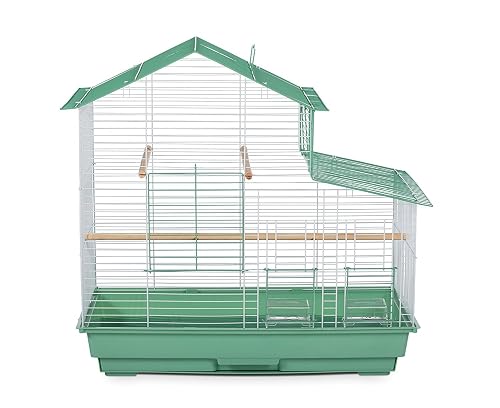
One thing I messed up with that first budgie: I kept rearranging her cage to 'make it nicer.' Every time I moved a perch, I reset her sense of security back to zero. Set the cage up properly before the bird arrives, then leave it alone during the settling period. If you need cage-setup guidance beyond what I cover here, the basics are horizontal space over vertical, appropriately sized bar spacing, and natural wood perches of varying diameters.
Read the body language before you act
Bonding speed is limited by your ability to read what the bird is telling you, and birds communicate discomfort constantly. A relaxed bird grinds his beak, fluffs up loosely, stands on one foot, and preens while you're nearby. A nervous bird goes still and thin, holds his feathers slicked tight against the body, leans or scuttles away from your approach, and may raise one foot slightly as you get close. That raised foot is a pre-emptive step away. Take it. Back off before the bird has to lunge or bite and you'll build trust twice as fast, because you've proven you listen.
Pinning eyes in a larger parrot, fanned tail feathers, and a crest standing straight up in cockatiels all signal heightened arousal, which can be excitement or agitation. Context tells you which. A cockatiel with a full crest hopping toward your hand is probably curious. The same cockatiel with a full crest pressed into the cage corner is telling you to stop. I've seen people push through those signals because the bird 'let' them pet him last week. Birds don't work on last week's terms. They work on today's, and pushing through a no today costs you a week of progress.
The slow blink trick and the treat economy
After the settling period, start spending short sessions near the cage doing nothing but existing. Five to ten minutes, a few times a day. Sit at whatever distance the bird remains relaxed, and gradually, over days, move your chair closer. A trick borrowed from cat behavior actually works with birds too: slow blinking. Look at the bird, blink slowly and deliberately, and look away. It's a non-threat signal, and many birds begin mirroring it within a couple of weeks.
Meanwhile, start identifying a treat the bird genuinely goes crazy for. For most budgies and cockatiels it's millet spray. For conures and bigger parrots it might be sunflower seeds, a nut fragment, or a piece of apple. The trick is that treats should not live in the food bowl. High-value treats appear only during bonding sessions, from your hand, so that you become the source of the best thing in the bird's world. Hold a spray of millet through the cage bars and simply wait. Don't move it toward the bird. Let the bird decide to approach the treat. The first time she eats from your hand inside the cage, resist every urge to celebrate loudly or try to pet her. Stay boring. Boring is safe. Safe is the whole game.

For treat delivery, I keep millet sprays stocked in bulk because bonding burns through them, and a good millet holder lets you clip a spray inside the cage without your fingers becoming part of the transaction during the earliest stages. This pack from Amazon has lasted me through multiple birds: millet spray for birds.
Hand feeding to step up: the ladder, not the leap
Once the bird readily eats treats from your hand through the bars and then inside the cage, you can invite the first real interaction. Present your index finger or the back of your hand just below the bird's chest height, at the level of his lower belly where his feet naturally meet a perch, and hold a treat slightly beyond your hand so the bird has to lean over you to get it. Don't poke him. Don't chase him around the cage. If he steps up even accidentally for one second, gently lower your hand to a perch level so stepping off is easy. You're teaching two things: your hand is a reliable perch, and stepping off is always allowed. Birds trust perches they're allowed to leave.
The verbal cue matters. Say 'step up' every single time, and soon the words themselves become part of the routine. According to the ASPCA, positive reinforcement training built on rewards and consistency is the recommended approach for companion birds, and aversive methods like yelling, squirting, or wing slapping destroy trust and can trigger long-term fear responses. I'd go further: with a scared bird, even a raised voice once can cost you weeks. I once clapped loudly at a cockatiel who was chewing a baseboard, and she wouldn't take a treat from me for eleven days afterward. Eleven days for one clap. The math of bird trust is brutally asymmetric.
Progress in this phase is not linear. Expect two good days, then a day where the bird acts like you've never met. That regression is normal, especially around molting, seasonal hormonal shifts, or a change in the household. Molting in particular makes birds irritable and sore, and pin feathers coming in on the head and neck are genuinely uncomfortable. During a molt, drop back to lower-pressure interactions and let the bird set the pace. Some birds will eventually invite head scratches once trust is deep, and a bird bowing his head with feathers fluffed is asking for exactly that. Never pet a bird below the neck, though. Touching the back, wings, or tail region is interpreted as courtship behavior and can create hormonal bonding that leads to aggression, screaming, and chronic egg laying. Head and neck only, always.
Out-of-cage time without the chaos
The first out-of-cage sessions should happen in a small, bird-proofed room with the door closed, windows covered or closed, ceiling fans off, and other pets out. Before you open that cage door, make sure the bird is comfortable stepping up reliably inside the cage, because a bird loose in a room who won't step up is how people end up chasing their parrot around with a towel at midnight, and chasing is trust annihilation. If it happens anyway, and eventually it will, don't scramble. Dim the lights, put the travel cage or a favorite treat on top of the main cage, and let the bird come down on his own. Most tired birds descend to their cage within a couple of hours.
Target training speeds this phase up enormously. Hold a chopstick or a small wooden dowel a few inches from the bird. The moment he leans over and touches the tip with his beak, click a training clicker or say 'good' and deliver a treat. Birds pick this up absurdly fast, sometimes within one session, and once you can direct the bird's beak anywhere in the room, you can guide him back to the cage without ever grabbing him. Target training is also the foundation for trick training later, and it gives a scared bird something to do with his brain other than be afraid. A busy bird is a braver bird.
You don't need fancy equipment for this. I use cheap wooden chopsticks, but a purpose-made training stick with a clicker is worth keeping in the bird supplies bin: bird training stick. For water and fresh food during out-of-cage sessions, a stainless steel cup that clips to the cage lets you reward generously without making a mess of your room.
Special cases: rehomes, bonded pairs, and the truly traumatized
An older rehomed bird carries history you can't see. Some were hand-fed babies who just need a refresher. Others were cage-bound for years, never handled, and regard hands as pure menace. With rehomes, extend every timeline by double and lower your expectations by half. Some birds never become cuddly, and that has to be an acceptable outcome. A bird who chooses to sit near you, eat while you're in the room, and take treats from your hand is a bonded bird, even if he never wants to be touched. Chasing cuddles a bird doesn't want to give is how 'difficult' birds get made.
Bonded pairs present a different situation. Two birds bonded to each other will generally tame more slowly because they have each other and don't need you. That's fine. Work with them individually during short separate sessions if you can, and expect companionship rather than deep tameness. And if you're taming a truly traumatized bird, one who panics at any human presence, consider working alongside an avian behavior consultant. Some fear responses are entrenched enough that professional guidance saves the bird months of stress.
Common ways people wreck the process
Grabbing with a towel outside of genuine emergencies. Forcing the bird out of the cage. Staring directly at him for long stretches, which is predator behavior. Changing the cage location mid-bonding. Letting well-meaning guests poke fingers through the bars. Punishing bites by yelling or shaking the hand, when a bite is nearly always a communication failure, the last resort after signals you missed. And the big one: comparing your bird's progress to someone else's bird on social media. I've watched a friend's hand-raised conure step up within an hour of coming home, and I've had rescue budgies take four months to eat from an open palm. Both ended up bonded. The timeline belongs to the bird.
Realistic expectations, honest timelines
A young hand-fed budgie or cockatiel from a good breeder might step up within days. A pet store budgie typically takes three to six weeks of consistent daily work to become hand comfortable. A rehomed or neglected larger parrot can take six months to a year to genuinely trust a new person. Two short sessions a day, every day, beats one long weekend marathon, because birds consolidate trust through repetition, not duration. Miss a few days and you won't lose everything, but consistency is what separates the birds that come around from the ones that stay wild.
Start today, but start small. Tonight, pull a chair up to the cage, eat your dinner at bird-observation distance, and talk to him about your day in a low, steady voice. That sounds like nothing. It isn't. That's the first deposit in a trust account you'll be building for the life of the bird, and the birds that take longest to trust are often the ones that trust deepest once they finally do.
Related Reading
Want more on this topic? Check out our guides on best bird cage accessories essentials, how to choose first pet bird buying guide, household dangers pet birds safety guide.