How to Litter Train a Rabbit: The Step-by-Step Guide That Actually Works
Disclosure: PawCritic is reader-supported. A couple of links below are Amazon affiliate links, and we may earn a small commission if you purchase through them — at no extra cost to you.
Here's the fact that flips everything: rabbits are already 90% litter trained the day you bring them home. They're one of the few pets that instinctively pick a corner of their enclosure to use as a bathroom, and they'll keep using it if you put the box there. Most people who fail at rabbit litter training aren't fighting the rabbit — they're fighting their own setup. Wrong box, wrong litter, box in the wrong spot, or no hay rack above the box.
I've fostered rabbits for a shelter for six years, and the single most common call I get from new adopters is "my rabbit pees everywhere." In almost every case, the fix takes less than a week once we correct the basics. This is that process, in the order that works.
Why Rabbits Are Unusually Trainable (When You Understand Them)
Rabbit toilet habits come from their survival instincts, and they're almost custom-made for litter training. Wild rabbits use a designated latrine area, not the whole burrow — keeping waste in one spot hides scent from predators and keeps the nest clean. Your house rabbit has that same instinct, and the entire job of training is to make your setup match the instinct instead of fighting it.
One more thing that makes rabbits different from, say, guinea pigs: they're much more consistent with their bathroom spot, and they're highly motivated by routine. Feed at the same time, clean at the same time, and the rabbit locks into the pattern fast.
Breeding and age note: rabbits reach sexual maturity around 4–6 months, and unneutered rabbits spray and scatter poop to mark territory — sometimes aggressively. If your rabbit isn't fixed and you're struggling with litter training, stop trying to train the behavior and get the rabbit spayed or neutered first. Every shelter and rescue I've worked with says the same thing: litter training success jumps dramatically after the surgery. The House Rabbit Society recommends spaying and neutering for health reasons as much as behavior — unspayed does have a very high rate of uterine cancer by age four.
Step 1: Pick the Right Litter Box
The pet store "small animal litter pan" is usually a trap. Those little triangular corner pans are designed for hamsters and guinea pigs, and most rabbits — even small ones — will sit in them like a circus bear or just ignore them entirely. Your rabbit needs a box it can turn around in comfortably, because a rabbit that can't turn around will often refuse to use the box.
For most rabbits, a cat-sized litter pan works perfectly. A 12×18-inch pan suits a Netherland Dwarf or a Holland Lop; a 16×24-inch pan suits bigger rabbits like Flemish Giants and French Lops. If you can't find a pan big enough, a cement mixing tub from the hardware store costs less and is basically indestructible — lots of rabbit owners use them.
Tall sides matter more than you'd think. Rabbits back up to pee, and a rabbit with its rear over the rim is a rabbit peeing on your floor. Eight inches of side height prevents most of this. If your rabbit is a flicker — some rabbits kick litter everywhere — a covered box or a box with a high back wall fixes it.
What about grids or grates? Skip them. Wire flooring in litter boxes is a holdover from old rabbitry practices, and it causes sore hocks — a painful, hard-to-treat foot condition. Your rabbit should stand on absorbent litter, not wire.
Step 2: Choose the Right Litter (This Matters More Than You Think)
Rabbits chew everything, and they sample their environment constantly. That means your litter has to be safe if swallowed, absorbent enough to control ammonia smell, and dust-free enough not to irritate a rabbit's delicate respiratory system. This rules out a lot of products.
Good choices:
- Paper-based pellet litter — my default recommendation. Highly absorbent, low dust, safe if nibbled. Brands like Yesterday's News (originally cat litter, but rabbit-safe and widely used) and Carefresh paper pellets work well. Expect to change it every 2–3 days.
- Wood pellets (kiln-dried, untreated) — the budget champion. A 40-pound bag of pine pellets from the feed store costs about $8 and lasts a single rabbit months. When wet, they expand into sawdust, which you scoop out daily. Make sure the pellets are kiln-dried — the aromatic oils in fresh pine and cedar are bad for rabbit lungs.
- Recycled paper pulp bedding — soft and absorbent, though dustier than pellets. Fine for rabbits that don't dig excessively.
Never use:
- Clay or clumping cat litter — the #1 mistake. Clumping litter contains sodium bentonite, which expands in the gut if swallowed. Rabbits groom constantly and will ingest litter off their fur. Clumping litter is a genuine impaction risk, and impaction can be fatal. It's also dusty as hell.
- Cedar or fresh pine shavings — phenols in the wood cause liver and respiratory damage with chronic exposure. Kiln-dried pine is fine; aromatic cedar is not.
- Corn cob litter — molds when wet and, if eaten, can cause blockages.
- Silica crystal litter — dangerous if ingested and doesn't control rabbit urine odor well anyway.
Step 3: The Hay Rack Trick — The Secret Weapon
Here's the single most effective litter training tip I know, and almost nobody starts with it: put the hay rack directly above or right next to the litter box.
Rabbits eat hay and poop at the same time. It's wired in — grazing animals eat while eliminating, because in the wild, stopping to poop separately means stopping to be vulnerable. If the hay is in the litter box area, the rabbit naturally spends its eating time sitting in the box, and the poop follows the hay. This one placement decision does more for litter training than any amount of reinforcement.
This is also why the diet matters for training: a rabbit on unlimited hay uses the box constantly; a rabbit fed mostly pellets with hay as an afterthought has no reason to sit in the box for long stretches. Hay first, always. Our guide to feeding rabbits the right way covers the hay-to-pellet ratios and why an all-pellet diet is a health disaster waiting to happen.
Step 4: Set Up the Box Correctly
Location matters more than anything else. Put the box in the corner the rabbit has already chosen. If you watch a new rabbit in its enclosure for a day, it will show you its preferred bathroom corner — that's where the box goes, not where it looks nicest. If the rabbit is already peeing in a corner, moving the box to that corner instantly converts most of the problem.
Layer it right: a 1–2 inch layer of litter, topped with a thin layer of hay. The hay on top does two things: it gives the rabbit a snack while it sits, and it absorbs and masks odor better than litter alone. Some owners add a handful of soiled litter from the rabbit's previous accidents to the box to reinforce the scent signal — that works, but only if the accident was on a safe, non-toxic surface.
One box per level, minimum. If your rabbit has a multi-level enclosure or free-range areas on two floors, you need a box on each level. A rabbit that has to travel to find a bathroom will often just go where it is. The general rule that works for cats works for rabbits: number of boxes = number of rabbits + 1.
Keep the box out of high-traffic corners. Rabbits want privacy and a clear sightline for predators. A box shoved behind the cage door or under a table where the rabbit can't see the room is a box that won't get used.
Step 5: Enclosure Training (Days 1–3)
Start small. If the rabbit has the run of a whole room, that's too much space to train in — you'll be chasing accidents everywhere. The standard protocol:
- Confine the rabbit to its enclosure for the first few days with the litter box set up as above. This isn't punishment — it's teaching the rabbit that the box is the bathroom, in a space where the box is unavoidable.
- Watch the pattern. Rabbits usually poop right after eating. After a meal, the rabbit will hop to the box — that's the habit forming.
- Clean accidents immediately and thoroughly. Use an enzymatic cleaner designed for pet urine. Ordinary soap doesn't break down uric acid, and if the spot still smells like a bathroom to the rabbit, it will keep using it. Vinegar and water works for non-porous floors, but enzymatic cleaner is the reliable choice. We've reviewed enzymatic cleaners extensively for cats, and the same logic applies to rabbit pee.
- When the rabbit is using the box reliably in the enclosure — usually 3–5 days — start opening up more space, one room at a time. Add a second box in the new room, in the corner the rabbit gravitates toward.
A note on "bunny berries": a few stray poops outside the box are normal and aren't the same as a training failure. Rabbits scatter a small amount of feces as scent markers, especially in new spaces or when they're excited. If it's a handful of pellets and no pee, you're fine — sweep them up and move on. Constant scattered poop with no box use is a different problem (see troubleshooting below).
Step 6: Free-Range and Multi-Room Training
Once your rabbit is box-reliable in one room, you can start expanding. The mistakes I see here are always the same:
Expanding too fast. Give the rabbit a new room only when the current space is consistently clean for about a week. Each new room needs its own box in the corner the rabbit picks. A rabbit given the whole house on day three will revert — not out of spite, but because the territory is suddenly too big to manage and the scent map is gone.
Ignoring barriers. Not every corner needs a box — but every room does, and so do the spots between rooms. Doorways and hallway junctions are common accident spots for free-roam rabbits because they're transition zones. A small box at the junction solves it.
Letting the box get gross. This is the #1 cause of training regression, in every species, ever. A rabbit will use a clean box and abandon a dirty one. Scoop daily, change the litter every 2–3 days, and wash the pan weekly with vinegar or a mild detergent. If your rabbit suddenly starts peeing outside a box it previously used, the first suspect is the box condition, not the rabbit.
Step 7: Troubleshooting — When It's Not Working
| Problem | Likely Cause | Fix |
|---|---|---|
| Pees in one corner, ignores the box elsewhere | Box not in the chosen corner | Move the box to that corner |
| Used to be good, suddenly regressing | Dirty box, or new stressor | Deep clean the box; check for new pets, moves, or schedule changes |
| Sprays walls or vertical surfaces | Unneutered male (or hormonal female) | Get the rabbit fixed; clean thoroughly with enzymatic cleaner |
| Squats and pees right outside the box | Box too small to turn around in, or rim too low | Bigger box, higher sides |
| Pees on beds, sofas, or blankets | Marking soft territory, or a spayed/neutered rabbit asserting ownership | Block access until trained; provide a "spare" box or blanket they're allowed to claim |
| Constant diarrhea or mushy stool | Diet problem (too many pellets, too much sugar) — medical | See a rabbit-savvy vet; adjust diet per our feeding guide |
| Drinking more, peeing more, straining to pee | Possible urinary tract issue | Vet visit — this is medical, not behavioral |
If your rabbit was reliably trained and suddenly starts peeing everywhere and drinking more or straining, that's not a training relapse — that's a possible urinary tract infection or bladder sludge, both common in rabbits. Behavioral fixes won't help a medical problem, and delaying a vet visit makes it worse. Rabbits need a vet experienced with exotics; a general practice dog-and-cat vet may not have the equipment or experience for rabbit dentistry and urinary work.
What NOT to Do
Never punish a rabbit for accidents. No scolding, no nose-rubbing in the pee, no confinement as punishment. Rabbits don't connect punishment to behavior the way dogs do; they connect it to you, and you'll end up with a frightened rabbit that hides from you and pees out of stress. If the accident is caught in progress, a firm "no" and moving the rabbit to the box is the extent of the correction.
Don't use ammonia-based cleaners on accident spots. Ammonia smells like urine to a rabbit (and to cats) and actually attracts repeat marking. Enzymatic cleaner or vinegar, every time.
Don't skip the spay/neuter and then blame the rabbit. An unneutered rabbit spraying is a biological drive, not a training failure. Training before surgery is possible but much harder; the order that works is surgery first, then training.
Don't expect perfection from day one. Most rabbits are reliably trained within 1–2 weeks. Some take a month. A few free-roam rabbits will always leave the occasional stray poop — it's the pee that's the real test, and pee consistency is achievable in almost every rabbit.
The Gear That Makes It Easier
You don't need much for litter training — the pan, the litter, the hay rack, and an enzymatic cleaner cover 100% of the setup. If you want the whole thing to run smoothly from day one:
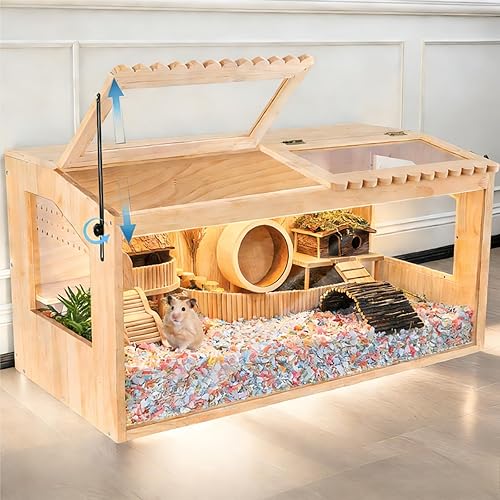
A hay feeder designed to mount over the litter box is the single best purchase for training, because it locks in the eat-and-poop synergy automatically. And a high-sided, appropriately sized litter pan that a rabbit can actually turn around in prevents the most common failure mode before it starts. If you're shopping for boxes, our roundup of rabbit litter boxes compares the designs that hold up to daily use.

Maintenance Routine That Keeps It Working
| Frequency | Task |
|---|---|
| Daily | Scoop soiled litter and hay, top up hay in the rack, spot-clean stray poops |
| Every 2–3 days | Full litter change, refresh the hay layer |
| Weekly | Wash the pan with vinegar, wipe the surrounding floor with enzymatic cleaner |
| Monthly | Full enclosure deep clean, check for chewed edges and urine stains on walls |
One habit worth stealing from experienced rabbit keepers: keep a dedicated dustpan and brush by the enclosure. Rabbits scatter hay, and the hay-and-litter trail is the main source of the "rabbits are messy" reputation. Two minutes of daily sweeping keeps the space genuinely clean — and a clean space makes a rabbit more likely to keep using the box, because the scent map stays simple.
My Take
Litter training a rabbit is honestly easier than house training a puppy — the rabbit comes with the instinct preinstalled, and your entire job is to not fight it. Put the box where the rabbit wants it. Put the hay where the box is. Keep the box clean. Fix the rabbit before you train the rabbit. Do those four things and the "untrainable" rabbit narrative collapses within a week.
The mistake people make is treating the rabbit like a small dog and applying dog training logic: corrections, punishment, dominance. None of that works, because the rabbit's brain is different. You're not teaching the rabbit a trick. You're setting up an environment where the rabbit's own instincts do the work — and once that clicks, you'll wonder why anyone thinks rabbits are hard to litter train at all.