The First Leopard Gecko I Kept Deserved Better
My first leopard gecko lived in a 10-gallon tank with a heat rock, calcium sand, and a single half-log hide. She survived eight years, which I now consider a small miracle, because everything about that setup was wrong. Heat rocks cause thermal burns. Calcium sand causes impaction. One hide in a 10-gallon tank gives a nocturnal prey animal essentially nowhere to feel safe. If you're building your first leopard gecko enclosure right now, this guide is my attempt to save you from the errors I made and the ones I still see at every reptile expo I attend.
Here's the good news: leopard geckos are one of the easiest reptiles in the hobby to house correctly. They don't need UVB the way a bearded dragon does, they don't need 80 percent humidity like a crested gecko, and a proper setup costs far less than most people assume. But easy to keep and easy to keep correctly are two different things, and the gap between them is where most first-year problems live.
Start With the Right Tank: Bigger Than the Pet Store Told You
The bare minimum I recommend for one adult leopard gecko is a 36-by-18-inch enclosure, which works out to about 40 gallons. A 20-gallon long tank can technically keep a gecko alive, but you will fight an uphill battle creating a proper temperature gradient in a 30-inch footprint. When your warm side and cool side are only a foot apart, your gecko can't thermoregulate, and thermoregulation is the entire engine of reptile health.
Reptiles are ectothermic. They don't generate their own body heat the way mammals do; they move between warmer and cooler zones to hit the temperatures their digestion and immune function demand. A leopard gecko needs a warm-side floor surface temperature of about 88 to 92 degrees Fahrenheit and a cool side sitting in the mid-70s to low 80s. That's a 15-degree gradient across the floor of the cage. You simply cannot build that in a cramped tank.
Front-opening enclosures are worth the extra money over glass aquariums. Leo geckos are ground dwellers with no interest in being approached from above, which in their world is exactly what a predator looks like. A front-opening tank lets you service the enclosure and interact with your gecko at eye level, and the difference in how quickly a new gecko settles in is obvious. If budget forces you into a glass aquarium, that's fine, just be aware your gecko may take longer to stop bolting every time your hand appears overhead.
Heat: Under-Tank Warmth, Not Glowing Rocks
Leopard geckos absorb heat through their bellies. In the wild of Afghanistan and Pakistan they spend their days tucked against sun-warmed rock and soil, not basking under a lamp like a bearded dragon on a branch. So your primary heat source should be an under-tank heater or heat mat, or better yet a deep heat projector or ceramic emitter positioned to warm the floor, paired with a thermostat.
I want to underline that word: thermostat. Not a dimmer, not a rheostat, a genuine thermostat with a probe. An unregulated heat mat plugged straight into the wall can hit 110 degrees or more, and I've seen the shed-stuck, burned-belly aftermath more than once. According to the Association of Reptilian and Amphibian Veterinarians, thermal burns are among the most common injuries seen in pet lizards, and nearly all of them trace back to unregulated heat sources. A thermostat with the probe taped to the floor directly over the mat, set to around 91 degrees, costs a fraction of one vet visit.
Position the heat source so it covers roughly one-third of the floor. Skip heat rocks entirely; their internal elements are unreliable and they've been burning lizards since before I got into the hobby. If your room drops below about 68 degrees in winter, add a low-wattage ceramic heat emitter on the warm side to keep ambient temperatures stable overnight. Leopard geckos need a nightly temperature drop, so turn any overhead heat off at night unless your home gets genuinely cold.
Do They Need UVB? The Honest Answer
For years the hobby line was that leopard geckos, being nocturnal, don't need UVB lighting at all. That consensus has softened. Wild leopard geckos emerge at dusk and are exposed to low levels of ambient UV, and modern research suggests a weak UVB source provides measurable benefit for vitamin D3 synthesis, especially in geckos that refuse supplemented insects. A low-output UVB tube, something in the 5 to 7 percent range, running across the top of the enclosure on a 12-hour cycle, does no harm and likely does real good.
If you skip UVB, you must be religious about dusting feeder insects with a D3-containing calcium powder. I use UVB anyway because redundancy in husbandry is how you avoid the metabolic bone disease cases that break your heart. Whichever route you choose, pick one and commit, because the worst option is the middle ground where an owner forgets dusting and offers no UVB.
Substrate: Where the Hobby Still Bleeds From Old Advice
Do not use calcium sand. I'll say it plainly because pet stores still sell it with leopard gecko kits: loose calcium sand is swallowed when geckos catch insects off it or deliberately ingest it, and it can clump in the intestines. Impaction from loose substrates is a documented cause of death in leopard geckos, and calcium-carbonate sands are the worst offenders precisely because they look like a calcium source to a calcium-hungry animal.
My recommended substrate for beginners is a 50-50 mix of organic topsoil and playsand, packed down firmly, at 2 to 3 inches deep. It holds burrows, drains well, and lets you provide a proper humid hide that actually works. If you want a set-and-forget option, slate tile cut to fit the floor is outstanding: zero impaction risk, holds warmth beautifully, wipes clean. Paper towels are fine for quarantine or hatchlings but ugly and useless for a display animal long-term. Avoid cedar and pine products entirely; the aromatic oils are toxic to reptiles.
You Need Two Thermometers Minimum, and Probably a Hygrometer
Guessing temperatures is the number one husbandry failure in this species. Buy a digital thermometer with a probe for the warm-side floor surface and a second one for the cool side. Dial thermometers that stick to the glass are close to useless; they read the air near the wall, not the floor where your gecko actually lives. A combo unit with a hygrometer is even better, because ambient humidity matters too.
Leopard geckos come from arid scrubland and want ambient humidity between 30 and 40 percent. Above 60 percent sustained, you start inviting respiratory infections. If you live in the humid Southeast like I do, a dehumidifier in the reptile room or better ventilation in the enclosure solves it. And this matters: never let the humid hide's moisture turn the whole cage soggy. The humid hide is a microclimate, not a design theme for the whole tank. One of the units I keep in my own rack system is this digital thermometer-hygrometer with probes, and having accurate floor-level numbers changed how I kept geckos more than any other single purchase.
The Three-Hide Rule
A leopard gecko enclosure needs a minimum of three hides. One on the warm side, one on the cool side, and one humid hide, ideally positioned on the warm side or mid-tank so the moisture actually cycles. The humid hide is the piece beginners skip, and it's the single biggest prevention tool for shedding problems, which I covered in detail in my shedding guide. Fill it with damp sphagnum moss or a folded paper towel kept moist but not dripping. When shedding time comes, your gecko will spend hours in there and come out with a clean shed instead of retaining skin on toes and tail tips.
Hides should have a single entrance, be snug enough that the gecko's back touches the ceiling, and be dark inside. Those decorative resin caves work fine. So do overturned plastic food containers with a door cut in the side, and honestly the gecko doesn't care about the difference. What it cares about is that it can tuck itself somewhere nothing can see it. Give it three of those places across the temperature gradient and you'll see a calmer, bolder animal that actually comes out during evening hours.
Feeding and Water: Simple, With Two Catches
Water should always be available in a shallow dish on the cool side. Change it daily; leopard geckos will drink stale water reluctantly and not at all if it's fouled. For food, adults do well on appropriately sized crickets, dubia roaches, and occasional mealworms, offered every two or three days, with insects no wider than the space between the gecko's eyes. Dust with plain calcium at most feedings and a multivitamin with D3 once or twice a week if you're not running UVB.
Catch number one: gut-load your insects. What's inside the cricket becomes what's inside your gecko, so feed your feeders on leafy greens and quality insect diet for 24 hours before offering them. Catch number two: never leave uneaten crickets in the cage overnight. Hungry crickets chew on sleeping reptiles, and the wounds get infected. I learned this one from a friend's gecko with a gnawed eyelid, and it's a mistake you only need to see once to never repeat.
One more thing worth saying, because the FDA and CDC have both weighed in on it: reptiles can carry Salmonella bacteria. According to the U.S. Food and Drug Administration, you should always wash your hands with soap and water after handling a reptile or anything in its enclosure, and never let reptiles roam in kitchens or near food-prep surfaces. This isn't a reason to skip the hobby. It's a reason to have a bottle of soap by the sink and basic habits.
Building It Step by Step
Here's the sequence I use when setting up a new enclosure from scratch. First, place the empty tank where it will live, because a fully furnished 40-gallon breeder is heavy and awkward. Second, install the under-tank heater on the outside bottom, on the appropriate side, and hook it to the thermostat with the probe secured on the floor above it. Third, add substrate, 2 to 3 inches packed firm, deeper at the back if you want a natural slope. Fourth, place the warm hide directly over the heated zone, the humid hide nearby, and the cool hide on the far end. Fifth, add the water dish on the cool side, and a small feeding dish if you use mealworms. Sixth, install lighting, UVB tube on top, any overhead heat lamp clamped or mounted safely. Seventh, run everything empty for 48 hours with thermometers in place and no gecko inside. That dry run is where you catch the thermostat that's off by five degrees or the mat that doesn't reach the surface temp you expected.
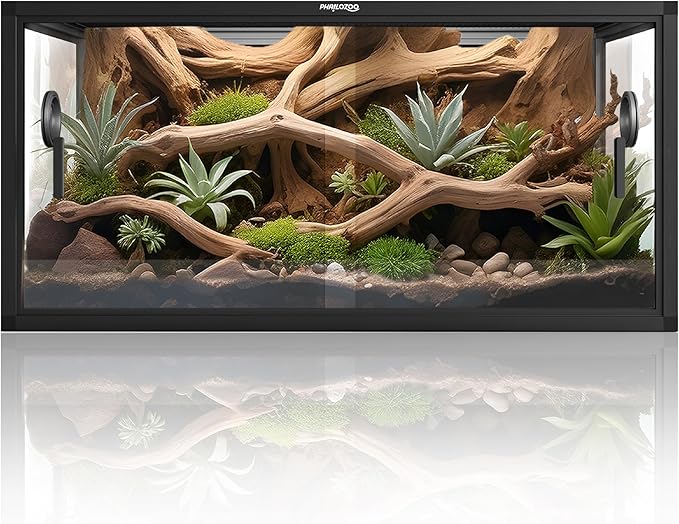
Only after the numbers read 90-ish on the warm floor and 78-ish on the cool side for two straight days do you move the gecko in. A well-planted option for cleanup crews and naturalistic builds is a bioactive approach, and if you go that route, a kit like this bioactive terrarium starter setup gets you the springtails and substrate base in one shot. Bioactive isn't required for a first gecko, though, and I'd honestly run a conventional setup for a year before complicating things.
Cohabitation: Just Don't
Leopard geckos are solitary. Two males together will fight and injure each other. A male and female together means relentless breeding stress. Even two females, the combination old care sheets blessed, ends in one animal dominating the food and the other quietly losing weight while the owner insists they're fine. I've rehoused 'fine' females that were skin and bones under a dominant cage mate. One gecko per enclosure, full stop. If you want multiple geckos, run multiple enclosures.
Handling and Settling In
Give a new gecko two weeks with zero handling before you even try. Let it learn that the giant opening the front door isn't a threat. When you do start, keep sessions under five minutes, low to the substrate, never grab from above, and never grab the tail. Leopard geckos drop their tails as a defense, and while the tail regrows, it grows back as a fat-storing blob that never matches the original, and the animal loses its fat reserves in the process. Support the body, let it walk hand to hand, and put it back the moment it seems stressed. Some geckos become genuinely dog-tame within months; others tolerate handling forever without loving it. Respect which one you have.
What This Actually Costs
Budget realistically: a 36-by-18 front-opening enclosure, a quality thermostat, an under-tank heater or deep heat projector, a low-output UVB tube and fixture, three hides, substrate, two thermometers, a hygrometer, dishes, and supplements. Done smart, you're in the $250 to $400 range, with the enclosure and thermostat being the two places not to cheap out. A reliable thermostat like the reptile thermostat controller I run on my own racks is a fire-safety item as much as an animal-welfare item, since it also protects you from an overheating mat while you sleep or travel.
Compare that to the $80 'starter kit' with a 10-gallon tank, heat rock, and sand, and you can see why so many first geckos get a rough start. The starter kit isn't a bargain if it ends in an impaction surgery or a burned belly. Spend it right the first time and the enclosure runs for a decade-plus, because a healthy leopard gecko routinely lives 15 to 20 years, occasionally past 25. That's a longer commitment than most dogs, and it deserves housing built like it.
The Takeaway I'd Give My 2006 Self
Every serious leopard gecko problem I've ever dealt with, either my own or other people's, traced back to one of four things: temperatures that were guessed instead of measured, loose substrate that got swallowed, no humid hide, or stress from too-small housing with nowhere to hide. Fix those four before your gecko ever arrives and you've eliminated the majority of what sends this species to the vet. Get the gradient right, give it three dark places to disappear, keep one of them damp, and measure everything with real instruments. Do that, and you're not just keeping a leopard gecko alive; you're keeping one that eats eagerly, sheds clean, and prowls the front glass at dusk like it owns the place, which, in its mind, it does.
Related Reading
Want more on this topic? Check out our guides on how to choose first pet reptile beginners guide, best crested gecko food diet prepared diets cgd supplements, leopard gecko shedding problems prevention guide.