The 4:47 AM Alarm You Never Asked For
Here's a number that will sound familiar to a lot of cat owners: 4:47 AM. That's roughly when my cat Bean decided the day should start, every single day, for about six months. Not 4:45, not 5:00 — 4:47, like he'd synced his internal clock to some feline stock exchange opening bell. First it was a gentle paw on my nose. Then knocking my phone off the nightstand. Then, when I made the fatal error of ignoring him, the sound of a full glass of water hitting the bedroom floor.
If you're reading this on three hours of sleep, I want you to know two things. First, this is fixable — but not the way most articles tell you. Second, the fix takes about two to three weeks of consistency, and the first five nights usually get worse before they get better. Anyone promising an overnight solution is selling something.
Let's talk about why cats do this, what you're probably doing wrong (I did all of it), and the exact routine that finally got me sleeping until 7.
Cats Are Crepuscular, Not Nocturnal — and That Matters
The most common myth is that cats are nocturnal. They're not. Cats are crepuscular, which means their peak activity windows are dawn and dusk. That's hardwired from millions of years of hunting prey that's most active in low light — mice don't exactly hold meetings at noon. According to the American Association of Feline Practitioners (AAFP), domestic cats retain these natural activity rhythms even when they've never caught anything more challenging than a dust bunny under the couch.
So your cat isn't waking you up at 5 AM to be a jerk. His body is telling him it's prime hunting time, and in his mind, you are the large, useless predator who controls the food supply. The paw on your face is a recruitment attempt. The problem isn't the instinct — the problem is that modern indoor cats sleep 16+ hours a day, burn almost nothing, and arrive at dawn fully charged with no outlet.
There's a second layer too, and this is the one people miss: you have trained your cat to wake you up. Not on purpose. But every single time you get up at 4:47 AM and pour food to make the screaming stop, you have paid him for the behavior. Cats aren't complicated. Behavior that gets rewarded gets repeated. You've essentially taught him that persistent harassment for ten minutes produces breakfast. From his perspective, it's the most reliable vending machine on earth.
Step 1: Stop Feeding the Beast First Thing in the Morning
This is the hardest part and the most important part. If your cat eats the moment you get out of bed, waking you up IS breakfast. You have to break the association between 'human rises' and 'food appears.'
The rule: never feed within 30 minutes of getting up. Ideally, make it an hour. Feed yourself first, have your coffee, shower, and then feed the cat. Your cat needs to learn that breakfast happens at 7:15 regardless of what he does between 4 AM and 7 AM — and that his behavior has zero influence on the timing.
When I did this with Bean, the first four mornings were genuinely miserable. He escalated. He cried louder, knocked more things over, walked on my head. Behaviorists call this an extinction burst — when a previously rewarded behavior stops paying out, the animal tries harder before giving up. It's actually a sign the plan is working. If you cave on night four, you haven't just lost that night — you've taught him that louder and longer works, and next time he'll push even harder. Consistency on nights three through seven decides the whole outcome.
Step 2: Hunt, Eat, Sleep — The Evening Routine That Changes Everything
Here's the single best piece of cat behavior advice I've ever gotten, and it comes from how cats naturally structure their day: hunt, catch, kill, eat, groom, sleep. A cat who hunts and eats right before your bedtime is biologically primed to do what cats do after a meal — bathe and crash.
So build a 15-minute play session into your evening, roughly 30 to 60 minutes before bed. Not lazy wand-waving while you watch TV. Real, engaged play where the toy acts like prey: it hides, it darts, it freezes, it escapes. Get your cat actually panting and jumping. Then finish the session by letting him 'catch' the toy, and immediately follow it with a small meal or a generous treat portion.
This simulates a complete hunt-cycle and taps directly into that hardwired post-hunt sleep pattern. I use a feather wand for ten minutes and a wand teaser toy with replaceable lures so the 'prey' keeps changing — cats habituate fast to the same old toy, and a new lure every couple of weeks keeps the hunt real. Rotate toys out entirely; a toy that's been in a drawer for two weeks is exciting again when it reappears.
One warning: don't play hard right before bed without the food. You'll amp up a hungry, stimulated cat and hand him a reason to wake you at 3 AM for calories. The meal after the play is not optional — it's half the mechanism.
Step 3: Solve the Boredom Problem During the Day
A cat who sleeps all day because there is literally nothing to do will be at maximum energy at exactly the hour you most need to be unconscious. Environmental enrichment isn't a nice-to-have; it's load-bearing in this plan.
The core moves:
- Window access. A perch with a view of birds, squirrels, or passing pedestrians is cat television. According to the Humane Society of the United States, visual enrichment like window views is one of the simplest and most effective stress-reducers for indoor cats. If you don't have a wide sill, a suction-mounted window perch solves it in five minutes.
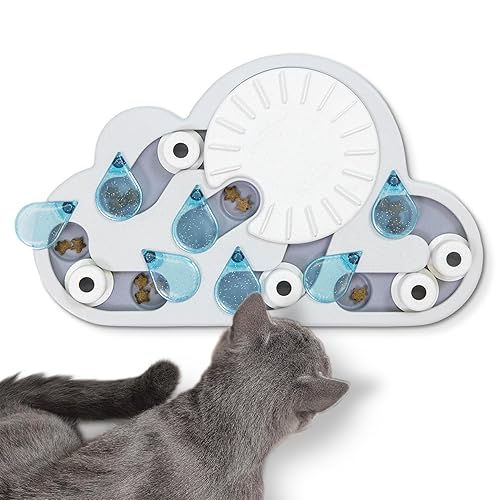
- Food puzzles. Make him work for part of his daily ration. Puzzle feeders turn eating into a 20-minute mental workout instead of a 90-second inhalation. Even kibble scattered in a muffin tin with a ball in each cup counts.
- Vertical territory. A cat tree or wall shelves give him climbing, surveying, and scratching options that don't involve your furniture or your face at dawn.
- A second session of real play. Fifteen minutes in the morning or after work, in addition to the evening session. Two sessions beats one long one.
An automated option that works well for midday: I leave a couple of electronic motion toys on a rotation so Bean gets unpredictable hunting opportunities while I'm working. Unpredictability is the key — a toy that moves on its own schedule keeps a cat checking on it instead of sleeping 18 hours.
Step 4: Water All Night, Food on a Schedule
Here's a subtlety: some cats wake owners not for food but because they're thirsty and the water bowl is stale or empty. Cats are notoriously poor drinkers — their ancestors got most of their moisture from prey, and that low thirst drive persists. A cat who's mildly dehydrated at 4 AM has a legitimate grievance.
Fix it by making water appealing and always available. Fresh bowl refilled nightly, placed away from the food dish (many cats prefer drinking away from their eating spot — again, instinct: in nature, water near a kill site is contaminated water). Better yet, a circulating fountain. Moving water is more attractive to cats, and a good filter keeps it from tasting like a swamp. Since I put a fountain in the bedroom-adjacent hallway, Bean's overnight water-related wake-ups dropped to zero. If you go this route, get one with a decent capacity and clean it weekly — a slimy fountain is worse than no fountain.
Step 5: Consider an Automatic Feeder (Carefully)
An automatic feeder timed to dispense a small meal at 4:30 or 5 AM can work — the cat gets food at dawn, learns the machine provides it, and stops bothering you because you're no longer the food source. This is the strategy that finally broke Bean's habit, combined with everything above.
The trap: don't use the feeder as a substitute for the behavior work. If you buy a feeder, set it for the pre-dawn meal, and also keep playing and feeding properly in the evening, you're shifting his whole feeding rhythm. If you just bolt a feeder onto the same bored, under-exercised cat, you'll buy yourself maybe two weeks of sleep before he starts waking you for attention instead of food. The feeder solves the food motive. Only play, enrichment, and ignoring the attention-seeking solve the rest.
When you shop for one, look for these specifics: a secure lid (clever cats defeat latches — I've seen it happen, and a cat who learns to raid the feeder learns it forever), portion control accurate to about an eighth of a cup, and a battery backup so a power outage at 3 AM doesn't reset the schedule and recreate the problem from scratch.
Step 6: The Bedroom Question — My Honest Take
Every list like this eventually says 'just shut the cat out of the bedroom.' That works for some cats. For others, it turns a 4:47 AM meow into a 2 AM door-scratching campaign, which is objectively worse. I've seen this go wrong both ways.
My take: if your cat's wake-ups are food-driven, you can usually keep him in the bedroom and let the training do the work. If they're attention-driven — and you'll know because he wakes you, gets fed nothing, gets played with nothing, and just wants interaction — a period of closed doors combined with serious evening play and daytime enrichment is often the reset button. Just commit: a door you open at 5:15 after twenty minutes of howling is a slot machine, and cats love slot machines.
Whatever you choose, don't yell and don't spray. Punishment doesn't teach a cat what to do instead, and according to the ASPCA, aversive methods mostly teach cats to fear you while damaging the bond — the behavior comes back the moment you're not there to punish it. Reward what you want, extinguish what you don't, and give the instinct a legal outlet.
What's Actually Normal (and What Isn't)
A word of caution before you blame everything on behavior. If your cat's night waking is new — especially in a senior cat — it can signal something medical. Cats over about 10 years old who start vocalizing at night, pacing, or seeming disoriented should see a vet, because hyperthyroidism, chronic kidney disease, high blood pressure, and cognitive dysfunction all show up as nighttime restlessness. A cat who suddenly wakes you while also eating more, drinking more, or losing weight isn't bored — he's sick, and no amount of wand toys will fix that. Rule out medicine first, then do behavior work.
Also normal to know: cats sleep a lot, but they cycle. A cat who sleeps at night alongside you is trained, not natural. Expect some activity. The goal isn't a cat-shaped statue for eight hours — it's a cat who entertains himself between 11 PM and 6 AM without involving your face.
The Two-Week Plan, Condensed
Here's the whole thing as a schedule, because I know you're tired and want the checklist:
- Days 1-14, every evening: 15 minutes of hard, prey-real play starting around 30-60 minutes before your bedtime. End with a catch and a small meal.
- Days 1-14, every morning: Do not respond to wake-up behavior. Get up at your real alarm time. Wait at least 30 minutes before feeding. No exceptions, ever, for any reason.
- Ongoing: Never feed within half an hour of waking. Feed at consistent times. Use a pre-dawn automatic feeder meal if the food drive is the main issue.
- Ongoing: Daily enrichment — window perch, puzzle feeding, rotated toys, vertical space.
- Nights 3-7: Expect the extinction burst. Hold the line. This is where 90 percent of people quit, and the cat learns the wrong lesson.
For most cats, meaningful improvement shows inside two weeks. My cat went from a 4:47 AM standing appointment to sleeping until my alarm at 7:00 — and I'll be honest, he still occasionally tests the system, usually after I've traveled and someone else fed him on a different schedule. Cats are always running the experiment. The answer is always the same: don't pay out for wake-up behavior, exhaust the hunter before bed, feed on a clock that has nothing to do with your alarm, and give him a life interesting enough that you're not the most exciting thing happening at dawn.
Start tonight. Set the feeder timer, hide the wand toy somewhere you'll find it at 10 PM, and sleep with earplugs for the first week. It gets better — and when it does, you'll be almost embarrassed by how simple the mechanics were. The hard part was never the cat. It was being consistent at 4:47 in the morning.
Related Reading
Want more on this topic? Check out our guides on best cat dental care products toothbrushes water additives, indoor vs outdoor cats which is safer, best cat food indoor cats.