Ball Python Not Eating? Take a Breath First
I once went seven months thinking I was slowly killing my ball python. She refused every rat I offered from October until late April. I tried everything, panicked constantly, and nearly rehomed her out of guilt. Then one evening in spring she ate like absolutely nothing had happened, and she has done the same winter fast almost every year since. That is the first thing you need to understand about ball pythons: a food strike is often a personality trait, not a disease.
Ball pythons hold the unofficial record among common pet snakes for willingness to skip meals. A healthy adult with good body weight can safely go three, four, even six months without eating and suffer no lasting harm. Hatchlings and juveniles are a different story, and I will draw that line clearly in a bit, because for a young snake the margin for error is much thinner. But if you landed here at 2 a.m. because your adult snake skipped two feeds, here is my honest answer: you probably do not have a problem yet.
According to the Association of Reptilian and Amphibian Veterinarians, anorexia is one of the most common reasons snake owners seek veterinary care, and in a large share of adult ball python cases the cause turns out to be husbandry or seasonal behavior rather than illness. That statistic should shape your entire approach. Before you assume disease, you audit the enclosure. In my experience, nine out of ten ball python hunger strikes trace back to one of about eight fixable causes, and I am going to walk through every one of them.
First, Learn What a Healthy Snake Actually Looks Like
Before you can judge whether a fast is dangerous, you need a baseline. Pick your snake up (gently, and only if she is not in shed) and look at three things. First, the spine: a healthy ball python has a rounded, almost loaf-like cross section. If the backbone feels like a ridge or looks like a tent pole down the middle, the animal is underconditioned. Second, the tail base just past the vent: it should be plump and muscular, not skinny and triangular. Third, the body overall: you should not see loose, wrinkled skin folds along the sides when the snake is not in shed.
Vets often use a body condition score from 1 to 9, similar to how dogs and cats are scored. A snake sitting at 5 out of 9 has visible muscle, a rounded spine, and a firm tail base. Anything below 3 is genuinely thin, and a prolonged fast in a snake that is already at 3 or lower is a real veterinary issue, not a wait-and-see situation. Learn to score your snake now, while she is eating, so you can tell the difference between a chunky snake taking a winter off and a snake quietly wasting away.
Weight is your best objective tool. Buy a kitchen scale that reads in grams and weigh your snake monthly, or every two weeks during a fast. Log it. An adult ball python at a healthy weight might drop 5 to 10 percent of body mass over a long fast without concern. When you start seeing 15 to 20 percent loss, or the weight keeps sliding week after week with no plateau, the situation has changed. Numbers do not lie, and my old panic spiral would have ended in week two if I had simply been tracking grams instead of vibes.
Cause Number One: It Is Winter, Whether Your Thermostat Knows It or Not
Seasonal anorexia is the single most common reason adult ball pythons stop eating, and it is the one most owners never consider. Wild ball pythons come from West Africa, where the climate swings between wet and dry seasons, and their metabolism is tuned to those cycles. Even in a climate-controlled living room, many ball pythons detect shorter day length and subtle household temperature drift and simply shut down feeding for the cooler months. Breeding season adds another layer: from roughly October through spring, males in particular may go off food, and females sometimes do the same.
How do you know it is seasonal? The timing is the giveaway. A strike that starts in fall and breaks in spring, in a snake that is otherwise alert, active at night, drinking water, and holding weight, is almost certainly seasonal. Do not fight it. Keep offering food every three to four weeks instead of weekly, keep the water bowl full, and resist the urge to crank the heat, which brings me to the mistakes.
Cause Number Two: Your Temperatures Are Wrong
This is the one I see ruin the most first-time ball python setups. These snakes need a hot-spot of 88 to 92 degrees Fahrenheit on the surface of the basking area, measured with an infrared temperature gun, not guessed from a dial. The cool end should sit around 76 to 80. If the hot spot only reaches 82, the snake cannot digest properly and its appetite fades, because ball pythons largely refuse food they cannot metabolize. If the whole enclosure sits above 95, the snake is stressed by chronic heat and also stops eating. Wrong in either direction, and the response is the same: no thank you.
Grab a temperature gun and actually check. Dial thermostats on cheap heat mats routinely run several degrees off, and a thermometer stuck to the side wall of the enclosure tells you almost nothing about surface temperature where the snake actually sits. If you want a solid upgrade, a quality thermostat like the Vivosun digital thermostat controller with a proper probe gives you a stable, verifiable hot spot, and stability matters more than raw wattage. Place the probe directly on the mat or basking surface under the substrate so it is controlling the temperature the snake actually experiences.
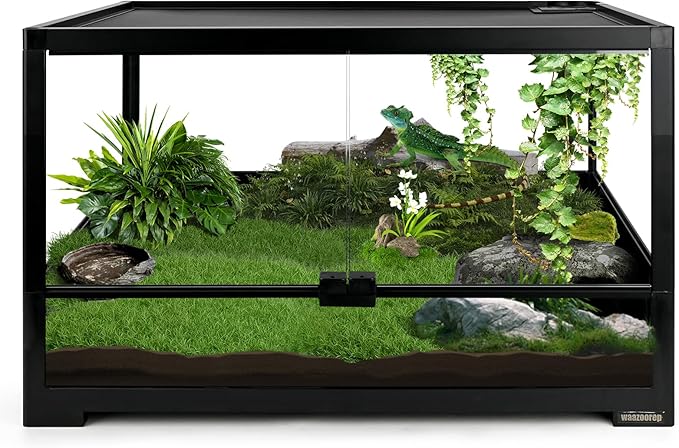
Humidity rides along with temperature. Ball pythons want 50 to 60 percent ambient humidity, bumping to 70 percent during shed. Chronic low humidity causes stuck sheds and respiratory stress, and a snake that feels rotten does not eat well. Measure it with a real hygrometer at substrate level, not the sticky dial that came glued to the enclosure.
Cause Number Three: Hides, or the Lack of Them
Ball pythons are ambush predators that spend most of their lives in termite mounds and burrows. In your living room, that instinct means they need at least two snug hides, one on the warm end and one on the cool end, and snug is the operative word. A hide is working when the snake touches the walls on multiple sides when curled up inside. Those big open reptile caves that look great on the shelf often fail this test, and a ball python sitting in the open all day, or hiding its face in a corner, is telling you it does not feel secure.
Insecurity kills appetite. If your snake is in a high-traffic room, a glass tank with three open sides, no visual barrier, kids tapping the glass, a cat staring in from the couch, you have built a stress factory. Cover the back and sides of the enclosure, switch to a front-opening vivarium if you can, and stop handling entirely during the fast. I mean entirely. Every handling session during a food strike sets you back days.
Cause Number Four: The Prey Is Wrong
Sometimes the snake is fine and the menu is the problem. Ball pythons develop opinions, and switching prey type can break a strike. If you have been offering rats and the snake was raised on mice, try mice again. If you feed frozen-thawed, make absolutely certain the prey is fully warmed to roughly 100 degrees, because a cold, soggy rodent reads as dead meat to a heat-pit-equipped predator, and ball pythons have spectacular heat-sensing pits that can tell. Warm the rodent in a bag under hot tap water or in a fridge-to-warm water bath, never in a microwave, and offer it with long feeding tongs. Wiggle it. Be patient. Some of my best feeds came fifteen motionless minutes into a standoff.
Size matters too. Prey should be roughly the same girth as the thickest part of the snake, about 10 to 15 percent of body weight. Oversized prey gets refused. And if live feeding is your only path, never leave a live rodent unattended with the snake; rodent bites cause horrific wounds, and I have seen photos from vet clinics that I cannot unsee. Frozen-thawed is safer for everyone, and if you want a reliable small freezer stock, a pack like frozen-thawed feeder mice from a reputable supplier keeps well and thaws consistently.
Cause Number Five: The Shed
A snake in the blue phase of a shed cycle, eyes clouded milky, skin going dull and gray, will almost never eat. This trips up new owners constantly because the signs are easy to miss in a dim evening enclosure. Check the eyes and belly scales before every feed. If your snake looks like it wandered into a fog, skip the attempt, wait for the shed to finish plus three or four days, and try again. In-shed refusals are so universal that they do not even count as a real strike.
Cause Number Six: Recent Change or a New Snake
A ball python that arrived last week and refused its first meal is not sick, it is adjusting. The standard protocol from essentially every experienced keeper: leave a new snake completely alone for one to two weeks, no handling, minimal opening of the enclosure, then offer one small meal. Refusal in the first month is common. A second month of refusal in a new hatchling warrants attention, but in a new adult it is often just more settling-in.
Relocations count as change too. A deep clean that rearranged every item, a move to a new enclosure, a new pet in the house, construction noise, even a different brand of substrate can trigger a sulk. If something changed and the snake stopped eating, the answer is to stop changing things. Pick a setup, leave it alone, and let the snake recalibrate.
Cause Number Seven: Parasites and Illness
Now the serious tier. According to the American Veterinary Medical Association, reptiles often mask illness until disease is advanced, which means by the time a snake looks visibly sick, you are late. This is why weight logs and body condition matter so much. Red flags that move a fast from normal to urgent include: weight loss past 15 to 20 percent, regurgitation after previous meals, open-mouth breathing, audible clicking or wheezing, stringy mucus in the mouth, swelling on one side of the body, lumps under the skin, prolonged straining, or a snake that cannot right itself. Any one of those means call a reptile vet this week, not next month.
Internal parasites are a classic hidden cause of anorexia, especially in wild-caught or imported animals, and a fecal exam costs a fraction of what advanced treatment does. If your snake came from a reptile expo with no history and will not eat, a fecal float and direct smear at an exotic vet is money well spent. Crypto, short for Cryptosporidium, is the nightmare diagnosis in ball pythons, presenting as chronic regurgitation and wasting, and it is one reason I strongly recommend buying captive-bred animals from breeders with health histories.
The Hatchling Question: When a Fast Is Urgent Sooner
Everything above assumes an adult or well-started juvenile. Hatchlings are different. A baby ball python that hatched at 60 to 80 grams has tiny reserves, and while even hatchlings can fast for six to eight weeks without catastrophe, a hatchling refusing food beyond about a month, or losing meaningful weight, needs intervention. Techniques for stubborn babies include braining a pinky (yes, it is exactly what it sounds like, and yes, it works), scenting with chick or lizard bedding, offering at night in complete darkness, and leaving the prey in a small confined container with the snake overnight. If none of that works in a few weeks, find a reptile vet, because assisted feeding exists but should never be a home project.
My Step-by-Step Plan for a Striking Snake
Here is the exact sequence I run when one of mine goes off food. Step one: verify temperatures and humidity with real instruments, surface hot spot 88 to 92, cool end 76 to 80, humidity 50 to 60 percent. Step two: confirm the snake is not in shed. Step three: cut handling to zero and cover exposed glass. Step four: check the calendar, if it is October through March in a healthy adult, I mostly just wait. Step five: adjust the offer, try a smaller prey item, a different species, feeding at dusk, or an overnight drop-feed in a paper bag. Step six: weigh every two weeks and write it down. Step seven: escalate to a reptile vet if weight drops past that 15 percent line, if any illness signs appear, or if a juvenile fasts past six weeks.
Do not fall for the desperate measures you will find on forums. Never force-feed at home, never assist-feed without veterinary instruction, and never dose random antibiotics bought online. Force-feeding a stressed snake risks broken teeth, regurgitation, and a worse spiral than the fast itself.
The Takeaway
A ball python refusing food is the reptile hobby's most common non-emergency wearing the costume of an emergency. Audit heat first, hides second, prey presentation third, and track weight the whole time so you have facts instead of dread. My seven-month faster lived another decade and a half, ate like a champ every spring, and taught me that patience is the most important tool on the shelf. Get the husbandry boring and consistent, and odds are overwhelming that one evening, when you have almost stopped expecting it, you will walk in and find a snake with a rat-shaped lump, looking entirely unbothered by the months of drama it put you through.
Related Reading
Want more on this topic? Check out our guides on bearded dragon brumation guide, best crested gecko tanks arboreal habitats for cresties, best reptile terrarium backgrounds 3d decor naturalistic vivarium.