Aquarium Air Pumps: A Complete Buying Guide
An aquarium air pump is one of the most underestimated pieces of equipment in fishkeeping. It drives oxygenation, powers sponge filters, and creates the water movement that keeps fish healthy. While some aquarists rely on filter output alone for surface agitation, an air pump adds redundancy and improves gas exchange, especially in warm-water tanks, heavily stocked tanks, or during medication treatments when dissolved oxygen levels naturally drop. According to the Merck Veterinary Manual section on exotic and laboratory animals, water quality parameters including dissolved oxygen are central to fish health, and inadequate aeration is a common contributing factor in home aquarium disease outbreaks.
This guide explains what air pumps actually do, which specifications matter, how to match a pump to a tank, and how to maintain one. It also looks at a small number of concrete examples available on Amazon so a reader can see current pricing and owner feedback before deciding. The goal is not to crown a single winner but to give a checklist a buyer can apply to any model.
What Air Pumps Actually Do
An air pump sits outside the water and pushes air through tubing to an airstone, sponge filter, or ornament. The bubbles themselves do not oxygenate water directly; the gas exchange happens at the surface where bubbles break and disturb the water. That surface disturbance increases the rate at which oxygen dissolves in and carbon dioxide escapes. A pump that moves a large volume of air to a deep tank therefore does more for oxygenation than a small pump with a short tube, even if both look busy.
A second job is circulation. Rising bubbles drag water upward, creating a gentle vertical current that prevents dead zones in corners and behind decorations. In tanks with low-flow filters, this circulation can be the difference between uniform temperature and water quality and pockets of stagnant, oxygen-poor water. A third job is powering air-driven biological filters, particularly sponge filters, which are widely used in quarantine tanks, breeding setups, and shrimp tanks because they are safe for fry and do not trap small animals.
A fourth function is emergency backup. If a main filter fails overnight, an air-driven sponge filter running on a separate pump can keep biological filtration and surface agitation going for days. Many experienced keepers treat an air pump as inexpensive insurance rather than an optional extra. The ASPCA pet care library at aspca.org/pet-care notes that appropriate housing and water conditions are foundational to fish welfare, and aeration is part of that foundation.
Key Factors When Buying an Air Pump
Output rating. Manufacturers rate air pumps in liters per minute (L/min) or gallons per hour (GPH) of air, not water. Output must overcome the back pressure created by water depth: a pump rated for a 10-gallon tank may deliver almost nothing at the bottom of a 24-inch-deep tank. As a rule, deeper tanks and longer tubing runs need higher-rated pumps. If a pump will drive two devices, the rated output should comfortably exceed the sum of what both devices need.
Noise. Air pumps vibrate, and vibration is the main source of noise. Cheaper models transmit vibration directly to whatever surface they sit on, which can amplify the hum through a cabinet or floor. Better models suspend the motor on rubber mounts or enclose it in a dampening housing. Published noise ratings, where available, usually fall between roughly 30 and 50 decibels; a 10-decibel difference is perceived as roughly twice as loud. Placing a pump on a foam pad and keeping it off hard surfaces reduces perceived noise substantially.
Adjustability. A manual flow dial or a gang valve lets the keeper throttle output. This matters for bettas, gouramis, and other labyrinth fish that come from still or slow-moving water, and for shrimp tanks where strong current is stressful. Many budget pumps run at full power only, so flow must be controlled with an inline valve, which is workable but less convenient.
Number of outlets. Single-outlet pumps suit one tank or one device. Dual-outlet pumps can run two sponge filters, or a sponge filter plus an airstone, from one unit. Multi-outlet commercial pumps with four to eight ports are intended for fish rooms and breeding racks, where one larger pump is more efficient than several small ones.
Wattage and running cost. Most hobby pumps draw between 2 and 10 watts; commercial units can draw 18 watts or more. Because a pump runs continuously, wattage matters over a year. A 4-watt pump running 24 hours a day uses roughly 35 kilowatt-hours per year, which is a small but real cost. A single 18-watt commercial pump replacing eight 4-watt pumps also saves electricity and outlet space.
Check valve compatibility. A check valve prevents water from siphoning back through the tubing into the pump if power fails or the pump is unplugged. Most pumps include one, but the valve must be installed above the water line to work. This is a safety item, not an accessory.
Serviceability. Diaphragms, the rubber parts that actually move air, wear out. A pump with widely available replacement diaphragms that cost a few dollars can be rebuilt rather than replaced. Before buying, it is worth checking whether the manufacturer sells replacement parts and how easy they are to find.
Representative Air Pumps and What They Suit
aquarium air pumps
The pumps below are examples that illustrate different points on the price, output, and noise spectrum. Specifications come from manufacturer listings and published owner reports; they are not the result of hands-on testing by this publication. Prices fluctuate, so check current listings before buying.
Tetra Whisper AP150
The Tetra Whisper line has been a default recommendation for years because it balances output, noise, and price. The AP150 is rated for tanks up to roughly 150 gallons and uses a suspended motor and dome-shaped housing intended to reduce vibration. Replacement diaphragms are inexpensive and widely stocked, which extends service life well beyond the warranty. Its main trade-off is that it runs at full output with no dial, so flow must be controlled with a gang valve or clamp. It suits a general community tank where quiet operation matters but precise flow control does not. You can check the current price on Amazon.
Hygger Quiet Air Pump
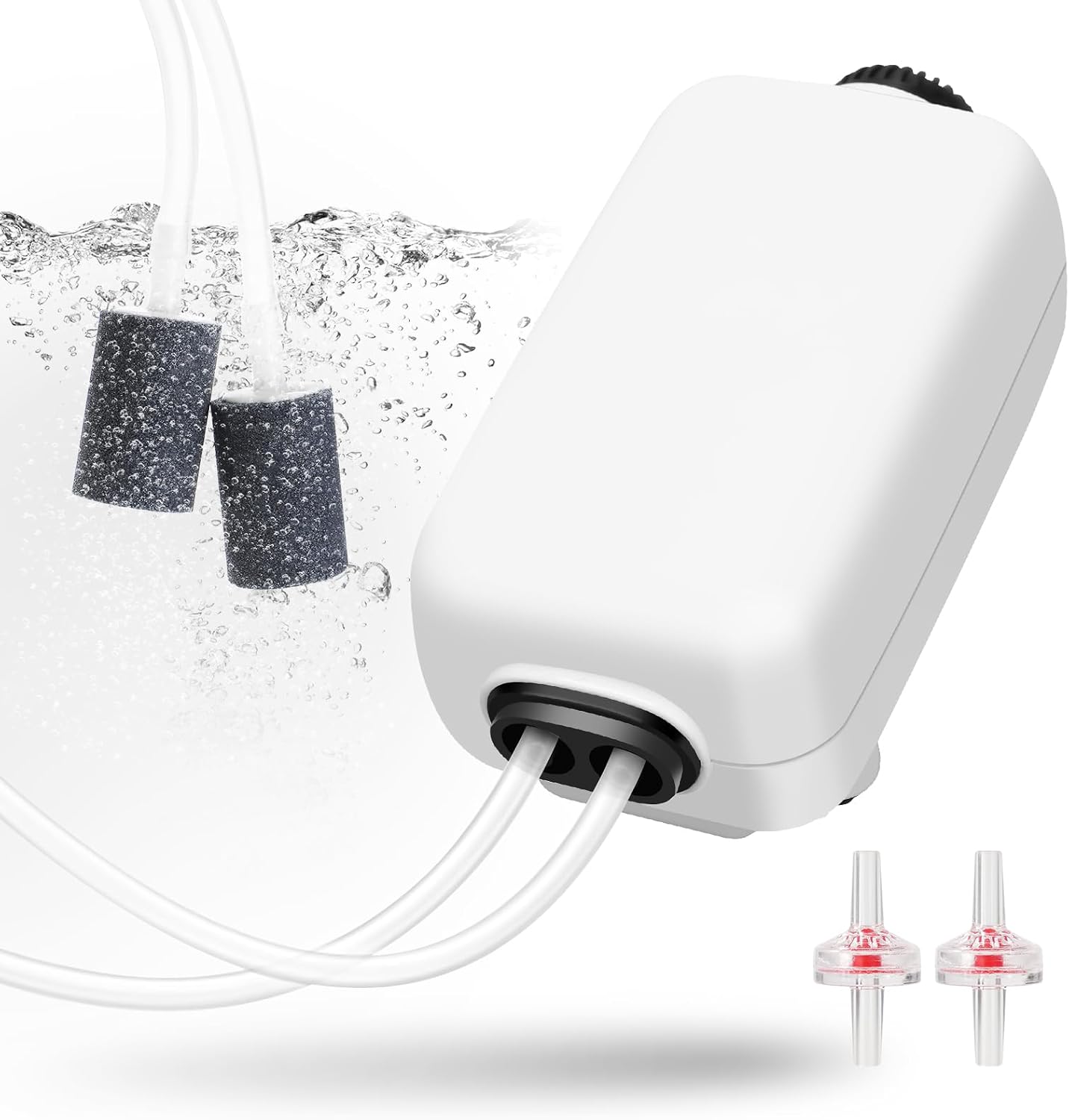
The Hygger unit is notable for including a manual flow dial at a budget price, a feature that is uncommon in this tier. A dual-outlet version can run two sponge filters or a sponge filter and an airstone at the same time, and the rubberized housing is intended to absorb vibration. Owner reports describe the dial as somewhat loose, so it can be bumped out of position, and the pump is louder than premium models at maximum output. It suits shrimp tanks, betta tanks, and any setup where adjustable flow is more important than absolute silence. To see the current listing, view this option on Amazon.
Eheim Air Pump 400
Eheim is known for quiet canister filters, and its air pumps use a double-silencing chamber intended to make them among the quietest hobby pumps available. Published noise figures for comparable Eheim models are often cited around 35 decibels, which is quiet enough for a bedroom or office. The trade-offs are price and output: the pump costs more than similarly rated competitors and delivers less air at the top end. It suits keepers who prioritize silence and are willing to pay for it. Check the current price on Amazon.
AquaMiracle Commercial Air Pump
An 18-watt commercial pump with eight outlets is designed for fish rooms, breeding racks, and retail setups where one central pump serves many tanks. An aluminum alloy casing is more durable than plastic, and a pressure gauge helps confirm the pump is working. The trade-offs are noise, which is typically higher than nano pumps, and the need for a dedicated shelf or mounting board. Manifold valves for fine-tuning individual lines are usually sold separately. It suits multi-tank hobbyists rather than single-tank owners. View this option on Amazon.
USB Nano Air Pump
A USB nano pump runs from any USB power source, including a power bank, which makes it useful during power outages, for fish transport, and for temporary quarantine tanks. Output is low, so it is not a permanent solution for tanks over about 10 gallons. USB cable quality varies between brands, and there is no adjustability. Its value is as a backup rather than a primary pump; many keepers keep one charged and ready. It is not linked to a specific listing here because the category includes many near-identical models.
Mylivell Quiet Air Pump
At under $10, the Mylivell pump is an entry-level single-outlet unit suitable for a child's first tank or a temporary hospital tank. It is louder than mid-range pumps, has no flow control, and the diaphragm may need replacement within about a year of continuous use. It is a reasonable choice when the priority is minimum cost and the setup is temporary. It is not linked to a specific listing here for the same reason as the USB pump.
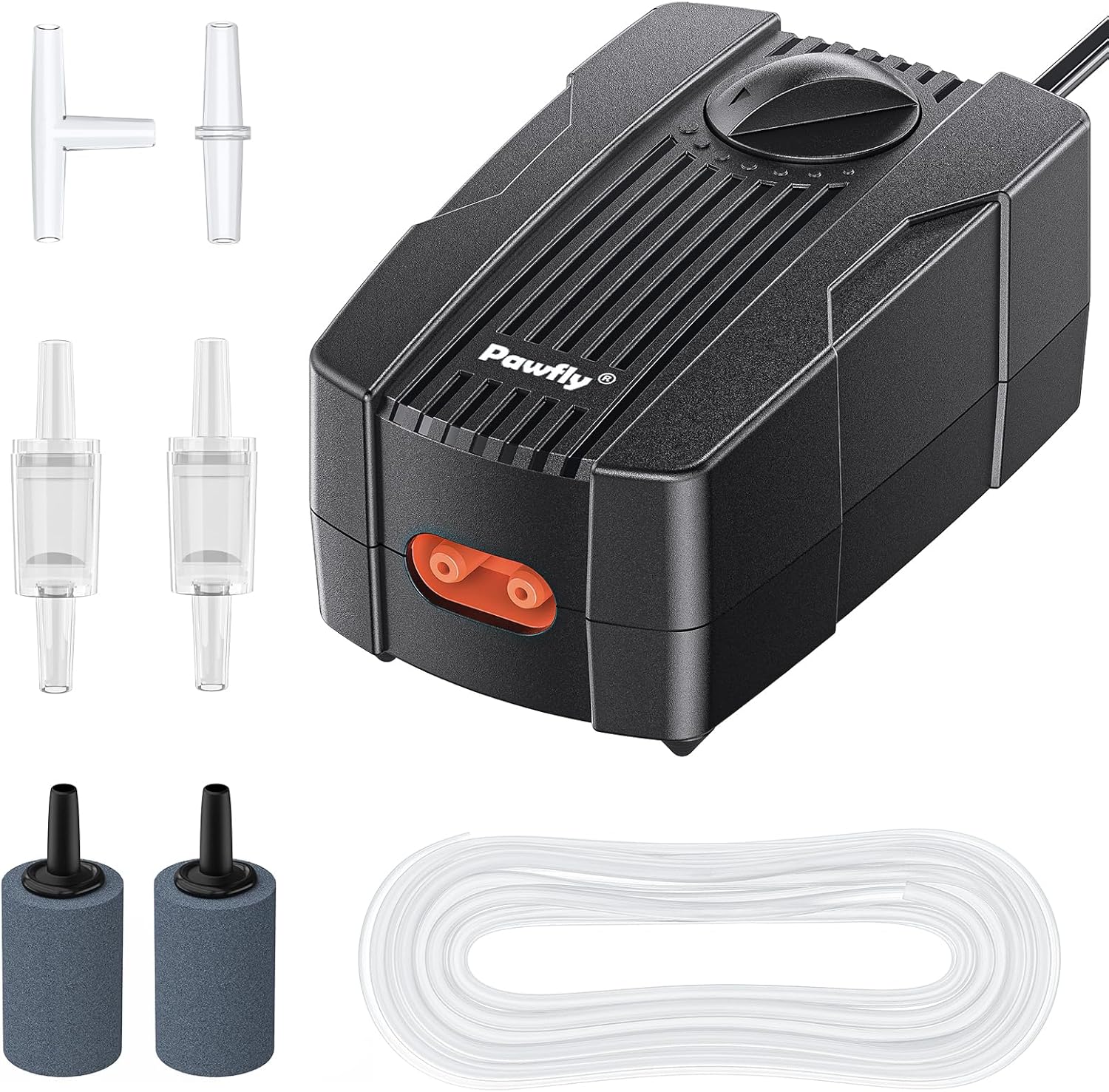
Pawfly Commercial Air Pump Kit
The Pawfly kit bundles a multi-outlet pump with airline tubing, check valves, airstones, and suction cups, which simplifies buying for someone running two to four tanks. Output is generally adequate for that scale, and the kit format is convenient. The included check valves and thin-walled tubing are basic, and many owners replace them with better components. It suits multi-tank hobbyists on a budget. It is not linked to a specific listing here.
Comparison Table
| Pump type | Typical price | Outlets | Noise | Adjustable | Suits |
|---|---|---|---|---|---|
| Tetra Whisper AP150 | $20-$35 | 1-2 | Low | No | General community tanks |
| Hygger Quiet | $15-$25 | 2 | Low-Med | Yes | Shrimp and betta tanks |
| Eheim Air Pump 400 | $40-$65 | 1-2 | Very low | No | Bedrooms and offices |
| AquaMiracle Commercial | $45-$75 | 8 | Medium | Manifold | Fish rooms and breeders |
| USB Nano | $8-$12 | 1 | Low | No | Backup and transport |
| Mylivell Quiet | $8-$10 | 1 | Medium | No | Budget and temporary |
| Pawfly Commercial Kit | $30-$50 | 4 | Medium | No | Multi-tank value |
Do You Really Need an Air Pump?
aquarium air pumps
An air pump is strongly indicated when a sponge filter is the primary biological filter, because sponge filters are air-driven. It is also indicated in heavily stocked tanks, where oxygen demand is high; in tanks above 80 degrees Fahrenheit, where warm water holds less dissolved oxygen; during medication treatments, since many medications reduce oxygen levels; and for fish from fast-flowing rivers, such as hillstream loaches and many danios, which are adapted to well-oxygenated water. A pump is also useful whenever surface agitation from the main filter is weak.
An air pump may be unnecessary when a hang-on-back or canister filter already produces strong surface agitation, when the tank is lightly stocked with hardy fish such as a single betta in a 10-gallon, or when a powerhead or wavemaker provides good circulation. Even in those cases, many keepers keep a small pump on hand as backup. The decision is less about whether a pump is mandatory and more about whether the tank has a reliable, redundant source of surface agitation.
Air Pump Setup and Safety
Install a check valve above the water line on every air line. Without one, a power failure can allow water to siphon back through the tubing into the pump, which can damage the pump and, in a worst case, create a slow leak. Place the pump above the tank if possible; if it must sit below, the check valve becomes essential rather than optional. Use a gang valve to split one outlet to multiple airstones or devices, and adjust each line individually.
Keep the pump intake clear. Most pumps draw air through a small filter on the bottom or side, and dust accumulation reduces output and strains the motor. Vacuuming or rinsing that filter quarterly is usually enough. Mount the pump on foam or felt to absorb vibration and reduce hum transmitted through furniture. Replace air stones when they become clogged or discolored, since a clogged stone increases back pressure and reduces the pump's effective output.
Replace diaphragms when output drops or noise increases, typically every one to two years of continuous use. Diaphragms cost a few dollars for most brands and are a straightforward replacement. Running a pump 24 hours a day is normal and intended; most units draw only a few watts. For tanks with CO2 injection and heavy planting, running an airstone on a timer at night is a common practice, because plants consume oxygen after lights-out while continuing to produce it during the day.
Common Mistakes to Avoid
A frequent mistake is buying a pump by tank volume alone without considering depth. A pump rated for a given gallon capacity may underperform at the bottom of a tall tank because back pressure rises with depth. Another is skipping the check valve, which risks water damage and pump failure. A third is oversizing flow for bettas and other slow-water fish, which can cause stress; an adjustable pump or a gang valve solves this.
Buying the cheapest pump for a permanent display tank often backfires, because noisy operation and short diaphragm life lead to replacement within a year. Conversely, buying a large commercial pump for a single nano tank wastes money and adds noise. Matching the pump to the number of devices, the depth of the tank, and the noise tolerance of the room is the key decision. Finally, neglecting maintenance, such as clogged airstones and dusty intakes, reduces performance long before the pump actually fails.
Frequently Asked Questions
Is an air pump necessary for a planted tank? Heavily planted tanks with CO2 injection benefit from nighttime aeration. Plants produce oxygen during the day but consume it at night, competing with fish. An airstone on a timer after lights-out addresses this without stripping CO2 during the photoperiod.
Can too many bubbles stress fish? Yes. Bettas, gouramis, and long-finned fish generally dislike strong current. Use an adjustable pump or gang valve to reduce flow to a gentle stream of fine bubbles rather than turbulent water.
Why is my air pump suddenly loud? The diaphragm is likely wearing out. Replacement diaphragms are inexpensive and restore quiet operation and output for most brands.
Can I run an air pump 24/7? Yes. Air pumps are designed for continuous operation, and most draw only a few watts. Expect to replace the diaphragm every one to two years.
How do I size a pump for multiple tanks? Add the output requirements of each device, account for depth, and choose a pump rated above that total. A multi-outlet commercial pump is usually more efficient than several small pumps for four or more tanks.
Where to Buy
As an Amazon Associate, PawCritic earns from qualifying purchases. This does not affect our reviews or recommendations. This article does not report hands-on testing; specifications and owner impressions come from manufacturer listings and published owner reports.
Affiliate Disclosure: PawCritic.com participates in the Amazon Services LLC Associates Program. We may earn commissions from qualifying purchases at no extra cost to you.