Why Aquarium Lighting Matters
An aquarium light does far more than make fish visible. It supplies the energy that drives photosynthesis in live plants, shapes how colors render inside the tank, and sets the day/night rhythm that regulates feeding, rest, and spawning behavior. Getting lighting wrong is one of the most common causes of chronic aquarium problems: green water, stubborn algae films, pale or perpetually hiding fish, and plants that melt or stagnate no matter how much fertilizer you dose.
It helps to think of light as the engine of the tank's ecosystem. Tropical fish and aquatic plants evolved under roughly ten to twelve hours of daylight, filtered through water depth and forest canopy. Recreating even a rough version of that rhythm in a home aquarium supports hormonal cues that govern activity and breeding. Fish kept on a consistent, appropriately bright cycle tend to show better coloration and more natural behavior than fish kept under whatever room lighting happens to be on. The widely cited planted-aquarium literature, including Diana Walstad's reference work on planted tank ecology, treats light as the single most controllable variable in planted aquarium success — often more consequential than fertilizers or substrate. If plants are yellowing, water is turning green, or fish hide all day, lighting should be the first variable you audit, because it is usually the cheapest and fastest to correct. For species-specific husbandry background, the Merck Veterinary Manual's exotic and laboratory animals section is a useful starting reference.
What to Look for in an Aquarium Light
PAR rating. PAR, or Photosynthetically Active Radiation, describes light in the 400-700nm band that plants can actually use for photosynthesis. This is the number that matters most for planted tanks, and it is why wattage and lumens are poor guides — a fixture can look bright to human eyes while delivering almost no usable energy to plants. As general published benchmarks: shade-tolerant plants like Anubias, Java Fern, and Cryptocoryne do well at roughly 20-30 PAR at the substrate; stem plants like Rotala and Ludwigia generally want 40-60 PAR; carpeting species such as Dwarf Baby Tears and Monte Carlo typically demand 50 or more. PAR also falls off sharply with water depth — a fixture producing 80 PAR at the surface may deliver only about 35 at the bottom of a 24-inch-tall tank, so always think in terms of PAR at the substrate, not at the lamp.
Kelvin rating. Color temperature describes the visual warmth or coolness of the light. Around 6500K approximates neutral midday sun and renders both plant greens and fish reds accurately, which is why most freshwater fixtures cluster in the 6500K-7000K range. Below about 4000K the tank looks yellow and dingy; far above 10000K it looks cold and blue. Marine reef aquarists often run 14000K-20000K because corals host photosynthetic zooxanthellae tuned to blue wavelengths, but for freshwater these very blue spectrums are usually an aesthetic choice rather than a biological one.
Spectrum. Plants rely most heavily on red (around 660nm) and blue (around 450nm) wavelengths, which correspond to the absorption peaks of chlorophyll a and b. Green LEDs contribute little to photosynthesis but noticeably improve how fish and plants look to human eyes, which is why many fixtures include them. Full-spectrum and RGB-capable fixtures let you tune this balance: more red for plant growth and richer fish coloration, more white for a natural look.
Programmability. Sudden on/off switching reads to fish as an abrupt predatory dusk and can trigger panic darting and jumping injuries, particularly in shy species like discus and apistogramma. A 15-30 minute ramp period mimics dawn and dusk and noticeably calms nervous fish. Timers, dimming, and programmable day cycles also protect the tank from the most common human error: forgetting to turn the light off and accidentally running 18-hour days that fuel algae.
Mounting and fit. Measure your tank rim-to-rim before ordering anything. A fixture advertised for a 36-inch tank may have legs that only stretch to 34 inches, and vice versa. Rimless tanks need either hanging kits or clamp-style arms; rimmed tanks need extendable legs that clear the trim. Check that the fixture is rated for its mounting position — many LED fixtures are water-resistant but not waterproof and must sit above the rim, not under a glass lid where condensation collects.
aquarium lights
Aquarium Light Options Worth Comparing
Below are three lighting options drawn from commonly recommended categories, each linked for current pricing. Note that PawCritic does not perform hands-on product testing; the descriptions below are based on manufacturer specifications, published hobbyist guidance, and aggregated owner feedback, so treat exact numbers as approximate and verify current specs before buying.
1. Full-Spectrum Planted Tank LED (App-Controlled)
This link represents the app-controlled, full-spectrum planted-aquarium category — fixtures with Bluetooth programming, adjustable color channels, and automated sunrise/sunset/moonlight cycles. This class of light suits serious planted tanks where you want to tune red channels for plant growth, start new tanks at low intensity and ramp up over weeks, and run a hands-off 24-hour photoperiod program. Owner reports generally describe strong plant growth support and good color rendering once dialed in. The trade-offs are price — this category typically costs several times a basic LED strip — and dependence on a companion app that some owners report as occasionally finicky after firmware updates. It suits aquarists running CO2 or demanding carpeting plants; it is overkill for a fish-only tank.
2. Compact High-Output Nano Light
This link points to a compact lighting option suited to small tanks — the puck and gooseneck style of fixture used on rimless nano cubes and desktop aquaria of roughly three to ten gallons. These small high-output fixtures often deliver more light than a nano strictly needs, which is a feature rather than a flaw: running at reduced intensity generates less heat and leaves headroom for demanding carpet plants. They suit aquascapers and shrimp-keepers who want precise control in a small footprint. The honest limitation is coverage — a single compact fixture typically illuminates only about an 18-by-18-inch area, so larger tanks need multiple units, and cost per square inch of coverage is high compared with strip lights.
3. Budget Full-Spectrum LED with Automatic Day Cycle
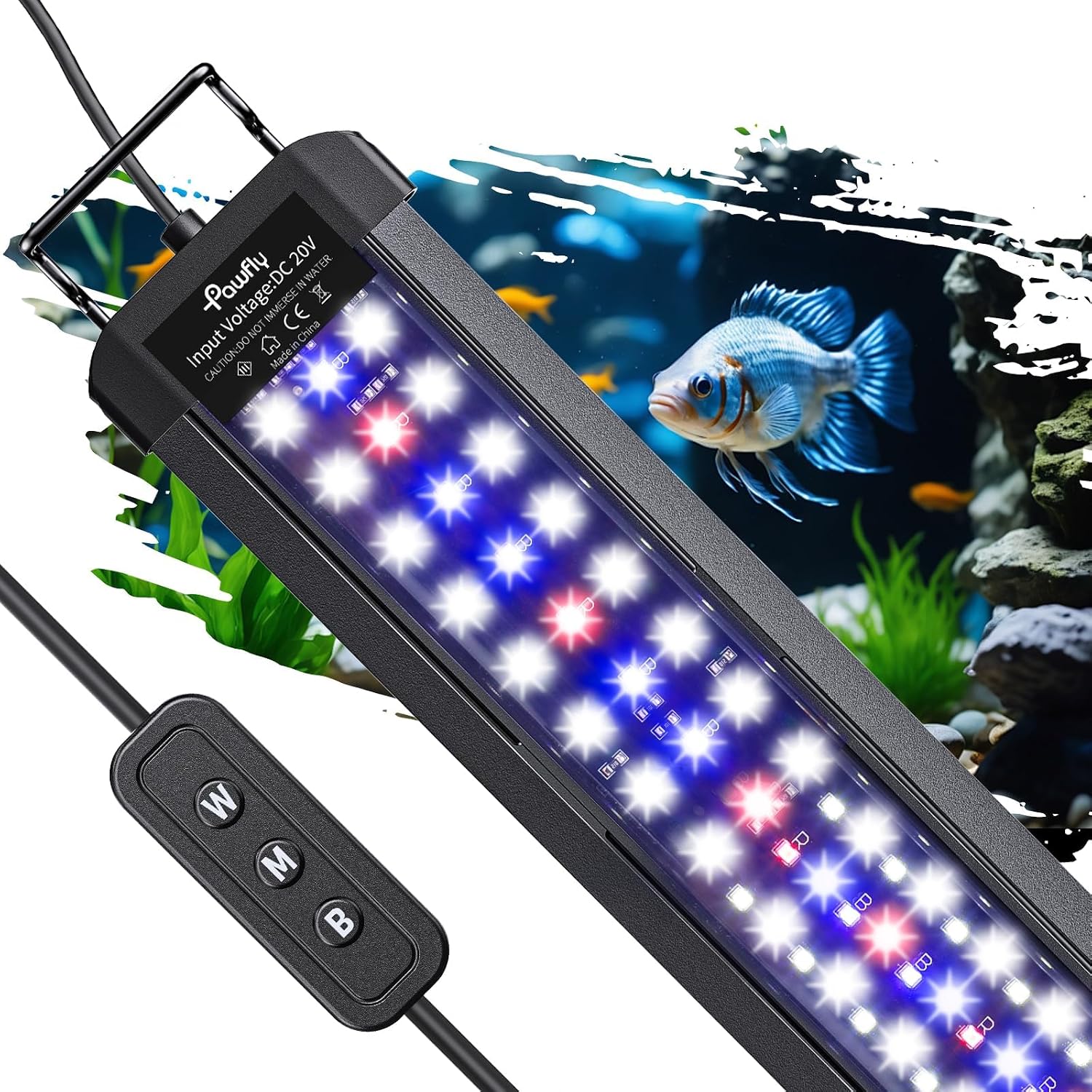
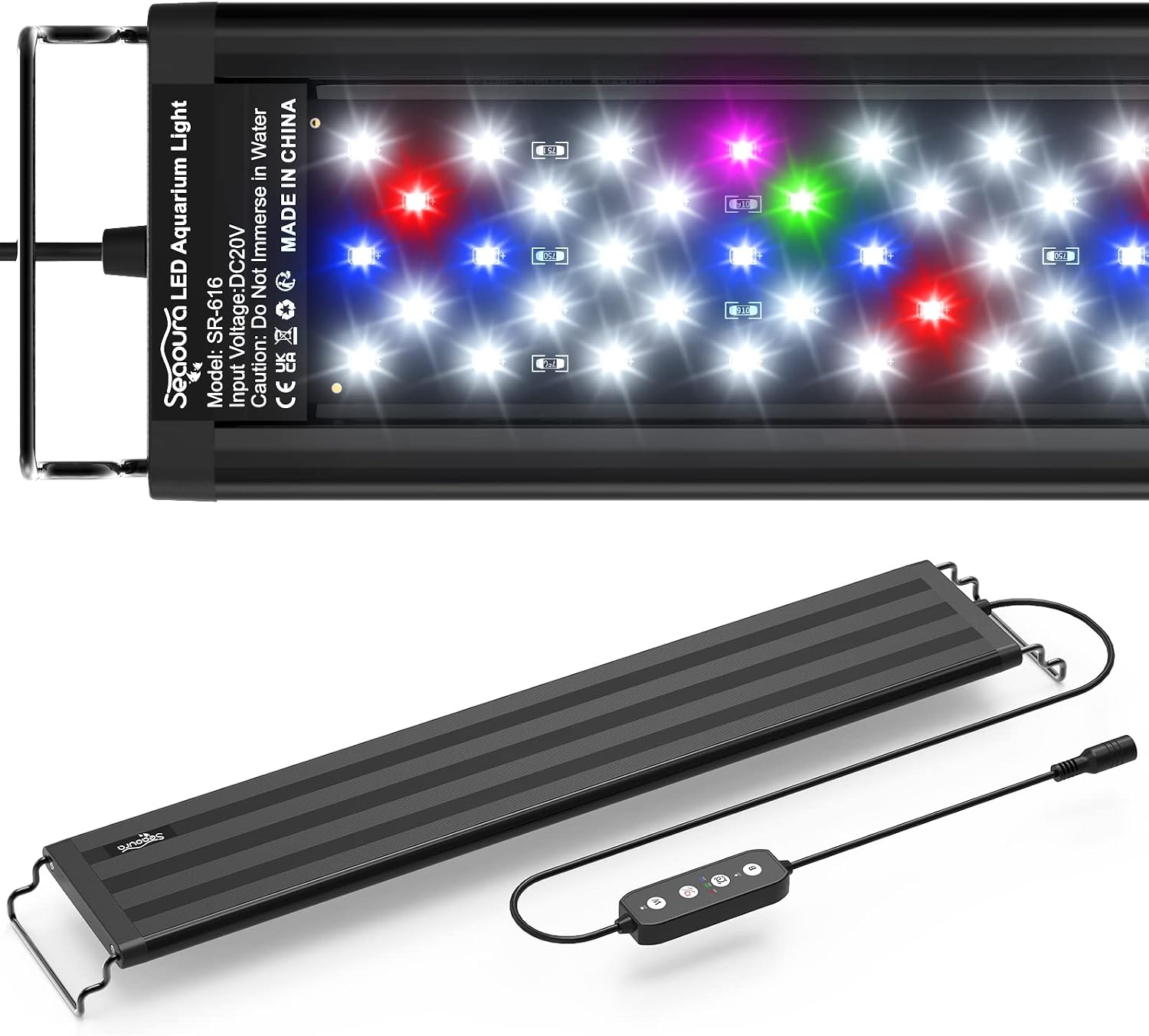
This link represents the budget-to-midrange full-spectrum category: strip-style fixtures with built-in timers, dimming, and a pre-programmed automatic day cycle that runs a soft sunrise, full midday brightness, a sunset fade, and a low blue night mode. Long-term owners generally describe these lights as a strong value for community tanks with easy-to-medium plants such as Cryptocoryne, Vallisneria, sword plants, and bacopa. The trade-offs are straightforward: build quality and light precision are not premium-tier, scheduling options can be rigid, and the blue channel tends to run strong — several owners recommend using manual mode at reduced intensity for the first month on tanks prone to algae. For a first planted tank, though, this category delivers most of the function of expensive fixtures at a fraction of the price.
Comparison Summary
| Category | Typical Price | Light Output | App/Timer | Best For |
|---|---|---|---|---|
| App-controlled full-spectrum planted LED | $100-$200 | High | App | Planted tanks, demanding plants |
| Compact high-output nano light | $80-$120 | Very high for size | App or Wi-Fi | Nano tanks, rimless cubes |
| Budget full-spectrum with day cycle | $35-$55 | Low-medium | Timer | Beginners, community tanks |
How Long Should Aquarium Lights Be On?
The general rule published across hobbyist and extension guidance is 8-10 hours per day for planted freshwater tanks, with fish-only tanks doing fine at 6-8 hours. Running much beyond 10 hours reliably invites algae. Consistency matters more than exact length: algae reproduce far faster than higher plants, and an erratic on/off schedule gives algae repeated windows where light is abundant but plant uptake lags behind. An inexpensive outlet timer, or the scheduling built into app-controlled fixtures, eliminates the problem entirely. If algae appear despite a fixed schedule, reduce intensity before cutting hours below six — plants need a minimum daily light dose, and starving them while algae persist makes the imbalance worse.
Ambient sunlight is the most commonly overlooked factor. Even two hours of direct afternoon sun on a tank can add the equivalent of a full day of LED output, overwhelming any fixture's carefully tuned schedule. Reposition tanks away from windows or close blinds during peak hours. For broader water-quality context, the UF/IFAS Extension EDIS aquaculture and fish health library publishes accessible guidance on algae dynamics and pond and tank management.
By Tank Type
- Fish-only tank: 6-8 hours; without plants there is no reason to push longer.
- Low-tech planted: around 8 hours suits easy plants like Anubias and Java Fern.
- High-tech planted with CO2: 8-10 hours; some aquarists split this with a midday 2-hour siesta if algae appear.
- Reef tank: 10-12 hours, since corals and their symbiotic algae need more total light energy.
- Newly set-up tank: start at 6 hours and increase by about 30 minutes weekly as plants establish and begin outcompeting algae.
Sizing a Light to Your Tank
Fixture sizing has two dimensions: length and depth. Length is simple — match the fixture's rated tank length to your tank's rim-to-rim measurement, allowing for leg extension. Depth is where most mistakes happen, because PAR falls with distance through water. On a standard 20-gallon tall tank, a midrange fixture that comfortably grows stem plants may only manage shade plants on a 24-inch-deep 65-gallon. Tall tanks often need higher-output fixtures or mounting adjustments to deliver adequate light to the substrate. Very shallow rimless tanks have the opposite problem: even modest fixtures can deliver too much light, encouraging algae, so dimming capability becomes valuable. Nano tanks under five gallons can be lit adequately by almost any purpose-built nano fixture, which is why spending heavily there is a choice about control and aesthetics rather than necessity.
Safety and Maintenance
Electrical safety around water deserves more attention than it usually gets. Use fixtures rated for aquarium use, keep power adapters and connectors above the water line and away from splashing zones, and route cords with a drip loop so water running down a cord cannot reach an outlet. Glass tops or mounting brackets keep fixtures safely above the water; a fixture that falls in because of cheap suction-cup mounts is a real electrocution and equipment-failure risk. Never handle fixtures or cords with wet hands. On maintenance: LED fixtures largely take care of themselves, but a monthly wipe of the lens or cover glass removes dust and salt or mineral film that can silently cut output by a surprising margin. Check legs, clamps, and hanging hardware occasionally for cracking, especially on acrylic legs that flex during cleaning. Replace any fixture with visible corrosion on connectors or a frayed cord — the cost of a new light is trivial next to a tank full of livestock on a wet floor.
Common Mistakes to Avoid
The first and most common mistake is upgrading light before balancing nutrients and CO2. Strong light turns a stable low-tech tank into an algae farm because plants cannot use the extra energy without corresponding fertilizer and carbon; matched, moderate lighting is easier to manage than maximum lighting. The second is chasing wattage or lumen numbers on the box, which say little about the spectrum plants use — PAR and spectrum matter, brightness to your eye does not. The third is running lights for long hours 'because the tank looks nice in the evening,' which quietly adds hours to the photoperiod; use a timer so the schedule does not depend on memory. The fourth is ignoring ambient sunlight, covered above. The fifth is sudden schedule changes — moving a tank abruptly from 12 hours to 6 shocks plants and often triggers a melt or algae spike; change photoperiod by 30-60 minutes per week instead. Finally, buying a fixture that does not fit: measure rim-to-rim, check leg extension, and confirm rimless-versus-rimmed compatibility before ordering anything.
Frequently Asked Questions
Do I need a light for a fish-only tank?
Not technically — fish can find food under room lighting. But a dedicated fixture brings out color and establishes a reliable day/night rhythm, whereas room light leaves fish on whatever schedule the household happens to keep. A modestly priced basic LED and a timer is one of the cheapest quality-of-life upgrades in the hobby.
Why is my water turning green?
Green water is suspended single-celled algae, and it almost always indicates too much light, too long a photoperiod, or unmanaged direct sunlight, combined with available nutrients. Reduce lighting to 6-8 hours on a strict timer, check whether afternoon sun hits the tank, and add fast-growing live plants to compete for nutrients. A blackout of two to three days can clear an established bloom, but the underlying light schedule still needs fixing or it will return.
Can I use a regular household LED bulb?
You can illuminate a tank that way, but the spectrum and optics are wrong for aquarium use. Household bulbs are designed for wide room illumination, not penetration through water, and their spectrum is tuned for human comfort rather than plant photosynthesis. Plants will struggle and colors will look washed out. Purpose-built aquarium fixtures cost more but deliver the right spectrum, moisture-appropriate construction, and mounting hardware that actually fits tanks. General companion-animal care principles are covered in the ASPCA pet care library, which is worth a read alongside species-specific aquarium references.
Wrapping Up
aquarium lights
Match the light to the tank rather than to a budget alone. For a serious planted aquarium with CO2 and demanding species, the app-controlled full-spectrum planted LED category is the sound investment — check its current price on Amazon and verify the size matches your tank. For nano and rimless setups, a compact high-output fixture gives room to grow. For a first community tank with easy plants, the budget full-spectrum automatic-cycle category covers the essentials without overspending. Whichever route you take, put the fixture on a timer, hold the photoperiod at or under about 10 hours, keep the fixture clean, and adjust intensity before adjusting hours when algae appear.
Affiliate Disclosure: PawCritic.com participates in the Amazon Services LLC Associates Program. We may earn commissions from qualifying purchases at no extra cost to you.