Why Water Testing Matters
Water quality is the single most important factor in aquarium keeping, and it is also the one factor your fish cannot communicate to you directly. Fish excrete ammonia continuously through their gills and in their waste, and as uneaten food and organic debris decompose, that waste load grows. In a river or lake, toxins are diluted across thousands of gallons; in a home aquarium, the same fish may live in 10, 20, or 55 gallons — a closed system where a single overfeeding, a dead fish hidden behind a decoration, or a filter that stopped running for six hours can push ammonia to dangerous levels in a tank that read clean the day before. Guidance on fish health, such as the Merck Veterinary Manual's reference material on aquarium and laboratory animals, consistently identifies poor water quality as a primary driver of disease and mortality in captive fish.
The biology behind this lag is well documented. The nitrifying bacteria that convert toxic ammonia into less harmful compounds — genera such as Nitrosomonas and Nitrobacter — take days to weeks to multiply in response to an increased waste load. That means there is always a delay between a problem starting and your biological filtration catching up, and the only way to see that gap is to test. Published figures put ammonia stress thresholds for most freshwater fish at remarkably low concentrations — free ammonia becomes stressful at levels around 0.02 ppm and potentially lethal between roughly 0.2 and 0.5 ppm depending on species, pH, and temperature. Those concentrations are invisible, odorless, and undetectable by human senses. Meanwhile, hobbyist literature attributes a large share of first-month fish losses to so-called new tank syndrome: ammonia and nitrite poisoning that a modest investment in a test kit would have caught in time.
The Nitrogen Cycle Explained
The nitrogen cycle is the engine that keeps an aquarium livable. Beneficial bacteria colonize filter media and substrate, converting toxic ammonia into progressively less harmful compounds through a process called nitrification. This process typically takes four to eight weeks to fully establish in a new tank, which is why the first two months are the most hazardous period for fish.
- Ammonia (NH3/NH4+): produced by fish waste and decomposing food. In an established tank it should read 0 ppm. At pH 7.0 and typical tropical temperatures, most ammonia exists as the less toxic ammonium ion, but as pH climbs above 8.0 the balance shifts sharply toward toxic free ammonia — a constant concern for saltwater keepers.
- Nitrite (NO2-): the first product of bacterial processing. It also must read 0 ppm. Nitrite binds to hemoglobin in fish blood, causing what is known as brown blood disease — the fish effectively suffocates despite adequate oxygen in the water.
- Nitrate (NO3-): the end product of nitrification. Generally considered acceptable below 40 ppm and ideally below 20 ppm. Plants consume it, and unlike ammonia and nitrite it does not break down further on its own — only water changes, plant uptake, or special resins remove it.
Without testing, you will not know ammonia is building until symptoms appear, and by then it is often late. Early warning signs include gasping at the surface, red or inflamed gills, lethargy, appetite loss, and fish sitting on the bottom with clamped fins. The catch is that these same symptoms appear in many other conditions, so without a test result you are guessing. Experienced aquarists follow one rule: test first, treat second. For beginners, the most reliable start is fishless cycling — adding a controlled ammonia source to an empty tank and testing every day or two until both ammonia and nitrite read 0 ppm across several consecutive readings before any fish are introduced.
Types of Test Kits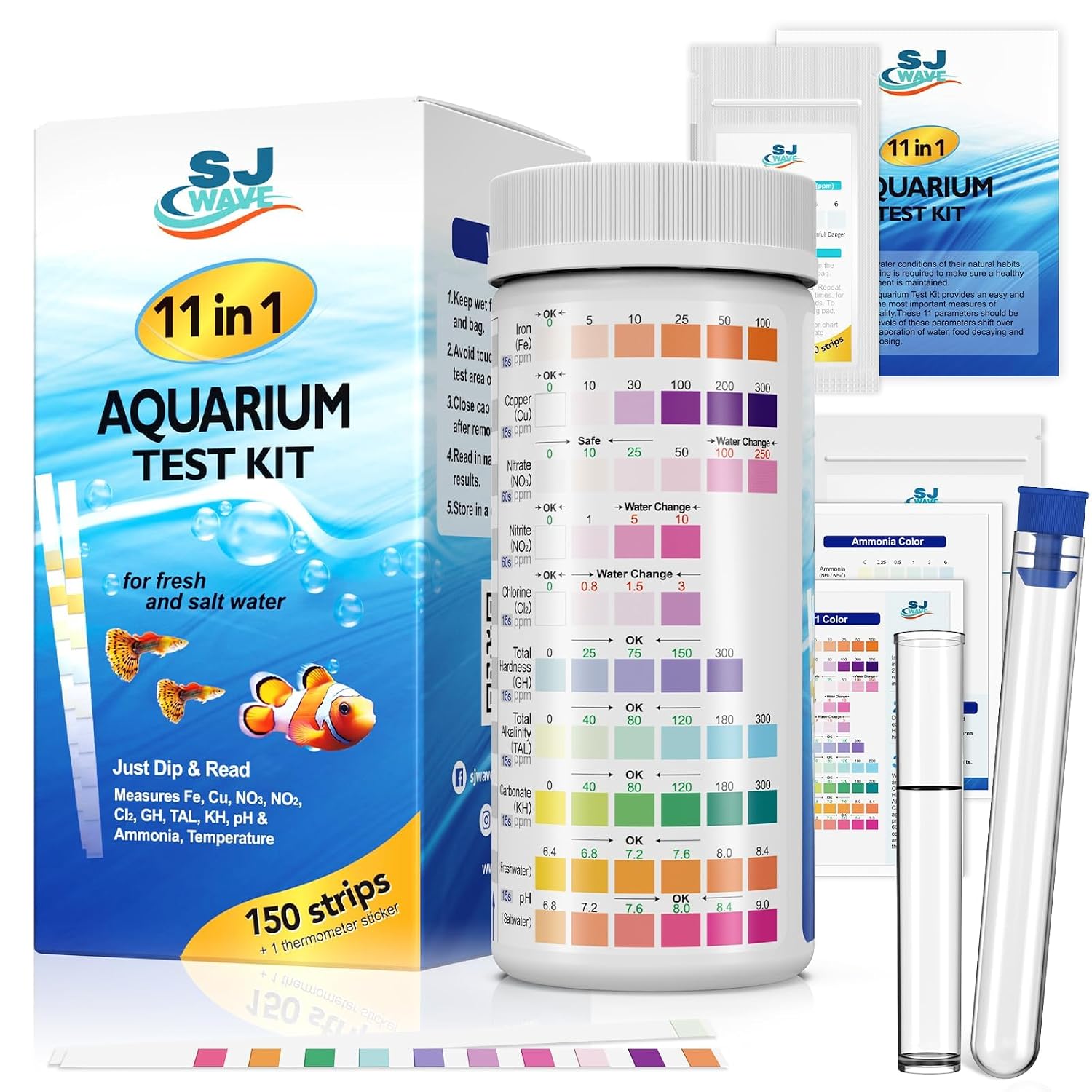
aquarium water test kits
aquarium water test kits
Liquid Reagent Tests
Liquid kits work by adding drops of reagent to a measured water sample, shaking, and comparing the resulting color to a printed chart. Manufacturer specifications for popular hobbyist kits indicate resolution down to roughly 0.25 ppm for ammonia and 5 ppm increments for nitrate, which is precise enough to guide dosing and water change decisions. They are the standard tool for cycling a new tank and for diagnosing problems.
Technique matters more than most beginners realize, and the instructions packed with liquid kits spell out why. Rinse the test vial with tank water, never tap water. Fill to the marked line exactly, because an under-filled vial concentrates the reagent and skews the color darker. Add the specified number of drops while holding the bottle vertically, since angled drops are smaller than full drops and the ammonia test is particularly sensitive to reagent volume. Cap and shake for the full instructed time, then hold the vial against a white background beside the chart in daylight-spectrum light. Rushing any step is the fastest route to a wrong number and a bad decision based on it.
Test Strips
Strips are dipped in water and read against color pads in about 30 seconds. They are quick and inexpensive but less precise: strips generally read in coarse bands, for example nitrate pads for 0, 10, 25, 50, and 100 ppm, meaning a true reading of 18 ppm could plausibly be read as either 10 or 25. For a mature, stable tank that granularity is usually acceptable; for a new tank where you need to distinguish 0.25 ppm from 1.0 ppm of ammonia, it is not. Note also that many multi-parameter strips do not include ammonia at all, which is the one parameter beginners most need.
Storage is the hidden variable with strips. The pads absorb moisture from the air and degrade within months of opening. Keep the desiccant pack in the tub, close the lid immediately after each use, and store the container somewhere dry — never next to the aquarium where ambient humidity is high.
Digital Meters
Electronic probes measure pH, TDS, or temperature with a numeric readout. A quality pH meter resolves to 0.01 pH units versus roughly 0.2 to 0.4 units with liquid color charts, which matters for sensitive species such as discus or for reef keeping where stability is everything. The trade-off is maintenance: pH meters need calibration every few weeks with standard buffer solutions, and the probe tip must stay wet in storage solution, because letting it dry out ruins the sensor. TDS meters are more forgiving and typically need only occasional calibration with a 342 ppm or 500 ppm standard. Budget for calibration fluids as an ongoing cost — an uncalibrated meter gives false confidence, which is arguably worse than no meter at all.
What to Look For When Buyingaquarium water test kits
aquarium water test kits
Rather than chasing a long list of products, evaluate any test kit against a handful of concrete criteria. First, parameter coverage: at minimum you need ammonia, nitrite, nitrate, and pH. Ammonia is non-negotiable because it is the most acutely toxic parameter and the one most likely to spike without warning. Kits that omit it should be treated as supplements, not as your primary kit. Second, resolution: check the stated increments on the chart. A kit that reads ammonia in 0.25 ppm steps can guide a cycling schedule; one that only distinguishes 'safe' from 'danger' cannot. Third, cost per test: liquid kits look expensive up front but typically supply hundreds of tests, working out to pennies each, while strips look cheap but cost more per reading at frequent testing schedules. Fourth, reagent shelf life: reagents degrade over one to two years, so a large kit only makes sense if you will actually use it before it expires. Fifth, readability: color charts printed on the box with clear daylight-balanced colors and a viewing window make a real difference in how consistently two people read the same vial.
Match the kit to your water type as well. Saltwater keepers need high-range pH coverage (roughly 7.4 to 8.8), since marine systems run at pH 8.0 to 8.4. Reef keepers additionally need to track alkalinity, calcium, and magnesium, which baseline kits do not cover — expect to layer specialist kits on top as coral stock grows. Planted-tank keepers benefit from general hardness (GH) and carbonate hardness (KH) tests, because KH buffers pH against swings and GH supplies calcium and magnesium. Shrimp keepers depend on these values even more closely: neocaridina shrimp are generally recommended at GH 6-8 and KH 3-6, while caridina such as crystal bees need soft, acidic water around GH 4-5 with minimal KH. Hardness test kits use a simple titration method — reagent is added one drop at a time to a 5 ml sample and the drops are counted until the color changes, with each drop equaling one degree of hardness (about 17.9 ppm). This method is nearly impossible to misread compared with color charts.
A Concrete Example: the API Freshwater Master Test Kit
As a single illustration of what a well-specified primary kit looks like, the API Freshwater Master Test Kit is worth examining. Per the manufacturer, it covers pH, ammonia, nitrite, and nitrate with liquid reagents and supplies over 800 tests — roughly 200 per parameter — enough for weekly testing on one tank for years, or for several tanks across a year. The ammonia test reads total ammonia in 0.25 ppm increments from 0 to 8 ppm; combined with your pH and temperature, that lets you estimate the free ammonia concentration using widely published conversion charts. That distinction matters during a crisis: at pH 6.5 a 1.0 ppm total ammonia reading is mostly harmless ammonium, while at pH 8.2 the same reading is an emergency. Owner reviews across hobbyist forums consistently describe the kit as accurate relative to store-lab comparisons, with the common complaints being the vigorous shaking the nitrate test requires, the three to five minutes each test takes, and fragile glass vials. You can check the current price on Amazon to compare it against your local fish store's pricing.
Supplementary Tools Worth Considering
Test strips from established brands such as Tetra's 6-in-1 EasyStrips make sense as a screening tool rather than a diagnostic one: dip one weekly, and if all pads read in their normal ranges you are done; if anything looks off, confirm with a liquid kit before acting. This hybrid routine — strips weekly, liquid monthly — is widely reported by hobbyists maintaining multiple tanks. Continuous in-tank sensors like Seachem's Ammonia Alert take a different approach: the sensor hangs inside the aquarium and reacts only to free ammonia (NH3), the gill-damaging form, changing color from yellow through green to blue. Because it bypasses the total-ammonia-plus-pH math, it serves as an early warning system between liquid tests, particularly during cycling, and per the manufacturer lasts up to a year. Owners note it reads less responsively below about 72°F, so coldwater goldfish setups should still confirm with liquid tests. For shrimp keepers and RO/DI users, an inexpensive TDS meter is a useful trend tracker: it measures conductivity and estimates total dissolved solids, which verifies that remineralized RO water hits consistent targets (commonly 100-150 TDS for neocaridina) and that an RO/DI membrane is still performing — pure product water should read under 10 ppm. It cannot identify what is dissolved, so it complements rather than replaces parameter-specific tests.
When to Test Your Aquarium Water
A testing schedule is like an insurance policy — uneventful when everything is fine, invaluable when something goes wrong. The right frequency depends on the tank's age and stability, so match your routine to your situation rather than testing on autopilot.
- Cycling a new tank: every 1-2 days until ammonia and nitrite both read 0 ppm. Expect a classic pattern: ammonia rises first (days 3-10), then falls as nitrite spikes (days 10-25), then nitrite falls and nitrate climbs. The cycle is complete only when ammonia and nitrite read 0 ppm across several tests a day or two apart.
- Established tank: weekly, covering nitrate, pH, and general hardness. If nitrate climbs above 40 ppm between water changes, increase your change volume or frequency; a mature tank should hold a predictable nitrate pattern week to week.
- Fish acting strange: immediately. Gasping, hiding, clamped fins, or sudden lethargy warrant a test before any other action, including feeding or medicating.
- After medication: test ammonia daily. Many antibiotics and parasiticides damage nitrifying bacteria in the filter, and a mini-cycle with detectable ammonia for a week afterward is common.
- After adding fish: test ammonia at 24 and 48 hours. Every new fish increases the bioload, and the bacteria population needs days to catch up — a frequent moment for ammonia surprises in otherwise mature tanks.
Two more situations deserve attention. After cleaning a filter, treat the tank as newly stocked for a few days: rinsing media in untreated tap water or replacing too much media at once can remove a large share of the bacteria colony. And after a power outage longer than a couple of hours, test before feeding — without oxygenated flow, nitrifying bacteria in canister filters begin dying within hours. Extension resources on fish health and water quality management, such as the UF/IFAS EDIS aquaculture publications library, reinforce the same principle for commercial systems: routine monitoring is the control point that everything else depends on.
Common Testing Mistakes
- Rinsing vials with tap water: tap water contains chlorine that skews results. Rinse with tank water instead; residual tap water can produce false chlorine readings and distort pH.
- Not shaking reagents enough: the nitrate reagent bottles in popular liquid kits must be shaken vigorously — the manufacturer's instructions specify 30 seconds for the second bottle — and this is the leading source of false 0 ppm nitrate readings.
- Using expired kits: reagents degrade after one to two years. Mark your purchase date on the box. Degraded ammonia reagent tends to read falsely high, prompting unnecessary emergency water changes.
- Testing right after a water change: wait at least an hour for the water to mix thoroughly, or better, test the day before your water change so the result reflects the worst conditions your fish experience during the week.
- Comparing colors in unnatural light: read results near a window or under daylight-spectrum bulbs, since some indoor lighting distorts color, and read at exactly the instructed time — colors keep developing, and a nitrate vial read at 10 minutes instead of 5 will look darker than reality.
One final mistake: writing down nothing. A test result without a log is a snapshot; the same result in a notebook or app is a trend. Keep a simple log with the date, parameters, and anything you changed — feeding amounts, new fish, filter cleaning. After a few months you will know your tank's normal nitrate climb rate, its pH drift, and its seasonal behavior, and you will spot problems weeks before they become visible in your fish. General pet-care guidance from sources like the ASPCA pet care library applies equally here: consistent observation and record-keeping are the foundation of preventative care for any animal.
Safety, Maintenance, and Honest Limitations
Treat test reagents as household chemicals. Keep them out of reach of children and pets, avoid contact with skin and eyes, and never transfer reagents into food containers. Glass vials break; many hobbyists eventually replace them with spare vials or handle them over a towel. Wipe up spills promptly, since some reagents stain. On the maintenance side, rotate stock: write the opening date on each bottle, and replace anything older than the manufacturer's stated shelf life. Store kits in a cool, dark cabinet away from the aquarium's humidity and heat, which accelerates reagent degradation for both liquids and strips.
Be honest about what testing can and cannot do. No hobbyist kit matches analytical-laboratory accuracy; color charts involve subjective reading, and two people can reasonably disagree near a boundary. Kits tell you what is in the water, not why — a rising nitrate trend could mean overfeeding, an undersized filter, a dead snail behind the driftwood, or simply a tank that has outgrown its water change schedule. Testing also cannot compensate for overstocking. And note the limits of each format: strips lack precision, liquid kits take minutes and careful technique, meters need calibration solutions, and single-parameter sensors like continuous ammonia badges cover only one value. The right approach for most keepers is one good liquid kit for the four core parameters, supplemented by whatever specialty tools their livestock actually demands — hardness tests for shrimp and plants, phosphate tests for persistent algae (phosphate above roughly 0.5 ppm is commonly cited as the threshold where algae accelerates, and tap water in some regions tests at 1.0 ppm or higher, meaning water changes can add to the problem), and a TDS meter for RO users.
Where to Start
For the large majority of freshwater aquarists, a single comprehensive liquid kit covering ammonia, nitrite, nitrate, and pH — such as the API Freshwater Master Test Kit described above — is the only essential purchase, with strips, hardness kits, or continuous sensors added as your livestock and goals require. If that example suits your setup, you can view this option on Amazon and compare prices before committing. Testing is the most important habit in fishkeeping: five minutes a week, logged and acted upon, is the difference between a thriving aquarium and a constant struggle. Master the routine early, record your numbers, and respond to what the results actually say rather than what you hope they say — everything else in the hobby builds on that foundation. If you want to see the kit that fits most beginners' needs in one place, check the current price on Amazon and read the manufacturer's specifications for yourself.
Affiliate Disclosure: PawCritic.com participates in the Amazon Services LLC Associates Program. We may earn commissions from qualifying purchases at no extra cost to you.