Why Climbing Structures Matter for Pet Birds
Parrots, parakeets, cockatiels, and finches spend much of their day navigating a three-dimensional world of branches and vines in the wild. Their feet are built for gripping, with zygodactyl toes arranged two forward and two backward, giving them remarkable dexterity. When a cage offers no climbing opportunities, a bird loses one of its most fundamental natural behaviors. Published guidance from the Association of Avian Veterinarians consistently emphasizes that environmental enrichment, including climbing and perching variety, supports both physical and psychological health in captive birds.
The consequences of an under-enriched cage are well documented in avian veterinary literature: boredom, obesity, foot problems such as pododermatitis, feather-damaging behavior, and other behavioral issues. The Merck Veterinary Manual's exotic animal section notes that inadequate exercise and monotonous environments contribute to these problems in captive psittacines. Ladders, rope bridges, climbing nets, and multi-level play stands are not luxury accessories; they are practical tools that help birds stay physically fit and mentally engaged.
This buying guide covers what actually matters when choosing a bird ladder or climbing toy in 2026: materials and their safety, rung spacing, weight ratings, attachment hardware, cleaning, and species-specific considerations. It also highlights one widely available example, the SunGrow Wooden Bird Ladder Bridge, so readers have a concrete starting point. The goal is not to rank products but to give bird owners enough information to evaluate any climbing toy on its merits.
Key Factors When Choosing a Bird Ladder or Climbing Toy
Material safety comes first. Natural, untreated wood is the standard recommendation for bird ladders because it is safe if chewed and does not introduce chemical finishes into a bird's environment. Painted or varnished wood should be avoided unless the manufacturer explicitly states the finish is bird-safe. Rope components should use natural fibers such as cotton or sisal; synthetic fibers do not break down if swallowed and can cause crop impaction or intestinal blockage. According to the ASPCA Animal Poison Control Center, birds are highly sensitive to many household chemicals and materials, so erring on the side of untreated, natural materials is the safer approach.
Size and rung spacing determine whether a bird can actually use a ladder. If rungs are too far apart, small birds struggle to reach the next step; if they are too close, larger birds cannot get a proper grip. A useful rule of thumb is that rung spacing should be roughly one to one and a half times the bird's body length, measured from beak to tail tip. For a budgie at about 7 inches, that means spacing around 0.75 to 1 inch. For a cockatiel at 10 to 12 inches, 1 to 1.5 inches works well. For an African grey or Amazon at 12 to 14 inches, look for 1.5 to 2 inches between rungs.
Weight capacity and build quality matter more than most buyers expect. A cockatoo or macaw can generate significant force with its beak, and a lightweight ladder designed for a parakeet will not survive that kind of treatment. Manufacturer weight ratings should be treated as ceilings, not targets. Choosing a sturdier ladder than strictly necessary is generally the safer decision for medium and large birds.
Attachment hardware deserves close inspection. Stainless steel hooks, quick-link connectors, and sturdy clips are the standard for safe attachment. Cheap plastic hooks can crack, be chewed through, or fail under load, dropping a bird unexpectedly. Metal hardware also tends to be easier to secure tightly to cage bars, reducing the chance that a ladder shifts or falls during use.
Versatility adds value. A ladder that can be configured as a bridge, a slope, or a hanging structure gives more options within the same cage footprint. Flexible designs are especially useful in smaller cages where space is limited and a single fixed ladder may not fit the available layout. Finally, ease of cleaning should factor into the decision: wood surfaces with bark or deep texture trap droppings and need more scrubbing than smooth dowels or plastic, which is a real trade-off against the foot-health benefits of natural textures.
A Closer Look: SunGrow Wooden Bird Ladder Bridge
The SunGrow Wooden Bird Ladder Bridge is a flexible ladder made from natural wood beads strung on a bendable wire core, with metal clips at each end. Because the core bends, the ladder can be shaped into a bridge between perches, twisted into a spiral, or hung as a straight climbing run. That flexibility is the main reason this style of ladder suits a wide range of cage layouts, since a single product can be reconfigured as the bird's environment changes. Owners can check the current price on Amazon to compare it against other options.
The wood beads are dyed with food-grade coloring, which is a meaningful detail because birds chew their climbing structures. Food-grade dye is not the same as an untreated surface, but it is generally considered a lower-risk choice than painted or varnished finishes. The flexible design also encourages balance work: the ladder shifts slightly under a bird's weight, so climbing requires continuous grip adjustments. Verified owner reviews frequently describe this as a favorite among cockatiels, conures, and similarly sized birds, while several reviewers note that larger parrots can damage the wire core over time.
The main trade-off is durability under heavy chewing. The wire core is not designed for the beak strength of a macaw or large cockatoo, and the beads can loosen with sustained chewing. For small to medium birds, though, the combination of flexibility, safe materials, and simple clip-on installation makes it a practical first climbing toy. Readers who want to evaluate this specific option can view this option on Amazon.
How to Set Up a Climbing-Friendly Cage
Buying the right ladder is only part of the job. Placement determines whether a bird actually uses it. The most effective setups create climbing paths that connect perches at different heights and on opposite sides of the cage, so a bird can move from the bottom to the top entirely by climbing rather than flying. This matters especially for birds with clipped wings or limited flight ability, for whom climbing is the primary form of exercise.
Mixing textures and materials is another principle worth following. Wooden ladders, rope bridges, and natural branch perches each exercise a bird's feet differently. Uniform dowels used everywhere can lead to pressure points on the foot pads over time, while varied diameters and textures distribute pressure more evenly. Avian veterinarians commonly recommend perches of differing sizes and materials for exactly this reason.
It is also possible to overcrowd a cage. Every climbing toy occupies space that could otherwise be used for wing-stretching or short flights. A cage packed with ladders and swings can become an obstacle course that limits movement rather than encouraging it. Leaving open space in the center or upper portion of the cage is generally better than filling every gap.
Rotation is one of the simplest ways to maintain novelty. Swapping climbing structures every few weeks, rather than buying new ones, refreshes a bird's environment at no cost. A ladder that has been ignored for a month often becomes interesting again after a short break. This is particularly relevant for highly intelligent species such as African greys and cockatoos, which habituate quickly to static environments.
Freestanding play stands offer a useful complement to in-cage climbing. A stand placed near the family's activity gives a bird out-of-cage exercise and social contact at the same time. The key is supervision: outside the cage, a bird can chew items that were never intended as toys, and household hazards such as open water, hot surfaces, and toxic plants become accessible. The ASPCA pet care library maintains general guidance on household hazards for pet birds that is worth reviewing before setting up any out-of-cage play area.
Materials Compared: Wood, Rope, Plastic, and Natural Fibers
Wood is the default material for bird ladders, and for good reason. It is rigid enough to support weight, soft enough for birds to grip and chew, and available in natural untreated forms. The main variables are the wood species (bird-safe options include pine, birch, and manzanita, among others), the finish (untreated is safest), and the surface texture. Smooth dowels are easy to clean but offer less grip variety; natural branch wood with intact bark offers better texture but traps debris.
Rope components, typically cotton or sisal, are softer on feet than wood and provide excellent grip. They are also the most maintenance-intensive material. Frayed rope creates entanglement risk for toes and, if swallowed, impaction risk in the crop or digestive tract. Rope toys should be inspected weekly and replaced at the first sign of significant fraying. Synthetic ropes, including nylon and polyester, are not appropriate for bird climbing toys because their fibers do not break down if ingested.
Plastic ladders occupy a specific niche. They are lightweight, easy to clean, and often the most affordable option for very small birds such as budgies and finches. The trade-off is that plastic is not chew-safe: a determined chewer can break off and swallow fragments. Plastic is best suited to birds that are not heavy chewers, and it should be inspected regularly for cracks or sharp edges. Plastic hooks are also less secure than metal ones and can fail under load.
Natural fiber materials such as palm leaf, seagrass, and untreated paper are common in foraging-style climbing toys. These are designed to be destroyed, which is part of their function: shredding is a natural behavior that occupies a bird's time and beak. The trade-off is a shorter product lifespan and more cage mess. For birds that pluck feathers or exhibit other boredom-related behaviors, destructible climbing and foraging structures can be more engaging than durable ones.
Size Guide: Matching Ladders to Bird Species
Small birds such as budgies, finches, canaries, and parrotlets generally weigh under 50 grams. They need lightweight ladders with closely spaced rungs, roughly 0.75 to 1 inch apart, and rungs thin enough for tiny feet to wrap around. Heavy wooden ladders intended for larger birds are difficult for them to climb and can swing or shift under their weight in ways that discourage use. Plastic or lightweight wood ladders are usually the best fit at this size.
Medium birds including cockatiels, lovebirds, conures, quakers, and similar species typically weigh between 50 and 150 grams. This is the broadest category, and most ladders sold for pet birds fall into it. Rung spacing of 1 to 1.5 inches works well. These birds are strong enough to use flexible ladders and rope bridges but not so strong that they destroy them quickly. Natural wood construction is a good default at this size.
Large birds such as African greys, Amazons, eclectus, and small cockatoos weigh between 300 and 600 grams. They need ladders with wider rung spacing, thicker rungs, and hardware rated for their weight. Flexible wire-core ladders are generally not appropriate because the wire can bend or break under sustained chewing and load. Solid wood construction with metal quick-links is the safer choice.
Very large birds including macaws and large cockatoos can exceed 1,000 grams and generate substantial beak force. They require heavy-duty climbing structures, often built from thick natural branches or hardwood, with hardware rated well above the bird's weight. Very few mass-market ladders are appropriate for this size class, and owners of these species are usually better served by custom or large-format climbing structures.
Safety, Cleaning, and Maintenance
Routine inspection is the single most important maintenance habit. Ladders should be checked weekly for loose rungs, cracked wood, frayed rope, bent hardware, and sharp edges. Any component that could trap a toe or beak, or that a bird could swallow, should be repaired or the ladder replaced. Wood that has been chewed into splinters is a hazard and should not remain in the cage.
Cleaning frequency depends on the material. Smooth wood and plastic can be wiped down with a damp cloth and mild bird-safe soap, then dried thoroughly before returning to the cage. Textured wood and rope need more attention because droppings and food particles lodge in the surface. A solution of one part white vinegar to three parts water is a common bird-safe cleaning option; the ladder should be rinsed well and allowed to dry completely before reuse. Bleach, scented detergents, and aerosol cleaners should not be used on bird enclosure items because birds have highly sensitive respiratory systems.
Rope components should be inspected more often than wood. Loose threads should be trimmed immediately, and any rope that has been significantly chewed should be replaced rather than repaired. Rope that has been soiled and cannot be fully cleaned should also be replaced, since trapped organic matter supports bacterial and fungal growth.
Hardware should be checked for tightness every time the cage is cleaned. Quick-links and clips can work loose over time, and a ladder that falls while a bird is on it can cause injury. Stainless steel hardware is preferable to coated or plated metals, which can chip and expose underlying material.
Common Mistakes to Avoid
Buying a ladder sized for the wrong bird is the most common error. A ladder that is too small for a large bird is a safety risk, not just an inconvenience, because it can fail under load. A ladder that is too large for a small bird is simply unusable and will be ignored. Matching the ladder to the bird's weight class and rung-spacing needs is the first decision to get right.
Overlooking attachment security is another frequent problem. A ladder that shifts or falls when a bird steps onto it can frighten the bird and discourage future use. Metal quick-links tightened properly against cage bars are the standard. Plastic clips and open hooks are more likely to fail.
Assuming a new ladder will be used immediately is a mistake. Many birds, especially those that have never had climbing structures, take days or weeks to approach a new object. Placing the ladder near a favorite perch or food dish, or clipping a favorite treat to a rung, can speed acceptance. Forcing a bird onto a new toy is counterproductive and can create lasting aversion.
Neglecting cleaning until a ladder is visibly soiled is also common. By the time droppings and food residue are obvious, bacterial growth has already occurred. A regular cleaning schedule, tied to the cage cleaning routine, prevents this. Finally, treating a climbing toy as indestructible is unrealistic. Wood splinters, rope frays, and plastic cracks. These are normal wear patterns, and the right response is replacement, not continued use.
Frequently Asked Questions
What size ladder does my bird need?
Rung spacing should be roughly one to one and a half times the bird's body length. Budgies need about 0.75 to 1 inch of spacing, cockatiels about 1 to 1.5 inches, and African greys or Amazons about 1.5 to 2 inches. When in doubt, slightly wider spacing is safer than too narrow, because birds can stretch to reach a rung but cannot shrink their grip.
Are rope ladders safe for birds?
Cotton and sisal rope ladders are generally safe when inspected regularly. Frayed fibers pose entanglement and impaction risks, so rope toys should be checked weekly and replaced at the first sign of significant wear. Synthetic ropes should never be used because their fibers do not break down if swallowed.
Can I use a small-bird ladder with a larger parrot?
No. A ladder sized for a budgie will not support a conure or African grey, and the rung spacing will be wrong for larger feet. A large parrot can also snap a lightweight ladder, creating sharp edges. Always match the ladder to the bird's size and weight class.
How do I clean wooden bird ladders?
Wipe with a damp cloth and mild bird-safe soap for routine cleaning, then dry thoroughly. For deeper cleaning, soak in one part white vinegar to three parts water for 15 to 20 minutes, scrub gently, rinse well, and dry completely. Avoid bleach, harsh detergents, and scented products.
My bird ignores the new ladder. What should I do?
Place the ladder near a favorite perch or food dish, clip a treat to a rung, and start with the ladder in a flat bridge position rather than vertical. Some birds take days or weeks to accept new cage items. Never force a bird onto a new toy.
How many climbing toys does a cage need?
For one or two small to medium birds, two to three climbing structures are usually enough to create distinct climbing paths between cage levels. Leave open space for wing-stretching and short flights. Two or three well-placed structures are better than five that turn the cage into a cluttered obstacle course.
Final Thoughts
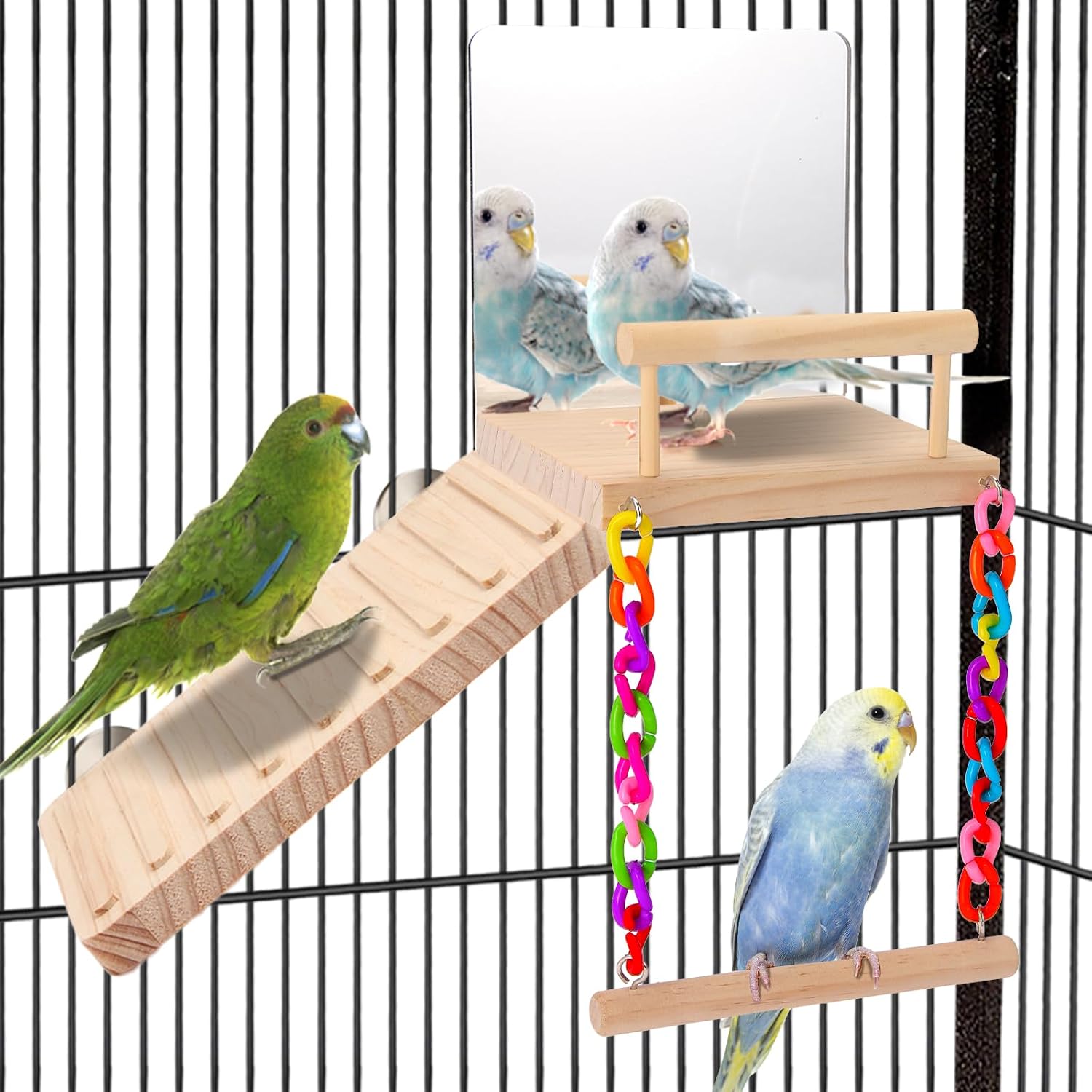
A climbing-friendly cage is one of the simplest improvements a bird owner can make. The right ladder or climbing structure supports natural movement, exercises the feet, and provides mental engagement that static perches cannot. The key decisions are material safety, rung spacing matched to the bird's size, secure metal attachment hardware, and a realistic expectation that wood, rope, and plastic components will wear out and need replacement. Buyers who want a concrete starting point for small to medium birds can check the current price on Amazon for a popular bird perch platform with a climbing ladder, while keeping in mind that any flexible, untreated-wood ladder with metal clips fills the same role. For owners who prefer to compare further, it is also reasonable to view this option on Amazon alongside other ladders in the same size class. Whichever product is chosen, the underlying principle is the same: a bird that climbs is a bird that stays active, and active birds tend to be healthier and better adjusted in captivity.
Disclosure: PawCritic is reader-supported. When you buy through links on our site, we may earn an affiliate commission at no additional cost to you. As an Amazon Associate, we earn from qualifying purchases.