Best Bird Toys and Enrichment 2026: Foraging, Chewing and Play Essentials for Parrots, Parakeets, Cockatiels and Every Caged Bird
Published on June 29, 2026 by PawCritic — Birds Category
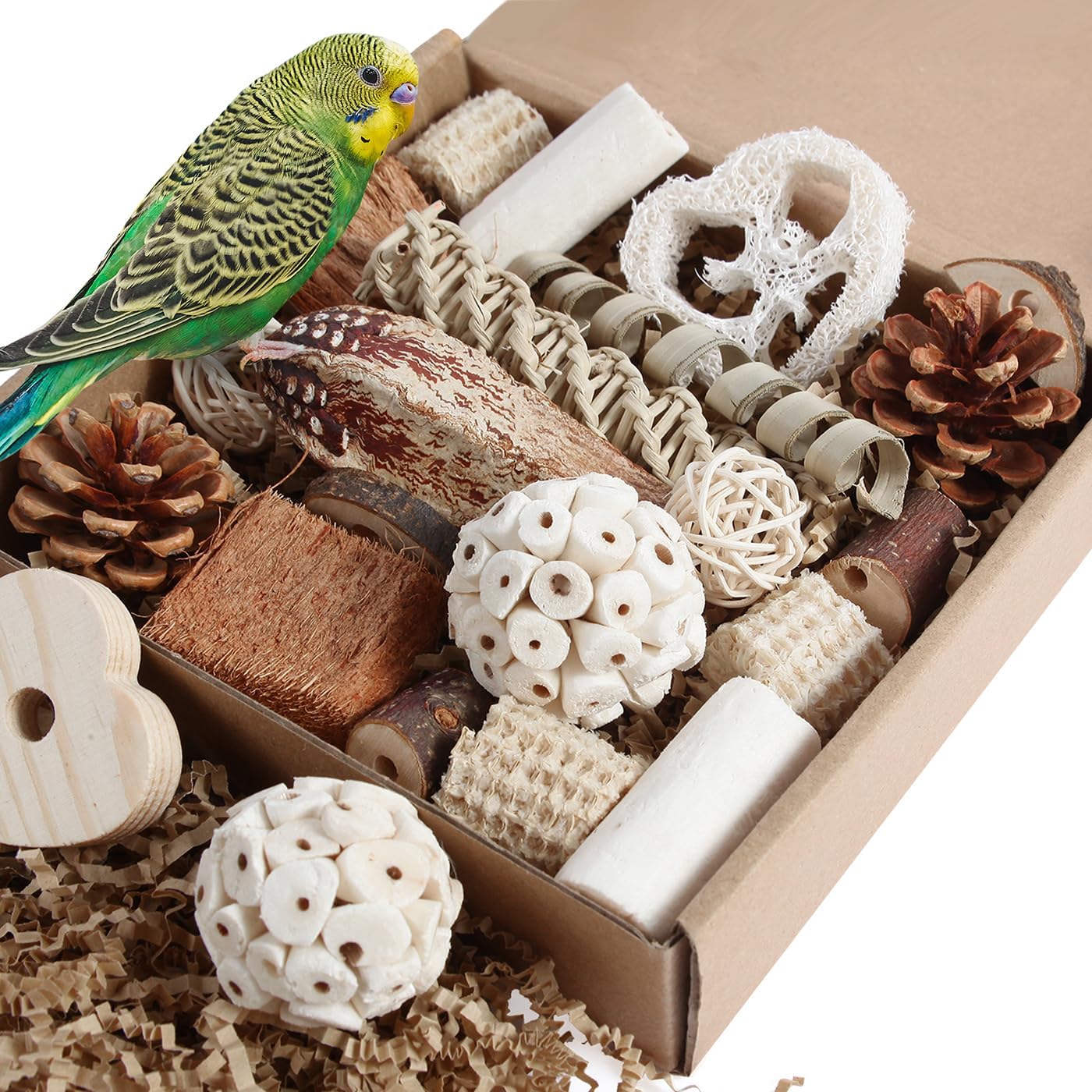
Birds rank among the most cognitively complex animals kept as companions. Published guidance from the Association of Avian Veterinarians notes that parrots are highly social, neophilic animals whose wild routines center on foraging, manipulating objects, exercising, and interacting with flock mates. In a cage, those drives do not disappear. They simply have nowhere to go unless the owner supplies appropriate outlets. Enrichment, in this context, is not a luxury add-on. It is a welfare requirement, and avian veterinarians routinely treat feather damaging behavior, repetitive screaming, barbering, and cage aggression as symptoms that begin with an under-stimulated environment.
The 2026 bird toy market reflects that understanding. The category has moved well past the plastic mirror and single bell of earlier decades. Current products include seagrass and paper foraging wheels that must be pulled apart to release food, natural rubber lattice toys that can be stuffed with paper and treats, acrylic foot toys built for grasping and rotating, and multi-stage puzzle feeders modeled on the food-extraction tasks wild parrots perform daily. Choosing among them is less about finding one perfect toy and more about matching materials, sizes, and difficulty levels to a particular bird.
This guide is written for owners of parakeets, cockatiels, conures, lovebirds, African greys, Amazons, cockatoos, and macaws. It explains what published avian guidance and manufacturer specifications say about toy safety, sizing, and enrichment categories, and it uses verified owner reports to describe how specific products tend to perform in real households. It is a buying guide, not a ranked list. Two concrete products are linked as examples, and the rest of the article focuses on the knowledge needed to evaluate any toy on a store shelf.
Why Enrichment Is a Health Issue, Not a Hobby
Wild parrots spend the majority of their waking hours locating, extracting, and processing food. A foraging session in the wild might involve flying to a fruiting tree, testing several items, cracking husks, and dropping debris. Each step involves decision-making, physical effort, and sensory feedback. Captive birds fed from a bowl receive calories in seconds and are left with hours of unmet behavioral need. The Merck Veterinary Manual's section on exotic and laboratory animals describes behavioral disorders in psittacines as frequently linked to inadequate environmental complexity, and standard veterinary practice now treats enrichment planning as part of routine wellness care.
The practical consequences of ignoring this are well documented. Feather plucking, self-mutilation, chronic egg laying, screaming, and destructive chewing of cage bars or household objects are common owner complaints that trace back to boredom, frustration, or unmet foraging drive. Providing toys does not guarantee these problems will not appear, since medical and hormonal causes must also be ruled out by a veterinarian. But an environment without foraging, shredding, and manipulation options removes one of the primary tools owners have for preventing them.
The Four Enrichment Categories Every Bird Needs
Avian behavior guidance consistently groups cage enrichment into functional categories rather than product types. A cage that contains five toys from the same category is less useful than a cage with one good example from each. The four categories below cover the main behavioral needs of companion parrots and softbills.
Foraging toys
Foraging toys require a bird to work for food. This can be as simple as a paper cup wrapped around a pellet or as complex as a multi-stage acrylic puzzle with sliding doors and lifting lids. The behavioral value scales with the effort required: a toy that releases food after one bite provides far less enrichment than one that demands pulling, twisting, and searching. Foraging toys are generally the highest-value category because they address the drive that occupies most of a wild bird's day.
Shredding and chewing toys
Parrots destroy things. Balsa, soft pine, palm leaf, corn husk, paper rope, seagrass, and untreated leather are all materials that allow a bird to reduce an object to fragments. This is normal, species-appropriate behavior, and providing safe outlets for it reduces the likelihood that a bird will redirect chewing toward feathers, baseboards, or furniture. Shredding toys are expected to be destroyed quickly; a bundle of balsa blocks may last a day with a determined conure, and that is the point.
Foot toys and manipulation toys
Parrots use their feet the way humans use hands. Holding, rotating, dropping, and retrieving objects builds coordination and provides fine-motor engagement. Foot toys are small enough to be picked up and carried, and they are often the toys a bird will play with while sitting on a perch or on the owner's hand. Acrylic beads, wood blocks, natural rubber shapes, and bells strung on safe hardware all fit this category.
Climbing, swinging, and perching structures
Physical exercise matters as much as mental exercise. Ladders, swings, rope boings, and out-of-cage play stands encourage movement, balance, and grip variation. Perches of different diameters and textures also help distribute pressure across the foot and reduce the risk of pressure sores that can develop when a bird stands on the same dowel all day. Play stands extend this benefit outside the cage and create a supervised space for social contact.
What to Look For in Any Bird Toy
Materials and hardware
Stainless steel is the standard safe metal for quick links, chains, and wire. Zinc-plated and galvanized hardware should be avoided, since birds can ingest metal through chewing and chronic zinc exposure is a recognized toxicity concern. Acrylic should be solid and polished, with no sharp edges or thin sections that can crack into shards. Wood should be untreated and unpainted, with species such as pine, balsa, manzanita, and birch being common safe choices. Natural fibers such as seagrass, palm leaf, sisal, and paper rope are widely used and are generally safe if small pieces are swallowed, though long cotton rope is a different matter because swallowed strands can ball up in the crop.
Glue, staples, and hot-melt adhesive are red flags. A well-made bird toy is assembled with mechanical fasteners, knots, or wire, not adhesive. The ASPCA pet care library and avian veterinary sources both emphasize checking new toys for loose parts, exposed wire ends, and small removable components before placing them in a cage.
Sizing relative to the bird
Part size is a safety issue and an engagement issue. A toy with components small enough to be swallowed whole is dangerous for any bird, and a toy that is too large or too heavy for a small species will be ignored or feared. As a general rule, components should be large enough that the bird cannot fit them entirely inside the beak, and the toy as a whole should be light enough to hang without straining cage bars. Small species such as budgies and lovebirds do best with components in the half-inch to two-inch range. Cockatiels and small conures handle slightly larger parts. Amazons, greys, and macaws need heavy-duty construction because anything less will be reduced to splinters within minutes.
Durability expectations by species
Durability is not a universal virtue. A balsa shredder that a macaw destroys in five minutes is a reasonable purchase for a budgie that will work on it for a week. Conversely, a lightweight acrylic puzzle designed for a cockatiel may be snapped apart by a cockatoo. Matching construction to beak strength prevents both wasted money and safety hazards from broken pieces. Manufacturer size recommendations are a useful starting point, but verified owner reports for a specific species are often more informative.
Two Concrete Examples Worth Looking At
The two products below come up repeatedly in owner discussions and illustrate the foraging and shredding categories well. They are examples rather than rankings, and they are not the only good options in their categories.
Planet Pleasures Foraging Wheel
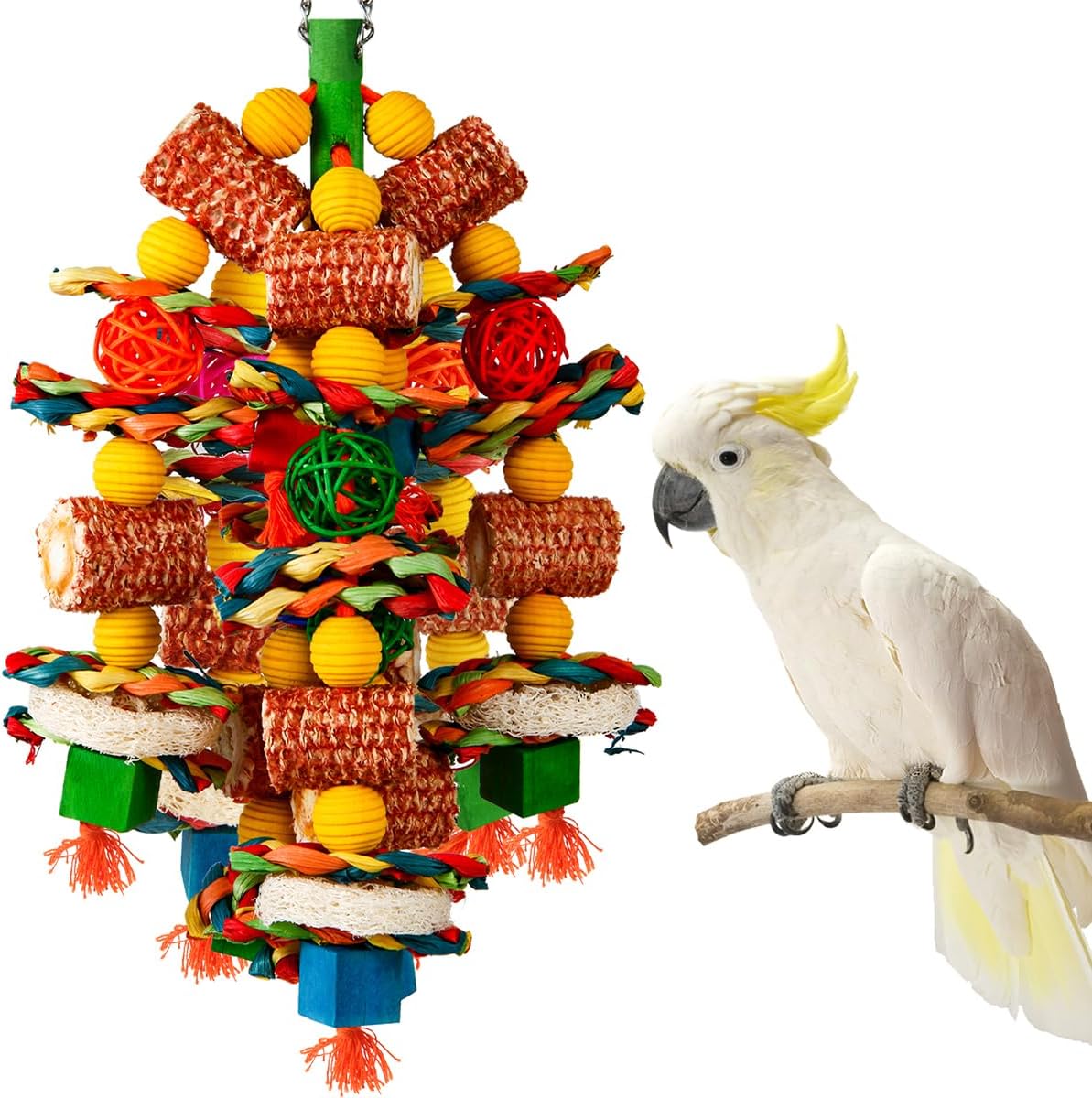
The Planet Pleasures Foraging Wheel is a seagrass and paper rope structure designed to be stuffed with pellets, treats, and shredded paper. The bird must pull apart the woven layers to reach the food inside, which combines shredding and foraging in a single object. Manufacturer specifications list it in small and large sizes with stainless steel quick-link hardware, and owner reports describe engagement sessions in the range of twenty to forty-five minutes for birds that take to it. The trade-off is lifespan: because the materials are natural and destructible, a determined bird may reduce the wheel to fragments within days, and the shredded material ends up on the cage floor. It suits owners who want a high-engagement foraging toy and are willing to replace it regularly. To see the current listing, check the current price on Amazon. A second listing for the same product line is also available if you want to compare sizes: view this option on Amazon.
JW Pet Hol-ee Roller Birdie
The JW Pet Hol-ee Roller Birdie adapts the well-known lattice ball design to birds. It is made from natural rubber with an open structure that can be stuffed with paper, treats, or small foot toys. The springy lattice flexes when bitten, which owner reports describe as encouraging repeated grabbing and tossing behavior. It works as both a foot toy and a simple foraging toy, and the rubber construction is dishwasher safe for cleaning. The main limitation is that it is not indestructible; heavy chewers can damage the lattice over time, and large parrots may destroy smaller sizes quickly. It is best suited to small and medium species, or to larger birds under supervision. To see the current listing, check the current price on Amazon.
Species-by-Species Toy Selection
Budgerigars and parakeets
Budgies are small, fast, and easily startled by oversized objects. Toys should be lightweight and scaled to a beak that cannot handle thick wood. Small bells, thin balsa blocks, paper shredders, and miniature foraging cups work well. Because budgies are prone to obesity in captivity, swinging and climbing structures that encourage movement are particularly valuable. Avoid heavy chains and large acrylic puzzles, which tend to be ignored.
Cockatiels and lovebirds
Cockatiels are enthusiastic shredders and often take to paper and palm leaf toys immediately. Lovebirds are bold, acrobatic, and frequently territorial about toys near their preferred perch, so providing multiple toys in different cage zones reduces conflict in pairs. Both species handle medium-sized foraging wheels and small foot toys. Softwood blocks and seagrass are good starting materials.
Conures
Conures are among the most playful companion parrots and often accept new toys faster than other species. They are strong chewers for their size and can destroy softwood toys quickly, so a mix of destructible shredders and more durable acrylic foot toys keeps them occupied. Many conures enjoy hanging upside down while manipulating foot toys, which makes swing-mounted toys especially useful.
African greys
Greys have a reputation for caution around new objects, and many owners report that a new toy may be ignored for days before being accepted. Introducing toys near a favorite perch and pre-loading them with treats reduces this hesitation. Greys benefit disproportionately from foraging puzzles and problem-solving toys because their cognitive capacity is high and boredom-related feather damage is a common concern in the species. Wooden and acrylic puzzles with adjustable difficulty are a good fit.
Amazons, cockatoos, and macaws
Large species require heavy-duty construction. Stainless steel hardware, thick natural branches, and hardwood blocks are baseline expectations. Anything less will be destroyed within minutes, which is not a safety problem in itself but does make lightweight toys a poor value. Macaws in particular can snap thin acrylic and bend unsoldered chain links, so hardware inspection before purchase is essential. Large foraging puzzles with multiple compartments tend to hold their attention longest.
Safety Issues to Take Seriously
Not every toy sold for birds is safe for every bird. The most common hazards reported by avian veterinarians and owners fall into a few predictable categories.
Zinc and lead exposure is the most serious. Metal components should be stainless steel or another bird-safe material, and any toy with unknown metal should be set aside. Cotton rope is a second concern: while short pieces are usually passed without incident, long frayed strands can wrap around a toe or accumulate in the crop, and many avian references recommend against it for unsupervised use. Bells with small clappers that can be removed and swallowed are a third. Finally, toys with glue, staples, or hot-melt adhesive can come apart in ways that expose sharp edges or small parts.
Supervision matters most during the first few days with any new toy. Owners should watch for signs that a bird is ingesting rather than shredding material, for loose hardware, and for any change in droppings or appetite that could indicate a problem. The ASPCA Animal Poison Control center maintains resources on household toxins that are relevant when birds are allowed out of the cage near plants, cleaning products, or human foods.
Rotation, Cleaning, and Replacement
Birds habituate quickly. A toy that is exciting on day one may be ignored by day ten, and the standard recommendation from avian behavior sources is to rotate cage toys every one to two weeks. Keeping three to five toys in the cage and storing the rest out of sight preserves novelty without requiring constant purchases. Rotating position within the cage also helps, since a bird that ignores a toy on the left wall may investigate the same toy near a favorite perch.
Cleaning depends on material. Acrylic and stainless steel components can be washed by hand with mild dish soap, rinsed thoroughly, and air dried. Natural wood, paper, and seagrass toys are not intended to be washed; they are discarded when soiled or substantially destroyed. Rope and leather can be hand washed and air dried, but frayed rope should be retired rather than repaired. Food cups inside foraging toys should be cleaned daily, since residue can grow mold in humid environments.
Replacement timing is straightforward for destructible toys: when a shredder is more than half gone, most of its enrichment value has been extracted and it can be retired. Acrylic and stainless toys can last for years but should be inspected monthly for cracks, sharp edges, or loose hardware. Any toy with a broken component should be removed immediately rather than repaired with glue.
Common Mistakes Owners Make
The most frequent mistake is buying toys that are too large for the bird. A toy that looks modest on a shelf can be intimidating to a budgie, and an intimidated bird will simply avoid that corner of the cage. The second most common mistake is buying only one category of toy, usually shredders, and then wondering why the bird still seems bored. Foraging and manipulation toys address different drives and are not interchangeable.
Another common error is leaving a destroyed toy in the cage because the bird still occasionally interacts with it. Frayed rope, exposed wire, and cracked acrylic are hazards even if the bird seems attached to the toy. Finally, many owners underestimate how much novelty matters. A cabinet full of stored toys that are rotated weekly provides more enrichment over a year than a single expensive puzzle that never leaves the cage.
DIY Options and Their Limits
Simple homemade toys can supplement commercial ones. Untreated paper towel tubes stuffed with paper and a few pellets, plain cardboard boxes with food hidden inside, and clean natural branches from bird-safe trees are all common suggestions in avian care literature. The limits are important: no glue, no staples, no paint, and no pressure-treated wood. Branches should come from trees that have not been sprayed with pesticides and should be washed and dried before use. DIY toys are best treated as supplements rather than replacements for well-designed foraging and foot toys, because the mechanical complexity that makes commercial puzzles engaging is difficult to reproduce at home.
Frequently Asked Questions
How many toys should be in the cage at once?
Three to five toys is a common recommendation, distributed across the foraging, shredding, foot, and climbing categories. More than that tends to clutter the cage and restrict movement, while fewer leaves gaps in enrichment. The exact number matters less than the mix of categories and the rotation schedule.
My bird ignores new toys. What helps?
Place the toy near a perch the bird already uses, pre-load foraging toys with a favorite treat, and give the bird several days to adjust. Some species, particularly African greys, are naturally cautious and need time. Demonstrating the toy by manipulating it by hand sometimes accelerates acceptance.
Are mirrors safe?
Opinions differ. Some birds use mirrors without issue, while others develop obsessive behavior, hormonal responses, or aggression toward the reflection. Many avian behaviorists recommend avoiding mirrors for single birds or using them only briefly under supervision.
Which materials are safest?
Stainless steel hardware, solid polished acrylic, untreated natural wood, seagrass, palm leaf, corn husk, unbleached paper, vegetable-tanned leather, and sisal rope are widely regarded as safe. Cotton rope, zinc-plated metal, and glue-assembled toys are best avoided.
Do different species need different toys?
Yes. Small species need smaller, lighter components. Large species need heavier construction. Species with high cognitive capacity benefit most from adjustable-difficulty foraging puzzles, while highly destructive species need a steady supply of shreddable material.
Final Thoughts
A well-enriched cage is not a collection of expensive toys. It is a rotating mix of foraging, shredding, manipulation, and climbing options that match the bird's size, beak strength, and personality. The two products linked above illustrate the foraging and shredding categories, and either can serve as a starting point, but the larger task is understanding what each category does and why it matters. Published avian guidance is consistent on this point: enrichment is part of basic care, not an optional extra, and the consequences of neglecting it show up in behavior, feather condition, and overall health.
Affiliate Disclosure: PawCritic is a participant in the Amazon Services LLC Associates Program, an affiliate advertising program designed to provide a means for sites to earn advertising fees by linking to Amazon.com and affiliated sites. Purchases made through links on this page help support our independent research at no extra cost to you.
Last updated: June 29, 2026. Prices and availability are subject to change. Always verify current pricing on Amazon before purchasing.