Why Your Cat's Carrier Matters More Than You Think
Most cat owners own the cheapest carrier they could find, bought in a hurry the day before a vet appointment. It sits in a closet for 364 days a year and emerges only to become an object of terror that sends the cat diving under the bed. This is the carrier-cat relationship that leads to scratched arms, canceled appointments, and a cat whose stress levels spike at the mere sight of a plastic box. The problem usually is not the cat — it is the carrier choice and, just as often, how the carrier is used.
A well-chosen carrier addresses the core feline travel stressors that veterinary behaviorists identify repeatedly: confinement anxiety, lack of visibility, poor ventilation, unstable footing, difficulty of entry, and negative associations built over years of vet-only use. Modern carriers have moved far beyond the basic plastic box. Top-loading designs eliminate the wrestling match of forcing a cat through a front door. Breathable mesh panels provide visibility and airflow. Backpack-style carriers allow hands-free walking while giving the cat a view of the route. Soft-sided carriers with washable bedding can function as a den rather than a cage.
The stakes go beyond convenience. During emergencies — wildfires, floods, building evacuations — a cat who refuses to enter a carrier can become a life-threatening logistical problem, which is why disaster-preparedness guidance from veterinary organizations consistently advises keeping an accessible, prepped carrier for each cat in the household. General feline health and handling guidance from the Cornell Feline Health Center and the Merck Veterinary Manual cat owner reference both emphasize minimizing transport stress as a routine part of preventive care, because stressed cats are harder to examine and more likely to have their visits cut short.
Buying guide note: this article is not a hands-on test. Everything below is drawn from manufacturer specifications, airline pet policies, and aggregated verified owner reviews, so you can check each claim against the listing before you buy. Rather than a numbered countdown of winners, treat this as a category guide: understand the types, the specs that matter, and the trade-offs — then look at one or two concrete examples that illustrate each design approach.
cat carriers travel backpacks safe feline transport
Carrier Types and Who Each One Suits
Soft-sided carriers
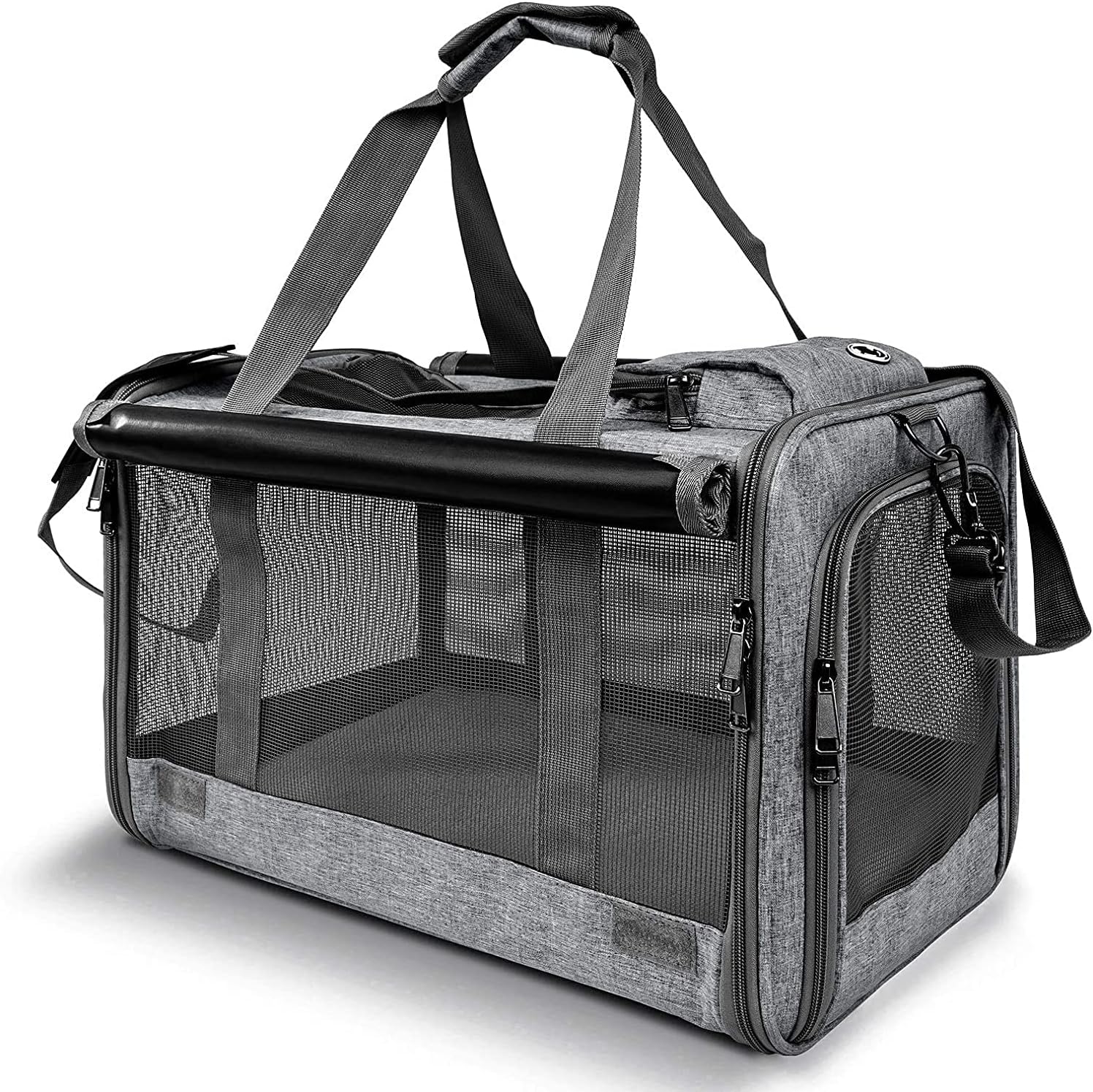
Soft-sided carriers are the default choice for vet visits and cabin air travel. They are light — typically under 3 lbs empty — flexible enough to compress slightly under an airline seat, and generally the least intimidating option for a cat because fabric walls and mesh windows feel more den-like than molded plastic. The trade-offs are durability and cleanability: determined claws can shred mesh panels over time, and accidents soak into fabric unless the liner is removable and machine-washable. If your cat is a scratcher or a chronic escape artist, a soft carrier with locking zipper pulls is essential; without them, some cats learn to work a zipper open from the inside within minutes.
Hard-sided kennels
Hard-sided kennels are the workhorse option. Injection-molded plastic shells shrug off clawing, hose off after accidents, and provide better structural protection in a car. Many behaviorists and shelter professionals prefer them for cats who panic, because a rigid box cannot collapse inward on a thrashing animal. The downsides are weight — typically 5 to 6 lbs empty — bulk in storage, and a more clinical feel that some cats associate with the shelter or the vet. Two-piece designs that snap apart without tools mitigate the storage problem considerably, and a top-loading lid is the single most useful feature in this category because you lower the cat in from above instead of pushing it through a front door.
Backpack carriers
Backpack carriers suit city dwellers walking to the clinic, transit users, and owners of harness-trained cats who join short outings. Because a backpack sits against your body heat, ventilation is the critical spec: look for mesh on at least three sides, ideally four. Structured frames matter too — an unstructured bag can sag inward onto the cat. Safety features worth insisting on include an interior tether clip that attaches to a harness, and locking zipper pulls. Front-facing windows let the cat see the direction of travel, which many owners report reduces vocalizing compared with rear-facing designs. Note that most backpacks are not sized for airline under-seat use, so check dimensions against your carrier's pet policy before assuming cabin approval.
Expandable carriers
Expandable carriers — usually backpacks with a zip-out rear compartment — solve the core compromise of carrier design: small enough to carry, large enough for the cat to stand and turn around. The expanded section can nearly double interior footprint, turning the carrier into a temporary enclosure at your destination, which is useful for hotel stays or multi-day trips. The honest limitation is that expanded mode requires level ground, the extension zipper can be fiddly, and expanded dimensions are nowhere near airline-compliant. An expandable carrier is a destination solution, not a flight solution.
Two Concrete Examples Worth Examining
Because this guide is reference-based rather than test-based, the two examples below are framed as illustrations of the soft-sided and backpack categories — designs you can evaluate against the checklist criteria, not verdicts from a lab. Both have long review histories on Amazon, which is where the owner-report evidence lives.
Example one: an airline-oriented soft-sided carrier
The Sherpa Travel Original Deluxe is the category's reference design and the carrier most often cited in airline-travel discussions. According to the manufacturer, its spring-wire frame lets the top compress by up to 3 inches to fit under-seat height limits and spring back afterward, and its Guaranteed on Board program documents compatibility with major U.S. airline dimension rules — always confirm with your specific airline anyway, since pet policies change and each flight caps the number of cabin animals. Mesh on the top and all four sides gives strong ventilation, a full-length top zipper makes loading a reluctant cat far easier than front-only entry, and the faux-lambskin liner is removable and machine-washable. Verified owner reviews are consistently strong for cats under the stated 16 lb weight guidance; the recurring complaints concern price and mesh durability under sustained clawing. If you fly with your cat even occasionally, this is the listing to study as a benchmark: check the current price on Amazon. If your cat shreds mesh, a hard-sided top-loader is the better category instead.
Example two: a ventilated backpack carrier
The PetAmi Deluxe Pet Carrier Backpack is one of the most-reviewed cat backpacks on Amazon, with tens of thousands of ratings documenting real-world use. The manufacturer specifies mesh ventilation on four sides — front, both sides, and top — which matters more in a backpack than any other type because the bag rests against your torso and traps heat. The structured frame keeps the bag from caving inward, and the listing includes an interior tether clip, locking zipper pulls, and reflective strips for evening visibility. Owner reviews repeatedly mention comfortable strap configuration (padded shoulders plus chest and waist buckles) for walks up to about an hour, and the front-facing window that lets the cat watch where it is going. The stated weight limit is 18 lbs, and reviewers note larger cats fit but feel cramped. It is not positioned as airline under-seat compliant, so treat it as a ground-transport tool: view this option on Amazon.
What the Specs Actually Mean
Dimensions and airline compliance. U.S. airlines that allow in-cabin pets generally require the carrier to fit under the seat in front of you, with maximum dimensions that cluster around 18 x 11 x 11 inches but vary by carrier and aircraft. Soft-sided carriers get some tolerance because fabric flexes. Never rely on a listing's 'airline approved' badge alone: call the airline, confirm the pet fee (commonly $95–$125 each way), confirm the per-flight pet count limit, and measure the carrier yourself against the airline's published numbers for your seat row, since bulkhead and exit rows often have no under-seat space at all.
Weight limits are about structure, not just size. A carrier's stated maximum cat weight reflects what the seams, frame, and straps are built to hold. Exceeding it stresses stitching and zippers at exactly the moment — a startled cat lunging — when failure is most dangerous. Weigh your cat honestly, including the carrier's own empty weight when thinking about what you will carry through an airport. A 16 lb cat in a 6 lb hard kennel means 22 lbs on your shoulder through a terminal.
Ventilation geometry. More mesh surface equals more airflow and more visual stimulation — good for curious cats, potentially overstimulating for anxious ones, which is why some anxious cats do better in carriers with one solid panel they can press against. In hot climates, prioritize cross-ventilation on opposing sides rather than a single large window. Avoid bubble-dome backpacks despite their social-media popularity: veterinarians and behaviorists frequently caution that the clear dome creates a greenhouse effect with interior temperatures rising well above ambient within minutes of sun exposure, and the small vent holes around the rim provide inadequate airflow.
Materials. 600-denier Oxford nylon is the standard durable shell fabric for soft carriers and resists claws reasonably well; lighter unspecified polyesters do not. Hard kennels should be injection-molded rather than thin vacuum-formed plastic, with metal-pin or squeeze-latch door mechanisms rather than simple friction catches. Removable, machine-washable liners are worth insisting on — they are the difference between a quick wash and a permanently smelly carrier after one accident.
cat carriers travel backpacks safe feline transport
Sizing Your Cat Correctly
The correct carrier size lets the cat stand up, turn around fully, and lie stretched out — but not so large that it tumbles around inside during braking. Measure your cat from nose to tail base and add 3 to 4 inches for length; measure standing height from paw to shoulder and add 2 to 3 inches. Remember that large-breed cats such as Maine Coons commonly exceed 16 lbs, which rules out many airline-sized soft carriers entirely and pushes you toward large hard kennels for ground travel or specifically larger soft designs for flying. Kittens should travel in smaller carriers with a towel bunched for footing; a kitten loose in an oversized kennel slides around and panics.
Safety Essentials Checklist
- Two points of entry (top plus front or side) so a panicking cat is never forced through one door.
- Locking zipper pulls or latch mechanisms a cat cannot operate from inside.
- An interior tether clip so the cat can be clipped to a harness before the door opens — this prevents the classic door-open bolting escape.
- A seatbelt loop or strap channel for car travel; an unsecured carrier becomes a projectile in a sudden stop.
- No protruding screws or unfinished edges inside hard kennels that could catch a collar.
- Quick-release buckles on harnesses, and never a collar leash alone inside an enclosed carrier.
For anything involving sedation, travel medication, or cleaning products used around cats, confirm safety with a veterinary source first — the ASPCA Animal Poison Control resource covers common household product and medication hazards, and many over-the-counter calming supplements are not appropriate for cats without veterinary approval.
Carrier Desensitization: Making the Carrier Normal
The most reliable way to fix carrier problems is not buying a more expensive box — it is changing the carrier's role in the household. The protocol below reflects standard behaviorist guidance on gradual desensitization and counter-conditioning.
- Make the carrier furniture. Leave the carrier out permanently in a room the cat frequents, with the door removed or fixed open. Put familiar bedding inside, and toss treats or catnip in daily. The goal is for the carrier to become as unremarkable as the couch — just another cozy cave.
- Feed meals near, then inside. Place the food bowl next to the carrier for a week, just inside the entrance the next week, and at the back the week after. Hunger is a powerful association-builder, and the cat's strongest drive becomes linked to carrier proximity.
- Close the door briefly. Once the cat eats comfortably inside, close the door for 30 seconds during a meal, then open it immediately. Extend gradually to one minute, then five. Always open the door before the cat shows stress, so door-closed never comes to mean trapped-forever.
- Add motion in stages. Lift the carrier and carry it a few steps, then set it down and open the door. Progress to room-to-room walks, a stationary car sit with the engine off, a short drive around the block, and finally a vet visit that ends with treats rather than only an exam.
- Consider a pheromone spray. Synthetic feline facial pheromone products, applied to the carrier interior about 15 minutes before loading, are reported by many owners and some clinical studies to reduce transport stress behaviors. Results vary by cat; it is a low-risk adjunct, not a substitute for desensitization.
Maintenance and Cleaning
After any accident, enzymatic cleaner is the correct tool, not standard detergent: uric acid crystals survive ordinary soap and continue emitting odor that both re-triggers accidents and stresses the cat. Remove and machine-wash fabric liners cold with mild detergent; wipe soft shells with the enzymatic product and air-dry fully before storage, because trapped moisture breeds mildew in fabric and odor in crevices. Hard kennels should be disassembled where the design allows, washed in warm soapy water, sprayed with enzymatic cleaner, and dried completely. Check zipper teeth, mesh seams, and door latches every few months — frayed stitching around a mesh panel is the most common failure point on soft carriers and is far better caught at home than mid-trip.
Common Mistakes to Avoid
The most frequent mistake is the closet carrier pulled out only for vet visits, which guarantees a purely negative association. The second is buying by price alone: an unstructured budget bag that sags onto the cat or a thin-shelled kennel with a weak latch creates problems exactly when safety matters. Third is ignoring weight limits for a large cat — a 20 lb Maine Coon in a 15 lb-rated soft carrier stresses every seam. Fourth is forcing front entry on a resistant cat when a top-loader would take ten calm seconds. Fifth is leaving the carrier unsecured in the car. And sixth is assuming an 'airline approved' label means approved by your airline on your aircraft this week — always verify before booking.
Frequently Asked Questions
Hard-sided or soft-sided — which is better?
Hard-sided carriers are more durable, easier to sanitize, and more protective in a car; soft-sided carriers are lighter, often airline-compliant, and feel more den-like. Many multi-cat or frequent-travel households keep one of each: soft for clinic visits and flights, hard for longer car trips and emergencies.
Can I bring my cat in the cabin on a plane?
Most U.S. airlines allow a limited number of cabin pets per flight for a fee, with carriers fitting under the seat. Confirm dimensions, fees, and availability with the airline for your specific flight before assuming anything — pet spots sell out, and aircraft type changes seat geometry.
My cat screams in the carrier. What can I do?
Vocalization during travel is nearly always anxiety rather than pain. The desensitization protocol above is the only durable fix; short term, draping a light blanket over the carrier while leaving one side open for airflow reduces visual overstimulation for many cats. Never give any sedative without veterinary approval — several common ones are unsafe for cats.
How do I clean a carrier after an accident?
Use an enzymatic cleaner on both fabric and plastic, wash removable liners cold, and dry everything fully before storage to prevent odor and mildew. Ordinary cleaners do not break down the compounds that cause re-marking.
Are bubble backpacks a good idea?
Generally no. Veterinary and behaviorist commentary consistently flags the greenhouse effect inside clear domes, inadequate ventilation from small perimeter holes, and the exposed position that makes many cats feel vulnerable rather than adventurous. Mesh-sided backpacks with multiple ventilated panels are the safer design.
Where to Look
If you want to examine the two designs discussed above against your own checklist, both listings carry extensive verified owner feedback you can read before deciding. For the airline-oriented soft-sided category: check the current price on Amazon. For the ventilated backpack category: view this option on Amazon.
Whatever you buy, the deciding factor is usually not the carrier at all. A modestly priced carrier that lives in the living room, gets fed in weekly, and feels like a den will outperform an expensive one that appears twice a year from a closet. Choose for ventilation, secure latching, honest weight rating, and entry geometry — then invest the real effort in making the carrier part of home.
Affiliate Disclosure: PawCritic.com participates in the Amazon Services LLC Associates Program. We may earn commissions from qualifying purchases at no extra cost to you.