Why a Good Cat Collar Is a Safety Essential
If you think cats do not need collars, consider the statistics. Research widely cited from the American Veterinary Medical Association suggests that cats wearing collars are far more likely to be returned to their owners if lost than uncollared cats. Unlike dogs, who are often reunited via microchip scanning at shelters, cats — especially indoor cats who slip out accidentally — may be mistaken for strays or rehomed before anyone thinks to scan for a microchip. A collar with an ID tag or embroidered contact information is the fastest, most visible way for a finder to reunite you with your cat. A microchip only works if someone takes the animal to a scanner; a collar works the instant someone reads the tag. General feline health references such as the Cornell Feline Health Center and the Merck Veterinary Manual cat owner section both treat visible identification as a basic part of preventive care, alongside microchipping, rather than an optional accessory.
The single most important difference between a cat collar and a dog collar is the breakaway mechanism. A cat collar must have a safety buckle that releases under pressure — if the collar snags on a branch, fence, or piece of furniture, the buckle pops open and frees the cat. Non-breakaway collars are genuinely dangerous for cats and should never be used, a point on which animal welfare and veterinary guidance is unanimous. PawCritic does not run hands-on product tests; this guide is built from published safety guidance, manufacturer specifications, and verified owner reports, so every claim here can be checked against its source. Rather than a long ranked list, what follows is a focused buying guide: what matters in a cat collar, what trade-offs each design carries, and two concrete examples you can look at on Amazon as a reference point while you shop.
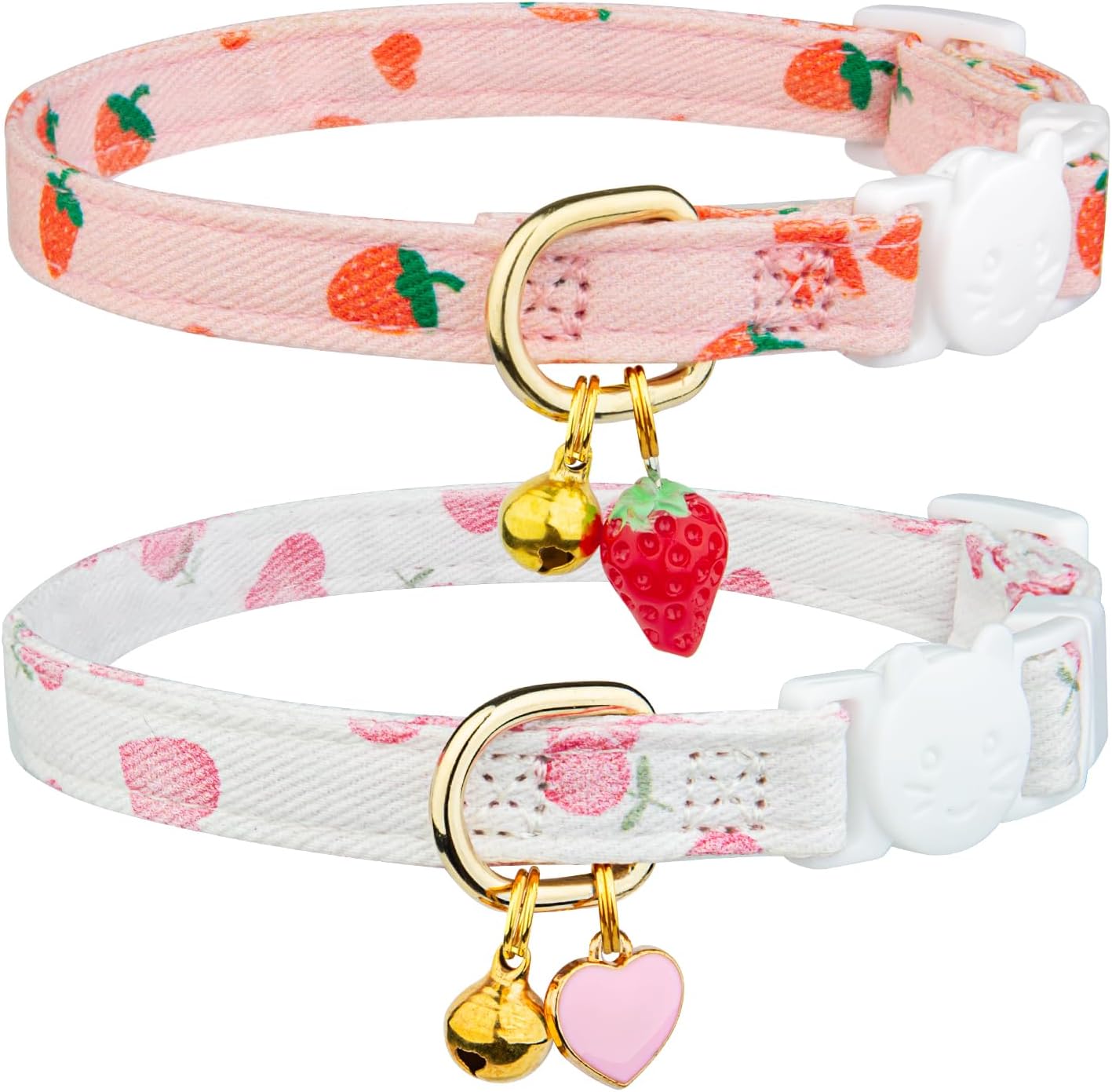
The Non-Negotiable Feature: A Breakaway Buckle
The logic behind breakaway buckles is straightforward. Cats climb, squeeze through tight gaps, scratch, and groom, and a collar that cannot release becomes a snag hazard on branches, fence posts, deck railings, cabinet handles, heating vents, and even the cat's own front claws during grooming. A non-breakaway collar that catches can cause panic, jaw or limb entrapment, strangulation, or serious soft-tissue injury. A breakaway buckle is engineered to pop open when a specific amount of force pulls on the collar — commonly in the range of roughly 5 to 10 pounds depending on the design. The goal is a window that is low enough to release reliably under snag pressure yet high enough that the collar stays on through normal jumping, running, and wrestling.
Some collars add a second layer of protection: an elastic or stretch section in the band itself. If the primary buckle fails to release for any reason, the stretch material can let the cat slip free anyway. Manufacturer descriptions of dual-safety designs — a breakaway buckle plus an elastic element — present this as redundancy rather than a replacement for a good buckle, and that framing matches how safety engineers usually treat backup systems. When evaluating any collar, read the product listing carefully: listings for breakaway cat collars almost always state the buckle type explicitly, and if a listing does not mention breakaway or quick-release safety, treat that as a red flag rather than assuming it is included. Note that accessories matter here too — heavy tags, charms, or trackers hung on a collar change the weight and the way force transfers during a snag, and some clip-on accessories can physically interfere with the buckle. Keep whatever hangs on the collar as light as possible.
How to Choose a Cat Collar: Materials, Fit, and Features
Materials and their trade-offs
Nylon webbing is the most common collar material: it is inexpensive, strong, and available in a huge range of colors, but the woven edges can fray over time and cheaper webbing can feel stiff against short fur. Softer weaves and rounded-edge designs reduce this problem. Stretch cotton-blend fabrics, used by a few cat-specialist brands, trade some longevity for comfort — the stretch also acts as a secondary safety release, though elastic materials lose snap over months of daily wear and eventually need replacing. Fleece-lined collars suit long-haired cats and sensitive skin because they reduce matting and static, but fleece collects litter dust and debris and takes longer to dry after washing. Whatever the material, check the hardware: nickel-plated rings and buckles resist corrosion reasonably well, and a small split ring for tags is generally more secure than a flimsy hook.
Sizing and the two-finger rule
Fit matters more than most owners expect. The standard guidance is the two-finger rule: you should be able to slip two fingers comfortably between the collar and your cat's neck, but no more. A collar that is too loose slips over the head — cats are famously good at backing out of loose collars — while one that is too tight causes discomfort, fur breakage, and skin irritation. Most adult cats fall in the 8 to 12 inch neck range, so a collar with an 8 to 13 or 7 to 14 inch adjustment range covers the majority. Kittens need the smaller end of the range and will outgrow a first collar quickly, so budget for at least one replacement during the first year. Slide adjusters allow finer tuning than fixed buckle holes. Recheck fit weekly: cats gain and lose weight, seasonal coat changes alter neck thickness, and a collar that fit in spring may be tight by autumn.
Identification options
There are three practical ways to put your contact information on a collar. A dangling tag on a split ring is the classic approach: tags are cheap, easy to update when your phone number changes, and available in reflective or brightly finished versions that are easy to read. Their weakness is that cats lose tags — a determined cat can pull a tag off, and tags wear smooth over time. Embroidered collars weave your phone number directly into the band, which cannot fall off, but the text is less visible at night than a reflective tag and you cannot change it without buying a new collar. Enamel or metal nameplates riveted or hung on the collar sit between the two: durable and attractive, though the plate adds a little weight and can clink against food bowls. Whatever you choose, include a phone number; a name alone does not help a finder. The ASPCA Animal Poison Control resource pages and similar welfare guidance consistently recommend layered identification — visible ID plus a microchip registered with current contact details — because each method covers the other's failure modes.
Bells and reflectivity
Bells divide opinion. On the plus side, a bell warns birds and small prey animals, which published predation studies suggest can reduce hunting success by a meaningful margin, and it tells you where your cat is in the house, preventing accidental lock-ins in closets and cabinets. On the minus side, some cats find the constant jingling stressful, and a bell adds a small snag surface. Most collars ship with a removable bell precisely so owners can try both configurations; watch your cat for a few days and remove the bell if they seem agitated or fixated on it. Reflective elements, whether full-body reflective material or stitched strips, are essential for any cat with outdoor access and a sensible precaution for indoor cats, since escape through an open door is always possible. Full-body reflective material is noticeably brighter than stitched strip accents under headlights; the trade-off is fewer color and pattern options.
Two Collars Worth a Close Look
As a starting point for comparison, here are two collars that come up repeatedly in owner reports and that between them illustrate the two main design philosophies in this category: a soft stretch-fabric breakaway collar and a reflective nylon breakaway collar. Neither is the only good option on the market, but examining their specifications side by side is a useful exercise in what to look for.
A stretch-fabric breakaway design
Beastie Bands is a brand that specializes exclusively in cat collars, and its flagship breakaway collar is the archetype of the dual-safety approach. The band is a soft, stretchy cotton blend that manufacturer specifications describe as machine washable, and the stretch itself acts as a secondary release if the primary buckle fails to separate. The closure uses a magnetic-style breakaway rather than a friction-fit plastic buckle, which the manufacturer says keeps release tension consistent over repeated use, since plastic buckles can wear or become brittle. Sizing spans kitten necks at the small end up to roughly 16 inches at the large end, and the pattern range runs to well over a hundred designs. Owner reviews praise comfort for long-haired cats and the fact that the collar survives regular washing; the recurring complaints are that the stretch fabric loses elasticity after several months to a year of daily wear and that determined chewers can damage the fabric. This style suits indoor cats, kittens getting their first collar, and any owner who prioritizes the redundancy of two independent release mechanisms. You can check the current price on Amazon and compare the sizing chart against your cat's neck measurement.
The honest trade-off with this design is longevity versus safety margin. Because the band stretches and flexes constantly, it simply ages faster than rigid nylon webbing, and the prudent habit is to inspect it monthly and replace it when the elastic no longer snaps back promptly. Owners who want a collar to last a year or more without attention may find that frustrating; owners who treat collars as consumable safety equipment — cheap enough to replace twice a year — will not mind at all. That reframing is worth adopting generally: a lost collar is not a failure, it is the breakaway doing its job, and buying with replacements in mind is rational, not wasteful.
A reflective nylon breakaway design
Rogz is a New Zealand pet-gear brand whose reflective breakaway cat collar represents the other main approach: durable nylon webbing with full-body reflective material rather than accent stitching. Manufacturer specifications list a generous one-size adjustment range of roughly 8 to 14 inches, a removable bell, and nickel-plated hardware. The advantage of full-body reflectivity is nighttime visibility — owner reports consistently describe the collar as conspicuous under headlights at distance, which matters for cats with outdoor access near roads or for cats walked on a leash in the evening. The trade-offs mirror the strengths: the reflective finish dominates the appearance, so style options are limited compared with fabric collars, and the traditional plastic breakaway buckle releases at a slightly firmer pull than the softest designs, which keeps the collar on through rough play but means the release force sits toward the upper end of the safe window. This style suits indoor-outdoor cats, adventure cats on harnesses and leashes, and any situation where being seen matters more than pattern choice. You can view this option on Amazon to check the current sizing and color availability.
Comparing the two designs is instructive beyond these specific products. A stretch-fabric collar optimizes for release reliability and comfort; a reflective nylon collar optimizes for visibility and abrasion resistance. Neither choice is wrong — the right answer depends on whether your cat's biggest risk is snagging indoors at night or being unseen outdoors near traffic. If your cat has outdoor access, lean toward reflectivity and durable webbing. If your cat is indoors-only or has never worn a collar before, lean toward softness and the lowest practical release force. For owners who want both qualities, buying one of each and swapping seasonally is a reasonable strategy some owners report using, since collars in this category are inexpensive enough that two cost less than a single premium dog collar.
Special Cases: Trackers, Personalization, and Multi-Cat Homes
GPS trackers designed for cats attach to a purpose-built breakaway collar and add real-time location through a phone app, usually with a monthly subscription. These suit owners of roaming cats in areas where wandering is a real risk — new homes, rural properties, cats with a history of long disappearances. The trade-offs are real: the module adds bulk and weight that some cats object to, batteries need charging every few days, and the breakaway must be engineered to release with the tracker attached, which pushes release force up to avoid losing an expensive device. Read the manufacturer specifications on waterproofing and release behavior carefully before committing to a subscription.
Personalized embroidery solves the lost-tag problem permanently, and several brands offer it at a modest premium with a wide choice of collar and thread colors. Check two things before ordering: confirm the collar has a genuine breakaway buckle (not all personalized collars do) and accept that embroidered text is hard to read in low light, so an outdoor cat may still benefit from a reflective tag alongside the stitching. Multi-cat households and foster or rescue situations are the natural home for budget multi-packs of basic breakaway collars — having spares on hand matters because breakaway collars are, by design, disposable. Color-coding collars across a multi-cat home also helps humans tell similar-looking cats apart and signals which cat is which during feeding and medication routines.
Common Mistakes to Avoid
- Buying a non-breakaway collar because it looks sturdier or was marketed for small dogs. Dog collars are built to stay on; cat collars are built to come off under load. The requirements are opposite.
- Over-tightening to stop escape artists. A too-tight collar causes fur loss and skin irritation and does not actually prevent a determined cat from working a paw under it. Fix the real problem by choosing a stretch band or lower release force instead.
- Hanging heavy accessories on the collar. Multiple tags, charms, or an oversized bell add weight, noise, and snag surfaces, and can interfere with buckle release. One lightweight tag or an embroidered band is enough.
- Never rechecking fit. Weight change, kitten growth, and coat season all alter neck circumference. A monthly two-finger check takes ten seconds.
- Assuming a microchip replaces a collar. A chip requires a scanner and a trip to a shelter or vet; a tag can be read by a neighbor on the spot. Layered identification is the standard recommendation for a reason.
- Keeping a released collar in service indefinitely. Every breakaway event stresses the buckle. Inspect after each release and replace the collar when the mechanism looks worn, sticky, or loose.
Care and Replacement Schedule
Cat collars lead hard lives: fur oils, litter dust, food residue, and constant flexing all degrade materials. Wash fabric collars periodically per the manufacturer instructions — many nylon and cotton-blend collars are machine washable in a laundry bag, though fleece versions take longer to dry. Inspect monthly for frayed edges, loose stitching, faded reflectivity, corroded hardware, and a buckle that no longer clicks together firmly. Typical service life is a few months to a year depending on the cat's activity and the material, with stretch fabrics on the shorter end and thick nylon on the longer end. Keep at least one spare on hand so a lost or worn collar is replaced immediately rather than deferred — an uncollared interval is exactly when the escape happens. For a second reference point on the durable-nylon style alongside the Rogz above, you can also check the current price on Amazon and note how the adjustment range compares with your cat's measured neck size. And if you want to revisit the stretch-fabric option after checking sizing, you can view this option on Amazon again before deciding.
Frequently Asked Questions
Should my indoor cat wear a collar?
Yes. Indoor cats escape through open doors, torn window screens, and during emergencies such as fires or construction, and an uncollared escapee is easily mistaken for a stray. Welfare organizations consistently report that return rates for cats with visible identification are dramatically higher than for cats without. The residual risk of a properly fitted breakaway collar is far lower than the risk of losing a cat with no visible ID. If you remain concerned, choose a dual-safety design — breakaway buckle plus elastic — for maximum redundancy.
How tight should a cat collar be?
Apply the two-finger rule: two fingers should slide between collar and neck with light pressure, but three should not. Snug enough not to rotate freely, loose enough not to press into the fur. Check weekly, and always recheck after a grooming clip or a change in weight.
Do cats need a bell?
Bells reduce wildlife predation modestly and help you locate your cat indoors, but some cats find them stressful. Try the collar with the bell for several days, watch for agitation or collar-fixation, and remove it if needed. Most collars include removable bells precisely for this reason.
How often should I replace a cat collar?
Inspect monthly and replace at the first sign of fraying, faded reflectivity, weakened buckle tension, or lost elasticity. Expect roughly three to six months from an active cat's collar and up to a year from a quiet indoor cat's. After any breakaway event, check the buckle before re-fastening it.
The Bottom Line
The non-negotiables do not change regardless of brand or budget: a genuine breakaway buckle, a fit confirmed by the two-finger rule, visible identification with a current phone number, and a monthly inspection habit. Beyond that, let your cat's lifestyle drive the choice — stretch-fabric dual-safety designs for indoor comfort and maximum release reliability, reflective durable nylon for outdoor visibility, embroidery for loss-proof ID, multi-packs for multi-cat homes, and trackers only where roaming risk justifies the cost and bulk. The two examples highlighted above are simply well-documented reference points for the two main design philosophies, not the only defensible choices. Whatever you buy, treat the collar as consumable safety equipment rather than a keepsake, keep identification current, and pair the collar with a registered microchip so that both the neighbor who finds your cat and the shelter that scans it can get her home.
Disclosure: PawCritic is reader-supported. When you buy through links on our site, we may earn an affiliate commission at no additional cost to you. As an Amazon Associate, we earn from qualifying purchases.