Best Cat Nail Care Products 2026: Clippers, Grinders, Soft Nail Caps and Scratching Solutions for Happy, Scratch-Free Homes
Published on June 18, 2026 by PawCritic — Cats Category
Few grooming tasks produce more anxiety in cat owners than trimming claws. A single cut into the quick causes pain, bleeding, and a cat that may refuse handling for months afterward. Yet regular nail care is not optional. Overgrown claws can curl back into the paw pads, catch on carpet and upholstery, alter the way a cat stands and walks, and contribute to joint discomfort in older animals. Indoor cats in particular wear their claws down far less than outdoor cats, so they depend on their owners for maintenance.
This guide is a reference for choosing cat nail care products based on published veterinary guidance, manufacturer specifications, and verified owner reports. It covers clippers, rotary grinders, soft nail caps, and scratching surfaces, and it explains the trade-offs that matter so you can decide what fits your cat and your household. Where a specific product is discussed, it is presented as one example in the category, not as a ranked winner. Every claim below can be traced to a manufacturer spec sheet, a veterinary or welfare organization, or a consistent pattern in owner reviews.
Quick Comparison Table — Clippers and Grinders
| Product | Type | Best For | Blade or Bit Type | Safety Features | Price | Rating |
|---|---|---|---|---|---|---|
| Safari Professional Nail Trimmer | Scissor Clipper | General use | Stainless steel | Safety stop guard | $$ | ★★★★★ |
| Millers Forge Cat Clipper | Scissor Clipper | Thick nails | Forged steel | Ergonomic handles | $ | ★★★★★ |
| Dremel 7300-PT Pet Nail Grinder | Rotary Grinder | Sensitive cats | Sanding bands | Variable speed plus LED | $$$ | ★★★★★ |
| Casfuy Cat Nail Grinder | Rotary Grinder | Small cats | Diamond bit | 2-speed plus LED light | $$ | ★★★★☆ |
| Pet Republique Nail Clipper | Guillotine | Thick claws | Carbon steel | Ergonomic non-slip grip | $$ | ★★★★☆ |
| Boshel Cat Nail Clippers | Scissor Clipper | Beginners | Titanium-coated | Safety guard plus LED | $$ | ★★★★☆ |
| Hertzko Electric Nail Grinder | Rotary Grinder | Quiet operation | Diamond plus sapphire | 2-speed plus rechargeable | $$ | ★★★★☆ |
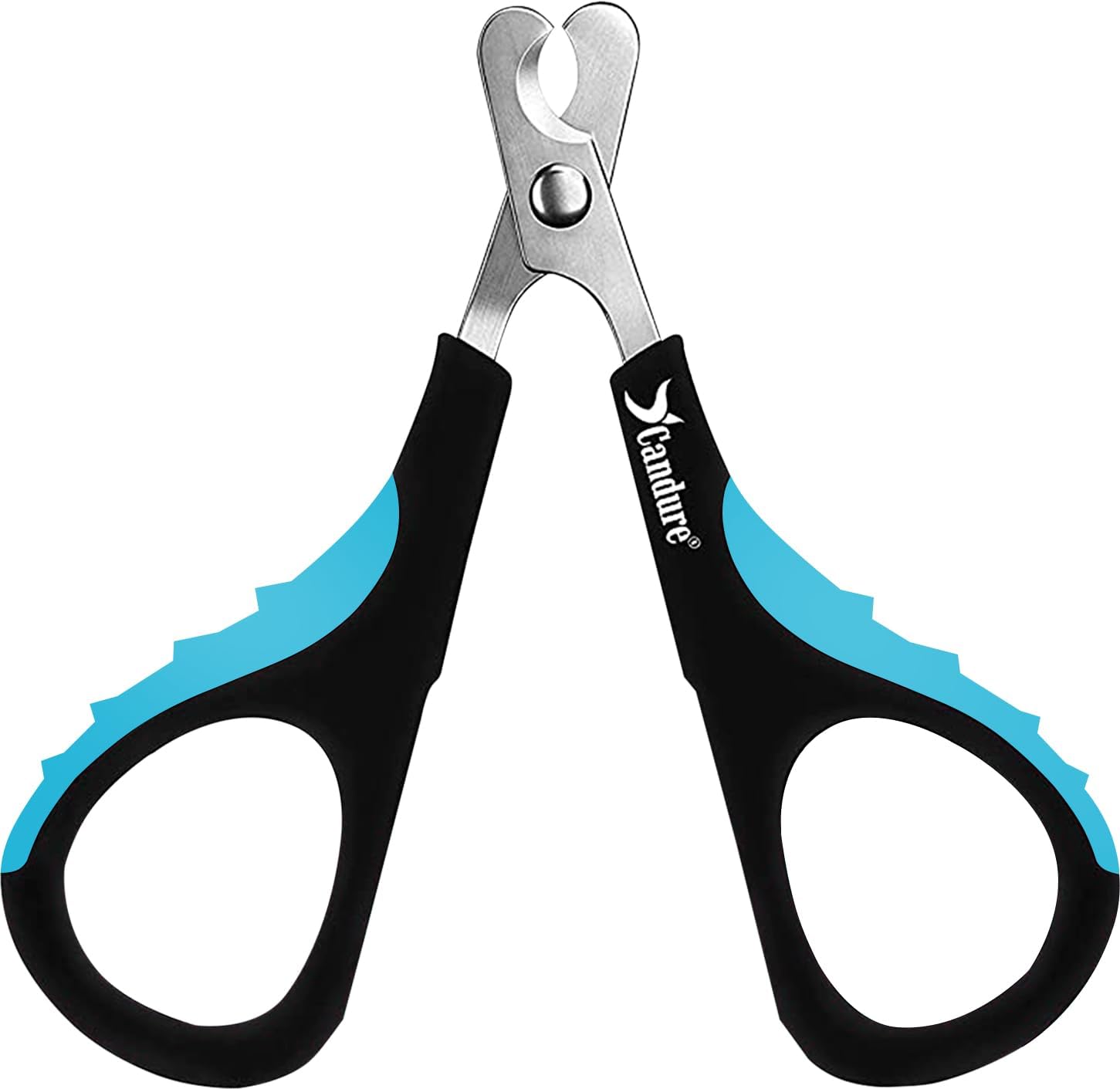
Safari Professional Stainless Steel Nail Trimmer
The Safari Professional is a scissor-style clipper with high-carbon stainless steel blades and a built-in safety stop that limits how far the blade can close. That guard is the main reason it appears so often in beginner recommendations: it reduces, though does not eliminate, the chance of cutting into the quick. The rubberized handles are shaped for a full-hand grip, which matters when a cat is squirming and you need steady control. Manufacturer materials describe the small size as suitable for cats, rabbits, and other small pets, and it carries a lifetime warranty.
The trade-off is that stainless blades on any clipper of this type dull with use, and owner reports commonly describe noticeable dulling after a year or more of regular trimming. Dull blades crush rather than cut, which is uncomfortable for the cat and can splinter the nail. This clipper also has no LED light and no file, so it suits owners who trim in good lighting and can see the quick clearly. It is a reasonable default for a household with one or two cooperative cats, less so for very thick or brittle claws.
check the current price on Amazon
Millers Forge Cat Nail Clipper
Millers Forge has manufactured cutting tools since 1917, and the company's cat clipper is a forged-steel scissor design rather than a stamped one. Forging produces a denser blade that holds an edge longer than stamped metal, which is why these clippers show up repeatedly in long-term owner discussions where people report using the same pair for many years. The design is deliberately simple: curved metal handles, textured grips, no guard, no light, and a price that is usually under ten dollars.
That simplicity is also the limitation. Without a safety stop, the tool depends entirely on the handler's steadiness and eyesight, so it is a poor match for anyone with arthritis, a weak grip, or a cat that pulls its paw away mid-cut. The metal handles can also become slippery with damp hands. For an experienced owner trimming thick, tough nails, the forged blade is the selling point. For a first-timer, a guarded clipper or a grinder is a safer starting point.
Dremel 7300-PET Nail Grinder
The Dremel 7300-PET is a cordless rotary grinder that files nail material away with a sanding band instead of shearing it off. Published product specifications list two speed settings in the range of roughly 6,500 to 8,500 RPM, a rechargeable battery good for about 30 minutes of continuous use, and a kit that includes sanding bands and a grindstone. Because material is removed gradually, the handler has more opportunities to stop before reaching the quick, which is the core safety argument for grinders over clippers.
The trade-offs are noise, speed, and cost. Owner reports and manufacturer documentation place the sound in the moderate range, around 65 to 70 decibels, which is enough to unsettle noise-sensitive cats. Grinding is also slower per nail than clipping, and sanding bands are a consumable that needs periodic replacement. This tool suits owners willing to invest several short desensitization sessions before the first full pedicure. It is less suited to a cat that panics at the sound of a hair dryer or vacuum.
Casfuy Cat Nail Grinder
The Casfuy grinder is built specifically for cats rather than adapted from a dog or workshop tool. Manufacturer specifications list a diamond-coated grinding wheel, two speeds in the roughly 8,000 to 10,000 RPM range, USB-C charging, and a noise rating near 55 decibels, which is noticeably quieter than a full-size rotary tool. A built-in LED illuminates the nail surface, which helps on black claws where the quick is otherwise invisible.
The diamond wheel outlasts sanding bands, so ongoing consumable costs are lower. The trade-off is power: the motor is smaller, so thick or dense claws take more passes and more time. The grinding surface is also narrower, which means more careful positioning per nail. It fits a single-cat household with a small or average-sized cat that startles easily, and it is a sensible first grinder for someone who is not ready to spend on a Dremel.
Soft Claws and Soft Paws Cat Nail Caps
Soft Claws and Soft Paws are vinyl caps that are glued over trimmed claws to blunt the tip while leaving the claw free to extend and retract. Manufacturer specifications describe a pack of about 40 caps, a medical-grade vinyl material, and a wear time of roughly four to six weeks per application, after which the cap sheds naturally with the outer layer of the claw. They are widely recommended by veterinarians and feline behavior organizations as a humane alternative to declawing, a procedure the ASPCA and most veterinary bodies oppose on welfare grounds.
The honest limitations matter here. Application requires trimming first, then gluing each cap, which takes 30 to 45 minutes for a full set and is best done with a second person for a wriggly cat. Caps can pop off early if the nail was not trimmed or cleaned properly, some cats chew them off, and the cyanoacrylate adhesive has fumes that call for a ventilated room. Caps are a management tool for problem scratching, not a substitute for providing appropriate scratching surfaces.
Boshel Cat Nail Clippers with LED Light
The Boshel clipper is a scissor-style tool with titanium-coated blades, a safety guard, and an LED that shines onto the nail. The light is the differentiator: on cats with dark claws, the quick shows up as a shadow, and a small directed light makes that shadow easier to judge. The set includes a nail file for smoothing cut edges, and the rubberized handles are shaped for a non-slip grip.
The drawbacks are minor but real. The battery adds weight to the handle, which some owners find tiring during longer sessions. The light angle can be awkward on front paws depending on how the cat holds its leg. Titanium coatings on cutting tools are a surface treatment, and owner reports describe flaking after heavy use over time. It is a good choice for a beginner working with a dark-nailed cat who wants visual help locating the quick.
Hertzko Electric Nail Grinder
The Hertzko grinder is a budget rotary tool that ships with both a diamond bit and a sapphire bit, two speed settings, and a rechargeable battery rated for roughly three hours of use. Manufacturer specifications put the noise level near 58 decibels, which is quiet enough that many cats tolerate it without the flinching seen with louder tools. It weighs a little over four ounces, so it is easy to hold in one hand while supporting a paw with the other.
The lower price reflects a smaller motor. Owner reports describe it stalling or slowing on very thick claws, and the plastic bit housing is not designed to survive drops onto hard floors. There is no LED light. For a household with one or two cats with average nails and a tight budget, it covers the basics. For dense claws or multiple cats in one session, a more powerful tool will finish faster.
KONG Naturals Scratching Pad and Post
Scratching is part of nail care, not a separate topic. It sheds the outer sheath of the claw, stretches the spine and shoulders, and deposits scent from glands in the paws. The KONG Naturals pad is layered corrugated cardboard with catnip infused between the layers, sized around 16 by 6 by 3 inches, and reversible so both faces can be used before replacement. Replacement inserts are available, and the material is recyclable.
The limitations are inherent to cardboard. Heavy scratchers wear through a pad in four to eight weeks, and the process leaves bits of cardboard on the floor around the pad. It is a horizontal scratcher, so it will not satisfy a cat that prefers to scratch upright. Pairing it with a vertical sisal post is the standard recommendation for covering both preferences. Cornell Feline Health Center notes that scratching is normal, necessary feline behavior, and that providing acceptable outlets is more effective than punishing the cat for using furniture.
SmartyKat Scratch Place and Catnip Mat
The SmartyKat Scratch Place is a curved corrugated cardboard lounger that doubles as a scratching surface, measuring roughly 17.5 by 7.5 by 5.5 inches and weighing about 1.2 pounds. The light weight makes it easy to move from room to room while you work out where your cat prefers to scratch. Catnip is infused into the cardboard, which owner reports describe as effective at drawing in cats that ignore plain pads.
Like all cardboard scratchers, it is a consumable. It wears faster than a sisal post, it scatters debris, and cats that prefer vertical scratching will ignore it. It is also not a bed in any structural sense; heavier cats flatten the curve over time. As a low-cost trial to learn your cat's scratching orientation, it is a sensible purchase before committing to a larger piece of furniture.
How to Choose Cat Nail Care Products
Clippers or Grinders: Which Fits Your Cat
Clippers are faster, quieter, cheaper, and require no charging. They are the better fit for a confident handler and a cat that tolerates paw handling, and a guarded scissor design is the safer choice for beginners. Grinders remove material gradually, which lowers the risk of hitting the quick and leaves a smooth edge that does not snag fabric. They are louder, slower, and more expensive, and they require a desensitization period for most cats. A practical approach is to start with a guarded clipper, and add a grinder later if your cat's nails splinter or you struggle to see the quick on dark claws.
Finding the Quick on Dark Nails
On white or translucent claws, the quick appears as a pink line inside the nail. On black claws it is invisible from the surface. Shine a bright light from behind or beneath the nail and the quick shows as a darker shadow; an LED-equipped clipper or grinder makes this easier. The standard rule is to trim small amounts and stop well short of the shadow. If you are unsure, take less. You can always remove more later, but you cannot put the quick back. The Merck Veterinary Manual cat owner reference covers normal claw anatomy and the structures involved if you want to understand exactly what you are looking at.
Sizing and Tool Fit
Cat clippers are smaller than dog clippers for a reason. A blade sized for a large dog will not fit around a cat's curved claw and encourages crushing rather than cutting. Scissor-style clippers sized for cats, rabbits, and small pets are the correct match. Handle size matters too: a tool that is too large for your hand reduces control, and a tool with a metal grip and no texture becomes slippery. If you have limited hand strength, a spring-loaded clipper or a lightweight grinder will be easier to manage than a stiff forged pair.
Scratching Surfaces: Vertical and Horizontal
Most behavior guidance recommends at least one sturdy vertical post and one horizontal pad per cat, placed in the rooms where the cat already spends time. Sisal rope and cardboard are the two most common materials; some cats prefer one over the other, and the only reliable way to find out is to offer both. Posts should be tall enough for a full stretch and stable enough not to wobble, because a rocking post discourages use. Placing a post next to a piece of furniture the cat already scratches is a common and effective tactic.
Nail Caps as a Management Tool
Caps are appropriate when a cat scratches people or damages furniture despite having acceptable scratching surfaces, or when a household member has a medical reason to avoid scratches. They are not appropriate as a permanent substitute for scratching outlets, and they require reapplication every four to six weeks. If caps fall off repeatedly, the usual causes are insufficient trimming before application, debris left on the nail, or too much adhesive. Applying caps to a cat whose nails have not been trimmed is the most common mistake.
Building a Low-Stress Routine
Desensitization works better than restraint. Touch and handle paws during ordinary petting, pair the handling with a high-value treat, and introduce the tool as an object to sniff before it ever touches a nail. Trim or grind one nail per session at first, reward, and stop before the cat becomes frustrated. Many cats reach a full pedicure over several weeks of short sessions. A towel wrap with one paw exposed is a standard fallback, and a second person to hold a treat at the cat's head makes the process faster. If a cat becomes genuinely distressed, a veterinary technician or groomer can do the job for a modest fee, and that is a better outcome than a bite or a lasting handling aversion.
Safety, Maintenance, and Common Mistakes
If You Cut the Quick
Apply styptic powder, cornstarch, or a clean bar of soap to the bleeding tip and hold gentle pressure. Keep the cat calm and quiet for 10 to 15 minutes. Minor bleeding usually stops within a few minutes. If bleeding continues beyond about 20 minutes, or if the nail later looks swollen, discolored, or infected, contact a veterinarian. Never use human nail clippers on a cat: they are shaped for flat nails and tend to crush or split a curved claw, which is both painful and more likely to splinter.
Blade and Bit Maintenance
Clipper blades dull with use, and dull blades are the most common cause of splitting and discomfort. Replace or sharpen clippers when cutting requires noticeably more pressure than it used to. Grinder bits and sanding bands wear down as well; a glazed or rounded band removes material slowly and generates heat, which is uncomfortable against the nail. Replace bands every few sessions and diamond bits when they stop cutting efficiently. Wipe tools after use and store them dry to prevent rust on carbon steel components.
How Often to Trim
Most indoor cats need trimming every two to four weeks. The practical signal is sound: clicking on hard floors means the claws have grown past the point where they clear the ground. Snagging on carpet and upholstery is another sign. Senior cats and less active cats may go slightly longer between sessions, while kittens and very active cats may need more frequent attention. Cats with certain medical conditions, including some endocrine disorders, can have altered nail growth, so ask your veterinarian if the growth rate changes suddenly.
What to Avoid
Avoid declawing, which is an amputation of the last bone of each toe and is opposed by major veterinary and welfare organizations. Avoid sedation or over-the-counter calming products before nail trims unless a veterinarian has recommended them. Avoid trimming a cat's nails while it is asleep if it startles easily, since a sudden wake-up during a cut is how many quick injuries happen. Avoid relying on caps alone without providing scratching surfaces, and avoid punishing a cat for scratching furniture; redirect to an appropriate post instead. If you are unsure whether a behavior is normal, the AAFCO and veterinary resources are useful starting points for general pet care standards, though nail and behavior questions are best directed to your own veterinarian.
Frequently Asked Questions
How often should I trim my cat's nails?
Every two to four weeks for most indoor cats. Clicking sounds on hard flooring or claws catching in carpet mean it is time. Less active and senior cats may need it slightly less often; kittens and very active cats more often.
What if I cut the quick?
Apply styptic powder, cornstarch, or soap to the tip and hold light pressure. Keep the cat calm for 10 to 15 minutes. If bleeding lasts beyond about 20 minutes or the nail looks infected afterward, call your veterinarian.
My cat hates nail trims. What should I do?
Desensitize slowly with paw handling, treats, and one nail per session. A towel wrap with one paw out helps, and a second person offering treats speeds things up. If the cat stays distressed, a groomer or veterinary technician can trim for a small fee.
Are nail caps humane?
Yes, when applied correctly and replaced on schedule. They are widely recommended as an alternative to declawing because they allow normal claw extension and retraction while blunting the tip. They are not a substitute for scratching surfaces.
Do cats still need scratching posts if I trim their nails?
Yes. Scratching is instinctive and serves functions beyond nail maintenance, including stretching and scent marking. Trimming and scratching surfaces address different needs, and neither replaces the other.
Can I use human nail clippers on my cat?
No. Human clippers are designed for flat nails and tend to crush or split a cat's curved claw, which is painful and can cause splintering. Use a clipper sized for cats and small pets.
Final Thoughts: Which Cat Nail Care Products Should You Buy?
The right setup depends on your cat's temperament and your own confidence. A guarded scissor clipper is the sensible starting point for most owners, and a quiet rotary grinder is worth adding if your cat has dark or thick nails or if clipping tends to splinter them. Soft nail caps are a targeted tool for problem scratching, not a daily necessity. Scratching posts and pads belong in every cat household regardless of how often you trim. If you want to look at one concrete option while you decide, you can view this option on Amazon.
Regular nail care prevents injury, protects your home, and reduces the risk of claws growing into paw pads. With the right tool and a patient, gradual approach, most cats learn to tolerate the process, and some come to accept it without much fuss at all.
Affiliate Disclosure: PawCritic is a participant in the Amazon Services LLC Associates Program, an affiliate advertising program designed to provide a means for us to earn advertising fees by linking to Amazon.com and affiliated sites. Recommendations are based on published guidance, manufacturer specifications, and verified owner reports. Purchases made through our links help support our independent research at no extra cost to you. Thank you for your support!
Last updated: June 18, 2026. Prices and availability are subject to change. Always verify current pricing on Amazon before purchasing.