Choosing a Cat Tree for a Small Apartment: A Complete Guide
Cats are natural climbers and scratchers. When indoor cats lack appropriate outlets for those behaviors, they redirect them toward furniture, curtains, and door frames. A compact cat tree can supply both climbing and scratching opportunities without taking over a studio apartment. The challenge is finding one that fits the room, stays stable, and matches the preferences of the cat who will use it.
According to the Cornell Feline Health Center, cats need environmental enrichment that includes vertical space, scratching surfaces, and places to hide. The AVMA has similarly identified vertical territory as one of the most effective stress reducers for indoor cats. A cat that can climb and observe from above is less likely to use a sofa as a scratching post. The catch is that a wobbly tree is worse than no tree: cats tend to avoid structures that move when they jump onto them.
This guide covers what actually matters when buying a compact cat tree for an apartment, how to evaluate stability and materials, how to match scratching surfaces to your cat, and how to place a tree so it gets used. It also looks at one widely available model as a concrete example of the category. Before buying anything, measure your available corner, ceiling height, and the weight of your cat, because those three numbers eliminate most poor choices immediately.
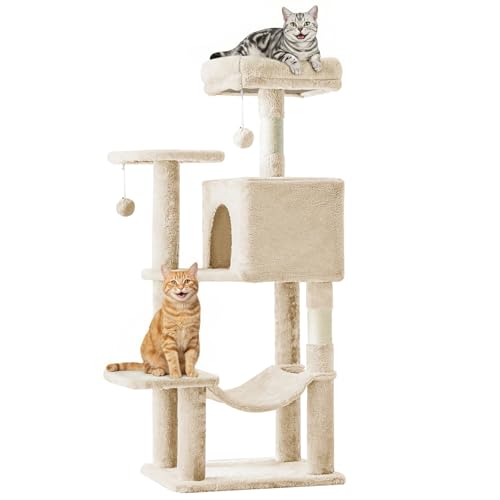
cat trees for small apartments
Why Indoor Cats Need Vertical Territory
Vertical space is not a luxury for indoor cats. In a home, the floor belongs to humans and other pets. Elevated platforms give a cat a zone that is entirely its own, where it can rest without being stepped over or approached from behind. Published feline behavior guidance consistently identifies height as a core component of a cat-friendly environment. A cat that has a high perch tends to show fewer stress behaviors such as hiding, over-grooming, and inappropriate elimination.
Climbing also provides exercise. Indoor cats burn far fewer calories than outdoor cats, and obesity is one of the most common health problems seen in veterinary practice. A cat tree encourages short bursts of jumping and climbing throughout the day, which contributes to muscle maintenance and weight management. The Merck Veterinary Manual cat owner reference notes that environmental factors, including activity opportunities, play a meaningful role in feline health and behavior.
Scratching is the other half of the equation. Cats scratch to mark territory, to shed the outer husks of their claws, and to stretch the muscles of the shoulders and back. This is normal, necessary behavior, not spite. A sisal-wrapped post on a cat tree gives cats a legal place to do it. Without one, they will use whatever vertical, textured surface is available, and upholstered furniture is an excellent substitute from the cat's point of view.
What Actually Matters in a Small-Space Cat Tree
Most cat tree marketing focuses on height and number of platforms. In a small apartment, the more important variables are footprint, base stability, material quality, and surface texture. A 60-inch tower with a narrow base can be less useful than a 30-inch tree that never moves.
Footprint and Placement
Measure the corner or wall space you are willing to give up before shopping. A compact tree typically occupies between 15 and 24 inches of floor width. Corner placement is efficient because the walls limit how far the tree can shift and give the cat a sense of security. Avoid placing a tree in a high-traffic path between the kitchen and living room, since cats use tall structures less when they are constantly disturbed.
Window placement is worth the effort. A tree near a window gives the cat a view of birds, street activity, and changing light, which extends the tree's usefulness well beyond naptime. If floor space truly is not available, wall-mounted shelves or a window perch can substitute, though they require drilling and careful weight rating.
Base Stability
Stability is the single most common reason cats reject a cat tree. When a cat lands on a platform and the whole structure sways, the cat learns that the tree is not a safe place to be. Stability depends on three things: the weight of the base, the width of the base relative to the height of the tree, and the rigidity of the connection between the base and the posts.
A good rule of thumb is that the base should be at least as wide as the tree is tall, and wider for taller models. Heavy bases made from dense board resist tipping better than lightweight bases. If a floor model rocks when nudged by hand, it will rock harder under a jumping cat. For tall trees in homes with multiple cats or large breeds, anchoring the tree to the wall with the included strap is standard practice and is recommended by most manufacturers.
Materials: Board, Posts, and Covering
The structural panels of a cat tree are usually made from particleboard, MDF, or plywood. Plywood and high-density board hold screws better and resist warping, which matters because a cat tree is repeatedly loaded and unloaded every time a cat jumps. Particleboard is acceptable in small, low trees but tends to fail at the joints in tall models over time.
Scratching posts are typically wrapped in sisal rope, sisal fabric, or carpet. Sisal rope is durable and gives cats the resistance they need to shed claw husks. Carpet is softer and some cats prefer it, but carpet fibers can snag claws and the material tends to shed over time. A tree that combines both surfaces lets the cat choose, which is useful when you are not yet sure what your cat prefers.
Platform covering is usually plush fabric or faux fur. These are comfortable but not especially durable, and they collect hair. Removable, washable covers are rare in this category, so plan on vacuuming platforms regularly and spot-cleaning with a pet-safe enzyme cleaner when needed.
Height and Ceiling Clearance
In a small apartment, tree height is often limited by the ceiling and by the cat's jumping ability. Most adult cats can comfortably jump to a platform around three to four feet off the ground, and many can reach higher with a running start. A 28-inch tree suits kittens, senior cats, and cats with limited mobility. A 40- to 50-inch tree suits most healthy adults. Anything taller than about 60 inches should be wall-anchored.
Leave at least a few inches of clearance between the top platform and the ceiling so the cat can sit upright without ducking. If the tree is placed under a shelf or cabinet, verify that the cat has headroom on the highest perch.
Matching the Tree to Your Cat
Cat trees are not interchangeable between cats. Age, size, temperament, and scratching preference all affect which design gets used and which one sits ignored in a corner.
Kittens and young cats benefit from multiple levels and a mix of surfaces because they are still developing preferences. Senior cats and cats with arthritis do better with low platforms, gentle ramps instead of steep jumps, and soft, warm resting spots. Large breeds such as Maine Coons and Ragdolls need wider platforms and heavier bases, since a platform that fits an average cat may not support a 15-pound cat comfortably.
Shy cats often use a tree with a covered condo or cubby as a retreat. Confident cats tend to claim the highest perch. Multi-cat households generally need more than one tree, or one tree with several distinct levels, to reduce competition for the best spot. If two cats are competing for a single top platform, the loser often stops using the tree entirely.
Scratching preference is worth observing before buying. Some cats scratch vertical posts, some prefer horizontal surfaces, and some prefer sisal over carpet or cardboard. A tree that offers at least one vertical sisal post and one alternative surface covers most preferences. If your cat has already destroyed a particular piece of furniture, note the texture and orientation of that surface, because it tells you what the cat wants.
One Widely Available Option: The Frisco 28-Inch Cat Tree
For readers who want a concrete starting point, the Frisco 28-Inch Cat Tree is a compact model that appears frequently in apartment-focused buying discussions. It is a small, multi-level tree with a footprint around 28 inches long by 20 inches wide and a height of 28 inches, which makes it suitable for corners and for cats that do not need a tall climb. It typically includes at least one sisal-wrapped post and a small hideaway or perch, and it is usually priced under $70.
The trade-off is scale. At 28 inches tall, this tree will not satisfy a cat that wants to survey the room from six feet up, and it is not designed for large breeds. It suits kittens, senior cats, and small adults in genuinely tight spaces. Owners who need more height generally move to a taller, wall-anchored model once they have confirmed their cat uses a tree at all.
If you want to see current specifications and pricing for this model, you can check the current price on Amazon. Treat it as one example of a compact tree rather than a universal recommendation, and compare its dimensions against your measured space before ordering.
Features to Prioritize
| Feature | Importance | Why It Matters |
|---|---|---|
| Wide, heavy base | Essential | Prevents tipping and swaying when the cat jumps |
| Sisal scratching post | Essential | Gives the cat a legal scratching surface |
| Multiple levels | Important | Encourages climbing and provides choice of resting spots |
| Hideaway condo | Nice to have | Useful for shy cats and multi-cat households |
| Plywood or dense board | Important | Holds screws better and resists warping over time |
| Wall anchor strap | Important for tall trees | Prevents tipping in homes with multiple or large cats |
| Washable or removable covers | Nice to have | Simplifies cleaning and reduces odor buildup |
Space-Saving Placement Tips
Placement determines whether a cat tree gets used. A tree tucked into a dark bedroom corner will see far less traffic than one placed near a window in the room where the family spends time. Cats want to be near activity without being in the middle of it, so a spot along a wall with a view of the room works well.
Corner placement is efficient because it uses otherwise wasted floor space and limits how far the tree can move. If your apartment has a bay window or a deep windowsill, a tree placed beside it effectively doubles as a viewing platform. Avoid placing a tree next to a heater, radiator, or in direct afternoon sun for long periods, since cats can overheat on plush platforms.
If floor space is genuinely unavailable, wall-mounted shelves and window perches are the zero-footprint alternatives. They require drilling into studs or using appropriate anchors and are best suited to cats that are confident jumpers. Wall systems also let you build vertical territory incrementally, adding a shelf at a time as your cat's abilities and preferences become clear.
Maintenance and Safety
Cat trees need periodic attention to stay safe and usable. Check the bolts and screws every few weeks, especially in the first month after assembly, because wood can compress slightly and joints loosen. Re-tighten as needed. If the base develops a wobble that tightening does not fix, the board may have stripped out and the tree should be repaired or replaced.
Inspect sisal rope for loose strands. Cats can chew or pull rope free, and loose fibers can be swallowed. Trim frayed ends and rewrap or replace the post when the rope is worn through. Carpet-covered posts should be checked for pulled loops that could catch a claw.
Clean platforms regularly. Vacuuming removes hair and dander, and a pet-safe enzyme cleaner handles accidents and saliva. Avoid harsh household cleaners on fabric surfaces, since residue can irritate a cat's paws and skin. If a platform cover is removable and machine washable, follow the manufacturer's instructions and air-dry where possible.
Finally, keep the tree away from anything the cat could knock over when jumping on or off, and away from unstable furniture. A cat launching from a high perch can generate significant force, and a tree placed next to a bookshelf invites accidents.
Common Mistakes to Avoid
Buying on height alone is the most common mistake. A tall tree with a narrow base and lightweight board is less useful than a shorter tree that stays put. Cats notice instability immediately and will avoid the structure.
Another frequent error is placing the tree in a low-traffic area and then concluding the cat does not like cat trees. Cats use structures that are near activity and have a view. Moving the same tree to a better location often changes the outcome entirely.
Skipping the wall anchor on a tall tree is a safety issue, not just a stability preference. In homes with multiple cats or large breeds, an unanchored tall tree can tip during a jump. Most manufacturers include an anchor strap for this reason, and using it is standard practice.
Buying a tree that is too small for the cat is also common. A platform that is comfortable for a 9-pound cat may be cramped for a 15-pound cat, and a tree rated for a single cat may not hold up under two. Check the manufacturer's weight guidance and platform dimensions before ordering.
Finally, do not assume all cats will use a tree immediately. Some cats take days or weeks to investigate a new structure. Placing treats or a favorite toy on the lower platforms, and leaving the tree in place without moving it, often speeds acceptance. Forcing a cat onto a tree tends to have the opposite effect.
Budget Considerations
Compact cat trees span a wide price range, roughly from under $50 for very small models to over $200 for large, solid-wood or designer pieces. In the small-space category, most useful trees fall between $50 and $120. Spending more generally buys heavier board, better hardware, wider platforms, and more durable fabric, all of which affect how long the tree lasts and how stable it feels.
It is reasonable to start with an inexpensive compact tree to learn what your cat actually uses. If the cat ignores one surface and claims another, that information guides the next purchase. If the cat uses the tree heavily, upgrading to a sturdier model in the same footprint is a straightforward decision.
Frequently Asked Questions
How tall should a cat tree be for an apartment?
For most healthy adult cats, a tree between 40 and 50 inches tall offers useful vertical territory without requiring wall anchoring. Trees under 30 inches suit kittens and senior cats. Trees over 60 inches should be anchored to a wall.
Do cats prefer sisal or carpet scratching posts?
Preferences vary by cat. Sisal is more durable and is generally recommended for claw maintenance. Carpet is softer and some cats prefer it, but it sheds and can snag claws. Offering both surfaces lets the cat choose.
Can I put a cat tree in a small studio apartment?
Yes. Corner placement and compact models with footprints around 20 inches wide work in studios. If floor space is not available, wall-mounted shelves and window perches are alternatives that use no floor area.
How do I stop a cat tree from wobbling?
Re-tighten all bolts, verify the base is fully assembled, and place the tree on a level floor. If wobbling continues, the base may be too small for the height, or the board may be stripped. Wall anchoring resolves most remaining movement.
How often should I replace a cat tree?
Replace a tree when the sisal is worn through, the board is warped or stripped, or the structure no longer feels stable when nudged. With regular tightening and occasional re-wrapping of posts, many compact trees last two to four years.
Where to Buy
As an Amazon Associate, PawCritic earns from qualifying purchases. This does not affect our reviews or recommendations.
If the Sweetcrispy 44 Inch Cat Tree matches your measurements and your cat's size, you can view this option on Amazon. Check the listed dimensions against your corner space and confirm the weight guidance before ordering, since compact trees vary significantly in how much cat they can safely support.
For readers comparing alternatives, the same category includes taller narrow trees, wall-mounted shelf systems, and window perches. Each has trade-offs in footprint, stability, and installation effort. A compact freestanding tree remains the simplest option for renters who cannot drill into walls, while wall systems offer more vertical range for cats that are confident climbers.
Disclosure: This article contains affiliate links. We may earn a commission at no extra cost to you.