Why Standard Cat Trees Fail Large Cats
A 15-pound Maine Coon or a solidly built domestic shorthair puts stresses on a cat tree that most budget furniture was never designed to handle. The failure points are predictable: a narrow base that tips when the cat launches upward, particle board platforms that sag under concentrated weight, and plastic joint connectors that crack where the posts meet the base. Manufacturers often list generous weight limits that assume a static cat, not a cat jumping, landing, and pivoting on a single perch.
Veterinary behavior guidance is consistent on why this matters beyond furniture damage. Scratching is a normal feline behavior tied to claw maintenance, territorial marking, and stretching, and cats that lack a stable, tall scratching surface often redirect that behavior to sofas and door frames. The ASPCA notes that scratching is normal and healthy, and that providing appropriate scratching outlets is the practical solution rather than punishment. A wobbly tree does not satisfy that need because the cat will not commit its full weight to a surface that shifts underneath it.
For 2026, the category has shifted in two directions. First, wall-mounted and stud-anchored modular systems have become the most reliable answer for cats over 20 pounds, because they transfer load into the building structure instead of relying on a freestanding base. Second, more manufacturers are using solid pine or birch framing rather than particle board, which reduces platform sag over years of daily use. The persistent weak point to check before buying is the connector hardware: metal bolts and through-bolts hold up, while press-fit plastic cams and thin dowels are the parts that fail first.
What Actually Makes a Tree Suitable for a Large Cat
- Base footprint and mass: A base under about 20 inches square is marginal for a cat over 15 pounds. Wider is better, and base weight matters as much as base width.
- Post diameter: Scratching posts of at least 3.5 to 4 inches in diameter give a large cat room to grip and stretch fully. Sisal rope wrapped around a thin cardboard tube is the most common failure point.
- Perch load rating: Look for perches rated at 20 pounds or more each, not a single total rating for the whole tree.
- Frame material: Solid wood or thick plywood beats particle board. Particle board swells and crumbles once a bolt loosens and moisture reaches the core.
- Anchoring provision: A wall-mount strap or bracket, or a design intended for stud attachment, is the single most effective anti-tip measure.
- Replaceable parts: Sisal posts and perch covers that can be reordered extend the usable life of the frame considerably.
One more factor that owners frequently overlook is placement. Even a heavy tree performs better in a corner where two walls limit tipping, and on a hard floor with a non-slip pad rather than deep carpet, which lets the base shift. Cornell Feline Health Center guidance on feline environmental needs emphasizes vertical space and elevated resting spots, which means the tree should be tall enough to give the cat a genuine high vantage point, not just a step stool.
Product Options for Large Cats
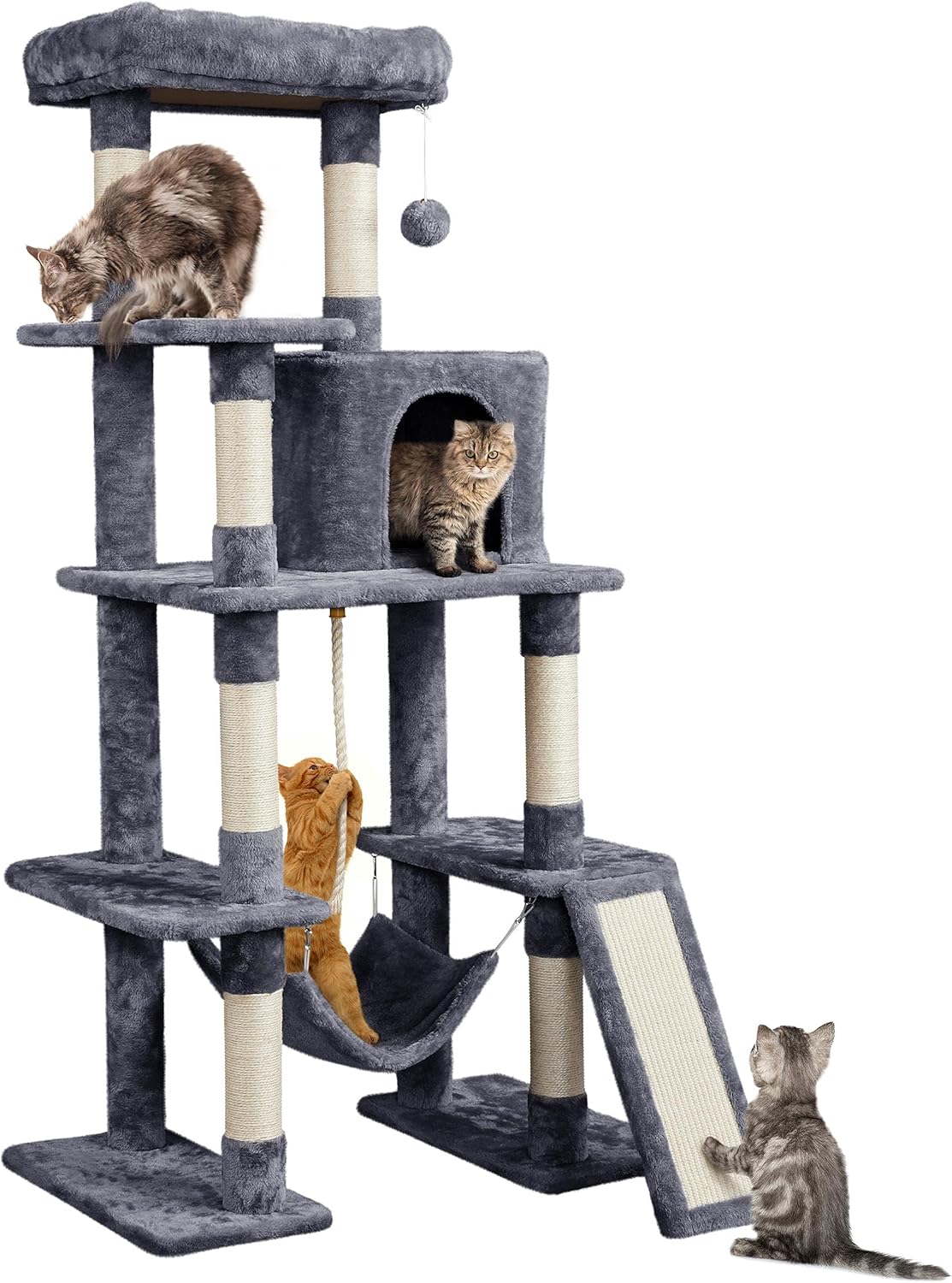
cat trees large cats
1. Feandrea Cat Tree Tower
This is a tall multi-level tower in the 70-inch class with a base in the 26-inch range, which is the size bracket where freestanding trees start to become genuinely stable for cats in the 15 to 20 pound range. The manufacturer rates the platforms for cats well above typical domestic weights, and the post diameter is close to the 4-inch target that lets a large cat stretch out fully while scratching.
The trade-off is assembly and material. Like most towers in this price band, the platform surfaces are covered board rather than solid hardwood, so the tree is best suited to a cat that uses it heavily but is not repeatedly launching from the top perch. Owners who report long-term satisfaction with this style of tower generally tighten all bolts after the first week of use and check them again monthly, since vibration from jumping is what loosens hardware.
2. Go Pet Club Cat Tree
This line is the value entry in the category, sold in heights ranging from roughly 50 inches up to the low 90s, with pressboard construction and multiple color options. For a household with a cat in the 12 to 16 pound range, a taller model from this line can be a reasonable first heavy-duty tree, particularly if it is placed in a corner and anchored to the wall.
The honest limitation is the material. Pressboard is denser and stronger than the corrugated and honeycomb cores used in the cheapest trees, but it is still not solid wood, and the joints are where these trees eventually loosen. A large cat that leaps onto the highest platform repeatedly will stress the upper connections most. Buyers who choose this option should treat wall anchoring as mandatory rather than optional, and should expect to re-tighten hardware periodically.
3. Vesper Cat Furniture Box
This is the design-forward option: a box-style structure built around wood-toned panels and a cube or condo element rather than a traditional carpeted tower. For owners who need furniture that reads as a piece of living room furniture rather than pet equipment, this category solves a real problem, and the solid panel construction is generally sturdier at the base than a tall thin tower.
The trade-off is height and scratching surface. Box-style designs tend to sit lower than a 70-inch tower, so they suit cats that want a den and a mid-height perch more than cats that want to survey the room from near the ceiling. The scratching surfaces are also often smaller than a dedicated 4-inch sisal post. This is a good fit for a large but less acrobatic cat, or as a second piece alongside a taller climbing structure.
4. Armarkat Cat Tree
This brand is the one most often cited by owners of very large cats specifically because of base dimensions, with some models offering bases approaching 28 inches across, plus wall-mounting hardware included in the box. For a cat at or above 20 pounds, that combination of a wide, heavy base and an actual anchoring kit is the most important thing a freestanding tree can offer.
The trade-off is footprint and appearance. A 28-inch base occupies a substantial square of floor, and these trees are typically covered in plush carpet rather than finished wood, which is durable and grippy but visually bulky. Replaceable parts availability is a genuine advantage here, since sisal posts and perch covers wear out long before the frame does, and being able to reorder them extends the life of the whole unit.
Size Guide by Cat Weight
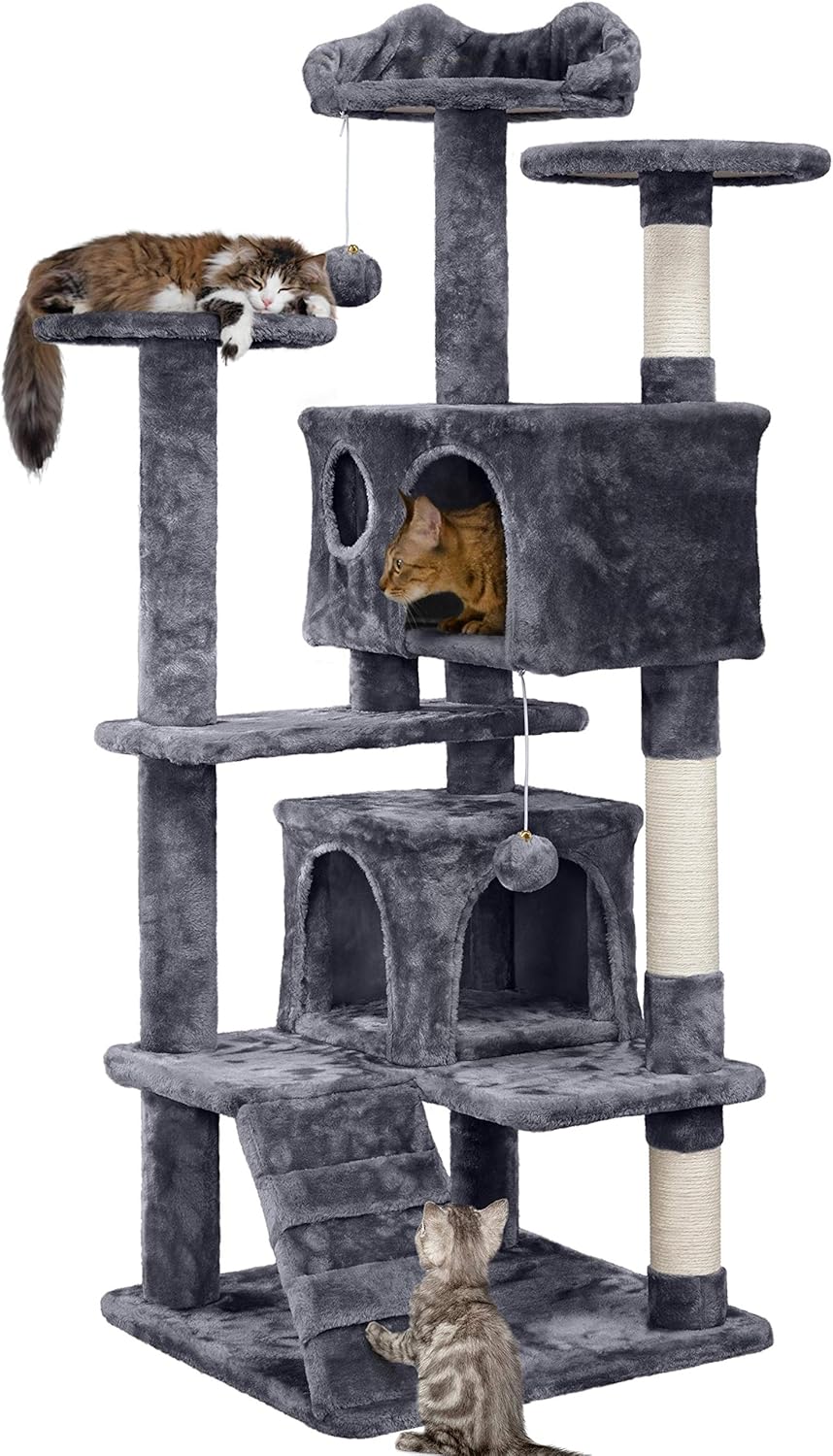
cat trees large cats
The table below translates common cat weights into the minimum specifications that published manufacturer ratings and owner reports suggest. These are starting points, not guarantees, because a 14-pound cat that launches vertically puts more stress on a tree than a 20-pound cat that climbs carefully.
| Cat weight | Minimum base | Post diameter | Perch rating | Anchoring |
|---|---|---|---|---|
| 10 to 15 lbs | 20 inches | 3 inches | 20 lbs each | Recommended |
| 15 to 20 lbs | 24 inches | 3.5 to 4 inches | 25 lbs each | Strongly recommended |
| 20 to 25 lbs | 26 inches or wall-mounted | 4 inches or more | 30 lbs each | Required |
| 25 lbs and up | Wall-mounted system | 4 inches or more | 35 lbs each | Required, into studs |
Why Weight Ratings Are Not the Whole Story
A platform rated for 44 pounds sounds conclusive, but static load ratings do not describe what happens when a cat lands on the edge of a perch from three feet above. Dynamic load is several times the cat's body weight, and it concentrates at the joint between the perch and the post. This is why two trees with identical weight ratings can perform very differently: the one with through-bolted posts and a solid wood platform survives, while the one with cam-lock connectors and a hollow-core platform does not.
Owners evaluating a tree before purchase can check a few specifics that correlate well with durability. Look for bolt heads visible on the underside of platforms rather than only recessed fittings on top. Look for posts that run continuously through a platform rather than terminating at it. Look for a base that is a single heavy panel rather than a hollow box. And look for a stated wall-anchoring method, because the presence of an anchoring kit signals that the manufacturer expects the tree to be secured.
Safety Considerations for Heavy Cats
The most common injury scenario with large cats and cat trees is not a fall from height, it is a tip-over. A tree that topples while a cat is on an upper platform can trap or strike the animal, and it can also damage whatever it lands on. Wall anchoring into studs, not drywall anchors alone, is the reliable fix. A stud finder and a pair of lag bolts or a rated furniture strap are inexpensive relative to the cost of the tree.
Assembly quality matters as much as design. Bolts should be tightened firmly at assembly and then re-checked after the first week, because carpet and wood compress slightly under load and hardware that felt tight on day one can loosen. A monthly check of every visible fastener takes a few minutes and catches the loosening that precedes most structural failures.
Positioning also affects safety. Corners limit tipping, hard flooring with a non-slip mat prevents sliding, and keeping the tree away from heat sources protects both the materials and the cat. Owners of cats that chew should check sisal rope for loose strands, since ingested fiber can cause gastrointestinal problems; the ASPCA Animal Poison Control and veterinary references are the right resources if a cat ingests non-food material and shows symptoms.
Finally, height should be matched to the room. A tree that reaches a ceiling fan or a shelf of breakables creates a new hazard. The goal is a stable high perch with a clear landing zone, not the tallest possible structure.
Maintenance and Longevity
Sisal rope is the wear item on almost every cat tree. Once strands begin to fray and pull away, the post becomes less satisfying to scratch and the cat may look elsewhere. Re-wrapping a post with new sisal, or replacing a modular post section, costs far less than a new tree and restores the surface the cat actually wants. Carpet-covered perches can be vacuumed regularly and spot-cleaned, and loose carpet edges can be re-secured before they become a chewing hazard.
Frame longevity depends mostly on moisture and hardware. Particle board that gets wet swells permanently, so trees should not be placed against a wall that condenses or near a humidifier. Bolts that are kept snug prevent the small movements that enlarge holes in soft board. Owners who keep a tree for many years generally do so by replacing posts and covers two or three times on the same frame.
Common Mistakes to Avoid
- Buying for height instead of base: A 90-inch tower on a 16-inch base is less stable than a 60-inch tower on a 26-inch base.
- Ignoring the connector type: Plastic cam locks and thin dowels are the parts that fail, regardless of the platform rating.
- Skipping wall anchoring: The hardware is often included for a reason, and using it is the difference between a stable tree and a tipping hazard.
- Assuming one rating covers every perch: A total weight limit is not the same as a per-platform limit, and cats concentrate weight on one perch at a time.
- Placing on thick carpet without a mat: A base that can slide will eventually slide, especially under a jumping cat.
- Never re-tightening hardware: Loose bolts are the earliest warning sign of structural failure.
- Choosing a tree the cat cannot fully stretch on: A scratching post shorter than the cat's full reach does not meet the behavioral need.
Frequently Asked Questions
How much weight can a typical cat tree hold?
Manufacturer ratings vary widely. Many standard trees rate individual perches between 15 and 30 pounds, while heavy-duty models designed for large breeds rate perches at 30 to 44 pounds or more. The rating that matters is the per-platform figure, not a single total for the whole structure.
Is wall mounting necessary for a 20-pound cat?
For a cat at or above 20 pounds, anchoring is the most reliable way to prevent tip-over, particularly if the cat jumps onto upper platforms. Freestanding trees with very wide, heavy bases can work, but anchoring removes most of the risk.
What post diameter do large cats need?
Posts of 3.5 to 4 inches in diameter let a large cat grip and stretch fully. Thinner posts wrapped in sisal on a cardboard tube are the most common failure point on budget trees.
How often should hardware be checked?
After the first week of use, then monthly. Carpet and wood compress under load, so bolts that were tight at assembly can loosen as the tree settles.
Do large cats need taller trees?
Height provides the elevated vantage point cats seek, and Cornell Feline Health Center guidance on feline environmental needs supports providing vertical space. But height only helps if the tree is stable enough for the cat to use the upper levels confidently.
Where to Buy
As an Amazon Associate, PawCritic earns from qualifying purchases. This does not affect our reviews or recommendations.
Affiliate Disclosure: This article contains affiliate links. We may earn a commission at no extra cost to you.
For further reading on feline health and behavior, see the Cornell Feline Health Center and the Merck Veterinary Manual cat owner reference. For questions about diet and feeding a large-breed cat, the AAFCO pet food standards define the nutritional adequacy statements found on cat food labels.