Why the Right Collar Matters More Than Most Owners Realize
A dog collar is far more than a fashion accessory. It is your dog's primary identification system, a control point during walks, and a critical piece of emergency equipment. If your dog ever escapes, a well-made collar with a readable ID tag is the fastest way for a good Samaritan or an animal control officer to reunite you with your pet, because a stranger on the street cannot scan a microchip but anyone can read a tag and dial a phone number. A reflective collar can be the difference between a driver seeing your dog at dusk and a tragedy on the roadside. A properly fitted martingale collar can prevent a dog from backing out of their collar mid-walk — a frightening and genuinely dangerous scenario that happens more often than most owners realize, particularly with narrow-headed breeds like Greyhounds and Whippets whose necks are wider than their skulls.
This guide is a reference resource, not a lab report. PawCritic does not run hands-on product testing programs. Every observation referenced here is drawn from manufacturer specifications and published product documentation, from verified owner reports on retail listings, and from established veterinary guidance. Where a claim comes from a manufacturer, it is labeled as such; where it reflects the consensus of long-term owner reviews, that is what the text says. The goal is to give you a durable framework for judging any collar you consider, plus two concrete examples you can look at on Amazon as illustrations of the principles at work.
What a Collar Actually Has to Do: The Four Jobs
Before comparing any products, it helps to be precise about what a collar is for. First, identification: the collar carries tags or embroidered contact information, so legibility and attachment security matter more than aesthetics. Second, control: the collar is a point of contact for a leash, which means the webbing, stitching, buckle, and D-ring are load-bearing safety components, not decorative ones. Third, comfort during continuous wear: a collar sits against your dog's skin for many hours a day, and poor edge finishing or rough materials can cause chafing, hair loss, and matting over time. Fourth, visibility and emergency function: reflective elements, high-contrast colors, and breakaway designs all exist to reduce specific, well-documented risks. A collar that fails any of these four jobs is the wrong collar, regardless of price or brand recognition. For general canine health and safety reference, the Merck Veterinary Manual dog owner section is a reliable starting point maintained by veterinary professionals.
Collar Types and Who Each One Suits
Flat collars are the standard everyday design: a simple band with a buckle and a D-ring. They suit dogs who walk politely on a loose leash and mainly need something to hold ID tags. They are not ideal for persistent pullers, because sustained pressure against the throat can contribute to tracheal irritation over time — many veterinarians recommend a harness as the primary walking tool for strong pullers and reserve the collar for identification.
Martingale collars use a limited-slip design: a fixed loop encircles the neck, and a smaller control loop tightens when leash pressure is applied, but only up to the width of the fixed loop. This prevents escape without the choking action of a true slip or choke chain. They are considered essential for sighthounds and any dog whose head is narrower than their neck, and they are widely used as a transitional tool during leash training. They must be fitted correctly and are generally not recommended for unattended wear, since the loop geometry can catch on objects.
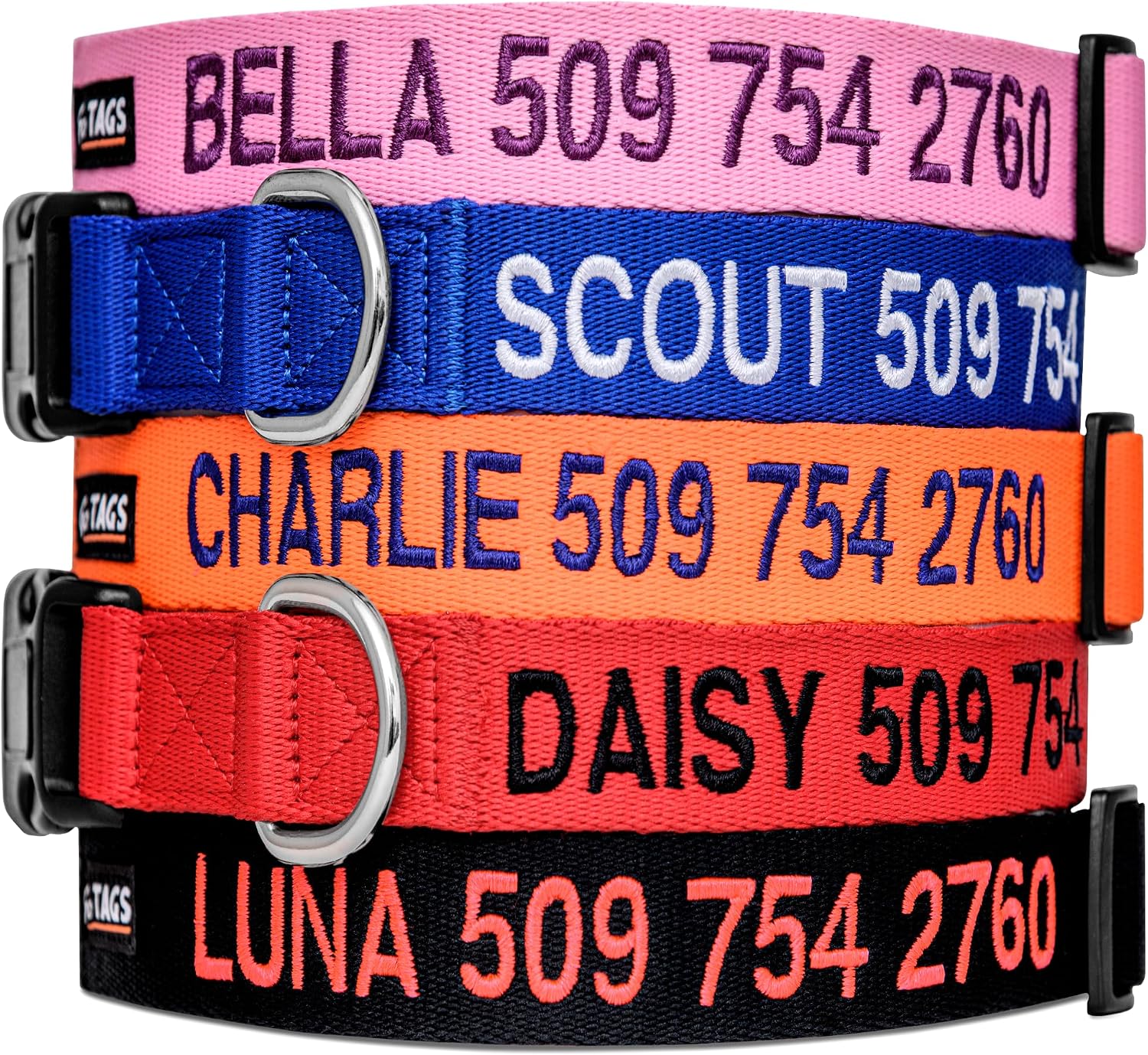
Reflective and high-visibility collars incorporate retroreflective thread, trim, or piping that returns light from headlights back toward the source. For dogs walked at dawn, dusk, or night — or in rural areas without street lighting — owners and safety advocates treat reflectivity as a genuine safety necessity rather than a styling choice. Breakaway collars, long standard for cats and available for small dogs, use a buckle that releases under a firm pull to reduce strangulation risk if the collar snags on a crate bar or branch. Personalized or embroidered collars stitch the dog's name and a phone number directly into the webbing, eliminating dangling tags that can fall off, catch on things, or wear illegible. GPS-enabled collars integrate tracking hardware for off-leash adventures, and tactical collars with MOLLE webbing add modular attachment points for lights, tags, or trackers on working dogs.
Materials: What the Webbing Is Made Of and Why It Matters
Nylon is the most common collar material because it is strong, inexpensive, dyeable into hundreds of colors, and machine washable. Its main drawback is that it absorbs water, stays damp for hours after a swim or a rainy walk, and damp nylon against skin is a common contributor to odor and, in some dogs, skin irritation. If your dog swims frequently or lives in a wet climate, look for materials that do not hold water.
Polypropylene webbing has a higher strength-to-weight profile than standard nylon and, importantly, does not absorb water, which is why it is favored for collars intended for swimmers and outdoor dogs. Grosgrain ribbon over a webbing core adds pattern variety and a pleasant texture, at a modest cost in grip. Biothane — a polyester webbing coated in PVC or TPU — is effectively waterproof, wipes clean, and resists odor, making it popular among owners of dogs who roll in mud; its trade-off is a stiffer feel and a plastic-like appearance. Leather, properly conditioned, is durable and develops a soft hand over time, but it is a poor choice for water dogs because it stiffens and cracks when repeatedly soaked and dried. Whatever the material, examine edge finishing: heat-sealed or bound edges resist fraying, while cut edges on cheap webbing begin to unravel within months of rubbing against crate bars and furniture.
Hardware: The Parts That Actually Fail
When collars break, they almost always break at the hardware, so this is where scrutiny pays off. Look for a welded D-ring rather than a folded one. A folded D-ring has a seam, and that seam is the single most commonly reported hardware failure point in owner reviews of budget collars. A welded ring is a continuous loop with no opening to deform under load.
Side-release buckles should be made of acetal or a comparable engineering plastic; thin, flexible buckles that flex visibly when you squeeze them are a sign of cost-cutting. Test the buckle action before relying on it — it should click firmly into place without needing to be squeezed at an angle, and it should release with deliberate pressure on both tabs rather than a light brush. Metal hardware should be stainless steel, anodized aluminum, or solid brass; nickel plating over base metal is common on inexpensive collars and can corrode or irritate sensitive skin after repeated exposure to water and salt. Check where the webbing passes through the buckle and D-ring: these are the stress points where reinforcing stitching, ideally box-stitched or bar-tacked, separates well-made collars from cheap ones.
Sizing and Fit: The Two-Finger Rule and Its Limits
Correct fit is the foundation of collar safety. The widely accepted two-finger rule says you should be able to slide two fingers flat between the collar and your dog's neck — snug enough that the collar cannot slip over the head, loose enough not to restrict breathing or rub. Measure your dog's neck with a soft tape at the base of the neck where the collar naturally sits, and add roughly two inches for comfort; then choose a size range where that measurement falls in the middle, not at the extreme end, so you have adjustment room in both directions.
Width matters as much as length. As a general guideline, collars around 3/8 to 5/8 of an inch suit very small dogs, 3/4 to 1 inch suits medium dogs, and 1 to 1.5 inches suits large and giant breeds. An overly narrow collar on a powerful dog concentrates leash force on a small strip of the throat; an overly wide collar on a small dog restricts natural neck movement and looks and feels bulky. For martingales, fit is more demanding: when the control loop is pulled, the two D-rings or slide stops should come close to, but not touch, the fixed loop. Recheck fit weekly on puppies and on dogs whose weight fluctuates seasonally — a collar fitted in November may be dangerously loose or tight by spring.
Safety Considerations Most Owners Overlook
The most underappreciated collar risk is snagging. Collars have caught on crate bars, fence gaps, heater vents, and other dogs' teeth during play, with occasionally fatal consequences. This is why most trainers and many veterinarians advise removing the collar before crating and during rough dog-to-dog play, and why breakaway designs exist. A related point: ID tags should be attached with a proper split ring, not a cheap keyring, because lost tags are among the most frequent owner complaints.
Avoid choke chains and properly applied prong collars unless you are working with a qualified trainer; both rely on discomfort and carry real potential for tracheal and neck injury in untrained hands. Check your dog's neck skin weekly under the collar for redness, hair loss, or moisture rash — these are early signs of poor fit, rough materials, or a collar that never dries. For toxic exposure concerns involving anything your dog chews or ingests, including collar components, the ASPCA Animal Poison Control resource maintains current guidance. And remember that a collar is only part of an identification system: pairing a tagged collar with a registered microchip gives you redundancy, since collars come off and tags fall silent.
Two Collars Worth a Close Look
LupinePet Originals Patterned Collar: A Benchmark for Warranty-Backed Everyday Wear
As a concrete example of the durability-first approach described above, the LupinePet Originals line is instructive. It is made in the USA from grosgrain ribbon over a polypropylene webbing core, and the manufacturer's published policy is a lifetime guarantee that explicitly covers damage the dog itself inflicts — including chewing — which is unusual; most brands exclude chew damage from warranty coverage precisely because it is so common. Polypropylene, as noted earlier, does not absorb water, which suits swimmers and dogs in wet climates. The hardware is specified as rust-proof, with a welded rather than folded D-ring, and the adjustment range on most sizes spans several inches. Verified owner reports over years of use consistently describe the webbing holding up without fraying and the warranty being honored without argument when dogs destroyed collars. The honest trade-offs: the grosgrain surface is smoother and slightly less grippy than plain nylon, some owners report minor pattern fading after many wash cycles, and the patterned line is a flat-collar design without a martingale option. It suits most dogs well, especially chewers and swimmers, and owners who want a one-time purchase — you can check the current price on Amazon.
Blueberry Pet Classic Solid Color Collar: A Benchmark for Value
At the opposite end of the price spectrum, the Blueberry Pet Classic illustrates what a competent budget collar looks like. It uses heavy-duty woven nylon with reinforced stitching at the buckle and D-ring attachments, nickel-plated hardware, and a side-release buckle that operates one-handed — convenient for quick removal. The size range runs from roughly 6-10 inch necks up to 22-26 inches, and the color selection exceeds thirty solid options including high-visibility shades. Verified owner reviews describe reliable everyday service, intact stitching, and secure buckles, which is respectable performance at a price point well under fifteen dollars. The trade-offs follow directly from the price: all-nylon construction absorbs water and dries slowly, there is no reflective trim, the D-ring is folded rather than welded, and there is no lifetime warranty. This makes it a sensible choice for budget-conscious households, puppies who will outgrow a collar in months, multi-dog homes that need spares, and backup collars kept in the car — you can view this option on Amazon.
Between these two poles, you can evaluate any collar on the market: compare the warranty terms, the D-ring construction, the material's water behavior, the presence of reflectivity, and the adjustment range against these benchmarks and the price premium being asked.
Special Cases: Pullers, Sighthounds, Large Breeds, and Personalization
For dogs who pull, the veterinary-consensus position is to walk them on a harness, particularly a front-clip design, and reserve the collar for ID. If a collar must serve as the control point, a limited-slip martingale prevents the backing-out escape and distributes pressure more evenly than a flat collar, but it is a management tool, not a substitute for loose-leash training. For sighthounds and any dog with a neck wider than the head, a martingale is close to non-negotiable for walk safety, and lined versions with a soft mesh inner surface reduce the fur matting that unlined martingales can cause on coated breeds.
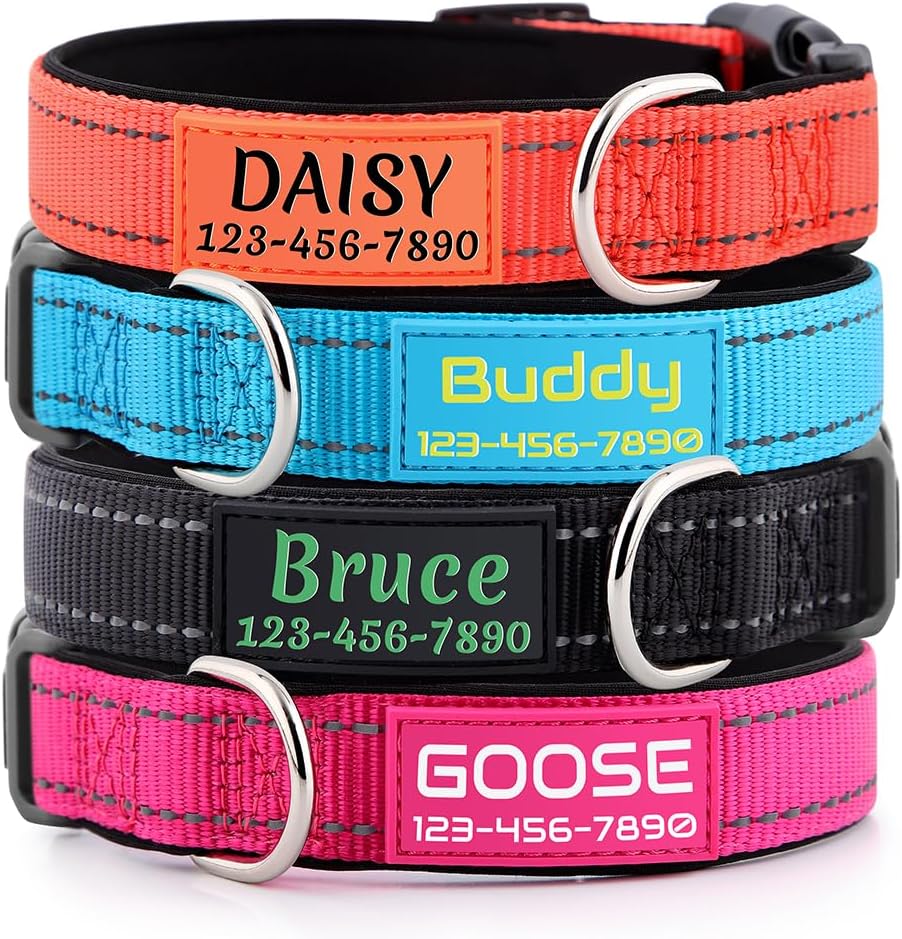
Large and powerful breeds need width and hardware rated for real force: look for 1 to 1.5 inch webbing, box-stitched stress points, welded hardware, and buckles specified for high load. On the flip side, small dogs under about fifteen pounds do better with narrow, lightweight collars; a heavy buckle and thick webbing that are reassuring on a Mastiff are an uncomfortable burden on a Chihuahua. For permanent identification, embroidered collars stitch name and phone number directly into the webbing — nothing to jingle, nothing to lose — and the ordering process on retail listings lets you preview thread colors and character limits before purchase. The honest limitation of embroidery is sun fading over long periods and finite character counts, so keep the text short: a name and one phone number outperforms a clever phrase.
Maintenance: Making a Good Collar Last
A collar is a maintenance item, not a purchase you make once and forget. Inspect it monthly: run your thumb along the edges for fraying, tug the stitching at the buckle and D-ring, flex the buckle tabs for cracks, and check that the D-ring has not deformed into an oval. Wash nylon and polypropylene collars in the machine inside a laundry bag, or by hand with mild soap, and air-dry them; high dryer heat can weaken webbing fibers over time. Rinse collars promptly after exposure to salt water, chlorine, or mud, because salt in particular accelerates corrosion on plated hardware. Replace the collar immediately if any hardware is damaged — a buckle or D-ring that fails mid-walk can turn an ordinary outing into a loose dog near traffic. Collars exposed daily to water and sun typically need replacement in one to two years even when well maintained; a lifetime warranty like LupinePet's is worth exercising rather than tolerating visible wear.
Common Buying Mistakes
- Buying by neck weight guesswork instead of measuring with a soft tape and choosing a size where the measurement sits mid-range.
- Choosing a collar at the extreme end of its adjustment range, leaving no room for seasonal weight change or growth.
- Ignoring the D-ring construction — a folded ring with a visible seam is the most frequently reported hardware failure on budget collars.
- Leaving a martingale on a crated or unsupervised dog, where the control loop can snag.
- Skipping reflectivity for dogs walked in low light, then relying on a dark collar that disappears at dusk.
- Assuming a microchip replaces a tag: chips require a scanner and a registered, current contact entry to do anything at all.
- Using choke chains or prong collars without professional guidance, given the injury potential in untrained hands.
- Never rechecking fit on puppies and dogs whose weight fluctuates, resulting in collars that slip off or rub.
Frequently Asked Questions
What collar is best for a dog who pulls on leash?
The general veterinary recommendation is a well-fitted harness as the primary walking tool, since sustained pulling against a collar can contribute to tracheal irritation. If you use a collar for control, a properly fitted limited-slip martingale prevents escape and evens out pressure. Choke chains, prong collars, and slip leads are tools that carry real risk of misuse and are best reserved for work under a qualified trainer's supervision.
How tight should a dog collar be?
Follow the two-finger rule: two flat fingers should slide comfortably between collar and neck. Too loose and the collar can slip over the head, especially on narrow-skulled breeds; too tight and you risk chafing, hair loss, and breathing difficulty. On a martingale, the control loop should tighten only to the width of the fixed loop, never beyond it. Recheck fit weekly on growing puppies.
Should I remove my dog's collar at night?
Most trainers and behavior professionals advise removing the collar before crating and during unsupervised play, because snagging on crate bars or another dog's teeth is a documented strangulation risk. Many owners use the collar during waking hours and rely on a registered microchip overnight. A breakaway collar is a reasonable compromise for dogs who wear collars around the clock.
How often should a collar be replaced?
Inspect monthly; replace at any sign of hardware damage, fraying, or cracked stitching. With normal use and care, a quality collar typically lasts one to three years, and water-heavy or sun-heavy use shortens that. If the manufacturer offers a lifetime warranty covering wear or chew damage, use it rather than working a degraded collar.
How to Choose: A Practical Checklist
Measure the neck, pick the width appropriate to the dog's size, and choose a size with adjustment room on both sides. Inspect the D-ring for a weld rather than a fold, the buckle for solid click action, and the stress points for reinforcing stitches. Match the material to the lifestyle: non-absorbing webbing for swimmers, strong wide nylon for powerful breeds, lightweight narrow collars for toy dogs. Add reflectivity if any walk happens in low light. Decide between hanging tags, embroidered identification, or both, and keep the microchip registration current regardless. Finally, budget honestly: a warranty-backed collar at the higher end of the price range can cost less over the dog's lifetime than replacing budget collars repeatedly, but a well-reviewed budget collar is entirely adequate as a spare or a puppy's temporary fit.
Final Thoughts
A collar is the most-worn item in your dog's life and one of the cheapest safety investments you will make. The categories above — flat, martingale, reflective, breakaway, personalized, GPS, and tactical — exist because dogs differ enormously in head shape, coat, pulling habit, and lifestyle, and the right choice follows from your specific dog rather than from any brand ranking. Evaluate materials, hardware, fit, and warranty against the principles here, look closely at how any candidate collar is actually constructed, and replace it the moment it shows wear. For further general guidance on responsible pet care and preventive health, the AVMA pet owner resources publish current, veterinarian-reviewed material.
Disclosure: PawCritic is reader-supported. When you buy through links on our site, we may earn an affiliate commission at no additional cost to you. As an Amazon Associate, we earn from qualifying purchases.