Dog Flea, Tick and Parasite Prevention: A Research-Based Buying Guide for 2026
Published on June 18, 2026 by PawCritic — Dogs Category
Fleas and ticks are more than a nuisance. They are vectors for diseases that can seriously affect a dog's health, including Lyme disease, Rocky Mountain spotted fever, ehrlichiosis, anaplasmosis, tapeworm infection, and in severe cases, life-threatening anemia in puppies and small dogs. The Companion Animal Parasite Council tracks rising exposure across the United States, driven partly by warmer winters and the geographic expansion of tick populations. For dog owners, the practical question is not whether to use prevention, but which form of prevention fits a specific dog, household, and budget. This guide explains the categories of flea and tick products, the active ingredients that matter, the trade-offs between delivery methods, and the safety considerations that published veterinary guidance consistently emphasizes.
PawCritic does not operate a testing laboratory and does not run product trials. Every statement below is drawn from manufacturer labeling and specifications, published veterinary and regulatory guidance, or verified owner reports. Where a claim depends on a specific product's label, the label is the source. Where a claim depends on general veterinary consensus, the relevant professional guidance is cited inline.
Quick Comparison of Common Prevention Categories
| Category | Typical Duration | Tick Coverage | Water Resistance | Prescription | Best Suited For |
|---|---|---|---|---|---|
| Oral isoxazoline chew | 30 days to 12 weeks | Yes, varies by species | Not applicable | Usually required | Dogs that swim, dogs with skin sensitivities, owners who prefer no residue |
| Topical fipronil and methoprene | 30 days | Yes | Yes after drying | Over the counter | Budget-conscious owners, dogs that tolerate topical residue |
| Topical permethrin blend | 30 days | Yes, plus repellency | Yes after drying | Over the counter | Dogs in mosquito-heavy areas, homes without cats |
| Long-duration collar | 7 to 8 months | Yes, with repellency | Yes | Over the counter | Owners who struggle with monthly dosing schedules |
| Fast-acting oral tablet | 24 hours | No | Not applicable | Over the counter | Rapid knockdown during an active flea infestation |
| Plant-based spray | 2 to 7 days | Limited | No | Over the counter | Multi-pet homes needing a cat-safe environmental option |
| Environmental and home spray | Up to 7 weeks on surfaces | Varies | Not applicable | Over the counter | Treating bedding, carpets, and kennels alongside pet treatment |
Oral Isoxazoline Chewables
Isoxazolines are a relatively recent class of systemic insecticides that include afoxolaner, fluralaner, sarolaner, and lotilaner. They work by interfering with specific neurotransmitter receptors in fleas and ticks, causing paralysis and death after the parasite takes a blood meal. Because the drug circulates in the dog's bloodstream rather than sitting on the coat, isoxazolines are not affected by swimming, bathing, or rain, and they leave no greasy residue on furniture or bedding. They are also generally not transferred to humans or other pets through casual contact, which makes them attractive in households with young children.
The main trade-offs are cost, prescription requirements, and the fact that these products kill after a bite rather than repelling before one. The U.S. Food and Drug Administration has issued a caution about neurologic adverse events associated with isoxazoline products, most commonly in dogs with a prior history of seizures or neurologic disorders. Owners of such dogs should discuss the risk-benefit balance with a veterinarian. The Merck Veterinary Manual dog owner reference is a useful starting point for understanding how these products differ from older classes.
One widely prescribed chewable in this class is available through a range of veterinary and retail channels. Because dosing is weight-banded, owners must match the chew size to the dog's current weight, and a veterinary prescription is typically required. For readers who want to see how this category is priced and packaged, check the current price on Amazon.
Key Specifications for a Typical Isoxazoline Chew
- Active ingredient: Afoxolaner, an isoxazoline-class insecticide
- Onset: Labeled to begin killing fleas within 30 minutes to 4 hours
- Duration: 30 days per chew
- Weight bands: Typically 4 to 10 lbs, 10.1 to 24 lbs, 24.1 to 60 lbs, and 60.1 to 121 lbs
- Labeled coverage: Adult fleas plus several tick species, including black-legged, American dog, and Lone Star ticks
- Prescription: Required in the United States
Who This Category Suits
Oral isoxazolines are a strong fit for dogs that swim frequently, dogs with sensitive skin that reacts to topical products, and households where residue on upholstery is a concern. The trade-off is that they require a veterinary visit and prescription, cost more per dose than most over-the-counter topicals, and do not repel parasites before they attach. Owners who want the fastest possible flea kill and the cleanest application experience tend to accept those trade-offs. The same product is also sold in larger weight bands for big dogs, and the same active ingredient appears in several veterinary brands, so price comparison across retailers is worthwhile. A second option in the same class can be viewed at this Amazon listing for readers comparing formats.
Topical Fipronil and Methoprene Spot-On Treatments
Fipronil combined with (S)-methoprene is one of the most widely used topical chemistries in veterinary medicine. Fipronil kills adult fleas and ticks, while (S)-methoprene is an insect growth regulator that prevents flea eggs and larvae from developing into adults. Together they interrupt the flea life cycle, which is important because the adult fleas visible on a dog represent only a small fraction of the total infestation in a home. Most products in this category are labeled for 30 days of protection and are water-resistant after the application site has dried, typically within 24 to 48 hours.
The practical drawbacks are familiar to anyone who has used a spot-on: a visible or greasy residue at the application site for a day or two, a distinct odor in some formulations, and the need to keep the dog from licking the site until it dries. Some flea populations have shown reduced susceptibility to fipronil in certain regions, which is one reason veterinarians sometimes rotate chemistries. For general guidance on parasite prevention and owner responsibilities, the AVMA pet owner resources are a reliable reference.
Key Specifications for a Typical Fipronil Spot-On
- Active ingredients: Fipronil 9.8 percent plus (S)-methoprene 8.8 percent
- Onset: Labeled to kill fleas within 12 hours and ticks within 48 hours
- Duration: 30 days per application
- Weight bands: Commonly 5 to 22 lbs, 23 to 44 lbs, 45 to 88 lbs, and 89 to 132 lbs
- Water resistance: Labeled as effective after swimming or bathing once dry
- Prescription: Not required
Who This Category Suits
Topical fipronil products are a reasonable fit for owners who want over-the-counter convenience, a lower monthly cost than prescription orals, and coverage that includes the flea egg and larval stages. The trade-off is slower flea kill than oral isoxazolines, a temporary residue on the coat, and no mosquito repellency. Dogs that are bathed more often than once a week may need more careful timing, since frequent shampooing can shorten the effective window even with water-resistant labeling.
Permethrin-Based Topicals with Repellency
Permethrin is a synthetic pyrethroid that both kills and repels a broader range of pests than fipronil alone, including mosquitoes, biting flies, and lice. Products in this category typically combine permethrin with imidacloprid and pyriproxyfen to cover fleas at multiple life stages. The repellent action is a meaningful advantage in regions where mosquito-borne disease is a concern, because it reduces the number of bites rather than simply killing insects after they feed.
The most important safety point in this category is species specificity. Permethrin is highly toxic to cats, and cats living in the same household can be poisoned through direct contact with a treated dog, shared bedding, or grooming. Any household with cats should avoid permethrin-based dog products entirely and choose a cat-safe alternative. Dogs with certain neurologic conditions or known sensitivity to pyrethroids may also react, and label instructions should be followed exactly. If accidental exposure is suspected, the ASPCA Animal Poison Control is the appropriate resource to contact.
Key Specifications for a Typical Permethrin Topical
- Active ingredients: Imidacloprid, permethrin, and pyriproxyfen
- Labeled coverage: Fleas at all life stages, ticks, mosquitoes, biting flies, and lice
- Repellency: Yes, for mosquitoes, biting flies, and ticks
- Duration: 30 days per application
- Water resistance: Labeled as water-resistant after 24 hours of drying time
- Prescription: Not required
Who This Category Suits
This category is best suited to cat-free households in areas with heavy mosquito or biting fly pressure, and to owners who want a repellent effect rather than kill-only coverage. The trade-off is the cat toxicity risk, which is absolute and not negotiable, plus the same greasy residue and drying-time considerations as other topicals. Owners who hike, camp, or live near wetlands often find the repellent action worth the additional handling requirements.
Long-Duration Flea and Tick Collars
Collars that release imidacloprid and flumethrin continuously represent one of the most convenient prevention formats available. A single collar is labeled to provide seven to eight months of flea and tick protection, including repellent action against ticks, which reduces the opportunity for disease transmission. The active ingredients spread across the skin and coat from the collar's contact surface, so the collar must be worn continuously and snugly enough to maintain skin contact. Most collars in this category are water-resistant and remain effective through rain, swimming, and bathing.
The trade-offs are upfront cost, which is higher than a single month of most other products, and the fact that some dogs dislike wearing a collar around the clock. Skin irritation at the contact point is reported occasionally, and efficacy can decline somewhat in the final weeks of the labeled window. Owners who travel, work long hours, or simply forget monthly doses often find the collar format solves a compliance problem that no other category addresses as effectively.
Key Specifications for a Typical Long-Duration Collar
- Active ingredients: Imidacloprid 4.5 percent plus flumethrin 2.0 percent
- Duration: 7 to 8 months of continuous protection
- Water resistance: Yes, labeled as effective after rain, swimming, and bathing
- Sizing: One size, generally labeled for dogs over 8 lbs
- Repellency: Yes, for fleas and ticks
- Prescription: Not required
Who This Category Suits
Collars are a strong fit for owners who want to eliminate monthly dosing decisions, for dogs that accept collars without fuss, and for households where multiple pets make individual monthly treatment logistically difficult. The trade-off is the higher upfront cost and the need to monitor the collar for fit, wear, and skin reactions. Owners of very small dogs should check the minimum weight on the label, since collars are not typically labeled for puppies under 8 lbs.
Fast-Acting Oral Tablets for Active Infestations
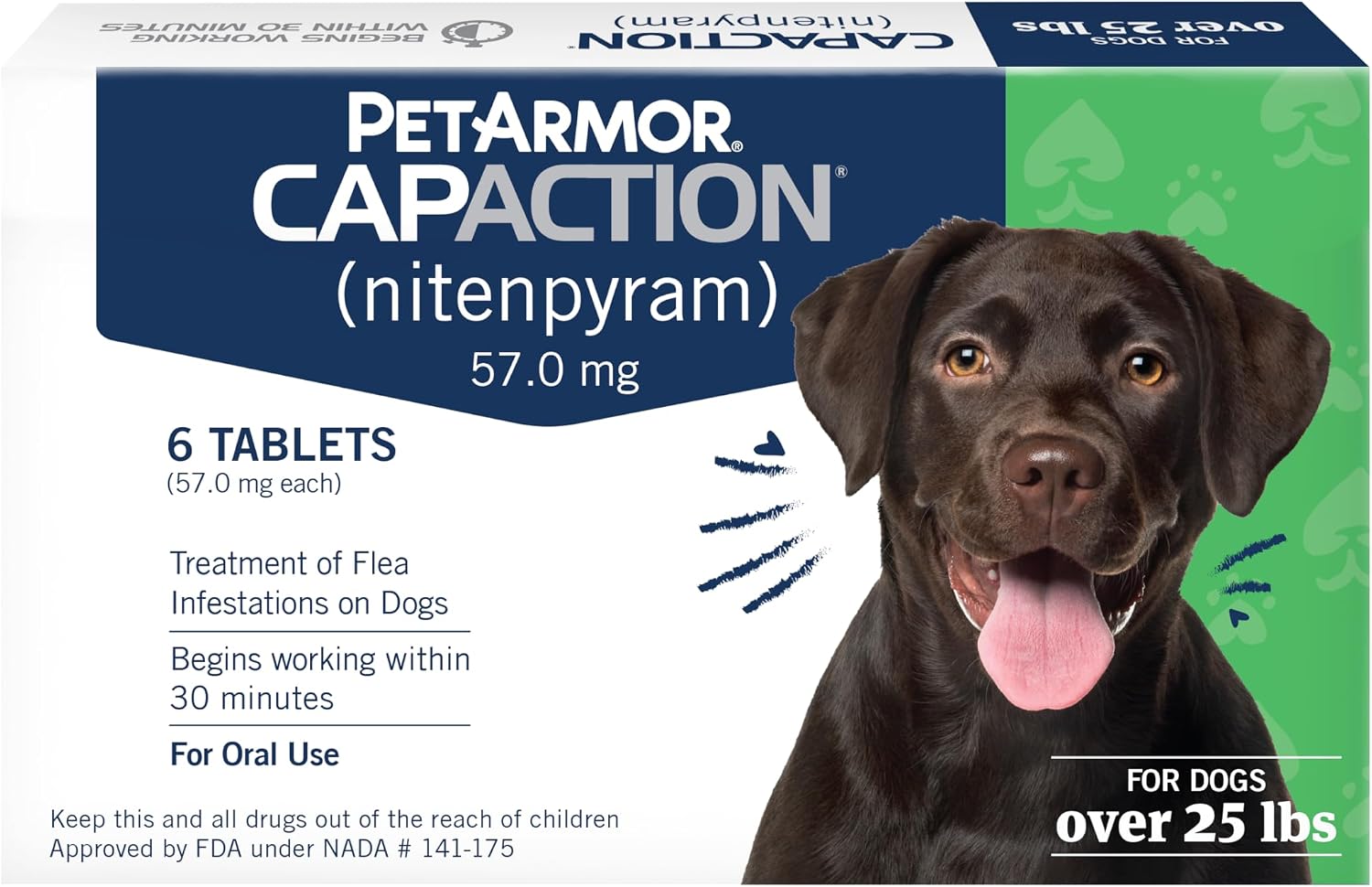
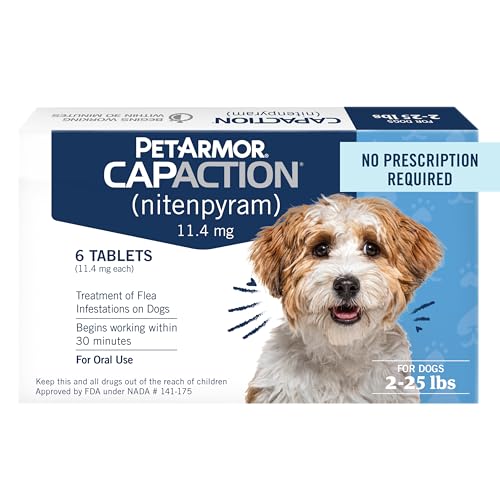
Nitenpyram is a neonicotinoid that begins killing adult fleas within about 30 minutes of oral administration, with peak effect in a few hours. It is not a preventive and does not last beyond roughly 24 hours, but it fills a specific and important role: rapid relief during an active infestation, when an owner needs fleas off the dog immediately while a longer-acting preventive takes effect. Because it is not a preventive, it is typically used alongside, not instead of, a monthly product.
Nitenpyram has no activity against ticks, flea eggs, or flea larvae, so it does nothing to address the environmental reservoir of immature stages. It is also labeled for use in puppies from as young as four weeks and two pounds, which makes it one of the few options available for very young animals. Owners should expect to see fleas jumping off the dog as the drug takes effect, which is a normal and temporary response.
Key Specifications for a Typical Fast-Acting Tablet
- Active ingredient: Nitenpyram, a neonicotinoid
- Onset: Begins killing adult fleas within 30 minutes
- Duration: Approximately 24 hours per dose
- Labeled coverage: Adult fleas only
- Minimum age and weight: Commonly labeled from 4 weeks and 2 lbs
- Prescription: Not required
Who This Category Suits
Fast-acting tablets are best understood as a rescue tool rather than a prevention strategy. They suit owners dealing with a sudden infestation, foster homes taking in dogs with unknown flea history, and multi-pet households where one animal needs immediate knockdown while others are already on prevention. The trade-off is the 24-hour duration and the absence of tick or life-stage coverage, which means it must be paired with a preventive to be useful long term.
Plant-Based Sprays and Natural Options
Plant-based sprays, typically formulated with cedar oil or similar botanical actives, occupy a different niche from pharmaceutical products. They are labeled for use on dogs, cats, bedding, furniture, and outdoor surfaces, and they are generally considered safe for multi-pet households that include birds, ferrets, or other sensitive animals. The appeal is the absence of synthetic insecticides and the flexibility to treat the environment as well as the pet.
The limitations are significant and should be stated plainly. Plant-based sprays typically provide only two to seven days of residual activity, are not water-resistant, and are not as effective against heavy tick pressure or established infestations as pharmaceutical options. They are best understood as part of an integrated approach in low-risk environments, or as an environmental supplement alongside a pharmaceutical preventive on the dog. Owners relying solely on botanicals in high-tick regions may find the coverage inadequate for disease prevention.
Key Specifications for a Typical Plant-Based Spray
- Active ingredient: Cedar oil, commonly at 1.0 percent concentration
- Labeled coverage: Fleas, ticks, mosquitoes, ants, and mites
- Duration: 2 to 7 days depending on environment and exposure
- Water resistance: None; reapplication is needed after swimming or rain
- Species safety: Labeled for dogs, cats, puppies, kittens, birds, and ferrets
- Prescription: Not required
Who This Category Suits
Plant-based sprays suit owners who want a cat-safe, chemical-free option for environmental treatment and light prevention, and who understand that the product is not a substitute for a veterinary preventive in high-risk areas. The trade-off is frequent reapplication, higher cumulative cost over a year, and reduced reliability against ticks. For homes with birds or reptiles, this category may be the only practical environmental option.
Sprays That Treat Both the Dog and the Home
Some spray products are labeled for dual use on dogs and on surfaces such as bedding, carpets, and kennels, combining etofenprox with (S)-methoprene and piperonyl butoxide. The insect growth regulator component prevents flea eggs and larvae from maturing, which addresses the environmental reservoir that re-infests treated pets. These products are typically more affordable than brand-name topicals and offer a way to treat hard-to-reach areas without hiring a pest control service.
The trade-offs include a stronger scent that some dogs and owners find unpleasant, a requirement to avoid bathing the dog for about 24 hours after application, and lower efficacy as a standalone solution for severe infestations. Home surfaces may remain protected for up to seven weeks, which is longer than the on-pet duration. Used alongside a monthly preventive, this category can meaningfully reduce reinfestation pressure.
Key Specifications for a Typical Dual-Use Spray
- Active ingredients: Etofenprox, (S)-methoprene, and piperonyl butoxide
- Labeled coverage: Fleas at all life stages, ticks, and mosquitoes
- On-pet duration: Approximately 1 month
- On-surface duration: Up to 7 weeks
- Water resistance: None; avoid bathing for 24 hours after application
- Prescription: Not required
Who This Category Suits
Dual-use sprays suit owners managing an active home infestation who need to treat bedding, carpets, and kennels at the same time as the dog. The trade-off is the scent, the lack of water resistance, and the fact that sprays are less convenient than monthly topicals or orals for routine prevention. Households with cats should check the label carefully, since some pyrethroid-based sprays carry the same cat toxicity warning as permethrin topicals.
How to Choose the Right Format for a Specific Dog
Delivery Format and Lifestyle
Oral chews are the cleanest option for dogs that swim often or have skin that reacts to topical products, and they remove any concern about residue transferring to furniture or children. Topicals are less expensive and available without a prescription, but require drying time and leave a temporary residue. Collars are the best fit for owners who struggle with monthly schedules, and they add repellent action that most orals lack. Fast-acting tablets are a supplement to a preventive, not a replacement. Plant-based sprays and dual-use home sprays address the environment rather than replacing on-pet prevention.
Geography and Tick Pressure
Dogs in the Northeast, Upper Midwest, and Mid-Atlantic face the highest tick pressure in the United States, and Lyme disease risk is concentrated in those regions. In these areas, a product with strong tick coverage, ideally with repellent action, is a reasonable default. Dogs in urban environments with minimal wildlife contact may do well with flea-focused coverage, though the Companion Animal Parasite Council continues to recommend year-round prevention nationwide because of indoor flea survival and warming winters.
Breed, Age, and Health Status
Herding breeds such as Collies and Australian Shepherds can carry the MDR1 gene mutation, which affects how some drugs are processed. Isoxazoline products are generally considered safe for these breeds, but any dog with a history of seizures or neurologic disease should have the risk-benefit discussion with a veterinarian before starting an isoxazoline. Puppies have minimum age and weight requirements that vary by product, and the label is the authoritative source. Pregnant and lactating dogs should only receive products specifically labeled for that use.
Multi-Pet Households
Households with cats must avoid permethrin-based dog products, which can be fatal to cats through direct contact or shared bedding. Cat-safe options include fipronil topicals, nitenpyram tablets, long-duration collars labeled for multi-pet homes, and plant-based sprays. When in doubt, the label's species restrictions are the deciding factor, not marketing language.
Budget Over a Full Year
Annual costs vary widely. Budget fipronil topicals can run under $50 per year for a small dog. Long-duration collars are roughly $100 per year. Prescription oral isoxazolines generally run $200 to $300 per year depending on dog size and product. Combination products that also prevent heartworm and intestinal parasites can replace a separate heartworm preventive, which partially offsets the higher sticker price. Plant-based sprays used frequently can exceed $200 per year because of reapplication requirements.
Common Mistakes and Safety Notes
One of the most common errors is combining two flea products without veterinary direction. Overlapping treatments can produce additive toxicity, particularly when both products contain similar active ingredients or when one is a pyrethroid and the other is an organophosphate. The exception is nitenpyram, which is designed to be used alongside a monthly preventive for rapid knockdown. Owners should read every label and confirm with a veterinarian before layering products.
A second common mistake is treating the dog without treating the environment. Flea eggs, larvae, and pupae live in bedding, carpets, and cracks, and can survive for weeks or months. Washing bedding in hot water, vacuuming daily for at least two weeks, and using an appropriate environmental product are standard steps in resolving an infestation. Skipping these steps means the dog is reinfested shortly after treatment.
A third mistake is assuming that natural products are automatically safer or equally effective. Botanical products have a legitimate role, especially in multi-pet homes with birds or reptiles, but they are not equivalent to pharmaceutical preventives for tick control or heavy infestations. Owners in high-risk regions who choose botanicals should understand that the trade-off is reduced reliability, not merely a different marketing story.
Finally, weight-band errors are a recurring problem. Giving a small dog a chew or topical labeled for a larger weight band can cause overdose, and giving a large dog a smaller dose can leave it unprotected. Weigh the dog before each refill, especially puppies and dogs on weight-management programs, and match the product to the current weight.
Frequently Asked Questions
Can two flea treatments be used at the same time?
Not without veterinary direction. Combining preventives can cause toxicity, particularly when active ingredients overlap. Nitenpyram is the main exception, as it is designed to be used alongside a monthly preventive for rapid flea knockdown during an active infestation.
What kills fleas fastest?
Nitenpyram begins killing adult fleas within about 30 minutes and is the fastest option for immediate relief. Oral isoxazolines such as afoxolaner and fluralaner are labeled to kill fleas within a few hours. Topical products generally take 12 to 48 hours to reach full effect.
Is flea prevention needed in winter?
Yes. Indoor heating and milder winters allow fleas to survive year-round in many homes, and the Companion Animal Parasite Council recommends year-round prevention across the United States. Tick activity can also occur on mild winter days in many regions.
How is a home treated for fleas?
Wash all pet bedding in hot water, vacuum thoroughly every day for at least two weeks, and use an environmental product labeled for indoor use. Treat the dog at the same time so that newly emerged fleas encounter a treated host rather than restarting the cycle.
What is safe for puppies?
Nitenpyram is labeled from 4 weeks and 2 lbs. Fipronil topicals are commonly labeled from 8 weeks. Isoxazoline chews are typically labeled from 8 weeks and 4 lbs, with some products labeled from 6 months. Always follow the specific product label for age and weight minimums.
Are natural flea products effective?
Plant-based products can be useful as part of an integrated approach, especially in low-risk environments and multi-pet homes with sensitive species. They are not as reliable as pharmaceutical options for tick control or heavy infestations, and they require more frequent reapplication.
Practical Takeaways
There is no single best flea and tick product for every dog. The right choice depends on tick pressure in the region, the dog's swimming and bathing habits, whether cats share the home, the owner's ability to maintain a dosing schedule, and the budget available over a full year. Oral isoxazolines offer the fastest flea kill and the cleanest application but require a prescription and cost more. Fipronil topicals are affordable and over-the-counter but slower and leave residue. Permethrin topicals add repellency but are toxic to cats. Long-duration collars solve compliance problems but cost more upfront. Fast-acting tablets are a rescue tool, not a preventive. Plant-based sprays and dual-use home sprays address the environment and multi-pet safety but are not a substitute for pharmaceutical prevention in high-risk areas.
Whichever format is chosen, consistency matters more than brand. A missed month leaves a dog unprotected, and an untreated environment re-infests a treated dog. Owners should confirm weight bands at every refill, read labels carefully, and consult a veterinarian before combining products or starting prevention in a dog with a neurologic history. For readers comparing options in the oral isoxazoline category, a representative product is available to view this option on Amazon, and a second listing in the same category can be checked at this Amazon page.
Affiliate Disclosure: PawCritic is a participant in the Amazon Services LLC Associates Program, an affiliate advertising program designed to provide a means for sites to earn advertising fees by linking to Amazon.com and affiliated sites. Purchases made through links on this page help support independent research-based content at no additional cost to the reader.
Last updated: June 18, 2026. Prices and availability are subject to change. Always verify current pricing before purchasing. Consult a veterinarian before starting or changing any parasite prevention regimen.