Choosing the right dog harness in 2026 is about comfort, safety, and matching your lifestyle. Whether you are training a reactive puppy on city sidewalks, gearing up for a weekend backcountry trek, or upgrading from a worn-out collar, the harness you choose directly affects your dog's freedom of movement, safety in the car, and your ability to manage walks without strain.
Source: American Kennel Club (AKC): The AKC recommends using a properly fitted harness for dogs, particularly for puppies and small breeds, to reduce strain on the delicate trachea and neck structures that are more vulnerable to traditional collar pressure.
Source: AKC: The AKC notes that proper collar and harness fit is essential for dog safety. A correctly fitted collar should allow two fingers to slide comfortably between the collar and the dog's neck.
This guide draws on published veterinary guidance, manufacturer specifications, and verified owner reports to explain what actually matters in a dog harness. It is not a ranked list of lab-tested winners. Instead, it is a reference for understanding fit, materials, attachment points, and safety features so you can evaluate any harness on the market with confidence. Two concrete examples appear throughout: a budget-friendly no-pull option and a crash-tested travel harness. Both are widely reviewed and easy to find.
At a Glance: What Matters Most in a Dog Harness
| Feature | Why It Matters | What to Look For |
|---|---|---|
| Attachment points | Front clips redirect pulling; back clips suit relaxed walks | Metal D-rings or reinforced webbing loops |
| Adjustability | Prevents slipping, twisting, and chafing | Four or more adjustment points, including neck and girth |
| Padding | Reduces friction during extended wear | Breathable foam or mesh lining at chest and belly |
| Hardware | Determines durability and escape resistance | Welded metal rings, quick-release buckles with locking tabs |
| Visibility | Critical for low-light walks | Reflective stitching or full reflective panels |
| Car safety | Unrestrained dogs are a hazard in crashes | Crash-tested harness with seatbelt tether included |
For a concrete example of a budget-friendly no-pull harness, check the current price on Amazon. For a crash-tested travel option, view this option on Amazon.
Why Harness Fit Matters More Than Brand
A harness that fits poorly can cause more harm than a simple collar. Veterinary guidance from the Merck Veterinary Manual dog owner reference notes that ill-fitting equipment can lead to skin irritation, hair loss, and restricted shoulder movement. The shoulder joint in dogs has a wide range of motion, and a harness that crosses too low or too tight can interfere with the gait cycle, especially in athletic breeds.
Proper fit starts with measurement. You need three numbers: neck circumference at the base of the neck, chest girth at the widest point behind the front legs, and body length from the base of the neck to the base of the tail. Manufacturer size charts are not interchangeable. A medium in one brand may match a small in another. Always measure before ordering, and if your dog is between sizes, size up rather than down, because a too-small harness will chafe and restrict breathing.
The two-finger rule applies to harnesses as well as collars. You should be able to slide two fingers under every strap. If you cannot, the harness is too tight. If you can fit a whole hand, it is too loose and your dog may back out of it. Check fit after every adjustment and recheck after your dog has worn the harness for a few minutes, because nylon webbing can settle and shift.
Front-Clip vs. Back-Clip: Understanding the Trade-Off
Front-clip harnesses have a leash attachment ring on the dog's chest. When the dog pulls forward, the leash tension redirects the body sideways rather than backward. This gives the handler more control without putting pressure on the throat. It is a management tool, not a training substitute, but it can make walks safer while you work on loose-leash skills. The trade-off is that the leash can get tangled under the dog's legs if you are not attentive.
Back-clip harnesses attach behind the shoulders. They are comfortable for dogs who already walk politely and are the standard choice for hiking, running, and casual walks. They do not discourage pulling, and for a strong dog, a back-clip harness can actually make pulling more comfortable by distributing force across the chest. If your dog pulls hard, a back-clip only harness is not the right tool.
Many modern harnesses offer both front and back attachment points. This dual configuration is the most versatile choice because you can use the front clip for training sessions and the back clip for relaxed walks or long-line work. Look for metal D-rings at both points. Nylon rings are lighter but can wear faster under constant load.
Materials and Construction: What Holds Up
Nylon webbing is the industry standard for harness straps. It is strong, dries quickly, and resists abrasion. Denier rating indicates fiber thickness: 1000-denier nylon is heavier and more durable than 600-denier, but it also adds weight. For small breeds, lighter webbing is more comfortable. For working dogs and adventure use, heavier denier is worth the trade-off.
Padding materials vary widely. Air-mesh is breathable and lightweight, ideal for warm climates. EVA foam is denser and provides more cushioning but can trap heat. Neoprene is soft and water-resistant but heavier. The best harnesses use a combination: mesh against the skin for breathability and foam or neoprene in high-pressure areas like the sternum and under the front legs.
Hardware is where budget harnesses often cut corners. Plastic buckles can crack in cold weather or fail under sudden load. Metal buckles are heavier but more reliable. Welded D-rings are stronger than bent wire rings. Look for bar-tack stitching at stress points, which is a dense zigzag stitch that reinforces webbing junctions. If a harness has no visible reinforcement at the leash attachment points, it is not built for strong pullers.
Car Safety: What Crash-Tested Actually Means
An unrestrained dog in a moving vehicle is a projectile. In a 35 mph crash, a 60-pound dog can generate over 2,700 pounds of force. That is enough to injure passengers and fatally injure the dog. A crash-tested harness is designed to distribute that force across the dog's chest and body without causing internal injury.
Crash testing for pet harnesses is not government-mandated in the United States. Independent organizations and some manufacturers conduct tests using a standardized protocol that simulates a 30 to 35 mph impact. A harness that has been crash-tested will typically include a seatbelt tether or a loop that threads through the vehicle's seatbelt. The tether should attach to the back D-ring, not the front clip, because the front clip is not designed for crash loads.
Even with a crash-tested harness, placement matters. The dog should be secured in the back seat, never the front. The seatbelt tether should be short enough that the dog cannot reach the front seat but long enough that they can sit, stand, and lie down comfortably. Never attach a tether to a collar; all crash protection must go through the harness body.
Two Concrete Examples
Budget No-Pull Harness
The Rabbitgoo No-Pull Dog Harness is one of the most widely recommended budget options in online training communities. It uses a dual metal D-ring design: a front chest ring for no-pull leash attachment and a back ring for relaxed walks and jogging. The harness fastens with quick-release buckles and adjusts at four points, two around the neck and two around the girth. Reflective stitching runs along the front panel and belly strap for low-light visibility.
Owner reports describe the front-clip attachment as effective for moderate pullers, with many reviewers noting a noticeable reduction in pulling force on the first walk. The padding is adequate for daily use but not as plush as premium harnesses, and some owners report that the belly strap can loosen slightly during vigorous activity. It comes in six sizes and multiple colors, and it is typically priced under $30. For a closer look, check the current price on Amazon.
Crash-Tested Travel Harness
The Kurgo Tru-Fit Smart Harness is one of the few harnesses on the market that has been independently crash-tested at 35 mph. It includes a seatbelt tether in the box, which loops through the back D-ring and clicks into the vehicle's seatbelt buckle. The harness features front and back leash attachment points, five-point adjustability, and reinforced bar-tack stitching at all stress points.
Owner reviews frequently highlight the five-point adjustment as a key advantage for deep-chested breeds like Boxers and Dobermans, where standard harnesses tend to slip. The front chest plate is lined with impact-dispersing foam, and the interior is brushed for comfort against short-haired dogs. The main trade-off is weight: it is heavier and bulkier than standard walking harnesses, and the front clip uses a nylon D-ring rather than metal, which is a consideration for extreme pullers. To see the current specifications, view this option on Amazon.
How to Choose the Right Harness for Your Dog
Start with your dog's pulling behavior. If your dog pulls hard enough to make walks unpleasant, prioritize a front-clip or martingale-style harness. If your dog walks politely on a loose leash, a back-clip harness is simpler and more comfortable. If you are unsure, a dual-attachment harness gives you the flexibility to switch as your dog's skills improve.
Next, consider your dog's body shape. Deep-chested breeds need more adjustability at the girth. Narrow-chested breeds like Greyhounds and Whippets need harnesses with a longer chest panel to prevent the strap from cutting across the shoulder. Flat-faced breeds like Pugs and French Bulldogs may do better with a step-in design that avoids pressure on the neck. Small breeds under 15 pounds need lighter hardware and narrower webbing to avoid bulk.
Finally, think about your environment. If you walk in low light, prioritize reflective materials. If you hike in rough terrain, look for a sturdy back handle and abrasion-resistant fabric. If you travel by car regularly, a crash-tested harness with a seatbelt tether is the only responsible choice. If you live in a hot climate, breathable mesh padding will keep your dog more comfortable than dense foam.
Sizing and Fitting: A Step-by-Step Approach
Measure your dog while standing. Use a soft tape measure and record neck circumference at the base of the neck, chest girth at the widest point behind the front legs, and body length from the base of the neck to the base of the tail. Write these numbers down and compare them to the manufacturer's size chart. Do not guess based on breed or weight alone.
When the harness arrives, adjust all straps to their loosest setting before putting it on. Put the harness on your dog and tighten the neck straps first, then the chest straps. Check the two-finger rule at every point. The chest plate should sit across the sternum, not on the throat. The belly strap should sit behind the rib cage, not across the last rib.
Watch your dog move. Walk them around the house or yard for a few minutes. The harness should stay centered and not shift more than an inch in any direction. If it twists or slides, tighten the straps or try a different size. Check for rubbing under the front legs and at the armpits. Redness or hair loss after a short walk means the fit is wrong.
Maintenance and Cleaning
Most nylon harnesses are machine-washable, but check the manufacturer's instructions first. Remove any metal hardware that could scratch the drum, or place the harness in a mesh laundry bag. Wash on a gentle cycle with cold water and mild detergent. Do not use fabric softener, which can leave residue that irritates skin. Air dry only. High heat can damage nylon webbing, melt reflective trim, and degrade foam padding.
Inspect your harness regularly for wear. Check the stitching at all stress points, especially where the leash attaches. Look for fraying webbing, cracked plastic buckles, and bent metal rings. A harness that has been involved in a crash or a severe pull should be replaced, even if it looks intact. Nylon can stretch under extreme load and lose its original strength.
For quick cleanups between washes, wipe the harness with a damp cloth and mild soap. Rinse thoroughly and air dry. If your dog has been swimming in salt water or chlorinated water, rinse the harness with fresh water after every use to prevent corrosion of metal hardware and degradation of the webbing.
Common Mistakes to Avoid
One of the most common mistakes is buying a harness that is too large. A loose harness can allow a dog to back out, which is dangerous near roads or in unfamiliar environments. Another mistake is leaving the harness on all day. Even well-padded harnesses can cause fur matting and skin irritation if worn continuously. Remove the harness during rest periods and at night.
Using the wrong attachment point is another frequent error. The front clip is for no-pull training and should not be used for car safety or long-line work. The back clip is for relaxed walks and should not be used with a retractable leash, which can cause sudden tension and injury. Never attach a leash to both the front and back clips at the same time unless the manufacturer specifically designs for it.
Finally, do not rely on a harness to fix a training problem. A no-pull harness is a management tool that gives you more control while you teach your dog to walk politely. Pair it with positive reinforcement training, and consult a professional trainer or veterinary behaviorist if your dog has severe reactivity or pulling issues. The AVMA pet owner resources offer guidance on finding qualified trainers and behavior professionals.
Safety and Poison Control
Harnesses themselves are not toxic, but dogs can chew through straps and swallow pieces of nylon or foam, which can cause intestinal blockage. Inspect your harness regularly for chew damage, especially if you have a puppy or a dog with a history of destructive chewing. If you suspect your dog has swallowed part of a harness, contact your veterinarian or the ASPCA Animal Poison Control for guidance.
Reflective materials and metal hardware are generally safe, but small parts like buckles can crack and create sharp edges. Replace any harness with cracked or broken hardware immediately. If your dog has sensitive skin or allergies, choose a harness with minimal dye and no harsh chemical treatments. Unscented, dye-free options are available from several manufacturers.
Frequently Asked Questions
Should I use a front-clip or back-clip harness for my dog?
It depends on your walking goals. A front-clip harness attaches the leash to a ring on the dog's chest, which redirects pulling forces sideways and helps train loose-leash walking. A back-clip harness attaches behind the shoulders and is ideal for dogs who already walk politely. Many modern harnesses offer both options so you can switch between them as your training progresses.
Is a no-pull harness humane?
Yes, when used correctly. Modern no-pull harnesses work through gentle redirection, not pain or discomfort. The key is proper fit. A harness should never restrict the dog's shoulder movement or dig into the armpits. Avoid any harness that tightens around the throat. All well-designed harnesses sit across the chest and shoulders, well clear of the trachea.
How should a dog harness fit?
A properly fitted harness should be snug but not tight. You should be able to slide two fingers comfortably between the harness and your dog at any point: neck, chest, and belly. The chest plate should sit across the sternum, not press on the throat. When your dog moves, the harness should stay centered and not shift more than an inch in any direction.
Can I leave a dog harness on all day?
For most dogs, removing the harness when they are in their crate or relaxing at home is recommended. Even the best-padded harness can cause fur matting or skin irritation if worn continuously. Comfortable harnesses can be worn for extended hikes, but taking them off during rest periods is still advised.
Are step-in harnesses better than over-the-head ones?
It is a matter of your dog's temperament. Step-in harnesses are excellent for dogs who are head-shy, anxious about having things approach their face, or have very large heads relative to their neck. Over-the-head harnesses tend to offer more adjustability and a more secure fit. Most dogs adapt to either style with patience and positive reinforcement.
How do I clean a dog harness?
Most harnesses are machine-washable. Remove any metal hardware that could scratch the drum, place the harness in a laundry bag or pillowcase, and wash on a gentle cycle with cold water. Air dry only. High heat can damage nylon webbing and foam padding. For quick spot-cleaning, a damp cloth with mild soap works well.
What is the best harness for a puppy?
For growing puppies, choose an affordable harness that is easy to adjust and gentle on developing bodies. Avoid buying an extra-large harness for your puppy to grow into. A poorly fitted harness can cause gait issues during critical development months. Step-in designs are often easier for puppies who are still learning to accept handling.
Can a harness help with leash reactivity?
A harness alone will not solve reactivity, which requires behavior modification and training. However, the right harness makes management easier. A front-clip harness gives you more control to redirect your dog's attention, and a sturdy handle gives you the ability to lift or physically reposition your dog if needed. For reactive dogs, a harness with a secure back handle and comfortable padding is a practical choice.
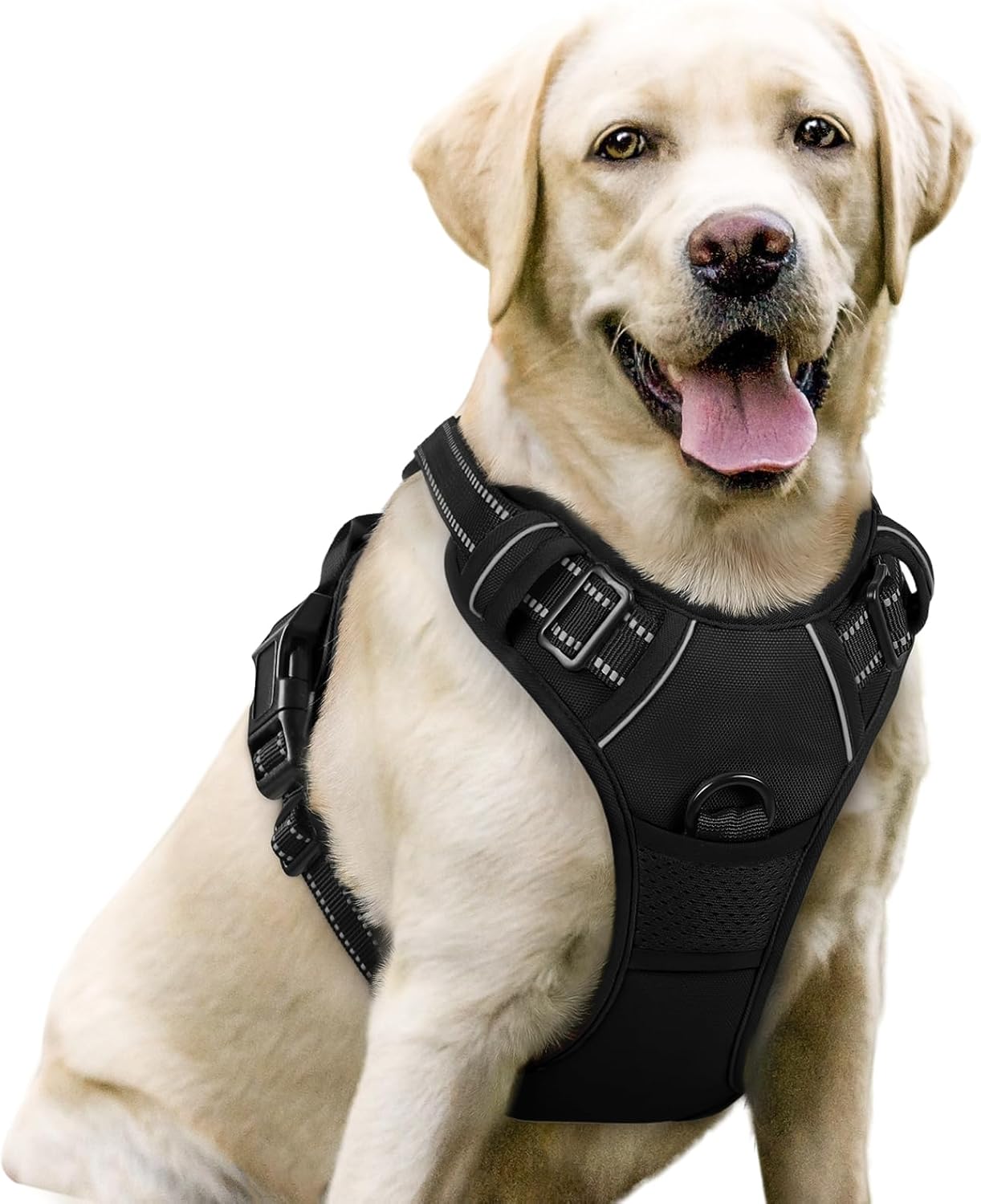
dog harnesses
Final Thoughts
There is no single best harness for every dog. The right choice depends on your dog's size, shape, pulling behavior, and the environments you walk in. A harness that fits well, attaches at the right points, and matches your daily routine will make walks safer and more enjoyable for both of you.
For most owners, a dual-attachment harness with four or more adjustment points is the most versatile starting point. If car safety is a priority, a crash-tested harness with a seatbelt tether is the only responsible option. If budget is tight, a well-reviewed no-pull harness under $30 can still deliver reliable control and comfort. For a concrete example, check the current price on Amazon.
Measure your dog, read the size chart, adjust the fit carefully, and inspect the harness regularly. Those steps matter more than any brand name. A harness is only as good as its fit, and a well-fitted harness is one of the simplest ways to protect your dog's neck, keep them secure in the car, and make every walk more pleasant.
Prices and availability are accurate as of the date of publication (May 26, 2026) but may vary. Checking current prices before purchasing is recommended.
Affiliate Disclosure: PawCritic is reader-supported. When you buy through links on our site, we may earn an affiliate commission at no additional cost to you. Our reviews remain independent and unbiased. We only recommend products that are supported by published guidance, manufacturer specifications, or verified owner reports. You can read our full disclosure policy here.