Dog Winter Coats and Jackets: A Research-Based Buying Guide
Published on June 25, 2026 by the PawCritic Editorial Team — Dogs
Winter walks present a genuine welfare question, not just a comfort one. Dogs lose heat through the same physical pathways as other mammals: conduction to cold ground, convection from wind, evaporation from wet fur, and radiation from exposed skin. A coat addresses the last three of those pathways by trapping a layer of warmed air near the body and blocking wind and moisture from stripping it away. Whether a specific dog needs that help depends on coat type, body fat, age, health status, and the actual conditions outside. The AVMA pet owner resources and the Merck Veterinary Manual dog owner reference both note that cold tolerance varies widely between individuals and that small, thin-coated, very young, very old, or medically compromised dogs are the first to struggle.
Double-coated breeds such as Siberian Huskies, Alaskan Malamutes, Samoyeds, and Newfoundlands carry a dense undercoat plus a weather-resistant topcoat that together outperform most synthetic insulation. For those dogs, a coat is usually unnecessary and can even flatten the coat and reduce its natural loft. Short-coated breeds, sighthounds, toy breeds, seniors, puppies, and dogs with chronic conditions are the opposite case. A Greyhound has almost no body fat and a single-layer coat; a Chihuahua has a high surface-area-to-mass ratio that accelerates heat loss. For these dogs, a well-fitted jacket is a practical piece of safety equipment rather than a fashion accessory.
This guide explains what actually matters when selecting a winter coat: how insulation and shell fabrics differ, how to measure a dog correctly, which features affect safety and fit, and where the common failure points show up. It is written from published guidance, manufacturer specifications, and verified owner reports rather than laboratory measurements. The product examples below are included as concrete illustrations of the categories described, not as ranked winners.
How Dog Winter Coats Are Built
Shell Fabrics: Water Resistance Versus Waterproofing
The outer shell determines how the coat performs in rain, snow, and wind. Three broad categories exist, and the labels are not interchangeable. Water-resistant fabrics, such as waxed cotton or untreated duck canvas, shed light precipitation and block wind but will eventually saturate in sustained rain. Waterproof fabrics, such as coated Oxford polyester, nylon with a polyurethane or TPU membrane, or laminated shells, prevent liquid water from passing through entirely, though seams and zippers are common leak points if they are not taped or covered by a storm flap. Breathability is the trade-off: a fully waterproof membrane traps some moisture vapor from the dog's own body, so a dog that runs hard in a waterproof coat can end up damp from the inside. For most urban and suburban winter walking, a waterproof shell with a fleece lining is the sensible default. For working dogs in brush or heavy snow, a tougher water-resistant canvas may outlast a lightweight membrane because it resists abrasion better.
Insulation: Loft, Fleece, and Synthetic Fill
Insulation works by trapping air. Fleece linings trap air in a brushed pile and are inexpensive, soft, and easy to wash, but they are relatively thin and lose most of their insulating value when wet. Synthetic fills, including polyester batting and branded microfibers, trap more air per unit thickness and retain some warmth when damp, which is why they appear in colder-weather designs. Down offers the best warmth-to-weight ratio but loses loft when wet and is expensive to produce in dog-sized panels. For most dogs in most climates, a fleece-lined waterproof shell handles the 20 to 45 degree Fahrenheit range well. Below roughly 20 degrees Fahrenheit, a jacket needs either a synthetic fill layer or a deliberate layering system: a stretch fleece base layer under a waterproof shell. Owners in extreme cold often combine two thin layers rather than buying one bulky parka, because two layers conform better to the dog's body and are easier to adjust as conditions change.
Fit Systems: Belly Straps, Zippers, and Step-In Designs
How a coat closes matters as much as what it is made of. Belly straps with hook-and-loop closures are the most adjustable and the most forgiving of odd body shapes, but hook-and-loop loses grip over time as fur and lint accumulate in the hooks. Zippers give a clean, secure closure and are quick to operate once the dog is still, but a misaligned zipper can catch skin or fur, and a wiggly dog makes alignment harder. Step-in designs, where the dog's front legs go through two openings and the coat wraps over the back, are the easiest for dogs that dislike being handled around the head and neck. Over-the-head designs cover more of the chest and neck but require the dog to tolerate a garment passing over its face, which some dogs never accept. Whichever system is chosen, the coat should allow a full range of motion at the shoulders and should not restrict the dog's ability to urinate or defecate.
Harness Access and Built-In Harnesses
Most owners now walk dogs on a harness rather than a neck collar, following guidance from veterinary organizations that pulling pressure on the throat is undesirable. That creates a compatibility question. A coat with a leash hole on the back lets a harness sit underneath the coat, which keeps the harness close to the body and the coat free to move. A coat with a built-in harness, usually a reinforced strap with a D-ring sewn into the jacket, eliminates the separate harness but locks the owner into that jacket's fit and hardware quality. A coat with no leash hole forces the harness over the top of the jacket, which can compress the insulation and shift the coat sideways on the walk. The leash hole is the simplest and most flexible solution for most owners.
A Concrete Example: The Kuoser Waterproof Dog Coat
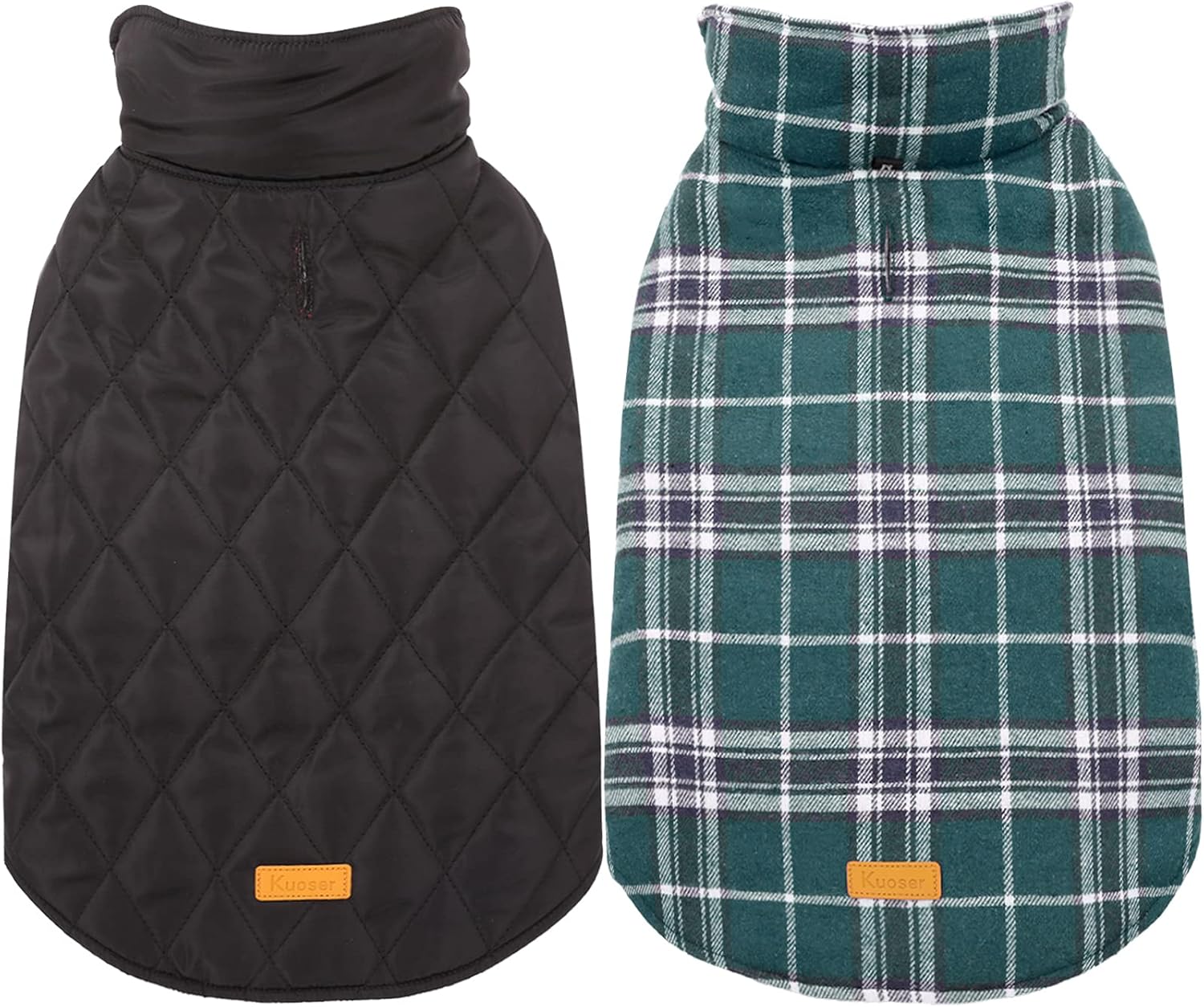
The Kuoser Waterproof Dog Coat is a useful reference point because its feature set matches the middle of the market almost exactly: a waterproof polyester shell, a soft fleece lining, a reversible design, an adjustable belly strap, and a leash hole on the back. Manufacturer specifications list sizes from X-Small through 3X-Large and colors including blue, red, orange, green, black, gray, and pink. It is machine washable on a gentle cycle and should be air dried to protect the waterproof coating. Verified owner reports describe it as effective in moderate rain and snow and note that the fleece lining is soft against the skin, with the usual caveat that the sizing chart runs slightly large and dogs near a size boundary should be measured rather than guessed.
The trade-offs are consistent with the category rather than unique to this coat. The fleece lining provides warmth but not the loft of a synthetic fill, so it is not the right choice for sustained exposure below roughly 20 degrees Fahrenheit without an added base layer. The reversible zipper can catch long fur if the coat is pulled on quickly. Owners of very large dogs have reported fewer color choices in the largest sizes. For a dog that needs a waterproof shell for ordinary winter walking in a temperate climate, this design covers the essentials. For a dog that will be outside for hours in deep cold, a fill-insulated parka is the better category. To look at the current listing and sizing chart, check the current price on Amazon.
Categories of Winter Coat and Who Each One Suits
Waterproof Shell With Fleece Lining
This is the most common winter coat design and the right starting point for most owners in temperate climates. The shell blocks rain, snow, and wind; the fleece lining adds a modest layer of warmth; and the coat is usually light enough that the dog forgets it is wearing anything. It suits short-coated breeds, seniors, and puppies on ordinary walks. Its limitation is that fleece alone does not hold enough loft for extreme cold, and a wet fleece lining loses much of its insulating value, so a dog that lies down in snow will get cold faster than the shell alone would suggest. Owners who walk in deep snow often add a thin fleece base layer underneath.
Insulated Canvas or Duck Work Coat
Work coats borrow their construction from human chore jackets: a heavy cotton duck or canvas shell with a quilted synthetic lining. They are the most abrasion-resistant option and the best choice for dogs that push through brush, work on farms, or spend long periods outdoors. The trade-off is weight and drying time. A soaked canvas coat is heavy and slow to dry, and the fabric is water-resistant rather than waterproof, so it sheds light snow but not a downpour. Many work coats also omit a leash hole, which means the harness must go over the top. They suit medium and large dogs with the build to carry the weight; they are usually too heavy for toy breeds.
Built-In Harness Jacket
A jacket with a sewn-in harness strap and D-ring is a convenience design for owners who want one piece of gear instead of two. It eliminates the problem of a harness shifting under a coat and reduces dressing time. The limitation is fit: a built-in harness is only as good as the jacket's sizing, and a dog between sizes may end up with a D-ring that sits off-center or a strap that does not align with the dog's chest. Owners who already have a well-fitted harness they trust often prefer a jacket with a simple leash hole instead, because it preserves their existing walking setup. Owners who want simplicity and have a dog that fits standard sizing well tend to be happy with the built-in design.
Stretch Fleece Vest
A four-way stretch fleece vest is the most comfortable option for active dogs because it moves with the body rather than resisting it. It is typically worn alone in mild cold or as a base layer under a waterproof shell in real winter. It offers no wind or water protection on its own, and the fabric is thin, so it is not a substitute for an insulated coat in freezing conditions. Its real strength is layering and tolerance: dogs that refuse stiffer garments usually accept a stretch vest, and it doubles as indoor warmth for thin-coated seniors in a chilly house.
Hooded Fleece Hoodie
A hooded jacket adds coverage for the head and ears, which matters for breeds with large, thin ear leathers that are prone to frostbite. The hood is also the feature most likely to be tolerated poorly: it can slip off, obstruct peripheral vision, or collect snow. A hooded fleece hoodie is best treated as casual cold-weather wear for small and medium dogs rather than serious foul-weather gear, since most are made of cotton blends that absorb water and dry slowly. Owners who walk in wet conditions should choose a hooded design with a synthetic or coated shell instead.
Waterproof Windproof Shell Without Insulation
A lightweight shell with a TPU or similar membrane blocks wind and rain without adding bulk. It is the correct choice for a dog that already has a warm base layer, or for a double-coated breed that only needs protection from wet snow. On its own it provides almost no warmth, and owners sometimes mistake it for a winter coat because it looks substantial. Read the specification carefully: if the listing describes a shell and a membrane but no fill or fleece, it is a rain layer, not a cold-weather layer.
How to Measure a Dog for a Winter Coat
Sizing errors are the single most common reason a dog coat ends up returned or unworn. Three measurements matter, and they should be taken with a soft tape measure while the dog stands still on all fours.
- Back length: from the base of the neck, where the collar sits, to the base of the tail. This is the primary measurement in most sizing charts. A coat that is too long will catch the tail and soil easily; one that is too short leaves the hindquarters exposed.
- Chest girth: around the widest part of the ribcage, just behind the front legs. This determines whether the belly strap will close comfortably. A coat that is tight here restricts breathing during exercise.
- Neck girth: around the base of the neck where the coat collar will sit. Important for breeds with thick necks or heavy ruff, and for hooded designs.
A correctly fitted coat allows two fingers to slide under the belly strap and the neck opening. It should not slide sideways when the dog trots, and it should not bunch at the shoulders when the dog lifts its head. Owners of deep-chested breeds such as Greyhounds, Whippets, and Boxers should expect to size up in girth while possibly sizing down in length, which is why some sighthound-specific patterns exist. Owners of barrel-chested breeds such as Bulldogs and Pugs face the opposite problem. When a dog falls between two sizes, the general rule is to size up for breeds with thick coats and size down for lean, short-coated breeds, because a loose coat on a lean dog shifts and rubs.
Safety Features Worth Paying For
Winter daylight is short, and most owners walk before or after work in low light. Reflective piping, strips, or panels on a coat meaningfully increase how far away a driver can see a dog, and they cost very little to include. Reflective trim is most effective on the parts of the coat that face traffic, which for a dog walking on the left side of the road means the left flank and the chest. A coat with reflective material only on the back is less useful. Some coats also include attachment points for small clip-on lights, which add a second layer of visibility. Beyond visibility, the safety features that matter are a secure closure that cannot pop open mid-walk, a leash attachment that cannot detach under load, and a fit that does not restrict the dog's ability to sit, squat, or turn its head. A coat that interferes with toileting will be resisted by the dog and eventually left in the closet.
Owners should also be aware of the cold-weather hazards that a coat does not address. Antifreeze spills are highly toxic and attractive to dogs because of their sweet taste, and road salt can burn paw pads and cause gastrointestinal upset if licked off. The ASPCA Animal Poison Control maintains guidance on both. A coat keeps the core warm but does nothing for the paws, so paw protection or a rinse after walks is a separate decision.
Maintenance and Longevity
A winter coat collects mud, salt, road grime, and dog oil, and it will need washing every two to four weeks during active use, or sooner if it is visibly soiled or smells. The washing method depends on the shell. Waterproof and water-resistant shells should be washed on a gentle cycle in cold water with a mild detergent and air dried, because heat degrades the waterproof coating and the membrane. Fabric softener should be avoided entirely, since it leaves a residue that breaks down water repellency. Fleece linings tolerate warmer water but still last longer when air dried. Hook-and-loop closures should be fastened before washing so the hooks do not snag the lining, and they should be cleaned of fur periodically with a stiff brush to keep their grip. Zippers benefit from an occasional wipe with a damp cloth and a light application of zipper lubricant if they begin to stick. Stored correctly, folded rather than hung by the collar, a well-made coat will last several seasons.
Common Mistakes Owners Make
The first mistake is buying by breed or by weight rather than by measurement. Weight tells you almost nothing about whether a coat will fit, because two dogs of the same weight can differ by several inches in chest girth. The second is choosing a coat that is too warm. A dog that wears a heavy parka on a 40-degree walk will overheat, pant, and resist the coat in future. Match the insulation to the conditions and to the dog's activity level; a dog that runs off-leash generates far more body heat than one that walks slowly on a leash. The third mistake is leaving a coat on indoors for extended periods, which can cause overheating and skin irritation from trapped moisture. The fourth is ignoring the harness interface, which leads to a coat that twists on every walk. The fifth is buying a cheap coat for a dog that will wear it daily; the seams, closures, and coating on a very inexpensive coat typically fail within a season, and the replacement cost erases the savings. None of these mistakes are dangerous on their own, but together they explain why so many dog coats are bought, worn twice, and abandoned.
Frequently Asked Questions
What temperature is too cold for a dog to be outside?
There is no single threshold, because cold tolerance depends on coat type, body condition, age, and health. Published veterinary guidance generally treats temperatures below about 45 degrees Fahrenheit as requiring caution for small, thin-coated, senior, or unwell dogs, and below freezing as requiring a coat for those groups. Below 20 degrees Fahrenheit, outdoor time for most dogs should be shortened to short walks and quick bathroom breaks, and below zero, only cold-adapted breeds should be outside for more than a few minutes. Owners should watch the dog rather than the thermometer: shivering, lifting paws, hunched posture, whining, or refusing to walk are all signs to go back inside.
Do all dogs need a winter coat?
No. Double-coated breeds with a dense undercoat are built for cold and generally do not need one. Dogs that benefit most are short-coated breeds, sighthounds, toy breeds, seniors, puppies, and dogs with heart, kidney, or endocrine conditions that affect temperature regulation. The WSAVA Global Nutrition Guidelines note that energy needs change with environmental temperature, which is one reason very old and very young dogs are more vulnerable to cold.
Can a dog wear a coat indoors?
Usually not. A healthy dog in a normally heated home does not need a coat and can overheat in one. The exception is a thin-coated, elderly, or ill dog in a house kept below about 60 degrees Fahrenheit. If a dog shivers indoors, the first step is to check the thermostat and the dog's health rather than reaching for a jacket.
How do I get a dog used to wearing a coat?
Introduce the coat gradually and pair it with something the dog values. Let the dog sniff it, then reward calm behavior. Put it on for short periods indoors, reward, and take it off before the dog becomes uncomfortable. Build up to wearing it for a full walk. Most dogs accept a coat within a handful of sessions if the fit is correct; a dog that continues to resist may be telling you the coat is too tight, too warm, or restricting movement.
Should I choose a built-in harness or a separate harness?
A built-in harness is convenient and keeps the walking attachment aligned with the coat, but it locks the owner into that jacket's fit and hardware. A separate harness with a coat that has a back leash hole is more flexible and lets the owner keep a harness they already trust. Owners who walk on a well-fitted harness they like should prioritize the leash hole. Owners who want one piece of gear and have a dog that fits standard sizing well may prefer the built-in design.
How often should a dog coat be washed?
Every two to four weeks during regular winter use, and immediately if it is muddy, salty, or smelly. Use a mild detergent, cold water, and a gentle cycle for waterproof shells, then air dry. Avoid fabric softener and high heat, both of which shorten the life of waterproof coatings and membranes.
What to Avoid
Owners should be cautious of coats that list no fabric composition, because the shell and lining are the two variables that determine performance and there is no way to judge them without that information. Coats with decorative elements such as dangling pom-poms, long toggles, or loose straps create a chewing and snagging hazard. Coats sized only by weight, with no measurement chart, are a poor bet. Coats with no reflective material are a missed safety opportunity for the price of a few cents of piping. And coats marketed with vague claims such as space-age insulation or Arctic-grade warmth without naming the fill material should be treated as unverified until the specification says otherwise. A useful coat is a simple object: a shell that blocks wind and water, a lining that traps air, a closure that stays closed, a leash hole that lines up, and a size that fits the individual dog. Everything else is preference.
Summary
A dog winter coat is a straightforward piece of equipment, and the decision comes down to four questions: does the dog need one, what conditions will it face, how does the dog's body measure, and which closure and harness system the owner can live with. Short-coated, small, old, young, or unwell dogs benefit most. A waterproof shell with a fleece lining covers most temperate-climate walking. A fill-insulated design is needed for deep cold. A stretch fleece vest is the best layering piece and the most tolerated by dogs that dislike clothing. Measuring back length, chest girth, and neck girth before ordering prevents most returns. Reflective trim, a secure closure, and a properly aligned leash hole are the safety features worth insisting on. For a concrete example of a waterproof, fleece-lined shell with a leash hole and a wide size range, view this option on Amazon and compare its size chart against the measurements taken above.
Affiliate Disclosure: PawCritic is a participant in the Amazon Services LLC Associates Program, an affiliate advertising program designed to provide a means for sites to earn advertising fees by linking to Amazon.com and affiliated sites. Recommendations are based on published guidance, manufacturer specifications, and verified owner reports. Purchases made through links help support PawCritic at no extra cost to the reader.
Last updated: June 25, 2026. Prices and availability are subject to change. Always verify current pricing and sizing on Amazon before purchasing.