Best Reptile Terrariums and Front-Opening Enclosures 2026: Habitat Guide for Lizards, Snakes and Amphibians
Published on July 3, 2026 by PawCritic — Reptiles Category
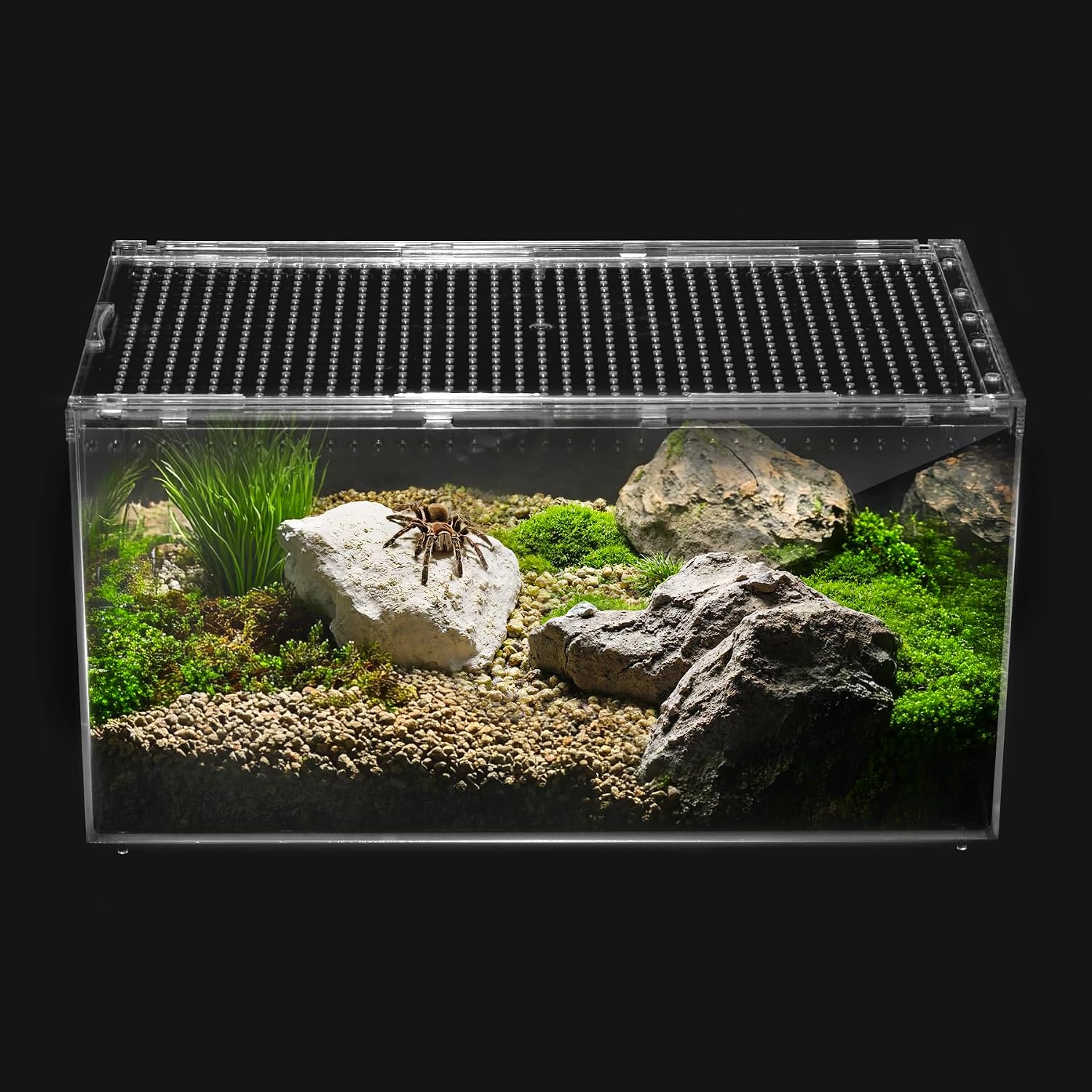
The enclosure is the single most consequential purchase a reptile keeper makes. Dogs and cats share our homes, but a reptile or amphibian lives its entire life inside the glass, PVC, or screen walls of a terrarium. Every thermal gradient, every humidity pocket, every hiding place and climbing branch exists only because the enclosure allows it. Published husbandry guidance from the Association of Reptilian and Amphibian Veterinarians consistently emphasizes that most captive reptile health problems — respiratory infections, dysecdysis, impaction, thermal burns — trace back to environmental parameters rather than to the animal itself.
Front-opening terrariums have become the reference standard for that environment. Traditional top-opening aquariums force a keeper to reach down from above, which reads as a predator strike to many lizards and snakes and produces a stress response that compounds over hundreds of interactions. Front-opening designs also retain heat and humidity far better than a mesh-topped fish tank, which matters enormously for tropical species such as crested geckos, chameleons, and tree frogs. This guide explains what actually separates one enclosure from another — glass thickness, frame material, door mechanics, ventilation geometry, and species fit — and uses one widely available model as a concrete example of the category.
Quick Comparison Table
| Enclosure Type | Best For | Typical Size Range | Material | Door Type | Price Band |
|---|---|---|---|---|---|
| Aluminum-framed glass terrarium | All-around tropical and temperate species | 18x18x12 to 36x18x36 | Aluminum frame plus tempered glass | Dual hinged or sliding front | $$–$$$ |
| Value glass terrarium | Budget setups, quarantine, juveniles | 12x12x18 to 36x18x18 | Aluminum frame plus 3.5mm glass | Dual hinged front | $ |
| PVC panel enclosure | High-humidity and large terrestrial species | 48x24x24 and larger | 1/2 inch PVC with glass front | Sliding front | $$$ |
| MEL or PVC premium display | Large monitors, iguanas, showpiece habitats | 24x18x18 to 72x24x24 | MEL or PVC panels plus 6mm glass | Dual sliding front | $$$$ |
| Rimless low-iron glass | Vivarium art, dart frogs, rare geckos | 18x18x24 and custom | Low-iron glass, rimless | Hinged plus sliding access | $$$$ |
| All-screen enclosure | Desert species, nursery setups | 12x12x18 to 24x24x24 | Aluminum frame plus screen panels | Dual hinged screen | $ |
What Actually Matters in a Reptile Terrarium
Glass thickness and frame material
Tempered glass in the 3.5mm to 4mm range is standard for small and mid-size terrariums, and 6mm appears on premium large-format enclosures. Thicker glass resists scratching, insulates slightly better, and flexes less under the weight of a large water bowl or a heavy basking rock. The frame matters just as much: extruded aluminum is light, rustproof, and holds precise tolerances, while powder-coated steel is stronger but heavier and can chip. Anodized aluminum is a middle ground that resists cosmetic wear better than bare metal. When a manufacturer specifies 4mm tempered glass and an extruded aluminum frame, that combination is adequate for almost any species short of a large monitor.
Hinged doors versus sliding doors
Hinged front doors seal more tightly against the frame, which translates directly into better heat and humidity retention — the single most important variable for tropical species. They also open outward, so they require clearance in front of the enclosure. Sliding doors need no clearance and provide full-width access, which is convenient for large enclosures and for keepers who work in tight spaces. The trade-off is that sliding tracks collect substrate, shed skin, and calcium powder, and they can bind or drop out of alignment over months of use. For a crested gecko or a chameleon, hinged doors are generally the better choice; for a 4x2x2 bearded dragon enclosure, sliding doors are often more practical.
Ventilation geometry
Ventilation is not simply about airflow; it is about where the air enters and exits. A front-bottom intake paired with a top-screen exhaust creates a chimney effect that pulls fresh air across the enclosure and out the top, which is the arrangement most published husbandry sources describe as ideal for glass terrariums. All-screen enclosures maximize air exchange but cannot hold humidity or heat, which makes them suitable only for desert species and nursery cages. Fine mesh over a ventilation strip is important because it prevents feeder insects — crickets, dubia roaches, and especially fruit flies — from escaping through the openings.
Substrate retention and the bottom lip
A recessed bottom lip is a small design feature with outsized consequences. Without it, burrowing species push substrate out through the door gap, and keepers end up vacuuming coco fiber off the floor every week. A raised lip of roughly one to two inches holds a proper substrate layer in place and also gives the door a positive stop. This is one of the details that separates a well-engineered enclosure from a cheap one, and it is worth checking in person or in owner photographs before buying.
Top panel and fixture accommodation
Screen tops with a raised rim accept standard dome lamps and clamp fixtures. Solid PVC or MEL tops with pre-drilled ports accept radiant heat panels, LED bars, and misting nozzles, but they require the keeper to plan fixture placement in advance. A pre-drilled top with removable covers is the most flexible arrangement because it allows either configuration. Keepers who intend to run a ceramic heat emitter or a deep heat projector should confirm that the top panel is rated for the fixture's surface temperature; PVC softens at temperatures that glass and aluminum tolerate without issue.
Size relative to adult, not juvenile, dimensions
Almost every enclosure mistake in the hobby comes from sizing to the animal in front of you rather than the animal it will become. A juvenile bearded dragon looks comfortable in a 36x18x18 and will outgrow it within six to eight months. A ball python that fits in a 20-gallon tank as a hatchling needs a 48x24x24 as an adult. Reference minimums commonly cited in herpetoculture place leopard geckos at 36x18x18, crested geckos at 18x18x24, bearded dragons and ball pythons and corn snakes at 48x24x24, and a pair of dart frogs at 18x18x18. Larger enclosures produce more stable thermal gradients and more usable microclimates, which is why the standard advice is to buy the largest enclosure the room and budget allow.
A Concrete Example: The Exo Terra-Style Front-Opening Glass Terrarium
Among the enclosures sold on Amazon, the aluminum-framed front-opening glass terrarium in the 18x18x24 range is the most widely referenced starting point, and it illustrates every design decision discussed above. The current listing for this model can be seen here: check the current price on Amazon. Manufacturer specifications for this class of enclosure typically list an extruded aluminum frame, 4mm tempered glass panels, dual hinged front doors with a turn-latch lock, a raised screen top that accepts dome and clamp fixtures, a front ventilation strip with fine mesh, and a recessed bottom lip for substrate retention.
Who it suits: keepers of arboreal and semi-arboreal tropical species — crested geckos, gargoyle geckos, green anoles, smaller tree frogs, and juvenile chameleons — because the 18x18x24 footprint provides vertical climbing space while the glass walls and hinged doors hold humidity well. Owner reports on hobby forums consistently describe this format as maintaining 70 to 85 percent relative humidity with once- or twice-daily misting, which aligns with the humidity ranges published for crested geckos and similar species. The trade-off is that a screen top loses heat faster than a solid PVC top, so keepers in cold rooms often need a higher-wattage heat source or a partial cover over the screen to hold temperatures.
The other limitation is scale. This format is not appropriate for adult bearded dragons, ball pythons, or any species that needs a 4x2x2 footprint at maturity. It is also not designed to hold standing water, so semi-aquatic setups require a different enclosure class entirely. For a single small-to-medium tropical reptile or amphibian, however, the combination of hinged doors, fine-mesh ventilation, and tempered glass is the configuration most published husbandry sources describe as the reference standard. If that matches your species, view this option on Amazon to compare dimensions against the minimums above.
Species-by-Species Sizing and Setup Notes
Leopard geckos
Leopard geckos are terrestrial, nocturnal, and desert-adjacent, which means they need a warm belly-heat zone, a cool retreat, and low ambient humidity with a humid hide for shedding. A 36x18x18 front-opening glass terrarium is the practical minimum for an adult, with a heat mat under one third of the floor and a thermostat controlling it. Published veterinary guidance warns specifically about unregulated heat mats causing thermal burns, so a thermostat is not optional. Screen-top enclosures work well here because the species tolerates lower humidity; a glass terrarium with a partially covered screen top also works and gives better visibility.
Crested geckos and other arboreal geckos
Crested geckos need height, not floor space. An 18x18x24 vertically oriented terrarium is the standard recommendation for a single adult, with a taller 18x18x36 for a pair or for keepers who want a planted setup. These geckos thrive at 70 to 80 degrees Fahrenheit with humidity cycling between roughly 50 percent during the day and 80 percent or higher overnight. That cycle is much easier to achieve in a glass terrarium with hinged doors than in a screen enclosure, because the glass holds the overnight humidity spike. Live plants — pothos, ficus, and similar — help maintain that cycle and provide cover.
Bearded dragons
Adult bearded dragons require a 48x24x24 enclosure at minimum, with a basking surface reaching roughly 100 to 110 degrees Fahrenheit and a cool side in the high 70s. This is the species for which PVC panel enclosures have become the community standard, because PVC holds heat far better than glass and is much lighter than an equivalent glass tank. A 4x2x2 PVC enclosure with a sliding glass front, a 100-watt basking bulb on a dimmer or thermostat, and a T5 HO UVB fixture across the back is the configuration most experienced keepers describe as complete. Screen-top glass enclosures can work but usually require a higher-wattage bulb to reach basking temperature.
Ball pythons and corn snakes
Both species do well in 48x24x24 enclosures with secure sliding or hinged doors. Ball pythons are the more demanding of the two on humidity, needing 55 to 65 percent routinely and 70 percent or higher during shed. That requirement pushes most keepers toward PVC enclosures or glass terrariums with partially covered screen tops. Corn snakes are more forgiving and tolerate a wider humidity range. For both, the critical safety feature is a door that latches positively — snakes are escape artists, and a sliding door without a lock or a hinged door without a latch is a known failure point.
Dart frogs and other small amphibians
Dart frogs need high humidity, moderate temperatures in the low 70s, and a planted vivarium with a drainage layer, a false bottom, and a clean-up crew of springtails and isopods. A rimless low-iron glass enclosure in the 18x18x24 range is the enthusiast standard because the clarity of low-iron glass makes a planted vivarium look like a museum display, and the rimless construction eliminates the black frame that otherwise cuts into the view. The trade-off is cost and the fact that a glass top holds heat and humidity so effectively that a small enclosure can overheat in a warm room without ventilation management.
Heating, Lighting, and Humidity: Matching Equipment to the Enclosure
An enclosure is only as good as the equipment inside it. Basking species need a focused heat source that produces a surface temperature gradient across the enclosure floor; the standard tools are incandescent or halogen basking bulbs, ceramic heat emitters for nighttime warmth, and deep heat projectors for species that benefit from infrared-A and infrared-B wavelengths. Every heat source should be controlled by a thermostat or a dimmer, because an unregulated bulb in a small glass enclosure can push surface temperatures past 120 degrees Fahrenheit within an hour.
UVB lighting is species-dependent and is one of the most frequently misunderstood parts of reptile husbandry. The Merck Veterinary Manual's exotic animal section notes that metabolic bone disease remains one of the most common presentations in captive reptiles, and inadequate UVB or an improper calcium-to-phosphorus ratio is usually implicated. A T5 HO linear fluorescent fixture with a 5.0 or 10.0 output, mounted above a screen top, is the standard configuration. Compact coil bulbs produce a much narrower useful footprint and are generally discouraged for anything larger than a nano enclosure.
Humidity control follows directly from enclosure material. Glass terrariums with hinged doors hold humidity well but require daily misting for tropical species. PVC enclosures hold humidity even better and often need only a single misting session per day. Screen enclosures cannot hold humidity at all and are unsuitable for tropical species. For keepers who travel or who keep multiple tropical enclosures, an automatic misting system with a programmable timer removes the daily dependency and produces more consistent humidity cycles. A digital thermometer-hygrometer placed at both the warm end and the cool end of the enclosure is the minimum monitoring equipment; analog dial gauges are notoriously inaccurate and are a common source of husbandry error.
Maintenance, Cleaning, and Common Mistakes
Daily maintenance is simple: spot-clean waste, remove uneaten feeders within a few hours, and check that water bowls are clean and full. Weekly maintenance includes wiping the glass inside and out with a reptile-safe cleaner or a diluted vinegar solution, cleaning door tracks and hinges, and checking that thermostats and hygrometers are reading consistently. Monthly maintenance should include removing and rinsing decor, inspecting heat mats and cords for wear, and checking the door latch or lock for positive engagement. Every three to six months, a full substrate replacement and a deep clean with a diluted bleach solution — followed by thorough rinsing and complete drying — resets the enclosure.
The most common mistakes in enclosure selection are predictable. Sizing to a juvenile animal rather than an adult is the single biggest error. Buying a screen enclosure for a tropical species is the second. Using an unregulated heat source is the third, and it is the one most likely to produce a veterinary emergency. Failing to seal or lock doors is the fourth, particularly for snakes. And treating the enclosure as a one-time purchase rather than a system — enclosure, heating, lighting, humidity control, and monitoring — is the underlying mistake that produces most of the others.
Two safety points deserve emphasis. First, any electrical equipment inside or near a reptile enclosure should be on a ground-fault circuit interrupter outlet, because misting systems and water bowls plus heat sources plus electricity is a foreseeable combination. Second, cleaning chemicals and any plant or substrate brought in from outdoors should be evaluated against the ASPCA Animal Poison Control guidance, since reptiles and amphibians are sensitive to many compounds that are harmless to mammals. That resource is a useful reference for keepers who keep live plants, use commercial cleaners, or house their enclosures near household chemical storage.
Frequently Asked Questions
What size terrarium does an adult bearded dragon need?
A minimum of 48x24x24 inches, which is a 4x2x2 footprint. Juveniles can start in a 36x18x18 but typically outgrow it within six to eight months. PVC panel enclosures in this size are the most common recommendation because they hold heat well and weigh far less than an equivalent glass tank.
Can a fish aquarium be used as a reptile terrarium?
It can, but front-opening enclosures are strongly preferred. Reaching down from above triggers a fear response in many reptiles and makes routine maintenance harder. If an aquarium is the only option, position it low and consider a front-opening conversion kit or a custom hinged lid that allows at-level access.
Do I need a bioactive setup in a front-opening terrarium?
No, but bioactive setups — live plants, a drainage layer, and a clean-up crew of springtails and isopods — are easier to maintain in front-opening enclosures because access is better and moisture retention is typically higher. Many keepers report that established bioactive enclosures need less frequent full cleaning than traditional substrate setups.
How often should a terrarium be cleaned?
Spot-clean daily, wipe glass and tracks weekly, rinse decor monthly, and do a full substrate replacement with a deep clean every three to six months. Any enclosure housing a sick animal should be cleaned and disinfected more frequently, and a quarantine enclosure should be cleaned between any new arrivals.
Can multiple reptiles share one terrarium?
Most reptiles are solitary and should be housed individually. Exceptions include some gecko species that can be kept in pairs in adequately sized enclosures, and communal dart frog setups. Different species should never be mixed, and multiple males of a territorial species should never share an enclosure.
Are front-opening terrariums suitable for semi-aquatic setups?
Generally no. Standard glass terrariums and PVC enclosures are not designed to hold standing water beyond a shallow water feature. Semi-aquatic species such as turtles, newts, and mudskippers require an enclosure with a sealed bottom or a purpose-built acrylic tank, and any water feature in a terrarium should be shallow enough that the keeper can fully drain and clean it.
How to Evaluate Any Terrarium Before Buying
Start with the adult size of the species and work backward. Confirm that the enclosure footprint meets or exceeds the published minimum for that species at maturity, and add margin if the animal is active or arboreal. Next, match the enclosure material to the species' humidity requirement: glass or PVC for tropical and high-humidity species, screen for desert species. Then check the door mechanism against your room layout — hinged doors need clearance, sliding doors need clean tracks. Confirm that the top panel accepts the fixtures you intend to use, and that any pre-drilled ports are the right diameter for your misting nozzles or wiring. Finally, verify that the enclosure has a positive latch or lock, a recessed substrate lip, and fine mesh over any ventilation openings.
Price is the last variable, not the first. A budget glass terrarium with 3.5mm glass and slightly less refined frame edges will house a crested gecko perfectly well for years; the compromises are cosmetic and durability-related rather than functional. A premium rimless low-iron glass enclosure is a genuine upgrade for a planted vivarium, but the same money spent on a larger PVC enclosure for a bearded dragon produces a much bigger welfare improvement for that animal. Match the spend to the species' actual needs. For a small tropical setup, check the current price on Amazon on the front-opening glass model referenced above as a baseline, and compare it against the sizing minimums for your species before deciding.
Final Notes
An enclosure is not a cage; it is the entire physical world available to the animal inside it. Every decision — glass thickness, door type, ventilation geometry, top panel configuration, and size relative to adult dimensions — either expands or constrains that world. Published husbandry guidance from veterinary and herpetological sources converges on the same recommendations: buy larger than you think you need, choose materials that match the species' humidity and temperature requirements, control every heat source with a thermostat, provide appropriate UVB, and monitor temperature and humidity at both ends of the enclosure. Get those fundamentals right, and the enclosure stops being a source of health problems and becomes the foundation of a long-lived, healthy captive reptile.
For species-specific husbandry questions, the Association of Reptilian and Amphibian Veterinarians maintains a resources page at arav.org/resources that lists find-a-vet tools and care references, and the Merck Veterinary Manual's exotic and laboratory animal section at merckvetmanual.com is a useful clinical reference for keepers who want to understand the conditions that poor husbandry produces. Both are worth bookmarking before the animal arrives, not after.
Affiliate Disclosure: PawCritic is a participant in the Amazon Services LLC Associates Program, an affiliate advertising program designed to provide a means for sites to earn advertising fees by linking to Amazon.com and affiliated sites. Purchases made through our links help support our independent research at no extra cost to you.
Last updated: July 3, 2026. Prices and availability are subject to change. Always verify current pricing on Amazon before purchasing.