Reptile Thermometers and Humidity Gauges in 2026: A Practical Buying Guide for Bearded Dragons, Geckos, Snakes and Every Terrarium
Published on June 29, 2026 by PawCritic — Reptiles Category
Temperature and humidity are the two environmental variables that decide whether a captive reptile thrives or slowly declines. A basking surface that runs ten degrees too cool can shut down digestion in a bearded dragon; humidity that sits thirty points too high can set up a desert lizard for respiratory infection and scale rot. Veterinary guidance on reptile husbandry consistently lists thermal gradient and humidity range among the first things to check when a reptile stops eating or sheds poorly, and resources such as the Association of Reptilian and Amphibian Veterinarians publish species care material built around exactly these parameters. Yet a large share of keepers still rely on the adhesive strip thermometers bundled with starter kits, which measure the temperature of the glass rather than the air or the basking surface and are widely reported by experienced keepers to read several degrees off in either direction.
This guide is a reference for choosing monitoring equipment for a reptile enclosure in 2026. It explains what each type of device actually measures, what specifications matter, where sensors should be placed, how to sanity-check accuracy at home, and which categories of product suit which species and keeper styles. Along the way it points to one concrete example of a WiFi-connected thermo-hygrometer that readers can look at on Amazon, plus its simpler non-WiFi sibling, as illustrations of the features discussed. Nothing here involves hands-on product testing by this publication; recommendations rest on manufacturer specifications, published husbandry guidance, and patterns reported consistently by reptile keepers in reviews and community forums.
Why Monitoring Matters More Than Almost Anything Else You Buy
Reptiles are ectothermic: they do not generate meaningful internal heat, so their body temperature tracks the environment they are given. Digestion, immune function, muscle performance, and shedding all depend on the animal being able to move between a warm zone and a cooler zone within the enclosure, behaviorally regulating its own temperature. The Merck Veterinary Manual's exotic animal sections describe this thermal gradient requirement for virtually every commonly kept species, and the numbers are not approximate suggestions. A bearded dragon basking surface targeted at roughly 100-110 degrees Fahrenheit, a leopard gecko warm hide near 88-93, a ball python hot spot around 88-92, and a crested gecko kept cooler still at 78-82 all represent fairly narrow windows.
Humidity is equally species-specific and equally unforgiving. Desert species such as bearded dragons and uromastyx generally do best in the 20-35 percent relative humidity range, and chronically damp conditions are a recognized trigger for respiratory disease and dermatitis in these animals. Tropical species sit at the opposite end: crested geckos and ball pythons typically need 60-80 percent, and rainforest animals such as dart frogs may need 70-90 percent sustained. Without a working hygrometer, a keeper is guessing, and guesses drift with the seasons, with home heating and air conditioning cycles, and with changes in substrate or ventilation. A reliable gauge converts an invisible problem into a number you can act on.
Monitoring equipment is also a safety layer on the heating equipment itself. Heat lamps, ceramic emitters, and heat mats all fail in both directions: they can die and leave an animal too cold, or a thermostat can stick and cook an enclosure. A display you glance at daily, or a connected monitor that pushes an alert to your phone, is the difference between noticing a failure in minutes and discovering it hours later. Experienced keepers treat monitoring as cheaper than a single veterinary visit, which is a framing worth adopting early.
The Four Categories of Monitoring Device
Digital Probe Thermometers
A probe thermometer is a display unit with a sensor on the end of a wire. The wire routes through a cable port or under a screen lid, and the sensor tip sits exactly where you want the reading: on the basking rock, inside the warm hide, or at animal height on the cool side. This is the only affordable device type that gives a continuous reading of the specific spot your reptile actually occupies. Specifications worth comparing include stated accuracy (plus or minus one degree Fahrenheit is typical and adequate for most species work; plus or minus half a degree costs a bit more), cable length (three feet is workable for a small tank, ten feet gives routing freedom in larger enclosures), and whether the display has a backlight. Reptile-branded units and general-purpose kitchen-grade probe thermometers both work; what matters is the accuracy figure and the cable length, not the logo.
Digital Hygrometer-Thermometer Combos
These units read both temperature and humidity, usually with internal sensors, and form the backbone of ambient monitoring in most collections. Accuracy for humidity is the headline spec: plus or minus two to three percent relative humidity is good, and anything worse than plus or minus five percent is marginal for species with narrow humidity windows. Look at where the humidity sensor actually lives. In many combo units, including several popular smart models, the humidity sensor is inside the display body rather than on the probe, which means the unit must physically sit inside the enclosure, or at least share its air, to read enclosure humidity. That matters in glass-front enclosures and screen-top tanks, where room air and enclosure air differ substantially. Mounting options (magnet, stand, hang hole), battery type, and display size are the practical differentiators at this level.
Infrared Temperature Guns
An infrared gun reads surface temperature from a distance, instantly and without disturbing the animal. This is the standard tool for checking basking surface temperature, because a basking rock under a lamp is almost always hotter than the air above it, and the surface temperature is the number the species cares about. The key specification is the distance-to-spot ratio: a 12:1 ratio means that at twelve inches away the gun averages a one-inch circle, letting you target a single basking stone rather than blending in the surrounding substrate. Fixed emissivity of 0.95, standard on consumer guns, works fine for rock, wood, and slate but reads incorrectly off polished metal or glass. IR guns measure surfaces only, never air temperature, and they are spot-check tools rather than continuous monitors. They also cannot tell you anything at 3 a.m. while you sleep, which is why they complement rather than replace probe thermometers.
Smart and Connected Monitors
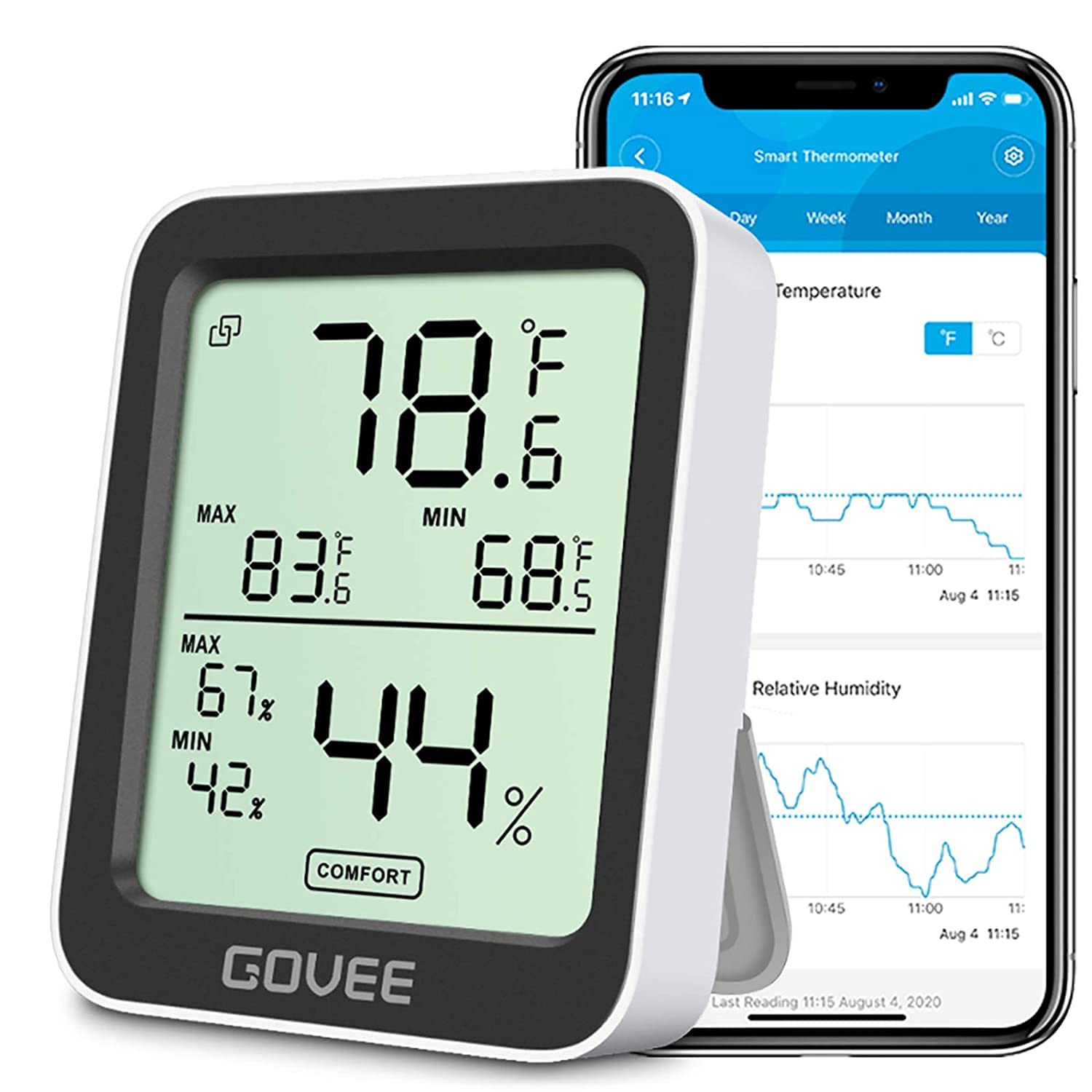
WiFi and Bluetooth thermo-hygrometers push readings to a phone app, log history, and, in the WiFi versions, send alerts when readings cross thresholds you set. For keepers of fragile or expensive animals, or anyone whose enclosure sits in a room they do not constantly occupy, alerting is the genuinely valuable feature: a heater failure at 2 a.m. or a humidity crash during a workday generates a notification instead of a discovery. History logging also helps tune heating and misting schedules, since you can see exactly when a lamp cycles or how fast humidity decays between mistings. The trade-offs are real: WiFi versions generally need a 2.4GHz network, they cost more, they add an app and an account to your life, and Bluetooth-only versions only sync when your phone is within range. Connected monitors with internal humidity sensors share the same placement caveat as any combo unit.
A Concrete Example: A WiFi Thermo-Hygrometer Worth Looking At

Rather than a long list of near-identical products, this guide points to one specific connected monitor as an illustration of the category done well: the Inkbird ITH-20R. Per the manufacturer's specifications, it pairs a remote temperature probe accurate to about plus or minus 0.5 degrees Fahrenheit with an internal humidity sensor accurate to about plus or minus 2 percent relative humidity, connects over 2.4GHz WiFi to a free companion app, and supports user-defined high and low alert thresholds for both temperature and humidity. The roughly five-foot probe cable is long enough to reach a basking spot in most home enclosures while the display unit remains outside the glass, and the unit runs on an AC adapter with battery backup so monitoring continues through a power cut.
Owner reports consistently highlight two strengths: the alerting genuinely catches heater and humidifier failures quickly, and the app's history charts make daily and weekly temperature patterns visible in a way a bare display cannot. The recurring criticisms are also consistent and worth weighing. The humidity sensor lives in the display body, not on the probe, so accurate enclosure humidity requires the display to be positioned in or very near the enclosure's air; the WiFi radio only works on 2.4GHz networks, which rules out some mesh setups configured for 5GHz only; and mounting hardware is sparser than on reptile-branded units, so some keepers add their own Velcro or magnet mounts. For a keeper who wants phone alerts for a single important enclosure, this class of device, with this model as a well-documented example, is a reasonable buy at its mid-range price. You can check the current price on Amazon and read recent owner reviews before deciding.
For keepers who do not need WiFi at all, the same manufacturer sells a simpler non-connected version of essentially the same probe-and-display formula. It drops the app, the alerts, and the price, and keeps the probe-based temperature measurement that is the core function. Verified buyer feedback describes it as a dependable budget option for enclosure monitoring where a human eyeball on the display a few times a day is sufficient. If your collection is one or two hardy animals in a room you occupy regularly, this simpler unit is arguably the more sensible purchase, and the money saved goes toward an infrared gun, which no smart monitor replaces. You can view this option on Amazon to compare the two side by side.
How to Choose: A Decision Framework
Start with your species, not with products. Write down the target basking surface temperature, the ambient warm-side and cool-side temperatures, and the target humidity band for your animal; species-specific care sheets from veterinary and keeper organizations are the right source for these numbers. Then map devices to numbers. The basking surface number needs either a probe thermometer placed at the spot or an infrared gun used at the spot, and ideally both, since the gun verifies the probe. The ambient numbers need a sensor at animal height on both ends of the enclosure, which argues for either two cheap combo units or one probe unit repositioned during setup. The humidity band needs a hygrometer whose accuracy is narrow relative to the band: for a desert lizard needing 20-35 percent, a sensor accurate to plus or minus 5 percent is a fifth of the entire acceptable range, which is why tighter accuracy is worth paying for in narrow-window species.
Second, match the monitoring style to your risk tolerance. A keeper with a corn snake in a stable room can check a ten-dollar combo unit each morning and be done. A keeper breeding crested geckos, or maintaining a chameleon with narrow humidity requirements, benefits from a connected monitor with alerts, and arguably from more than one. Third, budget for redundancy. Two inexpensive units that agree with each other are more trustworthy than one unit of unknown accuracy, and disagreements between them tell you it is time to recalibrate or replace. A sensible complete setup for a single enclosure costs less than a veterinary exam: one probe thermometer at the basking site, one combo hygrometer-thermometer for ambient conditions, and one infrared gun for spot checks.
Placement, Calibration, and Maintenance
Placement errors cause more bad readings than bad sensors. Put the probe tip on the actual surface the animal basks on, not floating an inch above it, because air and surface temperatures under a heat lamp can differ by twenty degrees or more. Put ambient sensors at animal body height, not on the ceiling of the enclosure where heat stratifies. Put humidity sensors at mid-height on the cool side, away from water bowls, misting nozzles, and ventilation gaps, all of which create local readings that do not represent the enclosure as a whole. Route cables through proper ports or tape them flat; a loose probe wire is an entanglement hazard, and some lizards will chew exposed cable, which is a genuine safety issue worth an animal poison control call if ingested materials are involved.
Even good sensors drift. A widely used home check for thermometers is an ice-water bath: a sensor in a stirred cup of ice water should read close to 32 degrees Fahrenheit, and anything more than a couple of degrees off deserves suspicion. For hygrometers, the salt test is the standard method: seal the sensor in a bag with a small container of damp, not wet, table salt, and after several hours the air in the bag should stabilize at about 75 percent relative humidity. Neither test is laboratory-grade calibration, but both catch gross errors cheaply, and doing them once or twice a year keeps a budget fleet of gauges honest. Replace batteries promptly, since weak batteries are a documented cause of erratic readings, and retire any unit that fogs internally, which is common for non-sealed displays in high-humidity enclosures.
Common Mistakes to Avoid
- Trusting the stick-on analog thermometer from a starter kit; these read glass temperature and are frequently off by five to ten degrees according to nearly every experienced keeper who has compared one against a digital probe.
- Reading air temperature at the top of a tall enclosure and assuming it describes the basking surface; under basking lamps the surface is nearly always hotter than the surrounding air.
- Placing the humidity sensor directly in the misting stream or over the water bowl, producing a reading far wetter than the enclosure average.
- Skipping a thermostat because the thermometer shows a good temperature; a thermometer reports conditions while a thermostat controls the heat source, and unregulated heat mats and lamps are the classic cause of thermal burns in reptiles.
- Believing one device can do everything; surface, ambient, and humidity measurements are different jobs, and the best setups layer two or three cheap tools rather than expecting one unit to cover all of them.
- Ignoring night-time drops and heating failures because monitoring happens only when the keeper happens to walk past; this is the specific gap connected monitors with alerts are designed to close.
Frequently Asked Questions
Are stick-on thermometers accurate for reptile tanks?
No. Adhesive strip thermometers measure the temperature of the glass or acrylic they are stuck to, not the air or surfaces inside, and keepers who compare them against digital probes routinely report errors of five to ten degrees Fahrenheit. Replace them with a digital probe thermometer or verify conditions with an infrared gun.
Do I need both a thermometer and a hygrometer?
Yes, because temperature and humidity are independent parameters with independent consequences. A combo unit covers both ambient readings in one purchase, but basking surface temperature still requires a probe at the spot or an infrared gun, since combo units with internal sensors cannot measure a basking rock directly.
What basking temperature does my reptile need?
It varies by species: commonly cited targets include roughly 100-110 degrees Fahrenheit for bearded dragons, 88-93 for leopard geckos, 88-92 for ball pythons, 78-82 for crested geckos, 85-90 for corn snakes, and 90-100 for many tortoises. Confirm the number for your specific animal against current veterinary or keeper-organization care guidance, and always provide a gradient down to a cooler side so the animal can regulate.
How often should I check temperature and humidity?
Spot-check the basking surface with an infrared gun daily or whenever anything changes, such as a new bulb or seasonal room temperature shifts. Glance at ambient displays at least a few times a week. Connected monitors log continuously, so reviewing their weekly history is often enough to catch slow drift.
Can I use a household thermometer or hygrometer?
Frequently yes for temperature, provided the range covers reptile basking temperatures, since some household units top out around 122 degrees Fahrenheit. For humidity, check the accuracy specification at high readings, because units designed for home comfort use are often least accurate above 70 percent relative humidity, exactly where tropical species live.
What causes inaccurate humidity readings?
The usual culprits are placement problems: sensors too close to water bowls, in the misting path, or in drafts from ventilation. Low batteries and plain calibration drift account for most of the rest. Relocate the sensor, run a salt test, and replace batteries before assuming the device itself has failed.
Do I need a thermostat or just a thermometer?
Both. A thermometer tells you what is happening; a thermostat limits the heat source automatically. Unregulated heat mats and lamps are a leading cause of thermal burns in captive reptiles, and veterinary guidance on reptile husbandry treats a thermostat on every heat source as basic equipment rather than an upgrade.
Can humidity be too high for desert reptiles?
Yes. Sustained humidity above roughly 40 percent in desert species enclosures is associated with respiratory infections, scale rot, and fungal growth. Keepers in humid climates may need a room dehumidifier or improved enclosure ventilation to bring numbers down into the species-appropriate range.
Putting It Together
The core setup almost every reptile enclosure needs is three measurements covered by two or three inexpensive devices: a continuous probe reading at the basking spot, an ambient temperature and humidity reading from a combo unit placed at animal height, and an infrared gun for verifying surfaces quickly and often. Keepers of delicate, valuable, or narrow-requirement animals should add a connected monitor with phone alerts, and the Inkbird ITH-20R is a well-documented example of that category whose specifications, strengths, and limitations are outlined above; you can view this option on Amazon to check current pricing and owner feedback. For simpler needs, its non-WiFi sibling covers probe-based temperature monitoring at a lower price. Whichever route you take, verify sensor placement before trusting any number, recalibrate occasionally with an ice bath or salt test, and treat disagreements between devices as a signal to investigate rather than ignore. Accurate monitoring is the least glamorous equipment in reptile keeping and, after the enclosure itself, the most consequential.
Affiliate Disclosure: PawCritic is a participant in the Amazon Services LLC Associates Program, an affiliate advertising program designed to provide a means for us to earn advertising fees by linking to Amazon.com and affiliated sites. Purchases made through our links help support our research-based guides at no extra cost to you. Thank you for your support.
Last updated: June 29, 2026. Prices and availability are subject to change. Always verify current pricing on Amazon before purchasing.