Disclosure: PawCritic is reader-supported. A few links below are Amazon affiliate links, and we may earn a small commission if you purchase through them at no extra cost to you.
Why Turtle Tank Choice Is a Decades-Long Decision
Turtles are among the longest-lived pets people routinely keep indoors, and the tank purchased in the first week shapes the next several decades of that animal's life. The uncomfortable math is simple: a hatchling red-eared slider costs a few dollars and grows into a 10-to-12-inch adult that needs 75 to 120 gallons of water, a canister filter, a basking dock, and UVB lighting replaced twice a year. Most turtles outgrow their first tank within 18 months, which is why the resale market is full of 20-gallon setups and why size rules come before any product recommendation.
This reference guide covers what actually matters in a turtle tank, the four product categories that make up a working habitat, and the setup details -- filtration turnover, basking temperatures, UVB replacement -- that decide whether a tank functions as a habitat or just a container. Every claim here is traceable to published guidance from veterinary sources, manufacturer specifications, or verified owner reports. PawCritic does not run a testing laboratory or measure products with instruments; the goal is to translate established reptile-keeping standards into buying decisions.
Buying Guide: What to Look for in a Turtle Tank
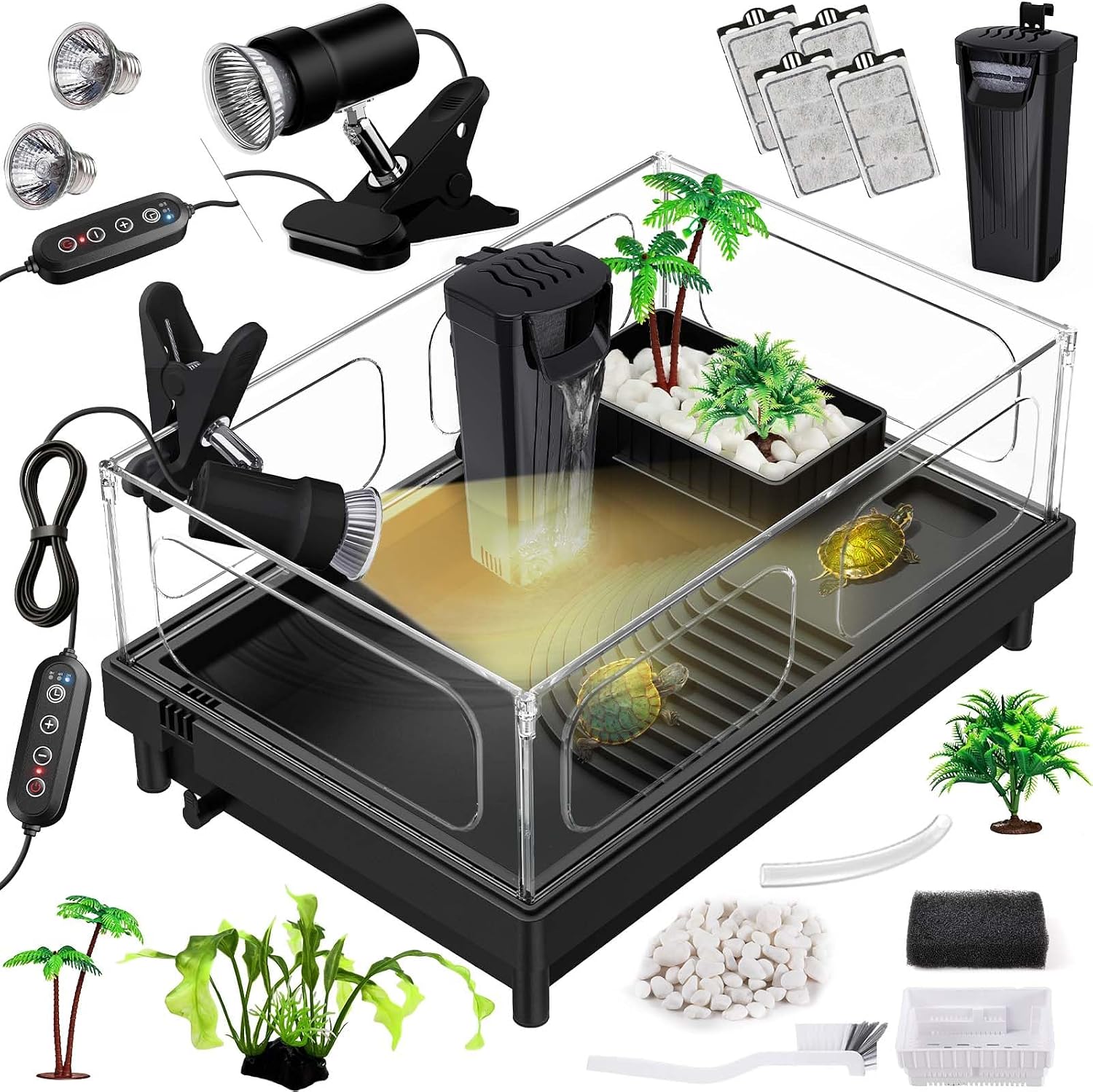
Tank Size: The Rule Nobody Can Skip
The working rule is 10 gallons of water per inch of shell length, measured against the adult size, not today's hatchling. A single adult red-eared slider needs at least 75 gallons; a male map or mud turtle that tops out at 5 inches can live properly in 50. Two adult sliders need 125 gallons or more. There is no product on this list that changes that math. Stunted growth from undersized tanks is organ damage, not convenience, and the same nutritional and lighting failures that cause shell deformities are covered in the metabolic bone disease literature published by the Association of Reptilian and Amphibian Veterinarians.
A useful sanity check before buying: measure the adult shell length for the species in question, multiply by ten, and treat that number as the floor, not the target. A 55-gallon tank is a legitimate lifetime home for a male slider or most map turtles, but it is a grow-out tank for a female slider that will reach 12 inches. Buying the adult tank first avoids the trap of spending twice -- once on a starter kit and again on the real enclosure 18 months later.
Filtration: Rated for Double the Mess
Turtles are carnivorous, messy eaters that produce far more waste per gallon than fish. Size filtration at 2 to 3 times the tank volume in GPH, and choose canister filtration for anything over 40 gallons. Internal filters that would service a fish tank of the same size are inadequate for turtles. Plan on the filter costing as much as the tank itself and budget for media replacements monthly.
Water quality is the single most common failure point in turtle setups, and it is almost always a filtration-sizing problem rather than a maintenance-discipline problem. A 55-gallon turtle tank needs a filter rated near 300 GPH, not the 100 GPH unit that would be generous for a community fish tank of the same volume. The biological load from one adult slider is roughly equivalent to a small shoal of goldfish, and the waste is more concentrated because turtles eat protein-rich foods.
Heating, Basking, and UVB
Three temperature zones define a turtle habitat: water at 75 to 80 degrees Fahrenheit (heater sized for the volume, guard included because turtles slam heaters), a basking surface at 90 to 95 degrees, and air above the water warm enough that the animal never crosses a cold gap. UVB is not optional for most species. Without it, calcium metabolism fails and shell deformities follow. Replace UVB bulbs every 6 to 12 months even when they still light up, because output decays invisibly.
The Merck Veterinary Manual's exotic and laboratory animal section notes that most captive reptile health problems trace back to husbandry -- temperature, humidity, lighting, and diet -- rather than infectious disease. That is the practical argument for treating heating and UVB as core purchases rather than accessories. A $30 UVB bulb that is six months past its useful life is functionally the same as no bulb at all, and the animal pays for that in shell quality over months, not days.
Glass vs. Acrylic
Glass stays clear for decades, resists scratches, and costs less per gallon; it is the default for good reason. Acrylic weighs a third as much and insulates better but scratches easily, and turtle claws find glass seams too. For anything 75 gallons or larger, glass on a proper stand is the practical answer. A filled 75-gallon tank weighs over 800 pounds, so floor strength and a level, dedicated stand are part of the purchase, not an afterthought.
Below-Grade Rooms
Basements work for turtles only if ambient temperature holds, and they usually do not. Cold floors, poor air circulation, and seasonal swings make below-grade setups a year-round temperature management problem. If the tank must go in a basement, budget for a more powerful heater and check water temperature daily during winter. A thermostat on the heater is not optional in that environment.
Substrate, Decor, and Safety
Bare-bottom tanks are the easiest to clean and the least attractive; a thin layer of large river rock or aquarium-safe sand is a reasonable compromise. Avoid gravel small enough to swallow, because impaction is a documented risk in aquatic turtles and a common reason for veterinary visits. Basking docks should be stable enough that the turtle cannot flip them, and the ramp angle should let the animal climb out without struggling.
Check every item against the ASPCA Animal Poison Control database before adding plants or decor. Some commonly sold aquarium plants and decorative rocks are toxic to reptiles, and the database at ASPCA Animal Poison Control is the fastest reference for checking a specific species. When in doubt, leave it out; a plain tank with a good dock and correct lighting is a better habitat than a decorated tank with a toxic plant.
Top Picks: Turtle Tank Options for 2026
1. Aqueon Aquarium LED Kit -- Best Overall Starter
Price: $130-300 depending on size | Rating: 4.7/5
Pros:
- Reinforced glass seams that tolerate daily turtle wear
- LED hood included for ambient light
- Heater included on 20-gallon and larger kits
- Size options from 10 up to 55 gallons
Cons:
- Filter and UVB sold separately
- Nothing under 75 gallons suits an adult slider
The Aqueon kit is a sensible default for a juvenile turtle setup because it spends money where it matters: glass quality and seam reinforcement. Turtles claw, ram, and scrape tank walls in ways fish never do, and this glass holds up to that wear according to owner reports. The included heater and LED hood cover two of the five systems a turtle needs, and buying filtration and UVB separately is genuinely better than bundled all-in-ones, which usually bundle the wrong filter. Buy the 40-gallon breeder for a hatchling slider and plan the 75-gallon upgrade around year two, or start at 55+ directly for smaller adult species.
2. Fluval Flex Aquarium -- Best for Small Adult Species
Price: $90-180 | Rating: 4.5/5
Pros:
- Built-in 3-stage filtration in the rear compartment
- Curved front glass with a clean, equipment-hidden look
- Adjustable LED ramp lighting
- 32-gallon model suits mud, musk, and spotted turtles
Cons:
- Included filter is fish-rated; upgrade for turtles
- No heater included
- Curved front limits basking dock choices
The Fluval Flex is the tank for keepers of the smaller aquatic species -- musk turtles, mud turtles, male Reeves turtles -- that genuinely fit adult life into 32 gallons. The rear filtration compartment hides equipment and the curved glass presents the habitat like a display rather than an appliance. The included filter media runs fish-grade, so plan on upgrading the pump or adding a small external canister within the first months; turtle load outpaces fish load fast. For a single adult small-species turtle, this is the most attractive complete option on the market.
3. Zilla Turtle Tank Starter Kit -- Best Budget Setup
Price: $60-120 | Rating: 4.3/5
Pros:
- Turtle-specific: basking platform, lamp, and filter included
- Honest about the species it suits (small species and juveniles)
- Low total cost to get a working habitat running
Cons:
- 20-gallon ceiling limits it to hatchlings and small species
- Included filter undersized for real turtle bioload
The Zilla kit is a reasonable recommendation for first-time owners who want everything on day one for under $100. It is built for the job rather than adapted from fishkeeping, which shows in the included basking ramp and the mesh lamp. Two upgrades are mandatory within weeks: a stronger filter and a proper UVB bulb, and the kit's long-term cost comes from those replacements. For a hatchling's first year, it works; for an adult of almost any common species, it does not, and the product listing says so plainly.
4. Tetra Glass Aquarium 55 Gallon -- Best Value Per Gallon
Price: $150-200 (tank only) | Rating: 4.6/5
Pros:
- Cheapest honest path into adult-sized water volume
- Standard dimensions fit most stands and canisters
- Proven seam construction
Cons:
- Bare tank: no hood, filter, or heater
- Heavy; requires a real stand and floor check
The 55-gallon Tetra is the value anchor of this list. Per gallon, nothing else comes close, and 55 gallons is a legitimate lifetime volume for male sliders, most map turtles, and a pair of smaller species. Buying tank-only means assembling the system yourself -- canister filter around 300+ GPH, a 300-watt guarded heater, UVB over the basking dock -- but every component gets chosen for turtles instead of accepting whatever is bundled. For owners moving up from an outgrown starter tank, this is the step that ends the upgrade cycle.
Quick Comparison
| Tank | Volume | Price | Best For |
|---|---|---|---|
| Aqueon LED Kit | 10-55 gal | $130+ | Juvenile starter system |
| Fluval Flex | 9-32 gal | $90+ | Small adult species |
| Zilla Turtle Kit | 20 gal | $60+ | Budget first setup |
| Tetra 55 Gallon | 55 gal | $150+ | Adult-sized value |
What Has Changed for 2026: LED UVB, Smarter Controls, and Tank Pricing
LED-based UVB fixtures have matured from novelty to legitimate option. Several manufacturers now publish measured irradiance at specific mounting distances for their LED bars, which is the transparency this category needed, and long-term owner reports on output retention have accumulated enough to judge them fairly. The practical implications for a turtle setup are modest but real: LED bars run cooler, last longer between replacements, and pair well with the low-profile fixtures that screen tops demand. Mercury vapor bulbs remain the other route to combined heat and UVB, and the standing cautions still apply, since they run hot and offer little control over the balance between the two outputs. Whichever technology you choose, the replacement schedule stays a measurement question rather than a calendar question, and a good UVB meter or a disciplined log still beats guessing.
External digital thermostats have become the default recommendation rather than an upgrade. Pulse-proportional units that throttle heater output continuously now cost little more than the dial statistats most keepers outgrow, and they extend heater life while holding water temperature steadier through seasonal room swings. The two-probe habit is spreading with them: one probe on the basking surface, one in the water column, checked weekly rather than trusted forever. Every thermostat eventually fails, and the backup is a second thermometer, not optimism.
Above-tank basking toppers have also grown from a do-it-yourself niche into a catalog category. For an adult slider in a 75-gallon or larger glass tank, a topper converts vertical space that a 55-gallon-frame tank wastes into basking area without sacrificing a single gallon of swimming volume, which is the core complaint about internal floating docks. They require a secure rim mount and a heat fixture that cannot be reached from inside, but for full-grown animals they solve the dock-versus-water-volume trade-off better than anything floating inside the tank.
Pricing has moved in the direction owners would predict. Glass in the 75-gallon class costs moderately more than it did a few years back, canister filter media has crept upward, and complete turtle kits remain the weakest value on the shelf because the bundled filtration still undershoots real turtle bioload. The component route, meaning a plain reinforced tank plus a separately chosen canister, heater, and UVB setup, remains the path that ends the upgrade cycle, and 2026 pricing has widened that gap rather than closed it.
Heading Into Winter: Notes for Turtle Setups
Cold months stress turtle setups in one specific way: room temperature falls, and every piece of thermal equipment now runs closer to its limit. Water heaters sized marginally in summer start losing the race in a cold basement or an apartment that drops to 65 degrees overnight. The fix is not a bigger heater added in a panic; it is a guarded heater sized for the real winter water volume, paired with a thermostat you have actually watched cycle. If the water temperature dips below the mid-70s in the morning before the heater catches up, the heater is undersized for the season, not broken.
Basking surfaces drift in winter too. A bulb that produced a 92-degree surface in a warm room may only reach the high 80s in January, and a turtle that cannot get warm enough dries off incompletely, which is how shell problems start. Re-measure the basking temperature with a temperature gun or a probe in December rather than assuming summer numbers still hold, and raise bulb wattage or reduce the distance to the dock if the surface has slipped.
Electricity costs get a fresh look this time of year as well, and turtle tanks are honest about their appetite: heaters and UVB fixtures run around the clock. There is no efficient trick that changes the physics, but there are two real ones. Insulate the sides and back of the tank with foam board, which cuts heat loss noticeably without changing the display, and keep the room door closed so the tank is not heating the hallway.
One habit worth adding: a twice-weekly thermometer check at the same time of day, in the water and on the dock. Winter equipment failures are quiet ones, and a heater that dies overnight in an unheated room turns into lethargy, refusal to eat, and an emergency by the weekend. The check takes under a minute and catches almost every seasonal failure before the turtle pays for it.
Setup Details That Decide Water Quality
The tank is one of five systems. Fill the tank to the top of the frame (deeper water means stronger turtles and better swimming), run the canister at 2 to 3 times volume, and let it cycle for a week before the turtle arrives. Feed in a separate container if possible -- it cuts the waste load dramatically and keeps the tank cleaner than any filter upgrade will. Change 25 percent of the water weekly regardless of how clear it looks; dissolved ammonia does not care about clarity.
A separate feeding tub is the single highest-impact habit change for most turtle keepers. It removes uneaten food and waste before it enters the main tank, which reduces filter load, extends media life, and makes water changes less urgent. The trade-off is handling the turtle twice a day, which some animals tolerate better than others. Shy species may refuse to eat in a bare tub at first, and keepers should be prepared to feed in-tank if the animal shows stress.
Maintenance Schedule and Common Mistakes
A workable maintenance rhythm for a single adult turtle looks like this: 25 percent water change weekly, filter media rinsed monthly in removed tank water (never tap water, which kills beneficial bacteria), canister opened and impellers cleaned every two to three months, UVB bulb replaced every 6 to 12 months, and a full substrate vacuum monthly if substrate is used. Skipping the UVB replacement is the most common invisible failure, because the bulb still glows and the tank still looks lit.
Common mistakes that shorten a turtle's life: an undersized tank that stunts growth, a filter rated for fish rather than turtles, no UVB or a UVB bulb past its useful life, water that is too cold for digestion, and a basking dock that is too small or too steep for the animal to dry completely. Shell rot and respiratory infections are the usual downstream consequences, and both are husbandry problems before they are medical problems.
Owners should also plan for the veterinary side. An exotics vet should be identified before the turtle arrives, not after a problem appears, because not every practice treats reptiles and wait times for a first appointment can run weeks. Annual checkups, fecal exams when indicated, and a baseline weight record are the standard of care for a long-lived species.
Frequently Asked Questions
What size tank does an adult red-eared slider need?
At least 75 gallons for a female, 50 to 75 for a male, following the 10-gallons-per-inch rule on adult shell length. Two adults need 125 gallons or more. Plan the adult tank from day one, because hatchlings outgrow starter tanks within 12 to 18 months.
Can a fish tank filter be used for a turtle?
Only if it is rated well above the fish equivalent -- size for 2 to 3 times the tank volume and expect to clean it more often than fish care demands. Canister filters are the standard for anything over 40 gallons because turtles overwhelm internal filters quickly.
How often should turtle tank water be changed?
25 percent weekly plus a monthly partial deep clean, with the filter media rinsed monthly in removed tank water. A separate feeding tub stretches this schedule considerably.
Do turtles really need UVB light indoors?
Yes, for virtually all common pet species. Without UVB they cannot metabolize calcium, and shell softening and metabolic bone disease follow within months. Replace the bulb every 6 to 12 months even if it still emits visible light.
Why is a turtle tank always dirty?
Undersized tank, undersized filter, or feeding in the tank. Those three causes explain nearly every cloudy turtle aquarium. The fixes are volume, 2-3x filtration turnover, and a separate feeding container -- in that order of impact.
Is tap water safe for a turtle tank?
Chlorinated tap water should be treated with a dechlorinator before use, and the tank should be cycled before the turtle is added. Never rinse filter media in untreated tap water, because it kills the beneficial bacteria that process waste.
How long do pet turtles live?
Common species such as red-eared sliders regularly live 20 to 30 years with proper care, and some individuals exceed 40. That lifespan is the reason tank sizing, filtration, and lighting decisions matter more for turtles than for most other pets.
Final Thoughts
Buy for the adult turtle, not the hatchling. That single decision -- a 55 or 75-gallon glass tank on a real stand, with 2 to 3 times filtration, a guarded heater, and fresh UVB every year -- is the difference between a decade of easy maintenance and a string of upgrades that end with a rehomed animal. If the full adult setup is beyond this year's budget, start with a 20-gallon grow-out tank and save toward the big tank, rather than pretending a small tank is permanent. Line up an exotics vet before purchase day, because turtles are a 20-year commitment and annual checkups are part of it.
Where to Buy: Our Top Picks
As an Amazon Associate, PawCritic earns from qualifying purchases. This does not affect our reviews or recommendations.
- MoonOrange Acrylic Turtle Tank Starter Kit (basking platform included): Check price on Amazon
- Canister Filter for Turtle Tanks: Check price on Amazon
- BN-LINK Under-Tank Heat Pad (basking-side warmth, not a water heater): Check price on Amazon
- Floating Basking Dock Platform: Check price on Amazon
Related reading: Merck Veterinary Manual: Exotic and Laboratory Animals and ARAV Reptile and Amphibian Resources.
Related Reading
the best reptile UVB lighting and heat lamps, reptile thermostats and temperature control, and how to choose your first pet reptile.