The Turkey Is in the Oven and the Year's Riskiest Day Has Already Started
By 9 a.m. on Thanksgiving, most kitchens already contain a brining bird, a cutting board dusted with garlic, a trash can with a loosely balanced lid, and a front door that will swing open a dozen times before dinner. For a cat, that combination is more dangerous than any single day of the year outside of July Fourth fireworks. The American Society for the Prevention of Cruelty to Animals fields its highest spike of food-related poisoning calls around the November and December holidays, and cats are disproportionately caught by a different set of traps than dogs: they sneak table scraps off plates left unattended, they chew decorative greenery, and they bolt through doors that humans prop open while carrying grocery bags.
This guide is our full-day playbook. It walks through the foods that land cats in the emergency room, the guest conversations that prevent most incidents, the quiet room that saves an anxious cat from a twelve-hour stress marathon, the door-traffic problem nobody budgets time for, and the decorations that look harmless but behave like string foreign bodies inside a feline gut. Everything here is written to be done on the holiday itself, not weeks in advance, because the reality of hosting is that you will not have a calm preparation week. We have ordered the sections by when the risks actually appear during the day, starting with the kitchen.
The Toxic Foods Sitting on Your Thanksgiving Table Right Now
The turkey itself is rarely the problem. Plain, boneless, skinless white meat in a small portion is harmless for a healthy cat. The danger gathers around the bird. Onion and garlic, which go into nearly every stuffing, gravy, and casserole on a traditional menu, belong to the allium family and damage feline red blood cells, leading to hemolytic anemia that can take several days to show up. Cats are far more sensitive to alliums than dogs are, and powdered forms in gravy mixes and broth concentrates are more concentrated than fresh cloves. A cat that licks a serving spoon or finishes the remains of a stuffing bowl can ingest a toxic dose without anyone noticing a single event.
Fatty drippings and skin deserve their own warning. A sudden load of turkey fat, pan grease, or buttered sides can trigger pancreatitis, which in cats often looks like hiding, vomiting, and refusing food rather than the dramatic abdominal pain dogs show. Cooked poultry bones splinter and are a choking and perforation risk. Raw yeast dough rises in the warm stomach and produces both alcohol and gas. Grapes and raisins, which show up in salads and desserts more often than people expect, can cause kidney damage, and the toxic dose in cats is not well established, so any confirmed ingestion warrants a call. Chocolate, alcohol, and anything sweetened with xylitol round out the list. The ASPCA Animal Poison Control Center at 888-426-4435 is open around the clock on holidays, and their guidance is consistent: call early, before symptoms appear, because inducing vomiting at home is wrong for cats and most of what owners try makes things worse.
One food gets a pass that surprises people. Plain canned pumpkin, a spoonful, actually helps a constipated or hairball-prone cat and is a safe treat if a guest insists on contributing something. The point is not that every human food is forbidden. The point is that the specific Thanksgiving sides carry specific, documented risks, and knowing which ones lets you relax about the harmless ones.
The Drippings Problem: Pancreatitis Does Not Look Like an Emergency
Pancreatitis is the injury most often missed on Thanksgiving, and it deserves a longer explanation than the food list above. When a cat eats a large fatty meal, the pancreas is suddenly asked to flood the intestine with digestive enzymes. In some cats that request goes wrong, the enzymes activate inside the gland itself, and the organ begins digesting its own tissue. Veterinary emergency clinics report their predictable bump in pancreatitis cases in the two days after major food holidays, and cats present differently than the textbook dog case. There is usually no rigid hunched posture. Instead, owners describe a cat that vomited once, then hid in a closet, then stopped eating. By the time the appetite loss is obvious, dehydration is already underway, and in cats even forty-eight hours without food raises the risk of hepatic lipidosis, a liver condition that can become fatal.
The prevention is boring and effective: drippings, skin, buttery gravies, and pan scrapings go in the trash or the dog-proof container, not the cat bowl. If you want the cat to feel included, set aside a few ounces of plain breast meat before anything is seasoned, and offer that instead. According to the American Veterinary Medical Association, sudden diet changes and high-fat meals are among the most common avoidable triggers of digestive emergencies in pets, and Thanksgiving is their single largest annual spike. Guests who want to feed the cat are the main breach point, which brings us to the conversation worth having before the doorbell rings.
The Thirty-Second Guest Briefing That Prevents Most Incidents
Guests do not poison cats out of negligence. They do it out of kindness, armed with the belief that one bite of stuffing is a treat. The fix is a single rehearsed sentence delivered at the door, before coats come off: the cat is on a strict diet for medical reasons, so please do not feed her anything, and here is what she is allowed instead. Framing it as a medical restriction rather than a house rule matters, because guests will bend a rule and will not challenge a vet instruction. Have the allowed treats pre-staged: a small dish of her normal kibble or a few commercial treats on the counter, so the guest who insists has a sanctioned option within reach.
Two guest behaviors deserve specific coverage. The first is medication exposure. Holiday guests travel with suitcases that contain ibuprofen, acetaminophen, sleep aids, and prescriptions stored in zippered pockets on the floor of a guest room or under a coat on a bed. Acetaminophen is catastrophic for cats at doses far below what a human would consider trivial, damaging red blood cells and the liver. Ask every overnight guest to keep bags zipped and on hooks or shelves, and check the bathroom counter before bedtime, because the dropped pill you find at midnight is one you can act on, while the one nobody noticed is the reason a Monday emergency visit happens.
The second is the well-meaning child who wants the cat to meet everyone. A cat that spends the afternoon being carried from lap to lap by strangers is not socializing, she is accumulating stress, and stress in cats expresses as hiding, over-grooming, inappropriate urination, and occasionally a redirected bite at whoever reaches in. The briefing should include one line about the cat: if she is in her room, that is her plan for the day, and she will come out if she wants to.
Building the Quiet Room Before the First Doorbell
The quiet room is the single highest-value preparation on this list, and it takes fifteen minutes. Pick a room that will stay closed all day, ideally one the cat already associates with sleeping. Move in the essentials: her litter box, water in a bowl she recognizes, a portion of her regular food, and at least two hiding options at different heights, one low such as under the bed and one elevated such as the top of a dresser or a cat tree moved in temporarily. Then add comfort in the middle of the room, because a hiding spot is for hiding but the goal is a room she is willing to relax in, not merely endure. We recommend a plush donut-style bed as the centerpiece; the raised rim gives a cat something to press against, which is the same principle behind why cats sleep in cardboard boxes and curled against your arm. Something like the Bedsure Calming Donut Bed in the 23-inch size fits most cats and most closets, is washable for the inevitable post-holiday cleanup, and does not look out of place in a guest bedroom.

Timing matters more than furniture. Put the cat in the quiet room before guests arrive, not after she is already hiding under the sofa in the living room. Relocating a frightened cat mid-party turns the quiet room into another scary grab, and a cat that has been chased once will not trust the room again. Feed her in the room, close the door, and post a small sign on it so a guest looking for the bathroom does not open the wrong door. According to the Humane Society of the United States, giving cats a retreat space during gatherings is the most reliable way to prevent stress-related behavior problems, and the behavior problems that follow a bad holiday, like litter box lapses, tend to persist for weeks because the cat now associates the hallway or living room with chaos.
One adjustment for the especially anxious cats: a radio or speaker in the room playing ordinary conversation-level audio masks the doorbell and kitchen noise. Some owners leave a television on; we have found that a consistent, boring sound works better than music with sudden volume swings. Do not add new scent items like candles or diffusers to the room. Many essential-oil products are toxic to cats even passively, and the quiet room should be the one scent-neutral zone in the house.
Keeping Her Busy Through the Long Kitchen Hours
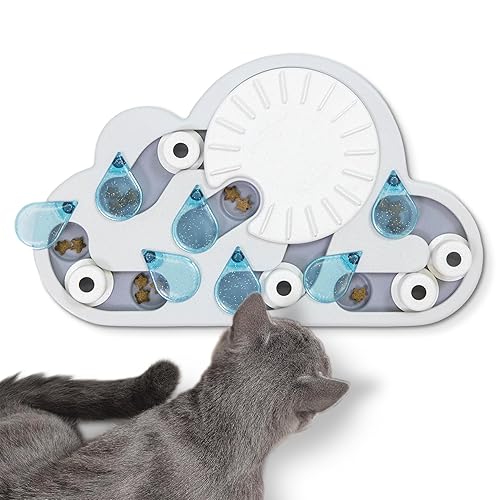
An occupied cat is a cat who is not orbiting the oven. The stretch between mid-morning prep and the meal itself is four to six hours of high-arousal noise and smells, and a food-motivated cat will shadow every cutting board. This is where a food puzzle earns its keep. Something like the Catstages Nina Ottosson Rainy Day Puzzle and Play turns her regular kibble ration into twenty minutes of focused work with spinning and hidden compartments, and because it dispenses her normal food rather than treats, it cannot tip into the overfeeding that holiday weekends usually bring. Serve her entire lunch ration in the puzzle inside the quiet room. The combination of a closed door, working for food, and a familiar smell of her own meal does more to normalize the strange day than any amount of extra petting.
Plan a second occupation for the dinner hour itself. After guests sit down, the kitchen briefly empties, and that lull is when the boldest cats make their move on unattended plates. Before you sit down, reset the puzzle with a small handful of kibble or swap in a different toy. A catnip-stuffed kicker such as the Potaroma Catnip Pillows three-pack gives her something to wrestle with that is hers, and the honest truth about catnip is that for the roughly two-thirds of cats who respond to it, it produces a few minutes of exuberance followed by a long mellow stretch, which is exactly the window you need while twenty people pass the gravy.
Door Traffic: The Escape Risk Nobody Budgets Time For
Count the door openings on a hosted Thanksgiving: guests arriving, guests stepping out to take calls, grocery runs for forgotten items, the cousin who smokes on the porch, the garbage runs. Twelve to twenty is a normal range, and every opening is an opportunity for a cat who has decided the living room is worth investigating. The escape on a holiday is worse than an ordinary escape because she may slip out during a noise spike, there are unfamiliar cars in the driveway, and your attention is divided by a house full of people.
The preparation is an identity audit done this morning, not next week. Her collar should be on, correctly fitted, with current tags. If her tag information is stale or her collar has been sitting on a hook since her last bath, fix both today. This is also the right moment to mention a tracking layer: a lightweight breakaway collar with a tracker holder, such as the Dgerp Airtag Collar with its integrated holder and reflective strip, means that if she does slip out, you are searching a known location within minutes instead of posting flyers. The breakaway mechanism matters; a collar that catches on a fence while she is frightened and escaping is its own emergency, which is why we never recommend collars without it for outdoor-capable cats.
Then manage the door itself with two cheap habits. First, establish a physical buffer at the main entrance, even a baby gate leaned across or a closed interior door to the room with the front door, so there are two barriers between the cat and outside during arrivals. Second, assign the door. One adult owns the entrance for the arrival window, greets, closes, and does not get pulled into conversation mid-transit. Most holiday escapes happen when two people assume the other one watched the door. If your cat is a known door-dasher, the honest move is to keep her in the quiet room for the entire arrival window rather than testing a fifteen-minute gamble.
Decorations: The Ones That Bite Back
Autumn and early winter decor brings a specific set of feline hazards, and most of them share one mechanism: a cat swallows string-like material, and it does what string does. Tinsel, ribbon, curling string, the twine tied around a pie box, and the ribbon on a hostess gift all become linear foreign bodies, the surgical emergency where the thread anchors under the tongue and saws through the intestines as the gut tries to move it. Signs appear days later: vomiting, refusing food, hiding. The ASPCA lists string, tinsel, and ribbon among its recurring seasonal hazards precisely because the aftermath is delayed and owners rarely connect a Tuesday surgery to Saturday's gift ribbon. The rule for a cat household is simple: nothing string-shaped within her reach all day, and gifts from guests get opened and de-ribboned at the door.
Plants are the second cluster. Chrysanthemums and autumn wreaths contain compounds that cause drooling, vomiting, and diarrhea. Mistletoe and holly arrive with December and both are gastrointestinal toxins, with mistletoe capable of causing cardiovascular effects in significant ingestions. Lilies deserve their standing warning, and it bears repeating every season because the consequence is uniquely severe: true lilies, including the asiatic, easter, and stargazer varieties that show up in pre-arranged bouquets, cause acute kidney failure in cats from contact with even a small amount of pollen, and a cat who brushes against an arrangement and then grooms herself has ingested it. If a guest brings flowers, verify the species before the vase hits the table, or redirect the bouquet to a room the cat cannot access.
Candles and hot surfaces round out the list. A cat walking a mantel does not respect an open flame, and a startled cat knocks things. Flameless candles solve this entirely at trivial cost. Electric cords for lighting on a tree or garland attract chewers, so run cords along walls secured with cord covers rather than draped across open floor. If you are decorating a tree, anchor the top to the wall, skip the tinsel, and if yours is a real tree, keep the cat away from the water reservoir under the stand, which often contains preservatives and becomes a stagnant, bacteria-rich bowl within days.
The Post-Dinner Kitchen Audit Takes Five Minutes
The meal ends and the risk does not. The post-dinner kitchen is where most of the actual poisonings happen, because the trash is now full of the exact items from the food list, the counter holds a carving board, and everyone is in the dining room. Walk the kitchen once before you join the table: plates cleared or pushed back from edges, the carcass bagged and taken out to a secured bin rather than resting in an open trash can, the trash lid actually closed or the can moved behind a door, string and foil balled up and discarded, the pastry rolling area wiped. Counter-surfing cats access what is left on counters, not what you assume they cannot reach, and a warm foil-wrapped turkey carcass on a stovetop back burner is an open invitation at nose height.
Do the same scan for the dining room when it empties. Dropped bits of stuffing, a fork with gravy, and the dessert plates with chocolate and a possible raisin payload get cleared before anyone drifts to the couch. Leftovers get stored in containers with real lids. A five-minute audit is the difference between a normal evening and a 10 p.m. emergency clinic call, and it is the habit that most reliably carries into other food-heavy days like Christmas and New Year.
Reading Her Stress Signals and Knowing When to Adapt the Plan
The quiet room plan assumes an anxious cat, but some cats are the opposite: bold, social, and likely to spend the whole day in the middle of the party. Forcing the social one into the quiet room is not required, and a cat who wants to supervise the gravy from a bookshelf is usually fine. What matters is watching for the middle-ground signals that say the day is wearing on her. Early signs are frequent lip licking with no food present, a tail held low and tight, ears rotated sideways, and grooming one spot repeatedly. Escalated signs are actual hiding with no exploration, refusal of her normal evening meal, and any litter box lapse. If you see those, close the quiet room door and let the night end early for her. A bad afternoon contained is recoverable; the same stress sustained for twelve hours is what produces the multi-week behavior fallout.
One honest caveat belongs here. If your cat has a history of true panic around strangers, a past holiday escape, or stress-related cystitis that has already sent her to the vet, a hosted party is the wrong experiment to run again without changes. Talk with your veterinarian about a situational anti-anxiety option in advance, board her for the day, or host elsewhere this year. We say this without judgment, because the goal of this guide is an uneventful holiday, and an uneventful holiday sometimes means the cat spends Thanksgiving Thursday at a calm, quiet boarding facility and comes home to a normal house on Friday.
The Six Mistakes We See Every November
First, treating the carcass as a trash problem instead of an immediate one. The bagged carcass goes outside immediately; a counter bin lid is a puzzle a determined cat solves in minutes. Second, assuming guests will read the room. Nobody reads the room; you brief them at the door with one sentence. Third, skipping the identity audit because the cat is indoor-only. Indoor cats escape on days like this, and an escaped indoor-only cat is the most frightened, least street-smart cat there is. Fourth, leaving decorations up within reach because they were fine last year. Cats change; a two-year-old cat investigates a lot that an eight-year-old ignored. Fifth, feeding scraps as affection. Love the cat with her own treats, not with gravy. Sixth, waiting on the poison call. If you know or even suspect she ate something from the toxic list, call while she still looks fine, because the window where intervention is easy closes once symptoms start.
The Thanksgiving Morning Checklist
Run this list before the first doorbell and you have covered the day's predictable failures: cat secured in the quiet room with litter, water, food, and two hideouts; one sentence guest briefing rehearsed; collar checked, tags current, tracker charged; the two-barrier setup at the main entrance with a designated door owner; plain unseasoned breast meat set aside for her bowl; string-shaped decor and ribbon cleared out of reach; flower species verified; kitchen audit scheduled for right after the meal clears; poison control number saved in your phone, which is 888-426-4435 for the ASPCA. Print nothing, memorize nothing, just walk the house once with this list. The whole audit is fifteen minutes, and it converts the year's riskiest day into a day where the only thing on fire is the oven timer.
Related Reading
Want more on this topic? Check out our guides on cat food recall alerts safety guide, best cat food indoor cats, best self cleaning litter boxes automatic sifting smart.