The Problem Is Rarely the Litter. It Is the Calendar.
Ask around in any cat owner group and you will hear the same story told a dozen ways: a cat starts avoiding the box, the owner buys three new brands of litter in two weeks, the avoidance gets worse, and nobody looks at the box itself. We have read hundreds of owner reports like this while researching for this site, and the pattern is hard to miss. The clumps were sitting there for four or five days. The ammonia smell hit the moment the lid came off. The litter had been in the box since sometime last month. No litter on earth stays appealing under those conditions.
A litter box on a proper maintenance schedule and a neglected one are practically two different products. The American Association of Feline Practitioners (AAFP) environmental needs guidelines treat daily scooping, an adequate number of boxes, and regular cleaning as baseline welfare requirements, not optional extras. Cats are fastidious animals with a sense of smell that puts ours to shame, and a box that smells faintly chemical or sour to you is a wall of stink to them.
This guide lays out the schedule we recommend: what to scoop and when, how often to do a full change and wash, which cleaners are safe, how deep the litter should sit, and the handful of health signals a daily scoop routine will surface before they become emergencies. Most of it takes minutes a day. The payoff is a cat that never learns the box is something to avoid, and an early warning system for kidney and urinary problems that catches changes weeks before you would notice them any other way.
Scoop Every Day. Twice Is Better.
Daily scooping is the single highest-value habit in cat ownership, and it is not close. Clumping litter works by absorbing moisture on contact, which means every clump left in the box keeps absorbing. By day three, a urine clump is a dense, ammonia-reeking anchor fused to the box floor. Scoop it on day one and it lifts out whole in two seconds.
The hygiene case is obvious, but the monitoring case is just as strong, and almost nobody talks about it. The litter box is the most honest health diary your cat keeps. Cats hide illness instinctively, and by the time a cat is visibly unwell, the disease has often been running for weeks. The box tells you sooner. Two enormous urine clumps where there used to be one small one can be the first visible sign of increased urination, which shows up in kidney disease and diabetes. Straining with nothing produced, or repeated trips with tiny clumps, points toward a urinary blockage or cystitis, and a blocked male cat is a same-day emergency. Loose stool, blood in the urine, or stool clinging to a hind end all get logged at scoop time, when you would otherwise never see them.
According to the AVMA, changes in elimination habits are among the earliest signs of illness in cats, and owners who never look closely at the box lose that signal entirely. So make the daily scoop a deliberate inspection, not a disposal chore. Note roughly how many urine clumps and stools you removed, and whether anything looks different from last week. Thirty seconds of attention buys you the earliest monitoring a home owner can get without a lab.
Twice daily is better in three specific situations. Multi-cat households, because territorial cats are less tolerant of a used box. Cats with a history of urinary problems, because output tracking matters more. And kittens under about six months, whose immune systems and bladders are both works in progress. If you are home anyway, the marginal cost is a minute.
The Full-Change Schedule, by Litter Type
Scooping removes the waste but not the accumulated bacteria, the microscopic residue, or the odor that has soaked into the remaining litter itself. A full change resets the box. How often that reset needs to happen depends on what is in the box.
Clumping clay litter: scoop daily, top up as needed, and do a complete change every two to four weeks. Because clumping litter binds moisture into solid clumps that you remove entirely, the litter bed stays relatively clean between changes, which is why it can go a month. Keep the depth topped up after heavy scooping weeks.
Non-clumping clay: it absorbs urine but does not let you remove it, so the whole bed saturates from the bottom up. Plan on a full change weekly, or every two to three days in a busy multi-cat box. This is the main reason we recommend clumping for most homes: the waste actually leaves the house on scoop day instead of sitting in the box dissolving into ammonia.
Wood, paper, and plant-based litters: follow the manufacturer interval, which usually lands between a few days and a week for pellet styles. Pine and paper breakdown fast and lose odor control abruptly, so do not stretch it.
Silica gel crystals: the adsorption capacity is real but finite, and saturated crystals stop working with little warning. Stir daily per most manufacturer directions and change fully every two to four weeks, sooner with multiple cats.
Whatever the material, the full change means an empty box, not a pour-over. Dumping fresh litter on top of old traps the bacteria and odor load underneath where it keeps working on your cat from below.
Wash the Box While It Is Empty
Each full change is your window to wash the box, and how you wash it matters more than most people expect. Warm water and a small amount of mild, unscented dish soap are enough. Scrub the corners and the floor of the box where residue accumulates, rinse thoroughly, and dry before refilling. Skip the dishwasher; the residue cycle and high heat are rough on plastic, and food safety boundaries are worth keeping anyway.
Now the part where we take a firm stance: do not clean the box with scented cleaners, citrus sprays, pine disinfectants, or anything containing essential oils. A cat cleaning its paws after every box visit licks whatever residue is left behind, and several common cleaner ingredients are genuinely toxic to cats. Phenols, which appear in some concentrated disinfectants, and essential oil compounds including citrus, eucalyptus, and tea tree are on the ASPCA's list of hazards for cats, whose livers lack the enzymes to process many of these compounds. A box that smells like a cleaning aisle is also, to a cat, a box that does not smell like a box anymore, and scent-avoidance is one of the most common fixable causes of elimination problems.
Bleach deserves a careful mention. A heavily diluted bleach solution, rinsed until there is no smell at all, and dried fully before refilling, is acceptable for the occasional deep clean if a cat has had a contagious illness. What is never acceptable is bleach mixed with or near ammonia, which includes used cat urine, because the combination produces chloramine gas. Our practical recommendation is simpler: unscented dish soap handles everything a routine wash needs, and bleach never enters the routine.
Depth, Number, and Placement: The Setup That Makes the Schedule Work
Two to three inches of litter is the depth that works for most clumping setups. Shallower than two inches and urine reaches the floor of the box, welding clumps down and doubling your scoop time. Deeper than about three or four inches and many cats dislike the instability underfoot, plus you are burning money on litter that just gets kicked out. Long-haired cats often do better at the low end of the range so less litter catches in their fur.
Box count follows the n-plus-one rule: one box per cat, plus one extra. Two cats, three boxes. The AAFP guidelines recommend this standard, and the reason is territorial. A subordinate cat that has to time its bathroom trips around a housemate will eventually start looking for alternatives. Single-cat homes should still run two boxes in different rooms if the space allows, because a cat with a spare box has a fallback when one is briefly unavailable during a change or wash.
Placement rules are short. Quiet but not isolated: cats need to reach the box without being cornered. Never beside the washer, dryer, or furnace, where sudden noise turns the box into an ambush. Away from the food and water. And do not put every box in one room; spreading them gives a nervous cat a genuine second option. If a box lives somewhere you would hate to use a bathroom, reconsider the location before blaming the cat.
Choosing the Litter That Fits the Schedule
The schedule above assumes a fine-grained, unscented, clumping litter, and that assumption is deliberate. Owner surveys and feline practice guidelines consistently point the same direction: most cats prefer unscented, fine-textured clumping litter, and heavily perfumed products exist to please human noses, not cat ones. A cat's sensitivity to odor is the whole reason fragrance can backfire.
For most households, a straightforward unscented clumping clay is the workhorse choice. Something like Dr. Elsey's Ultra Unscented Clumping Clay Litter matches what feline practice generally recommends: fine granules, no perfume, hard-clumping performance, and a texture most cats take to without transition drama. If a cat has box problems in its history, an unscented attractant-style litter is a reasonable part of the retraining toolkit alongside the schedule fixes in this guide.

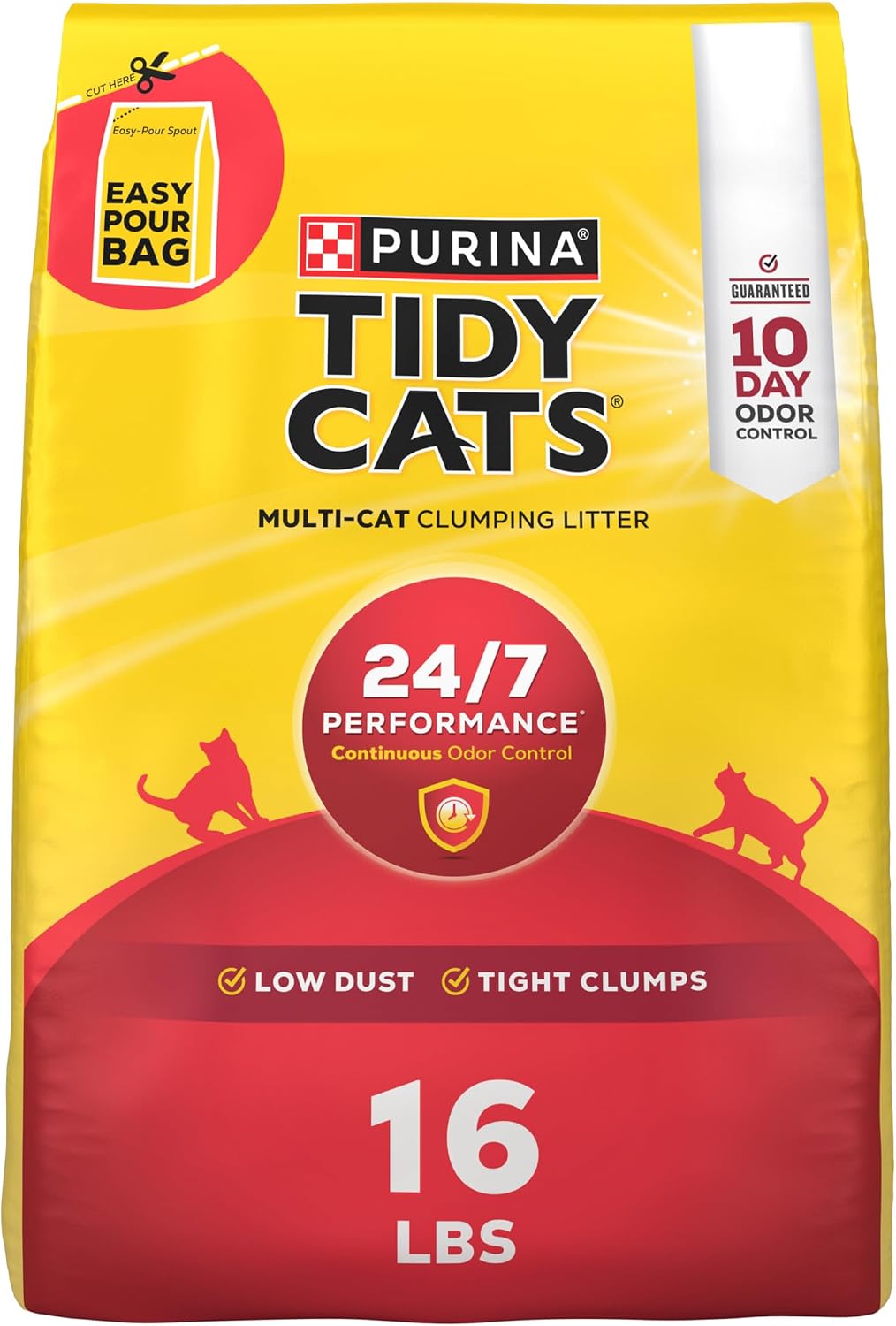
Multi-cat homes burn through litter faster and need odor control that survives between scoops, which is where a performance-grade option earns its keep. Purina Tidy Cats 24/7 Performance Clumping Litter is built for exactly that use case, with an ammonia-blocking formulation aimed at busy boxes. Whatever you pick, change only one variable at a time. If you switch litters, mix the new one in over a week rather than swapping all at once, because a sudden texture change is a known trigger for protest behavior.
The Box Itself: Replace It Before It Becomes the Problem
Plastic litter boxes age in a way that is invisible until you look for it. Every scoop pass cuts micro-scratches into the plastic, and those scratches hold odor and bacteria that survive the soap wash. By the time a washed box still smells like a box, the plastic has more odor habitat than surface. The practical rule we recommend is replacing plastic boxes roughly once a year, sooner if the floor is gouged or the smell lingers after a wash. Annual box replacement costs about the same as a bag or two of litter and quietly removes an entire category of box problems.
Stainless steel boxes have become a serious alternative for exactly this reason. Metal does not hold scratches the way plastic does, it does not absorb odor, and it tolerates years of washing. For households tired of the annual replace cycle, a high-sided stainless steel litter box is the more durable answer, and the high walls help with kickers and over-the-edge misses. The tradeoffs are honest ones: steel costs more up front and weighs more to move on wash day.
One placement note for senior cats: high sides are a feature for young kickers and a barrier for arthritic joints. A cat over roughly ten years old, or one showing hesitation before stepping in, may need a low-entry box instead. Arthritis is dramatically underdiagnosed in senior cats, and hesitation at the box edge is one of the few visible clues.
Tracking: Contain It Without Punishing the Cat
Litter granules migrate. Fine clumping litter especially acts like sand no matter what you do, and the fix is containment at the exit, not complaint. A good mat with a textured top and a catch layer underneath traps granules on the first or second step. The Pieviev double-layer litter box mat is a representative example of the design we find sensible: an open-textured top layer that lets litter fall through, and a sealed lower layer that holds it until you dump it out. Note that your cat has to be willing to walk on it, so if your cat is texture-fussy, a flat rubber-backed runner is the fallback.
On covered boxes, our editorial position is that they mostly serve the human, not the cat. A lid contains odor for your nose by keeping it concentrated at your cat's nose, and the dark, enclosed space amplifies everything a cat dislikes about a poorly maintained box. A covered box on a strict daily scoop schedule can work fine. A covered box on a lazy schedule is the classic recipe for avoidance. If you use one, take the lid off for a week if any elimination problem shows up; it is a free diagnostic.
What a Better Schedule Cannot Fix
A proper maintenance routine prevents a large share of litter box problems, and it is worth being clear about the share it cannot. If a cat that previously used the box reliably starts going elsewhere, and the schedule is already clean, the default explanation is medical, not behavioral. Urinary tract disease, crystals, constipation, and arthritis all announce themselves as box changes first. Location choices carry information too: a cat that urinates on smooth cool surfaces like tile or a bathtub is telling you something different from one that picks soft absorbent spots like laundry or a bed.
The rule we apply: any new elimination behavior gets a veterinary appointment booked, not a behavior experiment first. The AAFP's senior care guidance makes the same point for older cats, where box changes are frequently the first sign of kidney disease, hyperthyroidism, or joint pain. And if a male cat strains without producing urine, forget the schedule entirely; that is an emergency vet run, today, because a blocked urethra becomes fatal within a day or two.
The 7-Day Litter Box Audit
Run this checklist once a week and the schedule takes care of itself.
Days one through seven, every day: scoop once at a fixed time and log the approximate clump and stool count. Note anything unusual in size, frequency, or appearance. Top up depth if the bed looks thin.
Once this week: smell the empty-ish box from a foot away. Any ammonia or lingering odor after a wash means the box or the interval needs attention. Wash the box if you are within two weeks of the last wash on a monthly cycle, or plan the full change for the weekend.
Once this week: check the boxes themselves. Scratches, gouges, cracked rims, or a permanent smell mean the box goes on the replacement list. Confirm every box still has two to three inches of litter.
Weekly, multi-cat homes: watch for crowding. If one cat is shadowing another away from a box, add a box in a new location rather than moving existing ones.
Monthly: full litter change and box wash on the same day. Sanitize the scoop and the mat. Restock supplies before you run low, because the day you notice the bag is empty is never a shopping day.
The whole routine costs about a minute a day and ten minutes a month. Compared with the alternative, a cat that learned the box is unpleasant and a two-hundred-dollar vet workup to rule out disease, it is the cheapest insurance in cat care. Start tonight: scoop, log the count, and put the wash day on the calendar for two weeks out.
Related Reading
Want more on this topic? Check out our guides on toxic plants for cats safety guide, best cat window perches sunny spots for your kitty to lounge, stop cat waking you up night early morning guide.