Disclosure: PawCritic is reader-supported. Some links below are Amazon affiliate links, which means we may earn a small commission if you buy through them — at no extra cost to you.
One statistic explains why veterinary organizations keep bloat at the top of their emergency education lists: in the long-running Purdue University research led by Dr. Lawrence Glickman and colleagues, which followed thousands of large-breed dogs across years, roughly one in three dogs that developed full gastric dilatation-volvulus did not survive even with surgical treatment. That figure comes from an era before some modern refinements in emergency care, but it remains the most widely cited body of evidence on the disease, and it establishes the core fact every owner of a deep-chested dog should know: GDV kills quickly, and survival depends heavily on how fast the dog reaches a surgical facility.
The frustrating part of this disease is that it is survivable when it is recognized early. The dogs that die are frequently the ones whose owners waited, because the early symptoms can look like ordinary gastrointestinal upset — a bit of gas, a restless night, some unproductive gagging. Veterinary emergency clinics report that a common presentation is an owner arriving many hours after the first symptoms appeared, having decided to monitor the dog overnight. By morning, the dog is already in shock. Understanding what bloat is, what the first hour looks like, and what can be done in advance to reduce risk is the purpose of this guide, and the information below is drawn from published veterinary guidance, peer-reviewed research, and documented owner experiences rather than any form of hands-on product evaluation.
What Bloat Actually Is and Why It Kills So Fast
Veterinarians use two overlapping terms, and the distinction matters even though the emergency response is identical. Simple bloat, sometimes written as GD for gastric dilatation, means the stomach has filled with gas and distended. This is uncomfortable and sometimes painful, but the stomach remains in its normal anatomical position. GDV — gastric dilatation-volvulus — means the stomach has additionally rotated on its own axis. The comparison often used in veterinary patient education is a balloon twisted at the neck: gas and fluid become trapped inside the stomach, the blood supply to the stomach wall is compressed or cut off entirely, and the spleen, which attaches to the stomach by ligaments, can be pulled into the rotation as well.
That rotation is what turns a bad night into a fatal one. Once the stomach twists, the tissue of the stomach wall begins to die within hours because it is no longer being perfused with oxygenated blood. Blood pools in the abdomen and posterior vessels rather than returning effectively to the heart, cardiac output falls, and the dog progresses into hypovolemic shock. The American College of Veterinary Surgeons describes GDV as rapidly fatal when it goes untreated, and emergency clinicians consistently emphasize that the interval between a dog appearing normal at dinner and becoming critically unstable can be remarkably short — sometimes just a few hours.
Not every dog that bloats goes on to twist. However, there is no way for an owner to distinguish simple dilatation from volvulus at home, and simple bloat can progress to a full twist at any point. This is why every published emergency protocol treats the two presentations the same way: get the dog to a veterinary facility immediately, and do not wait to see which one it is. The diagnostic tools that separate the conditions — radiographs, decompression, and intravenous stabilization — exist only in the clinic.
Which Dogs Are at Risk
Deep-chested, narrow-waisted breeds top every risk list: Great Danes, standard poodles, German shepherds, Dobermans, Weimaraners, bloodhounds, various setters, and Saint Bernards are the names that appear most often. The Purdue research found that risk climbs with increasing chest depth-to-width ratio and, interestingly, with thinner body condition — underweight dogs in the study bloated at higher rates than dogs at healthy weights. Age is another factor the data identified, with risk rising steadily after roughly five years. General references such as the Merck Veterinary Manual's dog owner pages summarize these breed and conformation associations for owners who want to check their own dog's risk profile.
One point that owners frequently get wrong is the assumption that bloat is exclusively a giant-breed disease. Documented case reports and owner accounts include Labrador retrievers, corgis, and even miniature poodles. Any dog with a deep chest relative to its width carries some degree of risk. The breed lists indicate who should be most vigilant, not who is immune. Small deep-chested breeds such as dachshunds have also been reported with GDV, albeit rarely.
Behavioral factors appeared in the research as well. Fearful and anxious dogs bloated at higher rates than calm, relaxed dogs, which adds one more argument for managing chronic stress in at-risk pets. And a finding that reversed decades of conventional wisdom: the old advice to feed large dogs from raised bowls did not hold up. The data actually associated elevated feeders with a modestly increased risk of bloat rather than a protective effect, and current guidance has largely abandoned the raised-bowl recommendation for healthy dogs. Ground-level bowls at a comfortable standing height are now the safer default according to most veterinary sources.
The Three Signs to Memorize
Bloat symptoms can develop over the course of an hour or two, and in the earliest stage they can resemble an ordinary stomach ache. Emergency clinicians and owner reports converge on three cardinal signs that deserve permanent space in any large-dog owner's memory.
1. Unproductive retching. The dog makes repeated attempts to vomit — heaving, gagging, sometimes producing a small amount of white foam — but no real stomach contents come up. This is the single most classic sign of GDV. A dog with simple gas usually manages to actually vomit or pass gas from one end or the other. A dog whose stomach has twisted physically cannot, because the esophagus is occluded at the point of rotation.
2. Restless pacing and visible discomfort. The dog cannot get comfortable. It circles, lies down, immediately pops back up, glances or looks back at its flank, and pants. Heavy drooling is commonly reported by owners describing the episode afterward. This is the behavior of an animal in significant visceral pain that has no way to communicate it.
3. A tight, drum-like abdomen. The belly may look visibly swollen, though in deep-chested breeds the change is not always dramatic at first because the distension is partly hidden within the ribcage. Published guidance describes the abdomen in GDV as feeling hard and tympanic — drum-like — to gentle palpation. If the belly feels tight and rigid in a dog that is also retching or pacing, that combination is a red flag regardless of how the abdomen looks.
Later signs are those of advancing shock: pale or gray gums, a rapid weak pulse, weakness, cold extremities, and collapse. A dog displaying those signs is in the most dangerous phase of the disease, and the outcome at that stage depends on how close the nearest surgical facility is and how quickly the team can stabilize circulation.
What to Do in the First Hour
If even one of the three cardinal signs appears in an at-risk dog, the recommended sequence is straightforward, and every authoritative source — from veterinary college client handouts to the AVMA's pet owner resources — frames it the same way: treat it as an emergency until a veterinarian says otherwise.
Get in the car first, then call. Call the emergency clinic on the way rather than before leaving. Every minute of delay reduces the odds of a good outcome, and the staff can prepare and coach the owner over the phone while the dog is en route. Owners who do not already have an emergency veterinary hospital's number saved in their phone should save it tonight, before it is needed; nobody in the middle of a crisis is in a good state to be searching for one.
Do not attempt home remedies. No Pepto-Bismol, no simethicone, no antacids, no attempts to walk the dog out of it. None of these can affect a rotated stomach, and the time spent trying them is time the dog does not have. Veterinary toxicology and emergency resources such as the ASPCA Animal Poison Control center's owner materials reinforce the general principle that human medications should never be given to a dog without veterinary direction.
Do not force water or food. If the stomach has twisted, anything introduced into it worsens the distension and complicates both decompression and surgery. The dog should travel with an empty stomach.
If unsure, go anyway. The false-alarm scenario — arriving at the ER and learning the dog had plain gas — costs an exam fee and some embarrassment. The alternative scenario costs the dog's life. Emergency veterinarians consistently state that they would far rather see the false alarm, and published survival data backs the logic: outcomes improve dramatically when dogs arrive before shock develops. The question of whether one is overreacting should always be answered in favor of going in.
What Happens at the Emergency Vet
At the clinic, the response follows a well-established sequence. The dog receives intravenous fluids to support blood pressure and perfusion. The stomach is then decompressed, usually by passing a stomach tube, and in some cases by trocharization — placing a large needle or cannula through the body wall to release trapped gas. Radiographs confirm whether the stomach has actually rotated. If it has, the dog goes to surgery.
The surgery accomplishes three things: it untwists and repositions the stomach, it allows the surgeon to inspect the stomach wall and spleen for damage, and — with the owner's consent — it includes a gastropexy, in which the stomach is permanently tacked to the abdominal wall so that it cannot rotate again. This is not an afternoon procedure with same-day discharge. Dogs typically spend at least one to two days hospitalized on IV fluids, pain medication, and monitoring for cardiac arrhythmias and other complications. Some dogs require partial removal of the stomach wall where tissue has already died, and splenectomy is common enough that surgeons routinely evaluate the spleen during the operation, since it is often caught in the twist.
The financial cost is significant, which is one more reason the prevention section below matters. Pet insurance, if purchased before any bloat-related history exists, is worth considering for owners of high-risk breeds precisely because an overnight emergency surgery bill can run well into four figures.
Prevention: What Actually Moves the Needle
Nothing prevents bloat with complete certainty. But the accumulated evidence and current veterinary guidance point to several measures that genuinely lower risk, and they are worth implementing in combination.
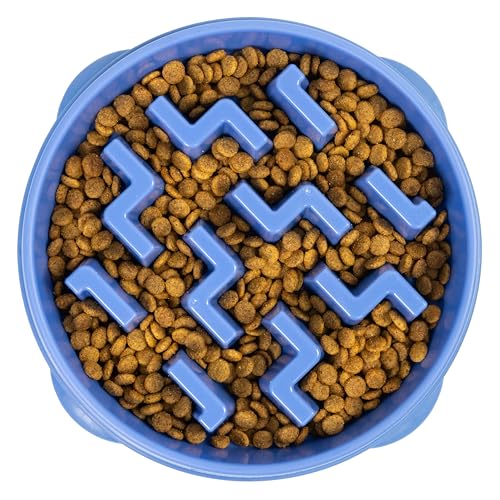
Slow the eating down. Dogs that inhale food swallow air along with it, and an air-filled stomach is more buoyant and more mobile within the abdomen — the mechanical precondition for rotation. Slow feeder bowls, which use raised ridges, mazes, or puzzle geometry to break a meal into many small mouthfuls, are an inexpensive intervention. A bowl that turns a thirty-second inhalation into a several-minute meal meaningfully reduces the air swallowed per sitting. If your dog is a known gulper, this is widely regarded as one of the highest-value low-cost changes an owner can make. As a concrete example of the category, you can check the current price on Amazon for a slow feeder puzzle bowl of this type and compare its ridge design and capacity against your dog's snout length and portion size.
Split meals. Feeding a single large meal per day was one of the feeding patterns most strongly associated with bloat in the research literature. Two or three smaller meals spread across the day are the recommended pattern for deep-chested dogs. This also pairs naturally with a slow feeder, since smaller portions are easier for the bowl's geometry to pace out.
Rest after eating. The link between post-meal exercise and bloat is less firmly established in the data than folk wisdom suggests — the Purdue study did not find a strong exercise trigger. Nevertheless, most veterinary guidance retains the cautious version: no sprinting, rough play, or hard running for an hour or two after a meal. The rationale is mechanical rather than statistical; a full, sloshing stomach undergoing vigorous acceleration and deceleration has more opportunity to rotate.
Skip the raised bowl. As covered above, the evidence pointed the opposite direction from the old advice. Ground-level feeding is now the standard recommendation for dogs without a specific medical reason — such as certain orthopedic or neurological conditions — for elevation.
Consider prophylactic gastropexy for at-risk breeds. This is the single most effective preventive measure available in veterinary medicine for this disease. Many owners schedule it concurrently with a spay or neuter, so the dog undergoes one recovery instead of two. The procedure does not stop the stomach from filling with gas, but it prevents the rotation — and the rotation is the component that kills. In the Purdue research and subsequent follow-up studies, the recurrence rate for GDV in dogs that had received a gastropexy fell to roughly four to five percent, compared with figures in the seventy-five to eighty percent range for dogs treated without it. It is not an absolute guarantee; the stomach can still distend, and rare cases of recurrence even after gastropexy have been reported. But no other intervention comes close to that magnitude of risk reduction. The American College of Veterinary Surgeons lists prophylactic gastropexy as the recommended approach for large, deep-chested breeds, and many veterinarians now raise it proactively whenever an at-risk dog is under anesthesia for another reason.
Timing questions come up constantly. Gastropexy is most commonly performed at the time of spay or neuter, meaning most at-risk dogs that receive it do so before their first birthday — but it can be done at any age. Dogs that have already survived one bloat episode are the highest-priority candidates, because a second episode is both more likely and more dangerous than the first. An owner in that situation should be having the conversation with their veterinarian promptly rather than waiting for the annual exam.
Two further preventive factors are easy to overlook because they are not products: keep the dog at a healthy body weight, and manage chronic stress and anxiety. The research consistently identified thin, fearful dogs as the highest-risk behavioral and body-condition group.
Bloat Myths, Quickly Debunked
'Only Great Danes get bloat.' No. Any deep-chested dog can develop GDV, and smaller breeds do so rarely — but rarely is not never. Breed statistics describe relative risk, not immunity.
'If he burps, it's not bloat.' Dogs with simple dilatation can burp or pass gas; dogs with a volvulus usually cannot. Burping rules out nothing, because an owner cannot know at home which version is developing.
'It only happens right after exercise.' The study data did not strongly support exercise as a trigger. Bloat occurs at rest, at night, and after perfectly ordinary meals. Waiting for a recognizable trigger is a dangerous habit.
'Gastropexy is unnecessary surgery.' For a high-risk breed, it is the best odds-improving intervention available. Owners should ask their veterinarian for an honest breed- and conformation-specific assessment. Because it is usually combined with a spay or neuter, the additional recovery burden is often minimal.
'Small dogs never get bloat.' Deep-chested small breeds, dachshunds among them, have been documented with GDV. Uncommon is not the same as impossible, and the same three warning signs apply regardless of size.
When to See the Vet
The rule is simple enough to memorize: if a dog begins retching without producing anything, or its abdomen looks or feels tight, or it is pacing and cannot settle, the situation is not diagnosed at home. The window between treatable and tragic in GDV is measured in hours, sometimes less, and every published survival analysis shows outcomes improving with earlier presentation. When in doubt, the dog goes in.
Being prepared for emergencies extends beyond bloat. Every dog household benefits from a stocked pet first aid kit — one that includes gauze, non-stick bandaging, adhesive tape, blunt-tipped scissors, tweezers, disposable gloves, and a digital thermometer, since rectal temperature is a vital sign owners can check while deciding whether a situation is urgent. Kits vary considerably in contents and quality, so compare the item list against what a veterinary first aid reference recommends. As a starting point for comparison shopping, you can view this option on Amazon and evaluate whether its contents match the checklist published by veterinary owner-resources before purchasing.
A final word on toxic exposure, since owners preparing for emergencies often overlook it: many common household items — xylitol-sweetened products, grapes and raisins, certain human medications, and some plants — are dangerous to dogs, and poison-control resources maintain current lists of specific hazards worth reviewing.
The Two-Minute Checklist
Save the nearest emergency veterinary hospital's number in your phone right now, before it is ever needed. Memorize the three signs: unproductive retching, restless discomfort, and a tight abdomen. Split meals for deep-chested dogs, feed at ground level, slow down a gulper's eating, and keep post-meal activity calm. And if you own a high-risk breed, raise prophylactic gastropexy with your veterinarian at the next routine visit rather than after an emergency. Most dogs will never need any of this. For the dogs that do, having the decision already made — the number already saved, the feeding habits already changed, the conversation with the vet already held — is what turns a survivable emergency into a survival story.