Why Aggressive Chewers Need Purpose-Built Toys
Some dogs can destroy a plush toy in under a minute. Owners of German Shepherds, Pit Bulls, Labrador Retrievers, Rottweilers, and other powerful breeds know the routine: a toy marketed as durable arrives, gets a few enthusiastic minutes of attention, and then comes apart at the seams. The problem is rarely the dog's attitude. It is physics — jaw strength, tooth pressure, and the way a dog works a toy against the molars rather than the front teeth. A toy that survives a Chihuahua is not engineered for a dog that can crack a marrow bone.
Chewing is a natural, species-typical behavior. The American Kennel Club advises that most adult dogs need a minimum of 30 minutes to 2 hours of structured physical activity daily, with working and sporting breeds often requiring considerably more. Destructive chewing in adult dogs is frequently a sign of under-exercise or under-stimulation rather than stubbornness, and providing an appropriate outlet for jaw activity is one of the standard recommendations for managing it. A toy that fails in five minutes does not just waste money — it removes that outlet and can create a swallowing hazard in the process.
What has changed in the category is transparency. Several manufacturers now publish material specifications that owners can actually check: rubber durometer ratings, replacement guarantees, and in at least one case a molded wear indicator that shows when the toy has reached the end of its service life. That is a meaningful shift away from the era when 'indestructible' simply meant 'thick.' It matters because no chew toy is genuinely indestructible. The well-designed ones fail predictably — in large, rounded chunks that are difficult to swallow — rather than splintering into sharp fragments or small pieces.
Before buying anything, apply one sizing rule: a toy that is too small is a choking hazard, and a toy that is too large is a toy the dog ignores. Measure against the dog's actual mouth, not the breed's reputation. Manufacturers publish size charts keyed to weight and chewing style, and those charts are a better guide than guesswork. It is also standard practice to supervise a power chewer with any brand-new toy for the first session, because that is when manufacturing weaknesses and design mismatches surface.
What Makes a Toy Suitable for a Power Chewer?
Four attributes separate toys that hold up from toys that do not. Material is the first. Natural rubber compounds, dense nylon, and reinforced composite materials resist compression and tearing far better than soft thermoplastic or plush fabric. Hardness matters in both directions: a material hard enough to resist a determined chewer is also hard enough to wear down enamel if the dog chews for hours daily, which is why veterinary dentists generally steer owners away from objects harder than the tooth itself — think antlers, hooves, and dense bones. The Merck Veterinary Manual dog owner reference covers fracture and wear risks in its dental section and is worth reading before choosing anything described as 'rock hard.'
Durability rating is the second attribute. Labels such as 'extreme,' 'power chewer,' or 'tough' are not regulated, but they do correspond to a manufacturer's own material specification, and the honest ones publish which rubber compound and shore hardness they use. Third is size: the toy should be large enough that the dog cannot get it behind the molars and work it apart, and large enough that it cannot be swallowed whole if it is somehow compressed. Fourth is construction. Squeakers, sewn seams, rope tassels, and glued-on appendages are the failure points on almost every toy that comes apart. A single molded piece with no inserts has nothing to detach.
One more consideration that owners often miss: novelty. A dog that has chewed the same rubber toy for three months will often abandon it, and an abandoned toy gets replaced by something worse — a shoe, a remote control, a baseboard. Rotating two or three appropriate toys, and using food-stuffable designs to reset interest, extends both the toy's useful life and the dog's engagement with it.
Product Rundown: Four Options Worth Knowing
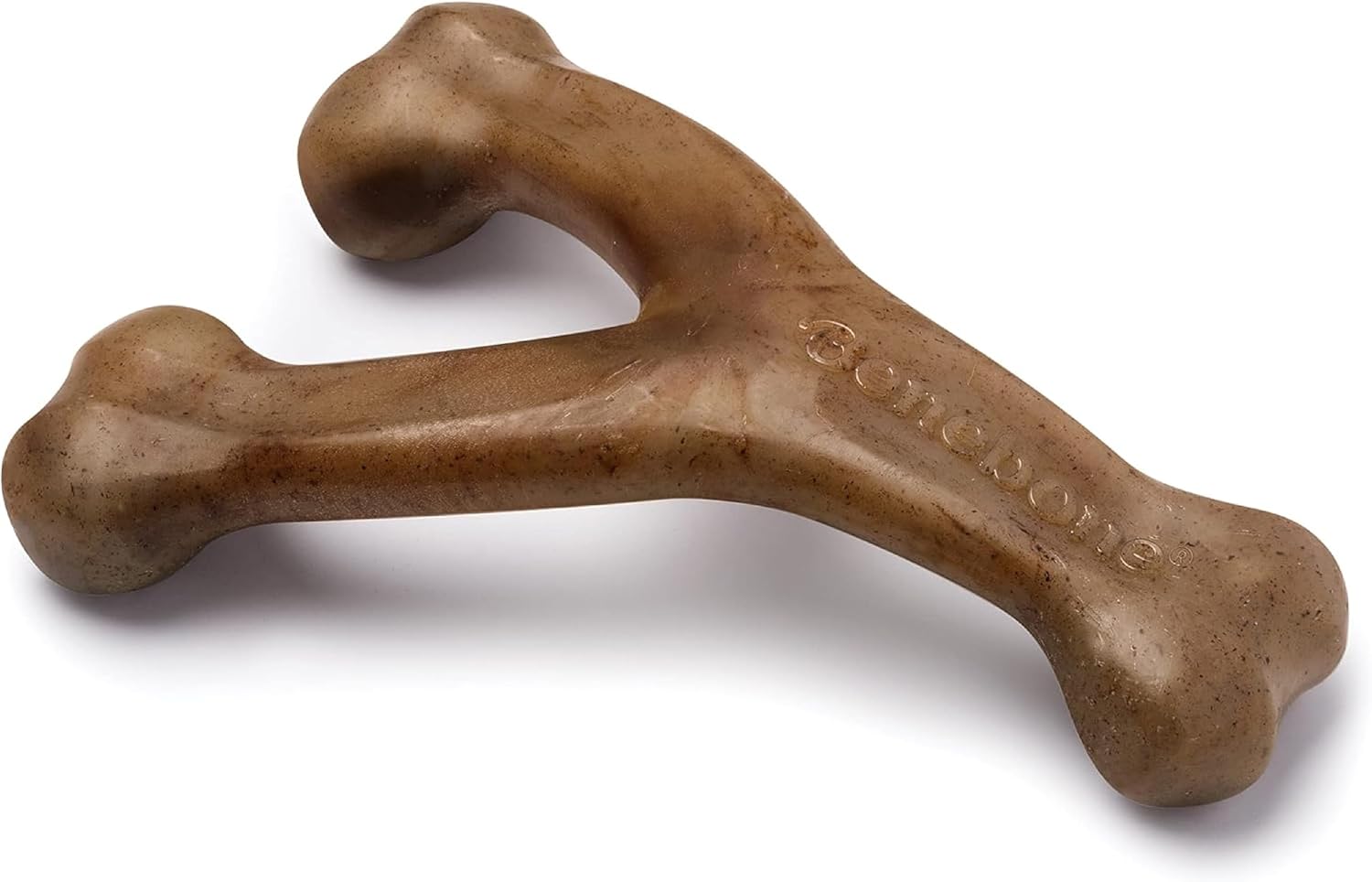
dog toys aggressive chewers
1. KONG Extreme — The Standard Reference Point
The KONG Extreme is molded from a proprietary ultra-durable black rubber compound that the manufacturer identifies as its hardest formulation, and it is the toy most frequently recommended by trainers and veterinary behaviorists for strong chewers. Its shape is the real advantage: the irregular bounce and the hollow center let owners stuff it with kibble, peanut butter, or frozen wet food, converting a chew object into a long-duration enrichment feeder. The trade-off is that it is not a chew-through toy in the way a nylon bone is — dogs that are determined to destroy rather than to extract food can eventually breach the walls, and KONG's own guidance is to inspect it regularly and replace it at the first sign of tearing.
It suits the widest range of dogs: shepherds, pit-type breeds, Labs, and any dog that needs both jaw work and mental engagement. Sizing runs from small to XXL, and the correct choice is the largest size the dog can comfortably carry, not the smallest one that fits. KONG Extreme is the entry point most owners should start with, because it is the toy against which other durability claims are usually measured.
2. Goughnuts MAXX — For Dogs That Have Already Destroyed Everything Else
Goughnuts builds its toys around a visible safety indicator: a red inner core molded into the rubber. When the red begins to show through the outer layer, the toy has reached the end of its safe service life and should be retired. That is a genuinely useful design decision, because it removes the guesswork from the question of when a chewed toy becomes a hazard. The company also backs its products with a replacement guarantee, which is unusual in this category and reflects confidence in the material specification.
The MAXX line is aimed at the top end of the chewing spectrum — dogs that have already worked through a KONG Extreme or a heavy nylon bone. The trade-off is cost and weight: these are dense, heavy toys that are not designed for fetch, and the price reflects the guarantee and the material. They are best treated as dedicated chew objects rather than all-purpose play toys. Owners who want to check current pricing and sizing can do so on Amazon.
3. West Paw Qwizl — Best for Holding Long-Lasting Treats
The Qwizl is built from Zogoflex, West Paw's recyclable thermoplastic elastomer, which is noticeably softer on the gums than hard nylon while still holding up to sustained chewing. Its geometry is the point: the shape grips bully sticks, jerky, and other long-format chews so the dog has to work to extract them, which stretches a single treat across a much longer period. That makes it a strong choice for dogs who lose interest in an empty rubber toy but will happily chew for an hour to get at food.
The honest limitation is that Zogoflex is not the hardest material in this roundup. A dog that deliberately targets and tears rubber rather than working at the food inside can damage it, so it is best suited to dogs whose motivation is food extraction rather than destruction. It is also made in the United States and is dishwasher-safe, which simplifies cleaning after sticky treats. The West Paw Qwizl on Amazon is available in several sizes and colors.
4. Nylabone DuraChew — The Budget Workhorse
Nylon chew bones occupy a different category from rubber toys: they are hard, long-lasting, and flavored throughout so the dog stays interested as the surface wears. The DuraChew line is the most widely stocked budget option and comes in a range of sizes and flavor infusions. For moderate chewers, a single bone can last weeks, which makes the cost per day very low compared with softer alternatives.
The trade-off is real and worth stating plainly. Hard nylon is not appropriate for every dog. Dogs who break off and swallow large pieces should not be given nylon at all, and any nylon chew should be retired the moment it wears down to a nub small enough to swallow. Because nylon is harder than rubber, owners of dogs that chew for hours at a time should watch for excessive wear on the premolars and discuss chew-object hardness with their veterinarian. The Nylabone DuraChew on Amazon is a reasonable first hard-chew purchase for a dog that has not yet been assessed on rubber toys.
How to Match a Toy to a Specific Chewing Style
Not all aggressive chewers chew the same way, and the distinction changes which product is appropriate. 'Power chewers' work a toy continuously with the back teeth, applying sustained pressure until the material fatigues. 'Destructive chewers' target seams, edges, and appendages, and will dismantle a toy piece by piece regardless of how strong the base material is. 'Oral fixators' chew constantly for hours and are the group at highest risk of dental wear from hard materials. A rubber toy addresses the first group well, a single-piece molded design addresses the second, and the third group benefits most from softer rubber and food-stuffable designs that redirect the behavior.
Body size is a separate variable from chewing intensity. A 25-pound terrier with an obsessive chewing habit may need a smaller toy than a 90-pound dog with a casual interest, and the sizing charts published by manufacturers are generally keyed to both weight and chewing style for that reason. When in doubt, choose the larger size — a toy that is slightly too big is inconvenient, while a toy that is slightly too small is a swallowing risk.
Safety and Supervision
The single most important safety practice with any chew toy is supervision. Most foreign-body obstructions in dogs involve something the dog was left alone with, and chew toys are a recurring culprit. The AVMA pet owner resources note that foreign-body ingestion is among the more common reasons dogs present for emergency surgery, and the presenting signs — vomiting, loss of appetite, straining to defecate, abdominal pain — warrant immediate veterinary attention rather than a wait-and-see approach.
Toys should be inspected before and after every session. Any toy with a crack, a tear, a loose insert, or a piece that can be pulled free should be discarded immediately, not repaired. Squeakers are the most frequently swallowed component and are a reason to avoid squeaky toys entirely for dogs that dismantle things. Rope toys present a specific hazard: the strands can be swallowed and can form a linear foreign body that saws through the intestine, which is a surgical emergency. If a dog swallows anything, the ASPCA Animal Poison Control and a veterinarian are the correct first calls, particularly if the swallowed material is unknown.
Chew sessions should be time-limited. Thirty to sixty minutes at a stretch is a common recommendation, partly because extended sessions on hard materials accelerate tooth wear and partly because the toy stays novel. Offering a frozen stuffed rubber toy is a useful way to extend a session safely, since the dog is working at food rather than grinding on rubber.
Common Mistakes Owners Make
The most common mistake is buying for the breed rather than for the individual dog. Breed reputation is a poor predictor of chewing intensity; a calm Labrador may be gentler on toys than a determined mixed-breed terrier. The second is treating a worn toy as still serviceable. Once a toy has lost material, its structural integrity is compromised, and the next failure may produce a swallowable piece. The third is choosing a toy that is too small because it fits the dog's mouth comfortably — comfortable to carry is not the same as safe to chew.
Another frequent error is using chew toys as a substitute for exercise and enrichment. A dog that is under-exercised will chew more intensely and more destructively, and no material survives that indefinitely. Pairing chew time with adequate physical activity and food-dispensing enrichment is the approach most behavior professionals recommend. Finally, owners often overlook dental consequences: dogs that chew hard nylon or bone for hours daily can develop slab fractures of the carnassial teeth, which are painful and expensive to treat. If a dog is a marathon chewer, softer rubber and food-stuffable designs are the safer default.
Maintenance and Replacement
Rubber toys should be washed in warm water with a mild dish soap, or run through a dishwasher on the top rack if the manufacturer specifies it is dishwasher-safe, and inspected for tears at each cleaning. Nylon chews should be rinsed and checked for rough edges, which can abrade the gums. Toys with a wear indicator, such as a colored inner core, should be replaced as soon as the indicator becomes visible. As a general rule, a chew toy that has changed shape, developed a crack, or lost a visible percentage of its original mass has done its job and should be retired.
Rotation extends both toy life and dog interest. Keeping two or three appropriate toys in circulation and swapping them weekly is a low-cost way to maintain engagement without buying new products constantly. It also gives each toy time to be inspected between uses.
The Bottom Line
For most strong chewers, a heavy-duty natural rubber toy with a hollow center is the most versatile starting point, because it combines durability with the option to stuff food and extend engagement. For dogs that have already destroyed rubber, a toy with a molded wear indicator and a replacement guarantee is the logical next step. For food-motivated dogs, a treat-holding rubber design does more work than a plain chew. For budget-conscious owners of moderate chewers, a flavored nylon bone remains the lowest cost-per-day option, provided the dog is supervised and the bone is retired at the first sign of wear.
No single product is right for every dog, and no toy is truly indestructible. The realistic goal is a toy that fails safely, is sized correctly, and is used under supervision — combined with enough exercise and enrichment that chewing is an outlet rather than a symptom.
dog toys aggressive chewers
Affiliate Disclosure: This article contains affiliate links.