Disclosure: PawCritic is reader-supported. A couple of links below are Amazon affiliate links, and we may earn a small commission if you purchase through them at no extra cost to you.
Category: Small Pet Care | Author: PawCritic Editorial Team | Date: as recorded
Most small-pet decisions fail before anyone reaches a checkout counter. A family picks a hamster because it is small, a guinea pig because it is fluffy, a rabbit because it is cute, a rat because it sounds clever. Almost nobody picks based on what the animal actually needs or what the household can actually provide, and that mismatch is why so many small pets are rehomed within their first year. Rescue organizations and exotic-animal veterinarians report the same pattern over and over: the animal was fine, but the fit was wrong from day one.
This guide walks through the four most common first small pets — hamsters, guinea pigs, rabbits, and rats — with an emphasis on the needs published by veterinary and welfare organizations, the real costs, the real daily time commitment, and the honest trade-offs of each species. Where specific supplies are mentioned, the point is to show a concrete example of the category so the reader can compare specs, not to rank products against each other. For general reference material on exotic animal husbandry, the Merck Veterinary Manual's exotic and laboratory animals section is a good starting point, and the Association of Exotic Mammal Veterinarians maintains a directory of vets who treat these species.
First, the Question Nobody Asks: Who Is This Pet For?
Every small pet guide starts with the animal. This one starts with the human, because the human is where the decision actually lives. Before looking at any species, three questions deserve honest answers, and each one eliminates at least one of the four candidates for some households.
1. How much daily time can the household actually give? Not the time people wish they had — the time that reliably exists. A guinea pig needs daily floor time and social interaction. A rabbit needs hours of supervised exercise every single day. A hamster needs very little beyond cage maintenance and fresh food. For a household with an unpredictable schedule, that difference alone can be the whole decision, and no amount of enthusiasm compensates for it later.
2. Who is going to handle the pet? If the answer is a child under about eight, that changes everything. Young children move quickly and grab, and a small prey animal does not experience that as affection — it experiences it as being caught. The Humane Society of the US explicitly advises against hamsters for young children, and exotic vets generally say the same about rabbits and guinea pigs in households with very young kids. Every species covered here does best with an adult as the primary owner who supervises each interaction.
3. What is the real budget? The animal itself is the cheapest part. The enclosure, bedding, food, hay, enrichment, and veterinary care add up quickly, and small pets fall under exotic veterinary medicine, which costs more than dog and cat care in most regions simply because fewer clinics provide it. A single dental procedure in a rabbit can run several hundred to over a thousand dollars. Realistic numbers for each species appear later below.
The Four Contenders at a Glance
| Hamster | Guinea Pig | Rabbit | Rat | |
|---|---|---|---|---|
| Lifespan | 2-3 years | 5-7 years | 8-12 years | 2-3 years |
| Daily time | ~15 min | 1-2 hours | 2-4 hours | 1 hour+ |
| Handling | Fragile, may bite; nocturnal | Docile, rarely bites; needs lap time | Fragile spine; needs training | Curious, social, learns tricks |
| Social needs | Solitary (Syrians); dwarfs need care | Must live in pairs or groups | Pairs ideal, singles possible with effort | Must live in pairs or groups |
| Noise | Nocturnal wheel noise | Quiet; loud happy wheeking | Quiet; thumping at night | Quiet; soft chattering |
| Diet cost per month | $15-25 | $30-50 | $40-70 | $20-35 |
| Setup cost, one-time | $150-300 | $300-500 | $400-800 | $250-450 |
| Vet care | Cheaper, shorter life | Moderate; needs vitamin C | Most expensive; dental issues common | Moderate; tumors common in older rats |
| Good for kids under 8 | No | Supervised only | Supervised only | Supervised only |
Hamsters: The Low-Maintenance Pet With a Catch
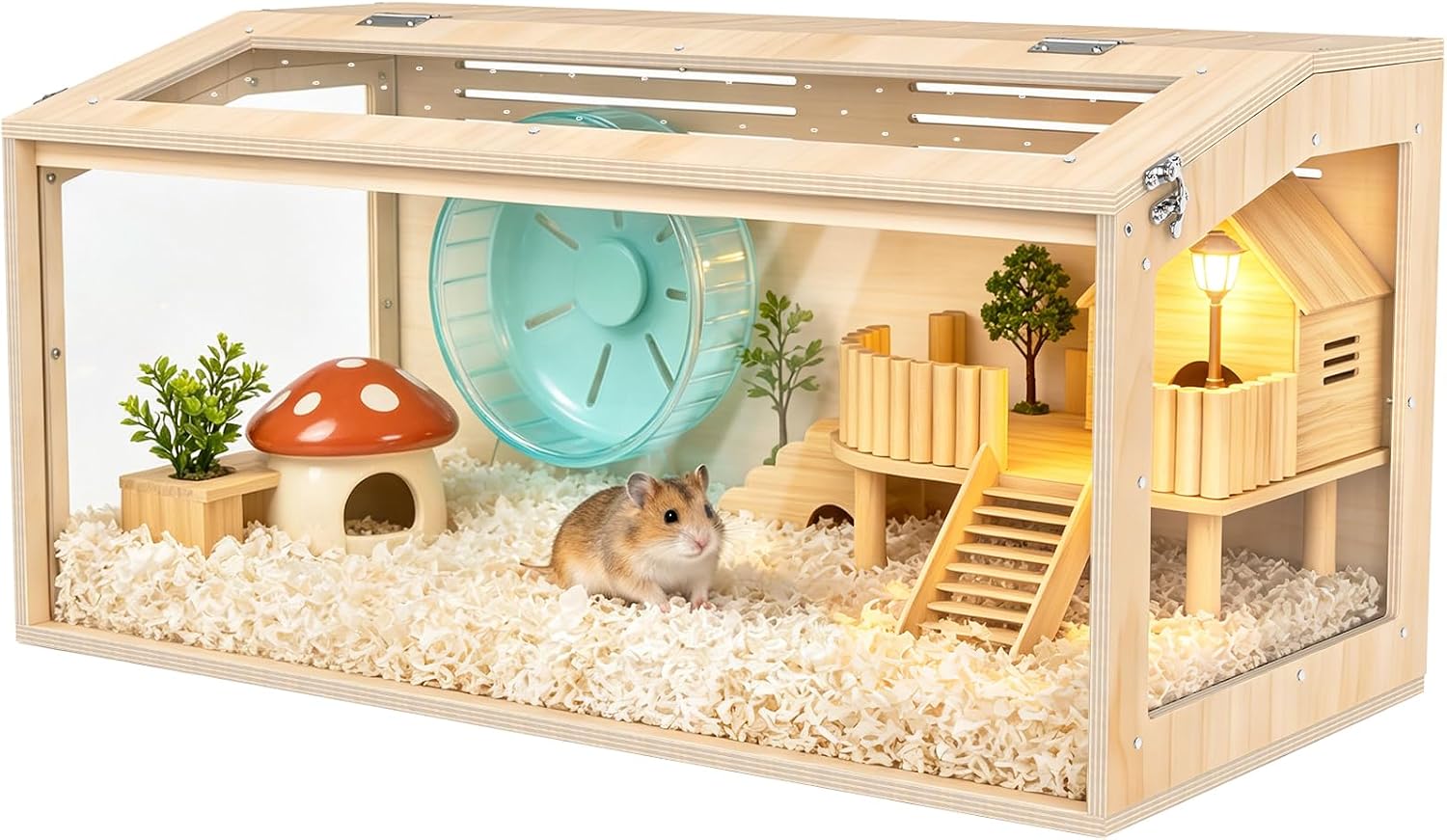
Hamsters are the default first pet for a reason: they are inexpensive to feed, self-contained, and do not need daily interaction. A Syrian hamster in a properly sized enclosure with a wheel and deep bedding will entertain itself for days. But the catch hides in the word self-contained. Hamsters do not need people, and most of them do not particularly want people either — they are prey animals with poor eyesight that wake up when the household goes to bed.
Here is what welfare guidance consistently tells first-time hamster owners: hamsters are nocturnal and mostly solitary. A hamster will sleep all day and become active around nine or ten at night, right around a young child's bedtime. Because they startle easily and cannot see well, they bite when grabbed or woken. A hamster that has been scooped out of its nest mid-afternoon is not being aggressive; it is behaving exactly as the species behaves. That predictable mismatch between child expectations and hamster biology is the reason hamster welfare organizations advise against them for young children.
The good news is that a patiently handled hamster, especially a Syrian handled from a young age, can become a genuinely pleasant companion. Owner reports describe hamsters climbing into an open palm, stuffing their cheek pouches, and sitting calmly for evening television. They are fascinating to watch, they take up little space, and they suit households that want an animal asking very little in the way of daily attention.
Who a hamster suits: teens and adults who want a low-maintenance, budget-friendly pet; night owls who will actually be awake during hamster hours; people in small apartments.
Who it does not suit: young children, anyone wanting a cuddly lap pet, and anyone expecting daytime activity.
The setup that matters: bigger than most people think. Widely cited hamster welfare standards call for a minimum of around 450 square inches of continuous unbroken floor space for a Syrian, with a 40-gallon tank or larger as a common recommendation, and deeper is better for bedding because hamsters are natural burrowers — six inches or more of paper or aspen bedding allows the tunneling behavior the species is built for. The wheel matters just as much: roughly an eight-inch minimum diameter for Syrians, because their spine bends unnaturally on small wheels, and a solid running surface rather than rungs to protect feet and legs. Chew items are necessary since hamster teeth grow continuously. One concrete example of a suitable deep paper bedding that works across small-pet enclosures is available if you want to check the current price on Amazon — compare the uncompressed volume on the packaging, because brands vary a lot in how far a bag actually stretches in a deep-bedded enclosure.
Guinea Pigs: The Beginner-Friendly Fluffballs With a Schedule
If one small pet had to be recommended for a family with school-age children, most exotic vets would point to the guinea pig — with the caveat that the family is signing up for a schedule, not a decoration. Guinea pigs are widely described as the most forgiving first small pet: they are docile, they rarely bite, they are active during the day, and they vocalize in ways most owners find charming. The loud hopeful wheek a guinea pig produces when it hears the refrigerator open is one of the small joys of the species.
But guinea pigs come with requirements that surprise people, and each one is non-negotiable according to published husbandry guidance:
- They must live in pairs or groups. Guinea pigs are herd animals, and keeping a single one is considered inadequate care by most welfare organizations — in Switzerland it is actually illegal to keep one alone. The companion must be another guinea pig; housing them with rabbits is no longer recommended because rabbits can injure pigs and carry species-incompatible needs. This doubles food, space, and eventual vet costs, but it is part of the deal.
- They need daily vitamin C. Like humans, guinea pigs cannot synthesize vitamin C and develop scurvy without it — symptoms include joint pain, a rough coat, and bleeding gums, and veterinary literature lists hypovitaminosis C among the most common preventable conditions in pet guinea pigs. Fortified pellets and daily fresh vegetables are the foundation; many owners also keep a vitamin C supplement on hand, and you can view this option on Amazon as one example of the category. Note that vitamin C degrades in water and light, so water-added formulations lose potency quickly unless freshly mixed.
- They need hay, constantly. Grass hay such as timothy makes up roughly eighty percent of a guinea pig's diet, and it must be unlimited. Alfalfa is too rich in calcium for adults and is appropriate mainly for young, growing animals or as an occasional treat.
- They need daily floor time. An hour or two in a protected floor area each day lets them run and exhibit the hopping behavior owners call popcorning, a reliable sign of a contented pig.
- They are vocal. Wheeking at mealtimes, rumbling, and purring are normal. In an apartment with thin walls, that deserves consideration before committing.
Who a guinea pig suits: families with children around eight and up, people who want an interactive daytime pet, and households able to provide real daily attention along with the hay budget and routine vet visits.
Who it does not suit: households that are empty all day, minimalist homes, people expecting a silent pet, and anyone unwilling to keep two.
Enclosure sizing is where most new owners go wrong. Pet-store cages are almost uniformly too small for a pair; widely used standards call for roughly eight square feet of floor space as a working minimum for two guinea pigs, with more being meaningfully better. A C-and-C grid cage built to those dimensions usually costs less than a commercial pet-store cage and provides far more usable space, which is worth knowing before the first purchase.
Rabbits: The Most Rewarding, Most Demanding Option
Rabbits are not a beginner pet, and saying that plainly matters because the rabbit is the most common small-pet mismatch. Rabbits are intelligent, social, litter-trainable, and capable of bonding deeply with their people. They are also fragile, destructive when bored, expensive to treat medically, and a commitment of eight to twelve years — a decade-plus that many buyers do not anticipate while holding a kitten-sized bunny at a store.
The reality check, drawn from rabbit welfare and veterinary guidance:
- They need real space. Not a hutch. An indoor rabbit needs a room or a large exercise pen plus several hours of supervised exercise daily. The traditional image of a rabbit in a small outdoor hutch is considered inadequate housing by modern welfare organizations, both for space and for social reasons.
- They chew everything. Rabbit teeth grow continuously and grinding on fibrous food and wood keeps them worn down. Baseboards, cables, and furniture legs are all targets, so a rabbit home needs the same kind of proofing a toddler home gets — cable covers, blocked-off zones, and supervision. Encased cabling is cheap; a chewed phone charger or worse is not.
- Their digestion is unforgiving. Rabbits need a high-fiber diet built on unlimited grass hay. Gastrointestinal stasis — the gut stopping — is a life-threatening emergency requiring immediate exotic vet care, and dental disease is common when diets are too low in fiber or too high in pellets and treats. Both conditions are expensive to treat, which is why locating an exotic vet before adopting matters so much.
- They are not cuddly by default. Most rabbits dislike being picked up; being lifted triggers prey-animal panic, and a struggling rabbit can kick hard enough to fracture its own spine. Affection happens at ground level — circling feet, grooming a preferred human, flopping over nearby. That is a real relationship, but it is not a lap-pet relationship, and families who expect one will be disappointed.
- They live a long time. Eight to twelve years is typical and fifteen is not unheard of. Among the four species here, the rabbit is the longest commitment by far.
Who a rabbit suits: adults and older teens with time, space, and budget; people who want an intelligent, interactive companion; households that have done their homework on diet and proofing.
Who it does not suit: young children, very busy households, small apartments without a safe exercise area, and anyone unprepared for significant veterinary bills.
One honest note for parents: a rabbit adopted for a child almost always becomes the parents' pet in practice. That works fine if everyone knows it at the start; it becomes a problem when nobody does.
Rats: The Best Pet Nobody Considers
Rats may be the most underrated animal in the small-pet category. Beyond the stigma — and the tail, which genuinely does bother some people — rats offer unusual intelligence in a body the size of a small hamster. Extensive owner experience and behavioral literature describe rats learning their names, coming when called, solving simple puzzles, and bonding intensely with their people. They groom themselves fastidiously, they are clean by rodent standards, and rats that are handled regularly almost never bite.
But rats have two honest problems that no prospective owner should skip past:
- Their lifespan is very short. Two to three years is typical, and the final stretch frequently involves mammary tumors and respiratory disease, both of which are common in aging rats. Falling in love with a rat means losing it within about three years, and that makes them a poor fit for young children who are not ready for that cycle.
- They need companions. Rats are highly social and must live in same-sex pairs or small groups; a solitary rat is a chronically stressed rat. That means committing to two or more animals and the associated veterinary planning for all of them.
What owners get in return is a genuinely interactive pet that greets them at the cage door, rides on a shoulder, and can learn tricks within days. Rats adapt well to apartment life and tolerate handling that would stress most other small pets. Their setup cost is moderate, centered on a tall multi-level cage with hammocks, ropes, and rotating enrichment — a bored rat is a destructive rat, so the cage interior should change regularly.
Who a rat suits: adults and teens who want an intelligent, hands-on pet; apartment dwellers; people who can accept a short but intense relationship. For older kids who specifically want a pet they can hold, rats compare favorably to hamsters on every axis except lifespan.
Who it does not suit: young children, anyone with a rodent phobia, and people who want a long-lived companion.
Budget Reality: The Numbers Nobody Quotes
Vague advice to budget for vet care goes in one ear and out the other, so here are representative figures drawn from typical retail pricing and widely reported exotic-vet billing ranges. Setup runs roughly $150-300 for a hamster with a proper tank-based enclosure, $300-500 for a guinea pig pair including the cage, hides, and bottles, $400-800 for a rabbit including an exercise pen, litter setup, and home proofing, and $250-450 for rats with a large multi-level cage and accessories. Monthly upkeep lands around $15-25 for a hamster, $30-50 for guinea pigs — hay is the recurring cost that surprises people — $40-70 for a rabbit once fresh greens are counted, and $20-35 for rats.
Veterinary care is the wild card. A routine exotic checkup commonly runs $50-100, but emergencies are where budgets break: rabbit dental work is frequently quoted in the $300-1,000 range, guinea pig urinary problems in the $200-500 range, and rat tumor removals in the $150-400 range. Because exotic vets are thinner on the ground than dog-and-cat clinics, the single most useful pre-adoption step is finding the nearest one and asking for a price list before bringing any animal home. If the nearest clinic is hours away, that is a decision factor to know in advance rather than at nine in the evening when a rabbit has stopped eating.
On paper the hamster is the cheapest species and the rabbit the most expensive over a lifetime, driven by both longevity and dental risk. Any household adopting a small pet should also note that poisonous-houseplant and household-toxin questions apply to free-roaming species like rabbits; the ASPCA Animal Poison Control resources cover common plant toxicities worth reviewing before floor time begins.
The Mistakes That Repeat Over and Over
Certain patterns show up so consistently in rescue and welfare reporting that they deserve their own list:
- Buying the pet-store starter cage. Commercial starter kits for hamsters and guinea pigs are sized for shelf appeal and margins, not welfare. Nearly every species here needs more space than the starter kit provides, and fixing this before the animal arrives is the single easiest upgrade in small-pet keeping.
- Getting one of a social species. Solitary guinea pigs and solitary rats are a welfare problem, and retail staff do not always mention it because single sales move more cages. Plan for two from the start.
- Bedding mistakes. Pine and cedar shavings release aromatic phenols that damage small-animal respiratory tracts over time; veterinary guidance is consistent on avoiding softwood shavings in favor of paper-based bedding or aspen. A large bag of unscented paper bedding is inexpensive and works across species — to gauge typical pricing, you can view this option on Amazon and compare cost per expanded liter across brands.
- Feeding alfalfa to adults. Alfalfa hay is appropriate for young, growing guinea pigs and rabbits but is too high in calcium and protein for adults, contributing to bladder stones. Grass hays such as timothy or orchard grass are the correct staple; alfalfa can remain an occasional treat.
- Not having an exotic vet lined up. Find the vet before the vet is needed. Emergencies involving stasis, fractures, or respiratory crises do not schedule appointments.
- Impulse holiday purchases. Easter bunnies and winter-holiday hamsters have predictable outcomes in rescue statistics. A pet given as a gift should involve the recipient in the decision, made weeks ahead rather than at a mall kiosk.
- Expecting a lap pet. Hamsters are nocturnal, rabbits mostly dislike being lifted, and even guinea pigs need trust built over weeks. Each species has its own physical language; learning it beats fighting it.
Which One Should You Get? A Decision Flow
Here is the honest decision path in plain terms:
- Maximum pet for minimum daily effort, and the household runs on a late schedule: hamster. One animal, small footprint, tiny food budget — with the nocturnal reality accepted up front.
- A daytime pet that is docile and workable for children eight and up, with commitment to daily floor time and keeping a pair: guinea pig. The strongest family small pet overall.
- An intelligent, interactive companion, with space and budget available, and acceptance of a ten-year commitment: rabbit. The most rewarding species here and the most demanding.
- A smart, affectionate, hands-on pet, with acceptance of a short lifespan: rat. Possibly the best-kept secret among small pets.
- The pet is intended for a child under eight: wait, or make the adults the real owners from day one. No species here is genuinely suitable for unsupervised handling by a very young child; a supervised pair of guinea pigs is the safest compromise.
Before You Buy: The Checklist
Run through this before any purchase. If any box cannot be checked, the timing is not right:
- The household knows the species' realistic lifespan and accepts it
- The correct enclosure size is budgeted — not the pet-store starter size
- An exotic vet within reasonable distance has been identified, with prices confirmed
- The diet is understood — hay-first for guinea pigs and rabbits, correct pellets, correct treats, daily vitamin C sources for guinea pigs
- Social requirements are clear — pairs for guinea pigs and rats, solitude for Syrian hamsters
- The household has agreed who feeds, cleans, and arranges vet care — a named person, not everyone, which in practice means no one
- Emergency veterinary costs are budgeted, not just setup
- At least one species-specific care resource from a veterinary or welfare organization has been read

The Takeaway
The best small pet is not the cutest one — it is the one whose needs match the life the household actually lives. A hamster asks for almost nothing and provides a fascinating night-shift roommate. Guinea pigs provide cheerful daytime companionship but demand a pair, daily floor time, and a permanent hay budget. Rabbits provide a decade-long intelligent partnership in exchange for space, money, and careful home-proofing. Rats provide something close to a dog's companionship in a body that fits in a carrier, for roughly two and a half years.
There is no wrong answer among these four species — only the wrong match. Matching the animal to the real schedule, real budget, and real handling expectations of the people involved is what separates a small pet that thrives for its whole lifespan from one that appears in a rehoming listing within a year. That calculation happens before adoption, and it is the one thing the pet store will never do for a buyer.