Crate training is one of the most misunderstood skills in dog ownership. The crate itself is neither cruel nor kind; it is a tool, and the outcome depends almost entirely on how it is introduced and used. A crate that is paired with meals, chews, and calm departures becomes a den a dog seeks out voluntarily. A crate that only appears when the owner is frustrated becomes a place of dread. The difference is not the box. It is the routine built around it.
This reference guide covers the mechanics of crate training for puppies and adult dogs, including how to size a crate, how to introduce it without triggering panic, how long a dog can reasonably be confined, and which mistakes most often derail progress. Where behavior advice is given, it is drawn from published veterinary and welfare guidance rather than from any hands-on testing.
Why Crate Training Works, and Why It Fails
Disclosure: PawCritic is reader-supported. A few links below are Amazon affiliate links, and we may earn a small commission if you purchase through them at no extra cost to you.
Dogs are not obligate den animals in the strict sense, but they do show a strong preference for enclosed, familiar resting spots. Puppies in the wild were raised in burrows, and domestic dogs often choose tight spaces under desks, behind sofas, or beneath beds when they want to sleep undisturbed. A crate works because it mimics that preference rather than fighting it. The crate is not a cage in the dog's mind if it has been conditioned as a resting place.
Failure usually comes from three sources. The first is punishment: a dog sent to the crate after an accident or a chewed shoe learns that the crate predicts the owner's anger. The second is duration: confining a young puppy longer than its bladder can tolerate guarantees accidents, and accidents inside the crate erode the dog's willingness to enter it. The third is isolation: a crate placed in a garage or basement removes the dog from social contact, which is the opposite of what a social species needs. The AVMA pet owner resources emphasize that humane confinement depends on adequate exercise, enrichment, and social contact outside the crate.
Step 1: Choose the Right Crate and Set It Up
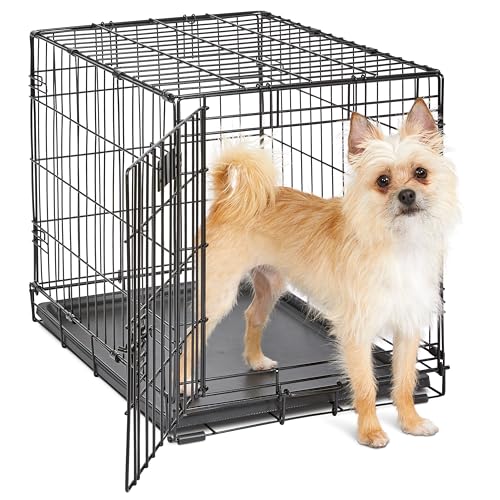
Size is the single most important specification. A crate should be large enough for the dog to stand without ducking, turn around without touching the walls, and lie flat on its side. It should not be large enough for the dog to eliminate in one corner and sleep in another. For a puppy that will grow, the practical solution is a crate with a divider panel: buy for the adult size, then use the divider to shrink the usable space to puppy proportions and move it back as the dog grows.
Wire crates are the most common choice because they allow airflow and visibility, and most models include a divider and a slide-out tray. Plastic airline-style crates are more enclosed and can suit dogs that prefer a darker den, but they are harder to expand and often do not include a divider. Soft-sided crates are portable but are not appropriate for dogs that chew or scratch, because the fabric panels can be damaged or ingested.
Placement matters as much as the crate itself. The crate should sit in a room where the household actually spends time, such as a living room or a bedroom. A dog confined in a back room learns that the crate predicts being alone. A crate in the middle of family activity, with the door open, becomes a normal piece of furniture that the dog can choose to use.
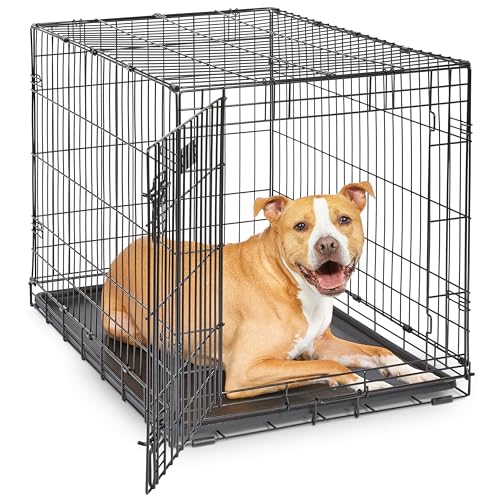
A mid-size wire crate with a divider panel is the standard starting point for most puppies and medium adult dogs. One widely purchased example is check the current price on Amazon, which is a representative wire crate with the features described above. The specifications that matter are the interior dimensions, the gauge of the wire, the presence of a divider, and whether the tray is removable for cleaning. Brand matters far less than fit.
Step 2: Build a Positive Association Before Closing the Door
The fastest way to build a positive association is to feed every meal inside the crate. Start with the bowl just inside the open door. Once the dog eats comfortably there, move the bowl a few inches deeper, then to the back of the crate. Most dogs will begin walking in on their own within a week when they hear the food bowl. This is not a trick; it is classical conditioning, and it works because the crate reliably predicts something the dog wants.
For dogs that are hesitant, scatter high-value treats near the entrance before moving them inside. The goal is to let the dog choose to enter rather than being placed inside. A dog that walks in under its own power has already made a small decision in favor of the crate. A dog that is pushed in has learned that the crate is something to resist.
Leave the door open during this phase. The crate should be a place the dog can enter and exit freely for several days before any confinement begins. A washable bed or a towel that carries the owner's scent can help, but avoid loose blankets that a puppy might chew and swallow. Chew-safe enrichment items such as a stuffed food toy can be introduced once the dog is comfortable entering.
Step 3: Close the Door Briefly, Then Extend Gradually
Once the dog eats happily inside with the door open, close the door during the meal and open it the moment the meal ends. Repeat this for several days. The dog learns that the door closing predicts food, not abandonment. From there, close the door for a minute or two after the meal while sitting nearby, then gradually extend the time while remaining in the room.
The most important rule during this phase is to never release the dog while it is crying, barking, or scratching. Wait for a moment of quiet, even a brief pause, and then open the door. Releasing a dog mid-protest teaches that protest is the mechanism that opens the door. This is difficult to listen to, particularly with a young puppy, but the alternative is a dog that has learned that volume works. If the dog is genuinely panicking rather than protesting, the correct response is to reduce the difficulty of the exercise, not to wait it out.
Distinguishing protest from panic matters. Protest is often intermittent, directed at the door, and stops when the dog is distracted. Panic includes drooling, dilated pupils, frantic attempts to escape, and self-injury. A dog in genuine panic is not being stubborn and should not be pushed through the exercise. The Merck Veterinary Manual dog owner reference notes that true separation-related distress is a clinical behavior problem, not a training failure, and warrants veterinary guidance.
Step 4: Add a Cue and Practice Departures
Choose a single word, such as kennel, crate, or bed, and say it consistently as the dog enters. Over repetitions, the word itself becomes a cue that predicts the crate and the reward that follows. Toss a treat inside, say the cue, and allow the dog to settle. Avoid repeating the cue multiple times, because a cue that is repeated becomes background noise.
Departure practice is the part most owners skip. Step out of the room for thirty seconds, return calmly, and release the dog only when it is quiet. Do not make arrivals dramatic. A low-key return teaches the dog that comings and goings are unremarkable. Gradually extend the absence from seconds to minutes to an hour. The goal is not to sneak away but to normalize the pattern of leaving and returning.
Dogs with separation-related behavior problems often do better when departures and returns are deliberately boring. No long goodbyes, no excited greetings. The AVMA and most veterinary behavior sources recommend this approach because it reduces the contrast between the owner's presence and absence, which is often what triggers distress.
Step 5: Crate Training Overnight
The first night is usually the hardest. Place the crate in the bedroom, near the bed, rather than across the house. Puppies are socially dependent and being alone in the dark is a genuine stressor. A crate beside the bed lets the puppy smell and hear the owner, which reduces distress. Expect some whining. If the whining escalates into panic, moving the crate closer or sleeping on the floor beside it for a night or two is a reasonable short-term measure, not a permanent arrangement.
Set an alarm for middle-of-the-night potty breaks. A ten-week-old puppy generally cannot hold its bladder beyond two to three hours. Skipping the break guarantees an accident, and an accident in the crate sets back the association the owner has been building. As the puppy matures, the intervals extend. By roughly four to five months, many puppies can sleep through the night without a break, though individual variation is wide.
For adult dogs, overnight crating is often optional. Many adult dogs can be trusted loose in a dog-proofed room. The crate remains useful for travel, boarding, veterinary recovery, and situations where the dog needs to be safely confined. Keeping the crate available after house training is complete preserves its value as a familiar resting place.
How Long Can a Dog Be Crated?
Duration limits are not arbitrary. They reflect bladder capacity, exercise needs, and social requirements. A commonly cited guideline for puppies is the dog's age in months plus one, expressed in hours. An eight-week-old puppy, therefore, has a maximum of roughly two hours. A four-month-old puppy can typically manage four to five hours. These are ceilings, not targets, and they assume the puppy has been walked and has eliminated immediately before confinement.
For adult dogs, four to six hours during the day is the usual upper limit cited by veterinary and welfare organizations. Overnight is a different situation because the dog is sleeping and metabolism slows, but even then, a full working day of crating is not appropriate. A dog that must be confined for eight or more hours needs a mid-day walker, a daycare arrangement, or a dog-proofed room rather than a crate. The WSAVA Global Nutrition Guidelines and related welfare guidance stress that confinement must be balanced against daily exercise and mental enrichment; a crate is not a substitute for either.
| Age | Typical maximum daytime crate interval |
|---|---|
| 8 to 10 weeks | 1 to 2 hours |
| 3 months | 3 hours |
| 4 months | 4 hours |
| 5 to 6 months | 5 hours |
| Adult | 4 to 6 hours daytime maximum |
Common Mistakes and How to Avoid Them
Using the crate as punishment. A crate used for time-outs becomes a signal of the owner's displeasure. If a dog needs to be separated after an incident, use a different space, such as a gated room, so the crate retains its neutral or positive association.
Confining too long. Exceeding the age-based interval produces accidents, and accidents inside the crate undermine house training. When in doubt, shorten the interval and add a potty break rather than extending it.
Skipping exercise before confinement. A dog that has not been walked or played with will not settle. Physical exercise and sniff-based enrichment before crating make settling far more likely. This is one of the most consistently repeated points in veterinary behavior guidance.
Removing the crate too early. Once a dog is trustworthy loose in the house, the crate can stay set up with the door open. Many dogs continue to nap in it by choice, and it remains useful for travel and emergencies.
Ignoring the divider. A crate that is too large for a puppy invites elimination in one corner. The divider is not an accessory; it is a functional part of house training.
Isolating the dog in the crate. A crate in a distant room with the door closed for hours is not den training. It is isolation. The crate should be in a social area during the day.
Releasing the dog mid-protest. Opening the door while the dog is crying teaches that crying works. Wait for a pause, then release. If the dog is panicking rather than protesting, reduce the difficulty instead of waiting.
Forcing a fearful dog inside. Pushing or shoving a dog into a crate creates exactly the association the owner is trying to avoid. Go back to feeding at the entrance and let the dog choose to enter.
How Long Does Crate Training Take?
Most dogs accept the crate as a familiar resting place within one to two weeks of consistent, positive introduction. Reliable behavior, including entering on cue and settling quietly for extended periods, typically develops over three to four weeks. Overnight training often takes longer in puppies because bladder capacity is still developing. Adult rescue dogs sometimes progress faster than puppies, because a covered, enclosed space can feel secure to a dog that has experienced instability.
If progress stalls after three weeks of consistent work, the cause is usually one of three things: the crate is too large, the confinement intervals are too long, or the dog has an underlying behavior or medical issue. A dog that drools heavily, injures itself, or vocalizes continuously in the crate is not being stubborn. That pattern is consistent with separation-related distress, and a veterinary consultation is the appropriate next step. The ASPCA Animal Poison Control resource is also relevant if a dog has chewed or ingested part of a crate pad, blanket, or toy while confined.
Choosing Crate Accessories
Accessories should support the crate's function without creating hazards. A washable, flat bed is safer than a thick, loose blanket for puppies that chew. Food-stuffable chew toys can occupy a dog during the early stages of confinement, but they should be sized appropriately and inspected for damage. Water is generally offered before and after confinement rather than left inside for puppies, because a bowl can be tipped and soaked bedding increases the risk of skin irritation and chill.
Crate covers can help dogs that settle better in dim, enclosed spaces, but they should not fully block airflow. In warm climates, a covered wire crate can trap heat, and dogs cannot efficiently cool themselves in an enclosed space. Ventilation matters more than darkness.
For travel, a crate should be secured so it cannot slide. A crate that shifts during braking can injure a dog and will make the dog reluctant to enter the crate again. Crash-tested crates and carriers exist, and their specifications are published by the manufacturers. Owners who travel frequently should look at those specifications rather than assuming any crate is safe in a vehicle.
Frequently Asked Questions
Is crate training cruel? Not when it is done with positive associations, appropriate durations, and adequate exercise. Dogs naturally seek enclosed resting spots. What is harmful is long-term confinement without exercise, enrichment, or social contact.
Can a dog be crated while the owner is at work? Only within the age-based interval and only with a potty break and exercise before and after. For a full workday, a dog walker, daycare, or a dog-proofed room is a better arrangement than a crate.
What if the dog cries all night? Rule out a full bladder first by offering a potty break. If the crying continues, avoid responding to the fussing with attention, and check whether the crate is positioned close enough to the owner. Persistent panic beyond several nights warrants a veterinary conversation about separation-related distress.
Can a dog that hates the crate be trained to use one? Yes, but the process has to slow down. Return to feeding meals at the open door, add high-value treats, and never force the dog inside. Forced entry undoes the association the owner is trying to build.
Do adult rescue dogs accept crates? Frequently yes, and sometimes faster than puppies. A crate can read as a secure den to a dog that has been through disruption. Some rescues will use the crate voluntarily with the door open long before they tolerate the door being closed.
Should the crate door stay open during the day? Once the dog is comfortable and house trained, leaving the crate open and available lets the dog choose it for rest. This preserves the crate as a positive space rather than a place that only appears when the owner leaves.
Bottom Line
Crate training is mostly about association and timing. Feed meals inside, keep early sessions short, never use the crate as punishment, and wait for quiet before opening the door. Size the crate so the dog can stand, turn, and lie flat but not eliminate in a corner, and use a divider for puppies. Respect the age-based duration limits, and treat panic differently from protest. Done this way, the crate becomes a place the dog chooses, which makes travel, boarding, and veterinary care easier for everyone.
If you are starting from scratch, a wire crate with a divider panel is the most flexible foundation for a growing dog. view this option on Amazon to compare dimensions and features before buying.