The Nursery Door Problem
Here's the mistake I see over and over: expectant parents spend nine months preparing everything for the baby and roughly zero minutes preparing the cat. Then they bring the newborn home, the cat sprays on the changing table within a week, and suddenly everyone's convinced the cat has to go. It doesn't. In almost every case I've encountered, the cat wasn't being jealous or spiteful — it was reacting to a sudden, total upheaval of its territory with no transition period at all.
Cats don't hate babies. What cats hate is unannounced change: new furniture, new smells, new noises, new rules about which rooms are off-limits, and suddenly absent humans. If you break that avalanche of change into small pieces spread across several months, the vast majority of cats adjust fine. The ones who struggle are usually the ones who got everything dumped on them in a single afternoon.
This guide walks through the whole timeline — starting around two months before your due date, through the hospital stay, through the first handshake between cat and baby, and into the toddler years, which honestly are the more dangerous phase. I'll also flag the genuine safety issues, because there are a few, and they're not the ones most people worry about.
Start Two to Three Months Before the Due Date
Your goal before the baby arrives is to make every single baby-related change feel old and boring by the time the newborn shows up. That means the nursery gets set up early, not the week before.
Set up the crib, changing table, swing, and stroller, then let the cat explore all of it. Let them sniff, walk through, even nap in the (empty) crib for now. I know some sources tell you to keep cats out of the crib entirely from day one, and I actually agree with the end state — but there's a strategic reason to allow investigation first. A cat that's been allowed to thoroughly examine new furniture loses interest in it. A cat that's been locked out of a suddenly forbidden room becomes obsessed with it. Curiosity you permit gets boring; access you restrict becomes valuable. So let them satisfy their curiosity now, and start enforcing boundaries a few weeks before the baby arrives.
While you're at it, address the double-standard problem. If your partner is going to be the primary cat-feeder while you recover, switch the feeding routine two months early — not the day you get home from the hospital. Cats track who does what very precisely, and a sudden swap of the person who fills the bowl reads as a loss, not a schedule change. Same with lap time, play sessions, and bedtime routines. Whatever the post-baby version of those routines looks like, start rehearsing it now.
Deal With the Room Access Question Honestly
Somewhere around four to six weeks before the due date, decide your permanent policy on the nursery and start enforcing it consistently. If the nursery will be cat-free, install a screen door or a baby gate and make the room off-limits from that point forward — no exceptions, no 'just this once.' Cats are superb at exploiting inconsistency. One day of lax enforcement can undo weeks of training.
My honest recommendation, based on what's worked for the families I've advised: make the nursery off-limits, at least for sleeping hours. The reason isn't the old myth about cats 'stealing babies' breath' — that's folklore with no basis in reality. The real issue is that cats seek warm spots, and a sleeping infant is a warm spot that can't move away. A cat curling up against a newborn's face is a suffocation risk in exactly the same way a blanket or pillow is. The American Academy of Pediatrics recommends bare sleep spaces for infants, and a cat in the crib fails that test completely.
If a physical barrier isn't practical, a crib tent or mesh canopy is a reasonable backup, though some cats figure out zippers and clips faster than you'd believe. A door is more reliable than any gadget. If you go the gate route, get a tall one — most cats clear a standard 30-inch gate from a standstill, and an athletic cat clears 36 inches without much trouble. Pairing a gate with a few strips of double-sided sticky tape along the top rail convinces most cats the whole structure isn't worth the trouble.
Desensitize to Baby Noises and Smells Before They Arrive
Crying is the big one. A newborn's cry sits in a frequency range that many cats find genuinely alarming, and the first few nights of real crying at 3 AM can send a sensitive cat into hiding. The fix is free: play recordings of babies crying, starting at low volume while the cat eats or plays, and gradually increase the volume over a few weeks. Ten minutes a day is plenty. You're not trying to make the cat love the sound — you're teaching it that the sound predicts nothing bad.
Do the same with the mechanical stuff. Run the swing, the white noise machine, the bottle sterilizer, the vibrating bassinet. Wear the baby carrier around the house while you do chores so it stops being a weird alien object strapped to your body. Every one of these sounds and objects that becomes familiar before the due date is one less stressor stacked onto the big day.
Smell matters more to a cat than anything you can see. Bring home a worn onesie or blanket with the baby's scent from the hospital before the actual homecoming if you possibly can — have your partner or a family member bring it back a day early. Let the cat sniff it, rub against it, sit on it. Scent is how cats file new information into the 'known and safe' category.
The Homecoming: Get It Backwards From What You Think
Here's where almost everyone gets it wrong. The baby comes home, everyone crowds around, the cat gets shoved into a bedroom, and the first introduction happens in a charged, chaotic moment. Flip the order.
When you walk in the door, have someone else hold the baby. You — ideally the person the cat is most bonded to — greet the cat first, calmly, the way you would after any trip away. Spend five or ten minutes on normal greeting behavior. Let the cat re-claim you before it has to process the baby. Then, and only then, sit down in a quiet room with the baby and allow the cat to approach at its own pace.
Rules for this first meeting: the cat should be free to leave, not held or cornered. No forcing nose-to-baby contact. No grabbing the cat and plopping it next to the infant. Let the cat sniff a foot or the blanket, and reward calm behavior with quiet praise or a treat dropped near (not on) the baby. If the cat hisses and retreats, that's fine — that's normal, and it's information, not aggression. Hissing means 'give me space,' and the correct response is to give it. Multiple short, boring, uneventful meetings over several days beat one long dramatic one.
Never punish hissing, swatting, or avoidance. According to the ASPCA, punishment-based approaches increase stress and fear in cats and often make aggressive or avoidant behavior worse, not better. What you want is a cat that feels in control of its own approach. A cat that chooses to investigate is calm. A cat that's forced into proximity is a cat building a negative association that can take months to undo.

Scent Swapping and the First Few Weeks
For the first couple of weeks, keep running parallel introductions at the scent level. Alternate which blankets and items the cat and baby contact. Let the cat sniff baby lotion on your hands, used burp cloths, the car seat cover. Scent mixing is how a cat's brain learns that the baby is part of the household, not an intruder.
Watch the cat's body language during this phase, and learn the subtle signs. Dilated pupils, flattened ears, a low twitching tail, hiding more than usual, decreased appetite — these are stress signals. Some cats also display displacement behaviors like over-grooming. The American Veterinary Medical Association lists changes in appetite and litter box habits among the first indicators of stress and illness in cats, so if your cat stops eating for more than a day or two after the baby arrives, call your vet. Stress can tip into real medical problems, including feline idiopathic cystitis, which has a well-documented link to environmental change.
Litter box problems are the most common casualty of a new baby. Sometimes it's the litter box location — moved to make room for baby gear — and sometimes it's cleaning frequency dropping because everyone's exhausted. Both are fixable, but only if you catch them early. According to veterinary behavior guidance, one of the most common causes of house-soiling is an unclean or poorly located litter box, so if a box got relocated to a noisy spot near the new washing machine, move it back. And if a cat that has always used the box perfectly suddenly stops, don't assume jealousy — rule out a urinary issue with your vet first. I've seen more than one 'behavioral' spraying case turn out to be a painful bladder condition that arrived at the same time as the baby, purely by coincidence.
Gear That Actually Helps
You don't need much, but a few things earn their keep. A plug-in pheromone diffuser in the main living area is worth trying for the transition period — it's not a sedative and it's not magic, but many cats show measurably calmer behavior with one running, and the science behind synthetic feline facial pheromones is respectable. This pheromone diffuser starter kit covers about 700 square feet, which handles most apartments and a floor of a house.
Second: a tall, dedicated cat tree placed in or near the main family room. Cats cope with chaos by gaining altitude, and a cat with a high perch overlooking the baby zone can observe everything without being in the middle of it. This multi-level cat tree with a top perch is the kind I mean — stable base, tall enough to matter, and a scratching post built in so the cat has a legal outlet for any redirected scratching urges.
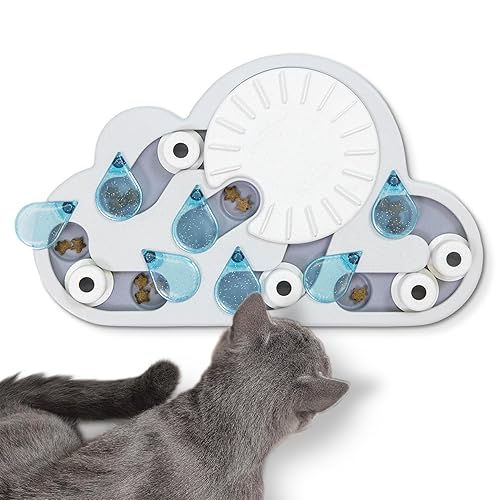
Third, if you'll be separating rooms at night, a microchip or magnetic pet door that only opens for the cat — installed in the nursery door or as a wall unit — sounds elaborate but solves the 'door closed, cat crying' problem elegantly. And finally, interactive toys that let you give the cat a real five-minute hunting session even when you're running on four hours of sleep. A wand toy you can work from the couch is worth its weight in gold during the newborn phase. Treat-dispensing puzzle feeders like this cat puzzle feeder buy you quiet time while keeping the cat mentally fed, which matters more than most people realize.
Protecting the Cat From the Baby (Yes, That Direction Too)
Everyone worries about the cat hurting the baby. The bigger long-term risk runs the other way. Once that baby becomes a grabby toddler, the cat becomes the grabbee, and how that goes depends almost entirely on the escape architecture you set up.
The single most important rule: the cat must always have an exit. Baby gates with a cat-sized gap at the bottom, cat trees the toddler can't climb, a cat-only room the child can't access. Teach 'gentle hands' from the moment the kid can reach, and supervise every single interaction until the child is old enough to read the cat walking away — which, developmentally, isn't reliable until around age four or five. Never leave a cat alone with an infant, and by that I mean not even a nap in the next room. Doors close for naps. Period.
Watch for warning signs on both ends. A cat that flicks its tail, freezes, or turns its head toward a toddler is two seconds from a swat, and toddlers don't read those signals. Rather than punishing the cat for defending itself, engineer the situation so it never needs to. A toddler chasing a cat around the house is the setup for the majority of child cat-scratch incidents, and cat scratch disease is a real bacterial infection — the CDC estimates roughly 12,000 diagnoses a year, with children under five among the highest-risk groups. Supervision plus escape routes prevents nearly all of it.
Schedule a Vet and Grooming Reset
Two practical items before the due date. First, get the cat to the vet for a checkup and make sure vaccinations and parasite prevention are current — an indoor cat sharing a home with a crawling infant should be on year-round flea and parasite control, because fleas don't care that you're tired. Second, if your cat has never been tolerant of nail trims, start training now. Blunt nails dramatically reduce the damage from any accidental contact, and the scissor-style cat nail clippers most groomers recommend cost about the same as a coffee. Weekly trims, front paws only, take ninety seconds once the cat accepts handling.
When Things Aren't Going Well
Give the adjustment six to eight weeks before you panic. Some cats take days, some take months, and progress isn't linear — a cat that was fine at week two might regress when the baby starts crying more or crawling. That's normal.
Situations that warrant a call to your vet or a veterinary behaviorist rather than more waiting: house-soiling that persists after a clean bill of health, aggression directed at the baby specifically, a cat that stops eating for more than 24 to 48 hours, or withdrawal so complete the cat barely leaves hiding. Medication combined with a behavior plan resolves a lot of these cases, and resolving them is far better than the alternative I've watched too many families reach for.
Rehoming should be the genuine last resort, after a behaviorist and your vet have both weighed in. Most 'cat won't accept the baby' cases I've been involved with turned out to be environmental problems — a relocated litter box, no escape route, a feeding schedule that vanished — that nobody had noticed because everyone was operating on three hours of sleep.
The Takeaway
Start early, change everything gradually, let the cat investigate before you restrict access, greet the cat before the baby on homecoming day, never force contact, and build escape routes for the toddler years. Do that, and in my experience the overwhelmingly likely outcome is a cat that tolerates the baby with mild indifference — and, in the best cases, a cat that ends up sleeping at the foot of a five-year-old's bed, having decided all along that the loud hairless kitten was family after all.
Related Reading
Want more on this topic? Check out our guides on cat hiding behavior when to worry guide, best cat outdoor enclosures catios tents, how to give a cat a pill step by step.