A bearded dragon can sit under a perfectly good heat lamp and still be cold. The problem is almost never the bulb. It is the distance, the surface, the thermostat setting, or the missing gradient on the other end of the enclosure, and in our experience reviewing reader setups, most of those mistakes are invisible until you put a thermometer exactly where the animal actually sits.
According to the AVMA, reptiles are ectotherms: they rely entirely on external heat sources to regulate body temperature, digest food, and fight infection. In the wild, an animal slides between sun-baked rock and deep shade and fine-tunes its body temperature minute by minute. In a glass box, we decide where the sun is and where the shade is. Get that decision wrong and the consequences show up slowly: long digestion times, appetite loss, lethargy, immune suppression, or the opposite extreme, burns on the belly and spine from a surface that got far hotter than anyone intended.
This guide walks through building a basking area that actually works: the target temperatures by species, how to position the heat source, why a thermostat is non-negotiable, what changes for aquatic turtles, and the measurement mistakes that keep otherwise careful owners guessing. We have written before about the symptoms of overheating and heat stress. This piece is about prevention at the setup stage, where it is far cheaper to fix.
What a basking spot actually does
Two separate jobs happen in the warmest zone of an enclosure. The first is digestive: after a meal, most lizards and snakes seek heat to power digestion, and a bearded dragon that cannot reach its preferred body temperature may sit on an unchanged meal for days. The second is behavioral regulation across a gradient. A healthy reptile does not want one temperature; it wants a choice. The basking surface might read 100 degrees Fahrenheit while the cool retreat sits at 75, and the animal moves between them dozens of times a day to hold its body where it needs to be.
That is why the single worst enclosure layout is uniform warmth: a heat mat on the whole floor, or a large lamp that raises everything to the same lukewarm reading. Without a gradient, the animal has no way to thermoregulate, and chronic low-grade stress follows. The basking spot is not a luxury feature. It is the engine of the entire thermal design.
A quick distinction that trips up newcomers: basking heat and UVB are different things. A bright white basking lamp supplies infrared heat and visible light. A UVB tube supplies ultraviolet radiation for vitamin D3 synthesis. Some combined mercury vapor bulbs do both, but most setups pair a separate heat lamp with a separate UVB source. Our earlier piece on UVB lighting mistakes covers that side in depth; here we stay on temperature.
The numbers that matter, by species
Publish care sheets vary a little, but the ranges below reflect the widely accepted targets across veterinary and breeder guidance. Measure at the level of the animal, not the lamp.
- Bearded dragon: basking surface 95 to 108 degrees Fahrenheit for adults, warm side ambient 88 to 95, cool side 75 to 85.
- Leopard gecko: warm side ambient 88 to 92 under a heat source, cool side 73 to 78; this species needs belly heat for digestion more than a tall basking perch.
- Ball python: warm side ambient 88 to 92, cool side 76 to 80, with a surface hotspot near 90; ambient humidity above 55 percent matters just as much.
- Corn snake: warm side 82 to 88, cool side 72 to 78.
- Red-eared slider and similar aquatic turtles: basking dock surface 85 to 95, water 75 to 82 depending on age.
- Crested gecko and other New Caledonia species: no dedicated basking zone at all; they thrive at room temperatures of 72 to 78 and can be harmed by sustained readings above 82.
Notice the pattern in the list: the target is a pair of numbers, not one. If you only remember one rule from this guide, remember that every species above is defined by its cool end as much as its hot end. An enclosure with a 105 degree hotspot and a 95 degree cool zone is not a bearded dragon habitat, it is an oven with one slightly less terrible corner.
Step 1: Choose the surface and its position
The basking surface is whatever the animal physically stands on under the heat source. Slate, cork bark, concrete paver, and stone all absorb lamp heat and become the true measured temperature; an air probe three inches away tells you very little about them. Dark, dense materials under a lamp can run 10 to 15 degrees hotter than the surrounding air, which is exactly why surface probes matter.
Position the basking zone at one end of the enclosure, never the center. Center mounting chops the gradient in half and leaves the animal nowhere to genuinely cool down. The warm end should include both the elevated surface under the lamp and a path down through intermediate temperatures, and the opposite end should hold the water dish or humid hide for species that need one. Placing the water bowl under the basking lamp is a classic error: it spikes evaporation and humidity, cooks the water, and pushes the animal to choose between hydration and comfort.
For arboreal species, the basking branch belongs near the top but with enough clearance that the animal cannot pin itself against the mesh screen directly under the lamp. Screen tops run hot where light passes through, and a lizard sleeping against that mesh overnight is how contact burns happen even under a correctly configured bulb. A simple cage clamp lamp with a ceramic housing and a bulb guard costs less than one vet visit for a thermal burn.
Step 2: Pick the lamp and set the distance
Wattage is a means, not a target. The same 100 watt bulb produces wildly different surface temperatures at 8 inches versus 14 inches, and mesh screen tops bleed a surprising share of the output before it ever reaches the animal. The only reliable method is to set the lamp at a starting distance from the manufacturer guidance, leave it on for two hours to reach steady state, then measure the surface with an infrared temperature gun or a probe taped to the basking rock. Adjust distance, not wattage, until you land in range.
Halogen flood lamps remain our default recommendation for diurnal baskers because their output spectrum and the way they heat surfaces closely mimic basking sunlight, and they dim cleanly on dimming thermostats. Ceramic heat emitters add heat with no light, useful for nighttime supplementation in rooms that drop cold. Colored night bulbs, red or otherwise, are a dated habit; snakes and lizards do see that light, and a dark, cool-appropriate night period is the better default for most species.
Photoperiod matters too. Basking heat should follow a day schedule, typically 10 to 12 hours on, matching the UVB timer. Around-the-clock heat lamps disrupt the natural cooling window that most temperate species expect, and they shorten bulb life for no benefit. Night heat, when needed for tropical species in cold rooms, should come from a thermostat-controlled ceramic emitter or heat panel rather than the daytime basking lamp.
Step 3: Put a thermostat in charge
An unregulated heat lamp is a space heater wired to an on-off switch operated by you. Room temperature swings with the weather and the furnace cycle, and a bulb that produced a perfect 100 degree surface in April will cook the same rock during a July heat wave. Every heat source in the enclosure, without exception, belongs on a thermostat.
Digital pulse-proportional and dimming thermostats hold a probe-set temperature by throttling power continuously, which is what you want for basking lamps and heat mats alike. We have set up dozens of enclosures around simple outlet units, and the one on nearly all of them is the Inkbird ITC-308 temperature controller, a two-stage outlet thermostat that switches heating and cooling independently up to 1100 watts. You set the target, tape the sensor probe where the animal sits, and the unit holds that reading by cycling the lamp or mat on its own.
The two-stage design matters more than it sounds. In a warm apartment, the same controller can cut power to heating gear when the room climbs past a ceiling you define, or switch a small cooling fan on. Owners who want a backlit display and a single-outlet simpler arrangement often run the INKBIRD digital outlet thermostat instead, which handles the same heating duty at up to 1200 watts with a straightforward set-and-hold interface. Either way, the probe placement rule is identical: the sensor belongs at the basking surface or the warm-side substrate, roughly where the reptile's body will be, not dangling in mid-air and not pressed against the bulb.
One hard warning we will repeat because the consequences are severe: never use a heat rock. According to the Association of Reptilian and Amphibian Veterinarians, under-rock heaters and heat rocks have caused serious and often fatal burns in reptiles, because they cannot be regulated and the animal rests directly on the heat source with no escape. Heat belongs above or beside the animal, on a thermostat, with a cooler zone always available. The association also notes that captive reptiles kept with proper thermal gradients show markedly better feeding response and immune function, which is the whole point of this exercise.
Aquatic turtles are a different build
For sliders, cooters, and maps, the basking spot is not a rock under a lamp on land; it is a platform the turtle climbs out of the water onto, and it has to hold a turtle's weight while staying dry under the lamp. The geometry of that dock decides whether your turtle actually basks or just stares at it from the water.
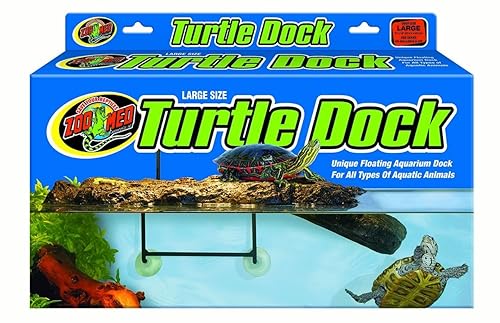
The two designs that dominate owner feedback are floating piers and fixed suction docks. The Penn-Plax Reptology Aquatic Turtle Pier is a large floating platform that rises and falls with the water level and includes a ramp submerged at an angle, so even a weak swimmer can walk up out of the water. Floating platforms suit deep tanks because the climb distance never changes. The Zoo Med Turtle Dock takes the same floating approach in a smaller footprint with a submerged ramp, and fits standard tank rims where a full pier will not.

Whichever platform you pick, three checks apply. First, stability: a dock that tips when a heavy slider hauls out will be abandoned, and turtles that cannot dry off fully develop shell rot and fungal infections at much higher rates. Second, size: the platform should fit the entire animal with limbs extended, because a turtle that must dangle half its shell off the edge cannot dry the plastron properly. Third, lamp coverage: the heat lamp and UVB should pool over the whole dock, not a corner of it, and the dock surface should read in the 85 to 95 degree range at the animal's shell, verified with a probe or temperature gun the same way you would check a lizard rock.
Water temperature is the other half of the equation for aquatics, and it belongs on its own submersible heater with its own thermostat control, set for the species range and measured independently. Basking air at 90 degrees over 68 degree water is a recipe for respiratory infections, not a gradient.
Measure like you mean it
The most common measurement failure we see is trusting a single stick-on dial thermometer stuck to the glass. Those dials read the glass, which is influenced by room temperature on the other side, and they can be off by 10 degrees or more. They are decoration. Replace them with two digital probes, one at the basking surface and one at the cool end, plus an infrared temperature gun for spot checks on any surface the animal touches.
Measure at the animal's level, after the lamps have run for at least two hours, and log the readings in both afternoon and early morning. Enclosures are dynamic: a reading taken at noon in an air-conditioned room tells you nothing about the 3 a.m. low in January. If your cool end creeps above the target at night in summer, that is the moment a two-stage controller with a cooling function earns its keep.
Re-verify seasonally. Bulbs dim and drift in output as they age, room heating schedules change, and a setup that held 100 degrees on the nose in October can sit at 88 by February or 112 by August. A five-minute probe check at each equinox is the cheapest insurance in reptile keeping.
Signs the basking zone is wrong
The enclosure usually tells you before the vet does. An animal that never basks is often telling you the spot is too hot, too unstable, too exposed, or in the wrong place in the enclosure. An animal that basks constantly and still sits with a cold body is telling you the reading on your dial and the temperature at its back are different animals. Digging frantically at the cool end, gaping mouth breathing under the lamp, or flattening against the mesh top are heat-stress behaviors, and they warrant an immediate probe check of every zone.
Appetite loss in a otherwise healthy-looking lizard is a thermal complaint until proven otherwise, particularly in bearded dragons and leopard geckos whose digestion is tightly coupled to belly and core warmth. Before you reorder feeder insects or suspect parasites, tape a probe where the animal sleeps and where it eats, and compare both against the species targets above. We have heard from many owners whose picky eater resolved within a week of fixing a thermostat that had silently failed to cycle.
And the opposite failure, burns, presents as discolored scale patches on the spine, hips, or belly, often discovered long after the contact that caused them. Any burn, even a small one, deserves a reptile-experienced vet, because damaged scales in a humid enclosure infection-prone fast.
The mistakes we see most, ranked by how often they cost a vet visit
First: no thermostat at all, or a thermostat whose probe lies in open air a foot from the basking surface. Second: the cool end missing entirely, because a large lamp or full-floor mat heats everything uniformly. Third: water dishes and humid hides placed under the lamp. Fourth: unregulated heat rocks and under-tank heaters glued to the glass, the burn machines the veterinary association has warned about for decades. Fifth: measuring once, on day one, and never again as bulbs age and seasons turn.
None of these are exotic failures. All five are invisible without a probe in the right place, which is why our standing advice to new keepers is blunt: the thermometer budget matters more than the lamp budget. A mid-range bulb on a good controller with two honest probes beats a premium lamp on guesswork every single time.
The takeaway
Build the gradient first: a measured basking surface in the species range, a genuinely cool retreat 15 to 25 degrees below it, and a clear path between. Put every heat source on a thermostat with the probe at animal level, verify with a surface thermometer after two hours of runtime, and re-check at every season change. For aquatic turtles, add a stable, full-body dock under properly pooled light. Do those five things and the thermal side of reptile keeping stops being a source of anxiety and becomes what it should be: set once, verified occasionally, and quietly correct.
Related Reading
Want more on this topic? Check out our guides on reptile mbd prevention guide, best reptile substrates bedding, best reptile misting automatic humidity systems.