Why an Aquarium Heater Is the Most Critical Piece of Equipment
An aquarium heater is not a luxury; it is survival equipment for tropical fish. Published care guidance from the ASPCA and the Merck Veterinary Manual consistently notes that most freshwater tropical species require a stable range of roughly 76-82 degrees F (24-28 degrees C). A temperature swing of just 5 degrees F in a few hours can trigger ich outbreaks, suppress immune systems, and stress fish to the point of illness. In the worst cases, a failed heater or no heater at all in a cold room means mass casualties overnight.
Unlike filters or lights, where a failure means dirty water or dim lighting for a day, a heater failure can kill. This reference guide covers what to look for when choosing a heater for your aquarium and how to keep your fish safe year-round, using published manufacturer specifications, veterinary guidance, and verified owner reports rather than hands-on testing.
Key Factors When Choosing a Heater
- Wattage: The widely cited rule is 3-5 watts per gallon. A 20-gallon tank needs 60-100W; a 55-gallon needs 150-250W. In cold rooms, size up. An oversized heater simply runs less often, but an undersized heater works constantly and still cannot keep up.
- Thermostat Accuracy: A heater rated for 78 degrees F that actually maintains 82 degrees F is dangerous. Look for heaters with plus-or-minus 0.5 degrees F accuracy or better, and always verify with a separate thermometer.
- Shatterproof Construction: Glass heaters can crack when exposed to cold air while hot, such as during water changes if you forget to unplug. Shatterproof polymer heaters eliminate this risk.
- Controller vs. Built-in Thermostat: External controllers add a safety layer. They cut power to the heater if the internal thermostat fails in the on position, which is the most common failure mode.
- Placement Type: Submersible heaters sit fully underwater, horizontally or vertically. Inline heaters connect to canister filter tubing and stay completely external to the tank.
- Safety Features: Auto shut-off when exposed to air, overheat protection, and indicator lights showing when the heater is actively heating.
Aquarium Heaters Worth Considering
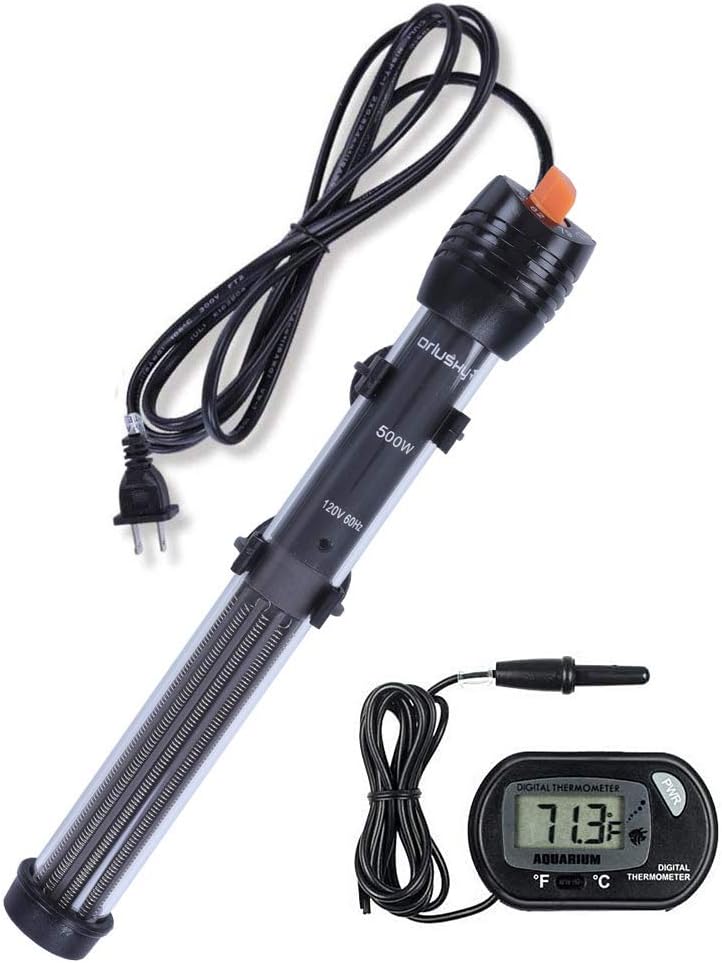
aquarium heaters
1. Eheim Jager TruTemp - A Long-Standing Standard
The Eheim Jager, formerly Ebo-Jager, has been a trusted name for decades, and the TruTemp line continues that reputation. It uses a glass jacket with a bimetallic thermostat that is easily calibrated via a top dial. The thermostat is hermetically sealed, meaning it is rated for full submersion. The TruTemp calibration ring lets you fine-tune the setting to match a separate thermometer exactly. It is available from 25W to 300W and carries a 3-year warranty.
This heater suits most home aquariums where reliability and calibratability matter more than a digital display. The trade-off is that the glass body is still breakable if dropped or exposed to extreme temperature shock, and higher-wattage models run 13-16 inches long, requiring vertical placement in taller tanks. There is no digital readout, so a separate thermometer is needed to verify temperature.
Check the current price on Amazon
2. Fluval M Series - Tighter Electronic Control
Fluval M Series heaters use an electronic thermostat rather than a bimetallic one, which typically delivers tighter temperature control around plus-or-minus 0.5 degrees F. The slim profile and dual-suction-cup mounting bracket allow discreet placement. The reflective M-coating is designed to distribute heat evenly across the heating element, reducing hot spots that can burn curious fish, and a built-in fish guard on the top prevents fish from resting directly on hot glass.
This model fits modern aquariums where precise temperature control is the priority. The trade-offs are that standard models are still glass and not shatterproof, suction cups degrade over one to two years, and there is no calibration option, so the heater relies on factory-set thermostat accuracy. Higher-wattage models also get quite long.
3. Aqueon Pro Adjustable - Shatterproof Construction
The Aqueon Pro uses a polymer rather than glass body. Drop it, knock it against hardscape, or accidentally expose it to air during a water change, and it will not shatter. The polymer construction is also thermal-shock resistant, so cold water hitting a hot heater will not crack it. The LED indicator is bright and easy to see from across the room, and the heater is fully submersible with a limited lifetime warranty.
This heater is a good match for accident-prone aquarists, turtle or cichlid tanks, and families with kids. The trade-offs are that there is no calibration option, the thicker profile takes more tank space than glass heaters, and the bright LED can be distracting in bedroom tanks at night.
4. Inkbird ITC-306A External Controller - A Safety Upgrade for Any Heater
This is not a heater; it is a safety device designed to pair with an existing heater. The Inkbird ITC-306A is an external temperature controller: plug your heater into it, place the separate temperature probe in the tank, and set high and low temperature limits. If the heater internal thermostat fails in the on position, the Inkbird cuts power at the high limit you set. Dual temperature probes and dual relay output provide redundancy. At roughly $30-40, it is one of the least expensive safety upgrades in the hobby.
This controller suits essentially every aquarium as a safety layer. The trade-offs are that it adds another device and cable to the setup, the temperature probe needs a calibration check every three months, and the mechanical relay has a lifespan that can fail after years of cycling. A solid-state relay version is available for more money. The probe must also be positioned correctly, away from dead spots and filter outflow.
5. Hydor ETH Inline Heater - External and Invisible in the Tank
Inline heaters connect to a canister filter outflow tubing, heating water as it returns to the tank. The result is zero equipment in the aquarium, no glass tubes marring the aquascape, and no risk of fish burning themselves on a hot surface. The Hydor ETH uses a PTC, or Positive Temperature Coefficient, heating element that self-regulates, meaning it cannot overheat beyond its design temperature. This makes it inherently safer than traditional resistive heaters and a popular choice for planted tank enthusiasts and aquascapers.
This heater fits planted tanks, display aquascapes, and canister filter setups. The trade-offs are that it requires a canister filter and will not work with hang-on-back or sponge filters, it is only available in 200W and 300W, which is overkill for tanks under 40 gallons, and it must be installed on the outflow side. It is also more expensive than submersible heaters, and if the canister filter stops, so does the heat, so a secondary submersible heater is worth considering for redundancy.
6. Hygger Adjustable Submersible Heater - Budget Digital Display
Hygger heaters pack a digital LED display and external controller into a package typically under $25, features usually reserved for $50-plus heaters. The display shows current and set temperature, with simple up and down buttons. The quartz glass tube is surrounded by a protective plastic guard that prevents fish from direct contact. It is not the most durable option long-term, but the feature set is hard to match at the price.
This heater suits budget-conscious aquarists who want a digital display for mid-sized tanks. The trade-offs are that build quality is adequate but not premium, with an expected lifespan of two to three years; the display can fog up or fail if moisture enters the controller housing; temperature accuracy can drift by one to two degrees F, so a separate thermometer is needed; and the silicone suction cups are lower quality and may need earlier replacement.
7. Tetra HT Submersible Heater - Compact Option for Small Tanks
Tetra HT line includes a 50W model designed for 2-10 gallon nano tanks, where the heater cannot be too long or it will not fit vertically. The compact size, under 8 inches, and indicator light make it suitable for betta tanks of 5 gallons or more, shrimp tanks, and hospital or quarantine setups. The preset 78 degrees F temperature simplifies operation: no dials, no confusion, just plug in and it maintains tropical temperature.
This heater fits nano tanks, betta tanks, beginners, and hospital or quarantine tanks. The trade-offs are that the preset 78 degrees F cannot be adjusted for species needing warmer or cooler water, there is no calibration if it drifts, the lifespan is shorter than premium brands at one to two years, and the glass body is breakable if dropped.
Comparison Table
| Heater | Price | Wattages | Type | Shatterproof | Best For |
|---|---|---|---|---|---|
| Eheim Jager TruTemp | $25-55 | 25-300W | Glass, Calibratable | TruTemp+ only | Most home aquariums |
| Fluval M Series | $25-50 | 50-300W | Glass, Electronic | No | Precise temperature control |
| Aqueon Pro | $30-55 | 50-300W | Polymer | Yes | Durability, accident-prone |
| Inkbird ITC-306A | $30-40 | N/A (controller) | External Controller | N/A | Safety redundancy for any heater |
| Hydor ETH Inline | $60-80 | 200-300W | Inline, PTC | N/A (external) | Planted tanks, canister filters |
| Hygger Digital | $18-25 | 50-300W | Quartz + Guard | Partial (guard) | Budget with digital display |
| Tetra HT | $12-18 | 50-300W | Glass, Preset | No | Nano tanks, beginners |
The Two-Heater Strategy: Reducing the Risk of a Heater Failure
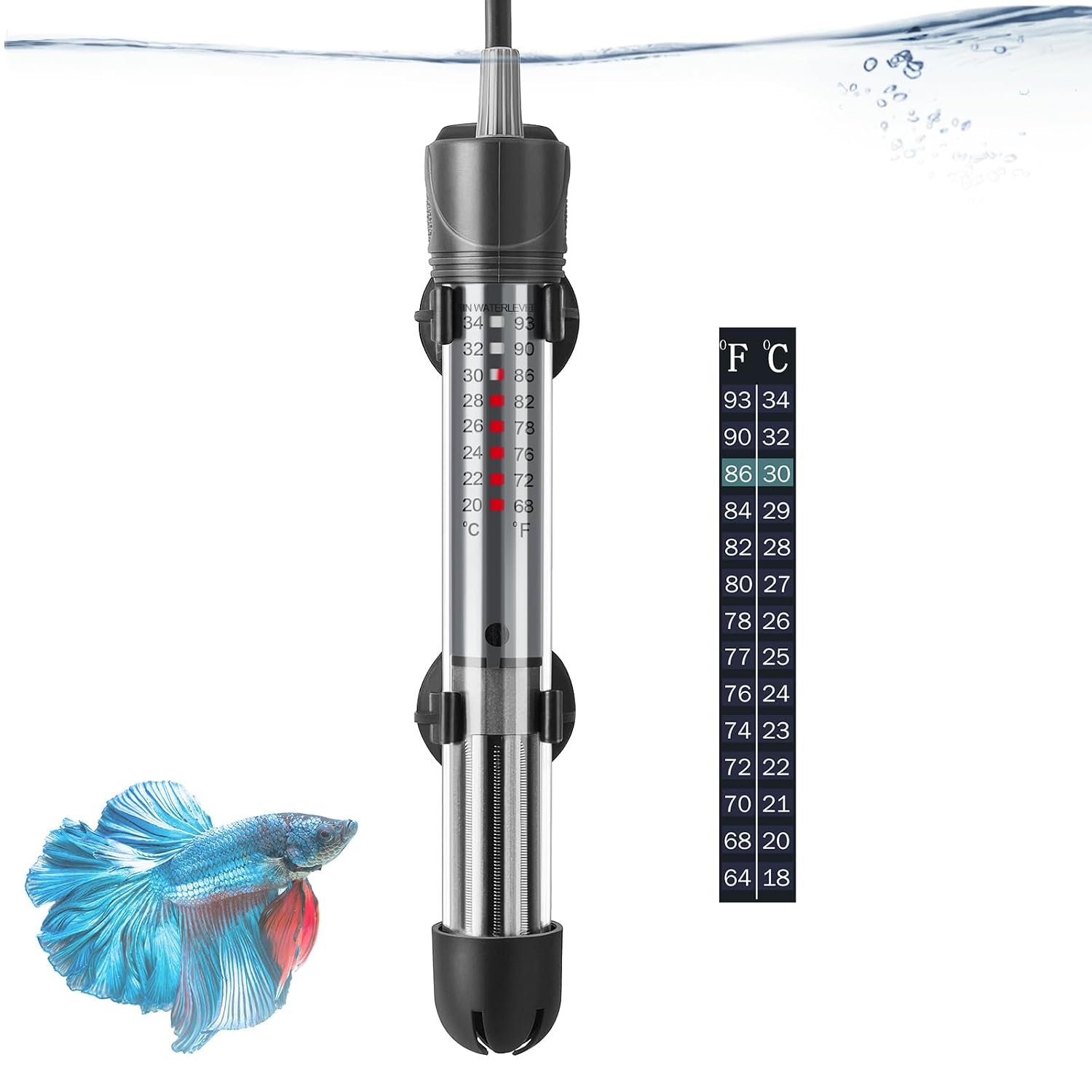
aquarium heaters
One of the most repeated recommendations in the hobby is to use two undersized heaters instead of one properly sized heater. For a 55-gallon tank needing 250W total, use two 125W heaters, or one 150W plus one 100W, on opposite ends of the tank. This approach is widely discussed in aquarium forums and owner communities and is supported by the basic logic of redundancy.
- If one heater fails off: The other heater runs more but can still maintain a survivable temperature, perhaps 74 degrees F instead of 78 degrees F, which is cooler but not deadly.
- If one heater fails on: One 125W heater cannot overheat a 55-gallon tank fast enough to kill fish before you notice. A single 250W heater stuck on can cook the tank to 90 degrees F or more in hours.
- Better temperature distribution: Two heaters on opposite sides reduce cold spots and thermal stratification.
- Redundancy: You have time to notice a problem and get a replacement before disaster.
Pair this with an external temperature controller for triple redundancy, and the probability of a heater disaster killing your fish drops substantially. The ASPCA pet care library and the Merck Veterinary Manual both emphasize stable environmental temperatures as a foundation of fish health, and redundancy is the most practical way to protect that stability.
Heater Placement Tips
- Place near water flow: Position the heater near the filter intake or outflow so heated water circulates throughout the tank.
- Horizontal or 45-degree angle: Mounting the heater at an angle, particularly under the filter outflow, ensures heat rises through the water column efficiently. Vertical placement at the back corner is acceptable but less efficient.
- Never bury in substrate: Heaters need water flow around the entire element. Buried heaters can overheat and crack.
- Keep away from decorations: At least 2 inches of clearance around the heater prevents localized overheating and ensures flow.
- Use a heater guard: A plastic cage that clips around glass heaters prevents fish from resting directly on hot glass and protects the tube from larger fish that might bump or strike it.
Heater Maintenance
- Check temperature weekly: Use a separate thermometer rather than trusting the heater dial. Digital stick-on strips are cheap but inaccurate; glass alcohol thermometers or digital probe thermometers are more reliable.
- Inspect for cracks and condensation: If water droplets appear inside a glass heater, unplug immediately. Water has entered the sealed tube and it can short or crack.
- Clean mineral deposits quarterly: Hard water leaves calcium scale on the heater tube, reducing efficiency. Wipe with vinegar on a cloth while unplugged, then rinse thoroughly.
- Replace every 2-3 years: Thermostats wear out. Even premium heaters can drift or fail after years of cycling. Mark the install date on the plug with a marker.
- Always unplug during water changes: When the heater is exposed to air while hot, thermal shock can crack glass tubes instantly. Plug it back in only after the water level covers it completely.
Sizing and Species-Specific Needs
Heater sizing is not only about gallons. The starting point is the 3-5 watts per gallon rule, but the real requirement depends on how much heat the tank loses to the room. A 55-gallon tank in a 70 degrees F room needs less wattage than the same tank in a 62 degrees F basement. The commonly cited adjustment is to size up by about 25 to 50 percent for rooms that run cold, and to consider two smaller heaters rather than one large one for better distribution and redundancy.
Species also matter. Betta fish, discus, and many tetras are generally described as needing 78-82 degrees F to thrive. Goldfish, white cloud mountain minnows, hillstream loaches, and dojo loaches are coldwater species that do not need heaters if room temperature stays between 65 and 75 degrees F year-round. The Merck Veterinary Manual notes that environmental temperature is a primary husbandry factor for exotic and laboratory animals, and fish are no exception. Keeping a coldwater species too warm is just as stressful as keeping a tropical species too cool.
Common Mistakes to Avoid
- Trusting the heater dial: The dial is a setting, not a measurement. Always verify with a separate thermometer.
- Plugging the heater back in before it is submerged: This is one of the most common causes of cracked glass tubes.
- Using a heater with no redundancy: A single heater is a single point of failure. Two smaller heaters or an external controller greatly reduce risk.
- Ignoring the probe placement on a controller: A probe in a dead spot or near filter outflow will read the wrong temperature and defeat the safety layer.
- Buying an oversized heater for a small tank: An oversized heater can raise temperature too quickly if it fails on, especially in nano tanks.
- Forgetting that a heater can only raise temperature so far above ambient: A heater can typically raise tank temperature about 5-10 degrees F above room temperature. If the room is very cold, no standard heater will reach tropical temperatures alone.
FAQ
Do I need a heater if my room temperature is stable?
Possibly not, but only if your room temperature matches your target tank temperature and genuinely stays there 24/7, year-round. Even a 72 degrees F room is 6 degrees too cold for tropical fish at 78 degrees F. Bettas, discus, and many tetras require 78-82 degrees F to thrive. Coldwater fish such as goldfish, white cloud mountain minnows, hillstream loaches, and dojo loaches do not need heaters if room temperature is 65-75 degrees F year-round.
How do I know if my heater has failed?
Check the tank temperature daily. A digital thermometer with an alarm is worth the small cost. Signs of heater failure include the indicator light being on but the tank feeling cold, which suggests the thermostat failed off; the tank being markedly warmer than the set temperature, which suggests the thermostat failed on and requires immediate replacement; and a heater that is cracked, fogged internally, or shows water inside, which is a shock hazard and requires immediate replacement.
Can I use a pond heater in my aquarium?
No. Pond heaters and aquarium heaters serve different purposes. Pond heaters are designed to keep a small hole open in ice on an outdoor pond, not to heat thousands of gallons to tropical temperatures. They lack precise thermostats and are inappropriate for indoor aquariums.
Why does my heater run constantly but the tank is still cold?
Your heater is undersized for the tank, or your room is significantly colder than you think. A heater can only raise the tank temperature about 5-10 degrees F above ambient room temperature. If the room drops below 68 degrees F at night and you are targeting 78 degrees F, even a properly sized heater will struggle. The solution is to add a second heater using the two-heater strategy, or to adjust room temperature.
Final Thoughts
For the majority of home aquariums, the Eheim Jager TruTemp is a strong default choice: a calibratable thermostat, a hermetically sealed design, decades of documented reliability, and availability in every wattage from nano to large tanks. If you are accident-prone or have a turtle or cichlid tank where glass might get broken, the Aqueon Pro with its polymer construction is a sensible alternative.
The single most important purchase below is not a heater at all. It is an external temperature controller such as the Inkbird ITC-306A. At roughly $30-40, paired with a quality heater, or two undersized heaters as recommended, it creates a heating system where a single component failure is far less likely to cook your fish. Combine this with the two-heater strategy, weekly temperature checks with a reliable thermometer, and replacement of heaters every two to three years, and your fish are far less likely to experience a heater disaster.
Related reading: ASPCA pet care library, Merck Veterinary Manual on exotic and laboratory animals, and UF/IFAS Extension EDIS on aquaculture and fish health.
Affiliate Disclosure: PawCritic.com participates in the Amazon Services LLC Associates Program. We may earn commissions from qualifying purchases at no extra cost to you.
Where to Buy
As an Amazon Associate, PawCritic earns from qualifying purchases. This does not affect our reviews or recommendations.