Aquarium LED Lighting: A Research-Based Buying Guide
The shift from fluorescent tubes to LED fixtures is one of the most significant changes in aquarium keeping over the past decade. LEDs use roughly half to two-thirds less electricity than comparable fluorescent lighting, are rated by manufacturers to last five to ten years without bulb replacement, and produce very little waste heat. They also enable features fluorescent tubes cannot match: programmable sunrise and sunset ramps, adjustable color channels, cloud and weather simulations, moonlight modes, and app-based control over Bluetooth or Wi-Fi.
For planted tanks, light is the engine of growth. The right fixture can support dense carpeting plants and richly colored stems; the wrong one leaves stems leggy and algae dominant. For reef keepers, spectrum tuning affects coral coloration and fluorescence. For community tanks with fish only, a well-chosen LED simply makes colors pop and water shimmer. This guide explains the specifications that matter, walks through fixture types and mounting options, and describes several widely available lights so you can match a fixture to your tank, budget, and experience level.
Key Specifications That Actually Matter
PAR (Photosynthetically Active Radiation) is the measure of light that plants use for photosynthesis. Lumens describe brightness to the human eye; watts describe power consumption. Neither tells you whether a carpeting plant will grow. PAR is the only metric that predicts plant response. As a rough reference, low-tech planted tanks generally do well with PAR in the 20 to 40 range at the substrate, medium-tech setups often target 40 to 70, and high-tech CO2-injected tanks may run 80 or higher. Fish-only tanks do not have a PAR requirement at all, so appearance and price can guide the choice.
Color temperature (Kelvin) describes the appearance of white light. Around 6500K to 6700K approximates noon daylight and is the common choice for freshwater planted tanks because it provides a broad spectrum. Cooler ratings of 8000K to 10000K shift toward blue and tend to flatter blue and silver fish. Marine and reef tanks often use 10000K to 20000K actinic-heavy spectra to support coral fluorescence. Fixtures with independent red, green, blue, and white channels let you tune the mix rather than accept a fixed Kelvin rating.
Programmability determines how the light behaves over the day. A simple on/off timer produces an abrupt transition that can startle fish. A programmable fixture ramps brightness up and down gradually, mimicking sunrise and sunset, and many allow color temperature changes through the day. This matters less for plant growth than PAR and photoperiod, but it reduces stress on livestock and makes the tank more pleasant to view in the evening.
Mounting options shape both aesthetics and light distribution. Legs or brackets sit on the tank rim and are the most common approach. Hanging kits suspend the fixture from a ceiling or wall, which suits rimless aquascapes and allows height adjustment to tune intensity at the substrate. Gooseneck clamps work well on nano and rimless desktop tanks. Wider tanks generally need the fixture mounted higher to spread light across the full footprint, which reduces intensity at any given point.
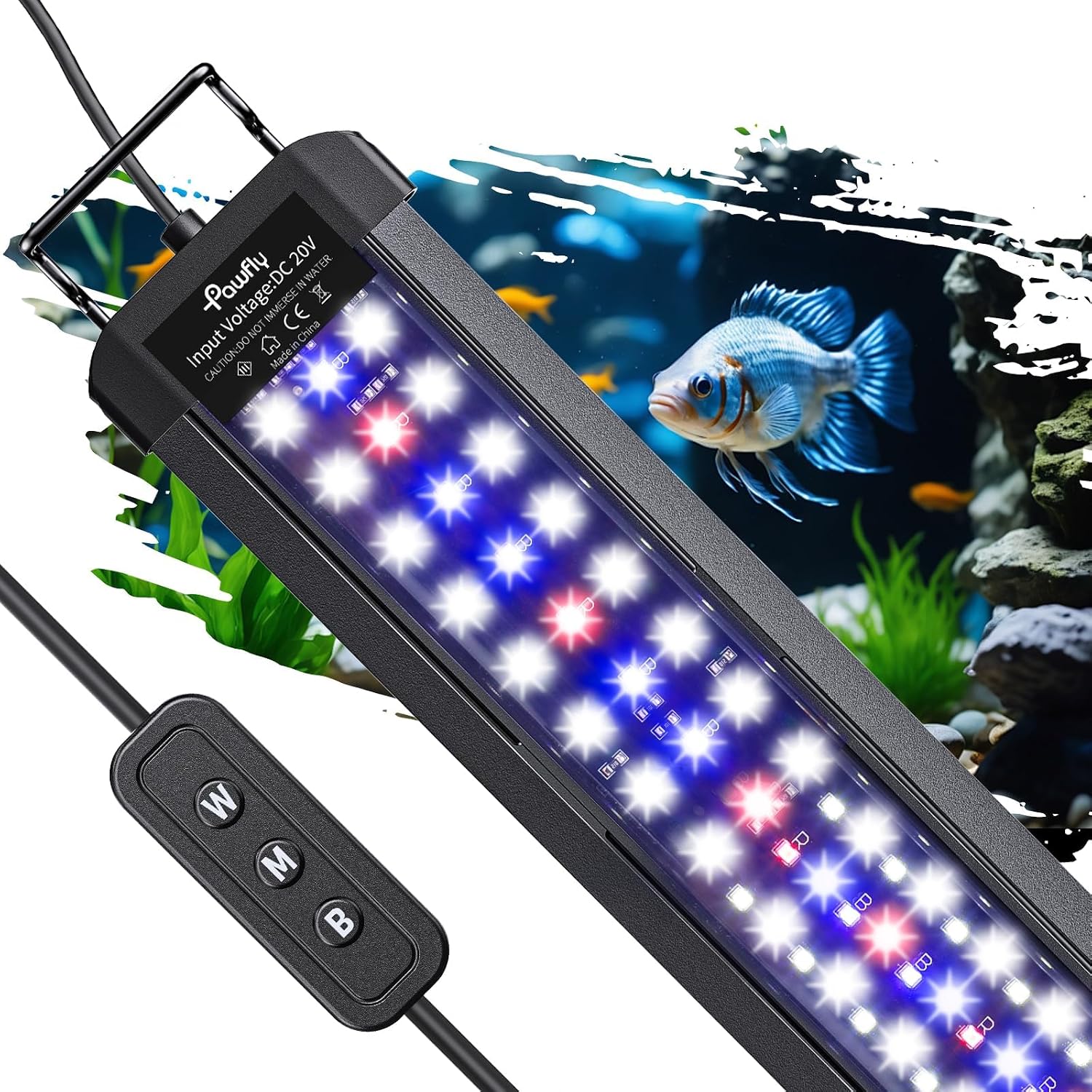
aquarium led lights
Fixture Types and What They Suit
Strip-style fixtures with adjustable legs are the most versatile format. They sit close to the water, spread light evenly across rectangular tanks, and are available from budget to premium tiers. The trade-off is that intensity at the substrate depends heavily on tank depth; a strip that produces strong PAR in a 12-inch-deep tank may be marginal at 24 inches. Manufacturers usually publish PAR figures at specific distances, and those figures are the most useful comparison point between models.
Pendant and puck-style lights concentrate output into a smaller area. They are typically mounted on a gooseneck arm or suspended over a cube or nano tank, creating a dramatic spotlight effect. Because the light is concentrated, a single pendant can deliver surprisingly high PAR at depth, but it covers a limited footprint. Long tanks generally need multiple pendants or a strip fixture instead. Pendants are popular for rimless aquascapes where the fixture itself is part of the display.
Built-in timers and automatic light cycles occupy a middle ground. Some fixtures include a fixed 24-hour program that transitions through sunrise, midday, sunset, and moonlight without any user setup. This is convenient for keepers who do not want to configure an app, but the schedule is not adjustable, which can be a limitation if your viewing hours do not match the factory program. Others include a simple sunrise and sunset ramp with a built-in timer, which covers the most important automation without adding complexity.
Representative Fixtures and Their Trade-Offs
Among programmable planted-tank fixtures, the Fluval Plant 3.0 is one of the most widely used. It provides full-spectrum RGB and white LEDs with Bluetooth app control, allowing a complete 24-hour cycle with adjustable brightness and color at each stage. Manufacturer specifications list PAR in the range of 80 to 100 at 12 inches and roughly 50 to 60 at 24 inches, which suits most medium-tech planted tanks. The housing carries an IP67 rating, meaning it is protected against temporary immersion. Trade-offs include limited Bluetooth range, an app that some owners describe as finicky during initial pairing, and output that may be insufficient for demanding high-tech setups in deep tanks.
The NICREW ClassicLED Plus occupies the budget end of the planted-tank market. It uses white and blue LEDs with dual-channel switches for daylight and moonlight, and it relies on an external outlet timer for automation. PAR is adequate for low-to-medium-light plants such as Java fern, Anubias, Amazon swords, and Cryptocoryne, but it will not drive demanding carpeting plants in a high-tech setup. The slim aluminum housing is attractive for the price, and the fixture is available in many lengths. The main limitations are the absence of onboard programming, no RGB color tuning, and plastic brackets that some owners report cracking over years of use.
The Chihiros WRGB II sits at the high-output end. It uses dense arrays of white, red, green, and blue LEDs with independent channel control and Bluetooth programming. Published specifications list PAR above 150 at 12 inches and around 80 at 24 inches, which is enough for CO2-injected tanks and demanding red plants. The ultra-thin aluminum profile and passive cooling fins suit rimless aquascapes. The trade-offs are price, limited availability compared with mass-market brands, and the fact that such high output requires balanced CO2 and nutrients; without them, the extra light tends to feed algae rather than plants.
The Current USA Satellite Freshwater LED Plus PRO emphasizes visual effects rather than maximum plant growth. It includes cloud cover simulations, lightning storm modes, gradual sunset transitions, and RGB color cycle presets, controlled by an infrared remote rather than an app. Dual ramp timers handle sunrise and sunset. PAR is adequate for low-light plants but not for demanding planted setups. The remote requires line of sight, and the storm effects are widely described by owners as a novelty used once or twice. For fish-only community tanks where the tank is a living-room centerpiece, the effect package is the main selling point.
The Finnex Planted+ 24/7 ALC takes a different approach: it runs a fixed automatic 24-hour cycle out of the box, transitioning through warm sunrise, bright midday, red evening, and blue moonlight without any programming. PAR in the 70 to 90 range at 12 inches suits medium-tech planted tanks. A separate remote mode allows manual control if the automatic cycle does not match your schedule. The limitations are that the automatic cycle is not customizable, there is no app, and the remote sensor has a narrow reception angle.
The Hygger Auto On/Off LED brings sunrise and sunset dimming to a very low price point. It includes a built-in timer with memory for brightness and color settings, and adjustable white, blue, and red channels. PAR is suitable for low-light plants only, and the sunrise and sunset ramps are shorter than those on premium fixtures, typically 15 to 30 minutes. Build quality reflects the price, with a plastic housing and basic controls, and warranty support runs through the seller rather than a dedicated service network.
The AI Prime Freshwater is a compact pendant designed for rimless cubes and nano aquascapes. It produces roughly 60 PAR at 24 inches from a puck-sized housing, mounted on an included gooseneck arm. Control is over Wi-Fi, which avoids the range limits of Bluetooth, and the app supports sunrise and sunset ramps, channel tuning, moonlight, and weather effects. The trade-offs are price, coverage limited to roughly an 18-to-24-inch square per unit, an industrial-looking mount, and a requirement for a 2.4GHz network during setup.
If you want to look at one concrete example of a programmable planted-tank fixture, you can check the current price on Amazon. For a budget-oriented alternative with a different feature set, you can also view this option on Amazon.
Comparison of Representative Fixtures
| Fixture type | Approx. PAR at 12 in | Programming | App | Typical size range | Best suited to |
|---|---|---|---|---|---|
| Programmable RGB planted strip | 80-100 | Full 24-hour cycle | Bluetooth | 15-48 in | Medium to high-tech planted tanks |
| Budget planted strip | 40-60 | External timer only | No | 11-48 in | Low-tech planted and quarantine tanks |
| High-output WRGB strip | 150+ | Full 24-hour cycle | Bluetooth | 30-120 cm | CO2-injected competition aquascapes |
| Effects-focused strip | 30-50 | Limited, remote based | No | 18-60 in | Fish-only community tanks |
| Automatic-cycle planted strip | 70-90 | Fixed 24-hour cycle | No | 20-48 in | Planted tanks with no setup desired |
| Budget auto-dimming strip | 30-45 | Sunrise and sunset only | No | 12-48 in | Betta, nano, and low-light tanks |
| Compact pendant | 60 at 24 in | Full 24-hour cycle | Wi-Fi | One 18 in square | Rimless cubes and nano aquascapes |
aquarium led lights
Lighting Schedules for Planted Tanks
A total photoperiod of six to eight hours at peak intensity is a common starting point. Longer periods tend to favor algae; shorter periods can starve plants. New tanks often begin at six hours and extend toward eight as the plant mass and biological filtration mature. The photoperiod should be continuous rather than split, unless you are deliberately running a siesta schedule to manage CO2 levels, which is a more advanced technique.
A sunrise ramp of 30 to 60 minutes brings the tank up gradually, which is easier on fish than an abrupt switch. Peak intensity then runs for four to six hours at the color mix that suits your plants and livestock. A sunset ramp of similar length brings the tank down. Some keepers add two to four hours of very dim blue moonlight for evening viewing, but complete darkness overnight supports natural rest cycles for fish. Running moonlight all night is generally discouraged for that reason.
Intensity should be matched to the tank's CO2 and nutrient supply. In a low-tech tank without injected CO2, running a high-output fixture at full power often produces algae rather than plant growth, because the plants cannot use the available light without sufficient carbon. Dimming the fixture, raising it, or adding floating plants to shade the surface are all practical ways to reduce effective intensity. In a high-tech tank with CO2 injection and regular fertilization, higher intensity becomes useful rather than problematic.
Common Problems and Practical Fixes
Algae after upgrading to a brighter light. Increasing PAR without adjusting CO2 and nutrients gives algae an advantage. Reducing the photoperiod to six hours, increasing CO2 if the tank is injected, and dosing a comprehensive fertilizer on a consistent schedule usually brings the tank back into balance within two to three weeks. The key is to change one variable at a time so you can see what worked.
Bluetooth pairing failures. Force-closing the app, confirming the fixture is powered on, and forgetting then re-pairing the device in the phone's Bluetooth settings resolves most issues. Staying within about 10 feet of the light during initial pairing helps, since some fixtures have weak antennas. Wi-Fi fixtures generally require a 2.4GHz network and will not connect to 5GHz-only routers.
Leggy, stretched plants. Long internodes and sparse leaves are the earliest sign that light is insufficient for the species being kept. The plants are growing toward the source. Options include upgrading the fixture, moving it closer to the water, or replacing demanding species with lower-light alternatives such as Anubias, Java fern, or mosses.
Fish hiding and plants melting after a lighting change. Reducing brightness to 60 or 70 percent through the app, or adding floating plants such as water lettuce, frogbit, or duckweed, gives livestock cover and naturally shades the tank. Floating plants act as a dimmer that the tank itself controls as they multiply or are removed.
Flicker at low dimming levels. Many budget fixtures use pulse-width modulation for dimming, which can produce visible flicker at low output. Some people and fish perceive it. Running the fixture at full brightness avoids the issue; otherwise, a fixture using constant-current dimming is the fix. This is one of the few specifications that separates budget and premium fixtures in daily use.
Sizing, Coverage, and Depth
Fixture length should roughly match tank length, but coverage depends on how the light spreads. A strip that matches the tank length with legs will cover the footprint evenly. A shorter strip leaves dark corners. Pendants cover a roughly circular area beneath them, so a 48-inch tank may need two or three pendants to avoid dim ends. Manufacturers usually publish coverage recommendations alongside PAR figures, and those recommendations are more reliable than guessing from wattage.
Tank depth is the other half of the equation. PAR falls off with distance, so a fixture rated at 100 PAR at 12 inches might deliver 50 at 24 inches and 30 at 30 inches. Deep tanks, generally those over 24 inches, benefit from higher-output fixtures or from mounting the light closer to the water. Shallow tanks, by contrast, can be over-lit easily; a fixture that seems modest on paper may be more than a shallow tank needs, and dimming becomes useful.
For fish-only tanks, coverage and appearance matter more than PAR. A fixture that spreads light evenly across the footprint and renders fish colors well is the right choice, and there is no need to pay for high-output plant lighting. For planted tanks, matching PAR at the substrate to the demands of the species being kept is the central decision, followed by programmability and mounting style.
Safety, Water Contact, and Long-Term Maintenance
Aquarium fixtures sit above open water, so splash and condensation resistance matter. An IP67 rating indicates protection against temporary immersion, which is relevant if a fixture is accidentally dropped into the tank during maintenance. Fixtures without a water-resistance rating should be mounted high enough that splashing from filters, bubblers, or fish cannot reach them. Any fixture that does get wet should be unplugged and dried before power is restored.
Heat management is generally less of a concern with LEDs than with fluorescent tubes, but high-output fixtures still produce heat at the emitter. Passive cooling fins and, in some models, fans keep emitter temperatures within specification. Blocking ventilation or mounting a fixture inside a closed canopy can shorten its life. Following the manufacturer's clearance recommendations is the simplest way to avoid premature failure.
Maintenance is minimal. Dust and mineral film on the lens or splash guard reduce output over time, so wiping the fixture with a damp cloth during water changes is worthwhile. LEDs are rated to maintain most of their output for five to ten years, and unlike fluorescent tubes they do not need scheduled replacement. Gradual dimming or a slight yellow shift after many years indicates the emitters are aging, but most aquarists replace the fixture for an upgrade long before that point.
Common Mistakes to Avoid
Buying light before deciding on plants is a frequent misstep. A high-output fixture on a low-tech tank without CO2 often produces algae, and a low-output fixture on a demanding aquascape produces leggy, pale plants. Choosing the plant list first, then matching PAR and photoperiod to it, avoids both problems.
Running the photoperiod too long is another common error. Eight to ten hours may seem reasonable for a display tank, but it gives algae more time to exploit any imbalance. Six to eight hours at peak intensity is usually sufficient, with the ramp periods adding a little viewing time at each end of the day.
Ignoring mounting height is a third mistake. A fixture mounted too low concentrates light in the center and leaves the ends dim, while one mounted too high spreads light but reduces intensity at the substrate. Adjusting height is one of the easiest ways to tune a tank after installation, and it costs nothing.
Finally, treating app connectivity as a measure of quality is misleading. A fixture with a polished app but inadequate PAR for the intended plants is still the wrong fixture. Specifications, published PAR figures, and coverage recommendations are the numbers that predict results; connectivity is a convenience feature.
Frequently Asked Questions
Can a household LED bulb or shop light work for an aquarium? For fish-only tanks, yes. A 6500K daylight LED in a clamp fixture will illuminate the tank adequately. For planted tanks, generally no. Household LEDs provide visible brightness but not the spectrum and intensity that plants use efficiently. Low-light plants such as Anubias and Java fern may tolerate a 6500K household LED, but anything more demanding needs a dedicated aquarium fixture.
How high above the water should the fixture be mounted? Leg-mounted fixtures typically sit zero to two inches above the water. Hanging fixtures are usually mounted 6 to 12 inches above for maximum intensity, or 12 to 18 inches for reduced intensity and better spread. Wider tanks need more height to cover the footprint, which lowers intensity at the substrate. Manufacturer recommendations are the best starting point, and height can be adjusted afterward to fine-tune algae and plant response.
Do LEDs need replacement like fluorescent bulbs? No. Fluorescent tubes lose a large share of their output within 6 to 12 months and need scheduled replacement. LEDs are rated to maintain most of their output for five to ten years. They do age gradually, and a fixture that looks dull after many years may be near the end of its useful life, but replacement is far less frequent than with fluorescent lighting.
Is moonlight necessary? No. Moonlight is a viewing convenience rather than a requirement. A very dim blue phase for two to four hours in the evening is fine, but running it all night interferes with natural rest cycles. Complete darkness overnight is the better default.
How do I know if my light is too strong? Persistent algae despite stable nutrients and CO2, fish hiding during the photoperiod, and plants that appear bleached or melting are common signs of excess intensity. Reducing brightness, raising the fixture, or shortening the photoperiod are the standard responses. Adding floating plants is a low-effort way to shade the tank naturally.
Where These Recommendations Come From
The guidance below is drawn from manufacturer specifications, published care references, and owner reports rather than hands-on laboratory measurement. For species-specific husbandry and health information, the Merck Veterinary Manual section on exotic and laboratory animals is a useful reference. For aquaculture and fish health topics, the UF/IFAS Extension EDIS publications cover water quality, disease, and system design. For general companion animal care, the ASPCA pet care library provides species-level summaries.
Putting It Together
Match the fixture to the tank before matching it to a brand. Decide whether the tank is fish-only, low-tech planted, or high-tech planted, then choose a PAR level and coverage pattern that fits. For fish-only tanks, appearance and even spread matter more than output. For low-tech planted tanks, a budget strip with adequate PAR and an external timer is often enough. For high-tech CO2-injected aquascapes, a high-output programmable fixture with independent color channels is the right tool, provided CO2 and fertilization are also in place.
Programmability is a convenience, not a requirement. A simple timer can run a budget fixture effectively, and a sunrise and sunset ramp is a nice-to-have rather than a necessity. Water resistance, mounting style, and coverage are the specifications that determine whether a fixture works in a given setup; app features determine how pleasant it is to live with.
Once the fixture is installed, run six to eight hours at peak intensity, use a ramp if the fixture supports it, and adjust height or brightness if algae or plant stretching appears. The right LED does not need to be the most expensive one; it needs to deliver the PAR and coverage the tank actually requires, with a mounting style that fits the space and a price that fits the budget.
If you want to examine one programmable planted-tank option in more detail, you can check the current price on Amazon. A budget-friendly alternative with a simpler feature set is also available if you view this option on Amazon.
As an Amazon Associate, PawCritic earns from qualifying purchases. This does not affect our reviews or recommendations.