Why Water Flow Is the Most Overlooked Part of Aquarium Health
Ask experienced aquarists what separates a merely decorative tank from a genuinely thriving ecosystem, and water flow usually comes up before lighting or filtration. Good circulation does four things at once: it delivers dissolved oxygen to every corner of the tank, including the lower third where many fish rest at night; it sweeps detritus off the substrate and toward the filter intake, preventing the anaerobic dead spots where decomposing waste can produce toxic hydrogen sulfide gas; it distributes heat evenly, eliminating the temperature gradient that commonly develops between the heater and the far corner of a large tank; and in planted aquariums it carries dissolved CO2 to every leaf, which is often the difference between plants that pearl with oxygen bubbles and stems that slowly stall. Veterinary references on aquarium fish husbandry, such as the Merck Veterinary Manual's exotic and laboratory animals section, consistently emphasize water quality and oxygenation as foundational to fish health, and circulation underpins both.
A powerhead is simply a submersible pump that moves water: no filtration media, just flow. A wave maker is a powerhead paired with a controller that pulses, ramps, or alternates output to mimic natural wave-like water movement, which reef corals and many riverine fish respond to instinctively. In freshwater tanks, a powerhead creates a gentle river-like current that resembles the natural habitats of tetras, danios, barbs, and loaches. In marine and reef tanks, dedicated flow equipment is effectively mandatory. Corals do not have lungs or gills that actively pump water; they rely almost entirely on ambient current to bring food, oxygen, and dissolved calcium to their polyps and to carry metabolic waste away. Guidance published by UF/IFAS Extension on aquaculture and fish health covers similar principles in farmed systems, where inadequate circulation is a well-documented contributor to poor dissolved oxygen and disease risk.
This guide walks through how to choose a powerhead or wave maker for your tank type, size, and budget: how to calculate the flow rate you actually need, what design differences matter, how to position the pump, and which trade-offs come with budget versus premium equipment. Rather than a ranked roundup, this is a buying framework, illustrated with one widely available circulation pump you can look at on Amazon as a concrete example of the category.
Understanding Flow Rate and Tank Turnover
The single most useful number in powerhead shopping is turnover rate: how many times per hour the pump moves the entire water volume of your tank. Divide the pump's rated gallons per hour (GPH) by your tank's actual water volume, remembering that substrate, rock, and displacement typically reduce nominal volume by ten to fifteen percent. A 500 GPH powerhead in a 50-gallon tank produces roughly ten times turnover. Different biotopes want different targets, and matching the target to your livestock is more important than buying the biggest pump available.
- Freshwater community tank: 5 to 10 times turnover. Gentle flow that moves water without blasting fish against the glass. A 55-gallon community tank needs roughly 275 to 550 GPH of total circulation.
- High-tech planted tank with CO2 injection: 10 to 15 times turnover, with flow aimed along the surface or across the mid-water column rather than at the substrate, so plants are not uprooted while CO2 is distributed evenly.
- Reef tank with soft corals and LPS: 20 to 30 times turnover. Torch corals, hammer corals, and frogspawn want moderate, irregular flow that makes their tentacles sway gently rather than whip constantly.
- Reef tank dominated by SPS corals: 40 to 60 times turnover. Acropora and similar branching corals need chaotic, high-energy flow to deliver calcium and alkalinity and to strip waste from dense colony interiors.
- Riverine biotope: 15 to 25 times turnover, ideally directional and unidirectional, simulating a stream for hillstream loaches, white cloud mountain minnows, and similar current-loving species.
Two caveats about manufacturer GPH ratings are worth knowing. First, ratings are usually given at zero head, meaning free flow with no restriction; a pump aimed through dense rockwork or fitted with a sponge pre-filter will move meaningfully less water. Second, flow decays quickly with distance, so a pump rated at 800 GPH may produce only a gentle breeze two feet away. This is why placement and pump count often matter more than the number on the box.
What to Look For When Buying a Powerhead or Wave Maker
aquarium powerheads wave makers
Motor Placement: Internal Versus External
Most powerheads place the motor inside the tank, fully submersed. This is simple and inexpensive, but it adds a small amount of heat to the water, places an electrical cord and seal inside the aquarium, and takes up visual space. A minority of premium designs split the motor from the impeller: the motor sits outside the glass, magnetically coupled to the wet-side propeller inside. This eliminates cords in the water, transfers essentially no motor heat to the aquarium, and shrinks the in-tank footprint to just a small propeller housing. For temperature-sensitive species and nano tanks, where even a few watts of continuous heat input matters, external-motor designs have a real advantage. For most freshwater community tanks, the heat from a modern submersible pump, typically three to fifteen watts, is negligible.
Controllability: Constant Flow Versus Wave Modes
Constant-flow powerheads are plug-in-and-go: single speed, no programming, no modes. They suit freshwater community tanks, quarantine setups, and anyone who wants reliable circulation without a learning curve. Controllable wave makers add a controller with modes such as constant, pulse, wave, random or tidal simulation, and a feed mode that pauses the pump for ten minutes so food is not blasted around before fish can eat it. Feed mode is genuinely useful in reef tanks, where pelleted and frozen foods otherwise end up in the overflow within seconds. Some mid-range and premium pumps also expose a 0-10V port or wireless protocol for integration with aquarium controllers such as Apex or ReefKeeper, which allows flow schedules tied to lighting cycles. That integration only pays off if you already own or plan to buy a controller, typically a two-hundred-dollar-plus accessory; otherwise the port sits unused.
Mounting and Adjustability
Mounting systems fall into three broad types. Suction cups are the cheapest and work fine on clean glass, but they age, harden, and lose grip within one to two years, and a detached pump falling into the substrate creates a mess and a hazard. Magnetic mounts are the practical standard for anything beyond entry level: a magnet inside the tank pairs with one outside, holding firmly on glass up to roughly three-eighths to half an inch thick depending on the model, and they allow the pump's angle to be re-aimed by rotating the external magnet without disturbing anything inside. Always check the rated maximum glass thickness before buying, because thicker acrylic or glass on larger tanks exceeds the rating of many consumer magnets. Cross-flow pumps, which use a long oscillating blade rather than a small propeller, distribute a wide sheet of gentle flow well suited to long tanks.
Fish Safety and Intake Design
Any submersible pump is an intake, and small fish, shrimp, snails, and anemones can be injured or trapped against an exposed impeller. Look for pumps whose impeller sits behind a slotted or fenced housing with openings too narrow for your smallest livestock. Several established manufacturers enclose the impeller in a cage specifically for this reason. If you keep nano fish or shrimp with an older or budget pump that lacks adequate guarding, the standard owner-reported fix is wrapping the intake in a fine filter sponge, which also acts as a crude pre-filter but reduces flow somewhat and requires periodic rinsing.
Noise
Pump noise comes from three sources: impeller or bearing rattle, motor hum transmitted through the glass and stand, and water turbulence itself. Premium pumps use balanced magnetic rotors and tighter tolerances to minimize the first two, and owner reviews consistently describe certain Italian- and American-made pumps as effectively silent at moderate speeds, audible mainly as water movement. Budget pumps frequently develop audible hum or rattle, sometimes within months. If the tank sits in a bedroom or living room, read recent owner reviews specifically for noise complaints at the flow setting you intend to run, because noise that is tolerable at fifty percent can be annoying at full output.
Durability and Service Life
Expectations should scale with price. Owner reports on entry-level pumps commonly describe one to three years of service before bearing noise, seal wear, or mount failure ends the useful life. Mid-range pumps from established brands often run three to five years, and premium external-motor designs are frequently reported to last five to eight years or more, with replacement parts available. In reef tanks, the main maintenance task on any wet-side assembly is removing calcium carbonate deposits; the standard practice is periodic soaking of the impeller housing in diluted white vinegar, typically every two to three months, followed by a thorough freshwater rinse. Budget pumps with sealed, non-serviceable units simply get replaced instead.
Categories of Flow Equipment and Who Each Suits
Rather than ranking specific models, it is more useful to understand the four categories every product on the market falls into, because the category determines most of your experience.
Premium Controllable Wave Makers (Roughly $300 and Up)
At the top of the market sit external-motor wave makers with seven or more flow modes, wireless synchronization between multiple units, and flow ranges spanning roughly 200 to 4,500 GPH depending on size. These suit serious reef keepers, especially SPS-dominated systems between about ten and two hundred gallons, where coordinated multi-pump chaotic flow directly affects coral growth and coloration. The trade-offs are price, typically three hundred to five hundred dollars per pump with large tanks needing two, and a controller interface that takes practice to learn. A documented caution applies to wave modes generally: a standing wave applies oscillating pressure to tank seams, so any tank with questionable silicone integrity, such as old, used, or cheaply built aquariums, should not run resonant wave settings.
Budget Controllable Wave Makers (Roughly $50 to $120)
Several manufacturers offer fully submersible propeller or cross-flow pumps with wired controllers offering five or so modes, adjustable speed, LED status displays, and feed mode, at twenty to twenty-five percent of premium pricing. Sizes typically span from around 530 GPH for nano tanks up to 5,300 GPH for very large systems. These suit entry-level reef tanks, planted tanks wanting programmable flow, and budget-conscious hobbyists. The honest trade-offs: the motor sits in the water, adding a few watts of heat that matters mainly in nano tanks; there is a cord through the tank wall; the controller is wired rather than wireless; and quality control is inconsistent, with owner reviews reporting occasional units that arrive faulty or develop noisy bearings within six months. Buying through a retailer with a straightforward return policy is the practical protection.
Simple Constant-Flow Circulation Pumps (Roughly $25 to $85)
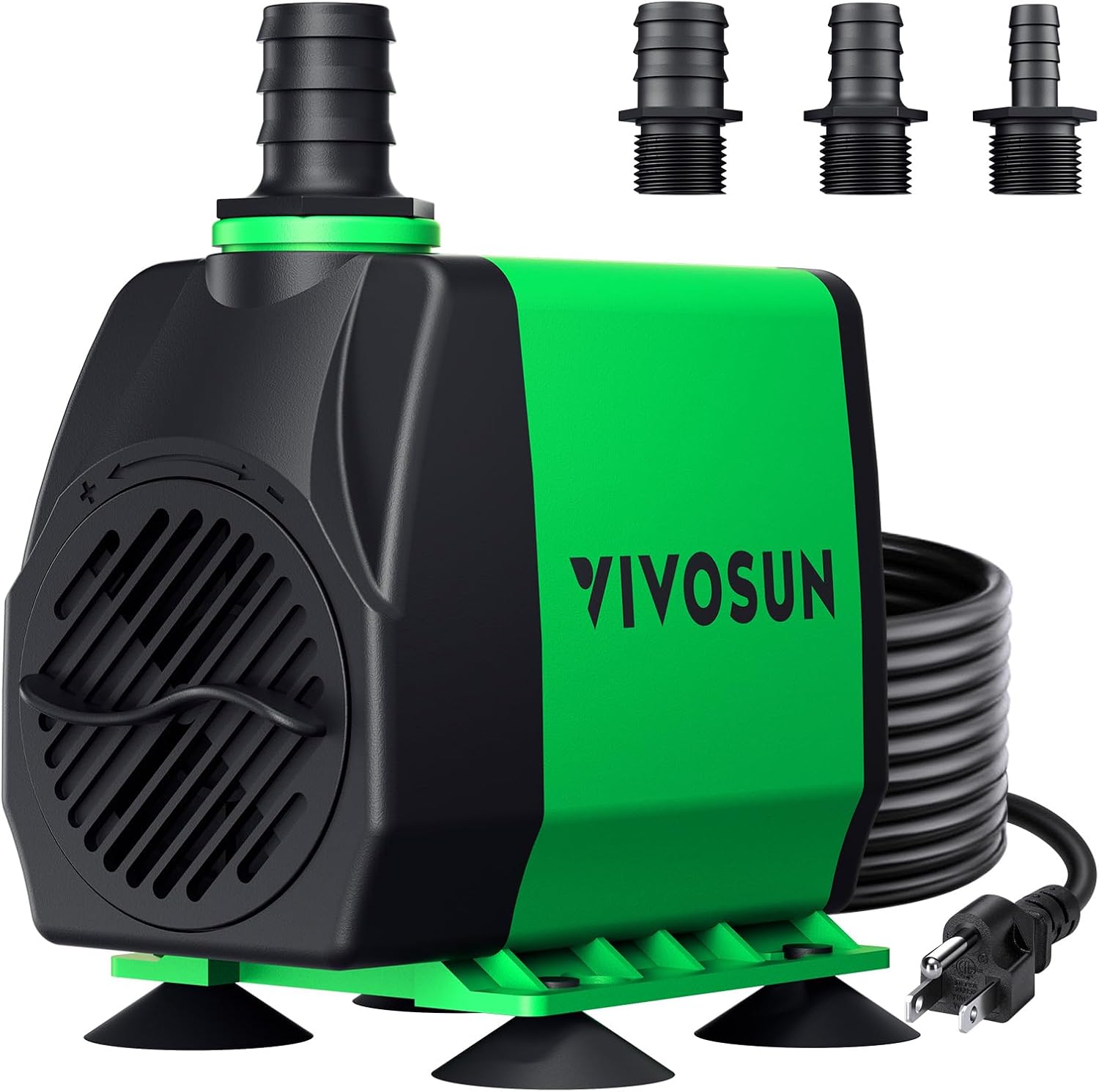
This is the workhorse category and the right choice for most freshwater keepers. These are submersible pumps with no controller, no modes, and no programming: plug in, adjust the aim, done. Established designs in this category have been sold for two decades or more with incremental refinements, and owner feedback describes them as reliably boring in the best sense. Look for a magnetic mount that allows re-aiming by rotating the external magnet, an enclosed fish-safe impeller housing, low power draw in the three-to-twelve-watt range, and a size range matching your turnover target, typically spanning about 240 GPH to 1,500 GPH across a brand's lineup. Within this category, quieter premium versions trade a higher price for magnet-rotor designs that minimize hum, wide cone-shaped flow patterns rather than narrow jets, and stronger mounts rated for thicker glass. One widely available example of the category, a magnetic-mount circulation pump with a guarded impeller and a long track record of owner-reported reliability, is the check the current price on Amazon listing; it is worth examining as a baseline even if you ultimately choose a different size or brand. The trade-off across the whole category is fixed output: if you later need slower or pulsed flow, you need a timer or a different pump.
Ultra-Budget Pumps (Under $20)
Ten-to-fifteen-dollar circulation pumps with mechanical flow dials and suction-cup mounts exist and do move water. They suit quarantine tanks, saltwater-mixing buckets, sump stirring, and temporary setups where the stakes are low and the budget is lower. The trade-offs are significant: audible impeller hum and occasional rattle, suction cups that owner reports say fail within six to twelve months, imprecise mechanical flow adjustment, and intake slots large enough to catch small fish or shrimp unless you add a sponge guard. For a display tank you care about, spending two to three times more for a magnetic mount and guarded impeller is almost always the better economics over even a couple of years.
Comparison of Categories
| Category | Typical Flow (GPH) | Flow Modes | Motor Location | Typical Price | Best For |
|---|---|---|---|---|---|
| Premium controllable wave maker | 200-4,500 | 7+, wireless sync | External (dry side) | $300-480 | Reef tanks, SPS systems, multi-pump setups |
| Budget controllable wave maker | 530-5,300 | 5, with feed mode | Internal (submersible) | $50-120 | Entry reef, planted tanks, programmable flow |
| Constant circulation pump | 240-3,300 | Constant only | Internal (submersible) | $25-85 | Freshwater community tanks, simple reliable flow |
| Ultra-budget pump | 530-800 | Constant, dial adjust | Internal (submersible) | $10-15 | Quarantine, mixing, temporary setups |
How to Position a Powerhead for Optimal Flow
Placement matters as much as purchase. A well-chosen pump aimed poorly will underperform a cheaper pump aimed well, and most flow problems reported by hobbyists are placement problems in disguise.
Surface agitation is mandatory. Aim the powerhead slightly upward so the flow breaks the water surface. The rippling surface is where gas exchange happens: oxygen enters, CO2 exits. A tank with a dead-flat surface has essentially no passive gas exchange beyond filter splash. In CO2-injected planted tanks, reduce surface agitation somewhat to retain injected carbon, but never eliminate it entirely, because fish still need oxygen, particularly at night when plants respire.
Create a circular gyre. Mount the pump on one side, aimed across the tank toward the opposite glass. The flow strikes the far wall, deflects downward and back along the substrate, and returns to the pump, sweeping the entire water column in a loop. This is far more effective than pointing a pump at a random mid-tank angle, where flow dissipates without circulating anything.
Do not blast corals or delicate plants directly. Sustained direct flow on a coral causes tissue recession at the impact point; coral polyps retract and the colony dies back in that spot. Direct flow on delicate plants such as vallisneria and cabomba flattens them against the substrate and tears leaves. Aim above, below, or around sensitive organisms, never straight at them.
Prefer multiple smaller pumps over one large one. Two moderate pumps on opposite sides creating converging, chaotic flow are healthier for the ecosystem than a single big pump producing a uniform swirl, and multiple pumps provide redundancy: if one fails, the other maintains circulation until you notice and replace it. That redundancy matters most in reef tanks, where even a few hours of zero flow stresses sessile invertebrates.
Hunt dead spots deliberately. Every tank has zones behind rockwork, under driftwood, and in lower back corners where flow does not reach. Detritus accumulates there, oxygen depletes, and in severe cases anaerobic pockets form. Identify dead spots simply by watching where debris settles and stays put, then re-aim the pump or add a small secondary pump dedicated to that zone.
Common Mistakes to Avoid
The most common mistake is overdoing flow for the livestock kept. Signs of excessive current include fish pinned against the far wall, fish swimming constantly just to hold position, fish hiding behind rocks and refusing to emerge, delicate plants flattened against the substrate, and substrate pushed into drifts exposing bare glass. Remedies include reducing pump speed if adjustable, adding a flow diffuser or nozzle spreader, aiming the pump toward the surface, or switching to a smaller unit. Note that riverine species such as hillstream loaches, danios, and white cloud minnows actively enjoy strong current and will swim into it, while broad-finned community species such as gouramis, angelfish, and bettas are stressed by the same flow, so the right setting is species-dependent, not universal. General husbandry guidance from sources like the ASPCA pet care library reinforces the principle that environment should be matched to the specific animals kept.
Other frequent errors: ignoring glass-thickness ratings and buying a magnet that cannot grip; skipping the vinegar soak until calcium deposits seize the impeller; running a single pump where two smaller ones would cover the tank evenly; and assuming the filter outflow provides adequate circulation in medium and large tanks. Filter flow is designed for media contact time, not tank-wide turnover, and no hang-on-back filter provides enough circulation for a reef ecosystem or a large display tank.
Frequently Asked Questions
Do I need a powerhead if my filter already moves water?
For tanks under about twenty gallons, usually not; filter outflow generally provides adequate circulation. For twenty-to-fifty-five-gallon tanks, it depends on filter GPH and stocking: a canister rated at 300 GPH on a 55-gallon tank gives roughly five times turnover, adequate for a lightly stocked community tank but not for heavily stocked cichlid tanks or CO2-injected planted tanks. For large tanks and all reef tanks, dedicated circulation pumps are needed.
Can I use a wave maker in a freshwater planted tank?
Yes, choosing a gentle mode and lower speed. Random or lagoon-style modes provide broad, gentle circulation that distributes nutrients and CO2 without creating hurricane conditions. Avoid pulse and wave modes in planted tanks, because back-and-forth oscillation uproots stem plants and tears delicate leaves. Cross-flow pump designs suit planted tanks well because their wide flow sheet covers a large area at low velocity.
Where to Look and Final Thoughts
aquarium powerheads wave makers
If you want a concrete starting point in the constant-flow category, you can view this option on Amazon and compare its rated GPH, mount type, and owner feedback against the turnover target you calculated earlier. If your needs point toward programmable flow instead, the same checklist applies to controllable models at whatever price tier fits your budget; you can also check the current price on Amazon for the example pump to calibrate what a reliable mid-tier option should cost before you shop elsewhere.
The broader takeaway: flow is what makes an aquarium an ecosystem rather than a box of standing water. Without circulation, oxygen does not reach sleeping fish in the lower water column, detritus rots into toxic anaerobic pockets, injected CO2 never reaches plant leaves, and corals slowly starve. Choose your turnover target based on livestock, buy the mount quality your tank deserves, position for surface agitation and a full-tank gyre, and maintain the impeller on a schedule. A correctly specified and positioned powerhead, at any price tier, is the quiet engine that keeps every living thing in the tank alive.
Affiliate Disclosure: PawCritic.com participates in the Amazon Services LLC Associates Program. We may earn commissions from qualifying purchases at no extra cost to you.