Automatic Cat Feeders: A Research-Based Buying Guide
An automatic cat feeder is a programmable device that dispenses a set amount of dry food, and sometimes wet food, at times you choose. The appeal is straightforward: it separates the act of feeding from the person doing the feeding, which matters for households where someone works long shifts, travels overnight, or simply wants to stop being woken at 4:30 in the morning. It also lets you control portions precisely, which is the part veterinarians tend to care about most.
This guide covers how these devices actually work, what the published guidance says about feeding schedules and portion control, which specifications separate a reliable unit from a frustrating one, and the failure modes owners report most often. There is one concrete product example linked below for readers who want to see a representative model, but the information here applies to the category as a whole.
Why Scheduled Feeding Matters
Free-feeding, where a bowl is simply kept full, works for some cats and fails badly for others. Cats evolved as small, frequent hunters, and many self-regulate reasonably well. But indoor cats with limited activity are prone to gradual weight gain, and the Cornell Feline Health Center identifies measured, scheduled meals as a foundational step in weight management for cats. A feeder that dispenses a fixed portion at a fixed time removes the guesswork and the negotiation.
There is a behavioral argument as well. Cats are crepuscular, most active around dawn and dusk, and a cat that associates a human with breakfast will begin campaigning well before sunrise. When the food arrives from a machine on a timer instead, the association weakens over time. Owners who make this switch consistently report that the early-morning vocalizing decreases, though it usually takes a week or two and rarely disappears entirely.
Scheduled feeding also has a medical dimension. Cats with diabetes, hyperthyroidism, or a history of urinary blockages are frequently placed on prescription diets with strict timing. The Merck Veterinary Manual cat owner reference notes that consistency in feeding supports management of several common feline conditions. A feeder cannot replace veterinary direction, but it can make compliance easier when a cat needs food at specific intervals.
Types of Automatic Feeders
Automatic feeders fall into three broad categories, and the category matters more than any single specification.
Gravity feeders are the simplest design: a hopper that drops kibble into a bowl as the bowl empties. They have no electronics, no timer, and no portion control. They are cheap and nearly indestructible, but they encourage free-feeding and offer no scheduling benefit. For a single cat that self-regulates, they are adequate. For a household trying to control weight, they defeat the purpose.
Programmable portion feeders use a motor, an auger or rotating drum, and a digital timer. You set the number of meals per day and the portion size in fractions of a cup or in grams. These are the workhorse category and cover most of the price range from roughly twenty dollars to well over a hundred. The differences within this category come down to portion accuracy, hopper sealing, power backup, and how easy the parts are to clean.
Microchip and RFID feeders are a specialized design. They read a cat's implanted microchip or an included collar tag and open only for that specific animal. They exist to solve one problem: a multi-cat household where one cat is on a prescription diet or a restricted calorie plan and the others are not. They are the most expensive category and the most mechanically complex, which means more to go wrong, but for the household they serve there is no real substitute.
What to Look For
Portion Accuracy and Range
Portion size is usually expressed in cups or in milliliters per dispense, and the range matters more than the label. A feeder that dispenses in one-eighth-cup increments gives you finer control than one that only offers quarter-cup steps. A typical adult cat eats roughly a quarter to a third of a cup of dry food per meal depending on the food's calorie density, so a feeder whose smallest portion is half a cup is effectively useless for weight management.
Accuracy is a separate question from range. Kibble varies in size and density between brands, and a feeder calibrated for one kibble shape may dispense slightly more or less with another. Published owner reports frequently mention this, and it is worth measuring the dispensed amount yourself with a kitchen scale for the first few days after switching foods. Manufacturers typically note in the manual that portion accuracy depends on kibble size.
Power and Backup
Almost all programmable feeders run on household current with battery backup, or on batteries alone. Battery-only models are simpler and can be placed anywhere, but they need consistent battery changes and lose their schedule when the batteries die. Plug-in models with battery backup are the more reliable arrangement because the schedule survives a power outage. Check whether the backup uses common AA cells or a proprietary battery pack, and check whether the feeder retains its programmed schedule after a full power loss or resets to default.
Hopper Capacity and Sealing
Hopper capacity ranges from about two cups to more than twenty. A larger hopper means less frequent refilling, but it also means food sits exposed to air for longer. Dry cat food oxidizes and loses palatability over time, and the AAFCO pet food standards framework treats freshness and proper storage as part of nutritional adequacy. A hopper that seals with a gasket keeps kibble fresher than an open-top design, and for a single cat a four-to-six cup hopper is usually a better choice than a twenty-cup bin that takes a month to empty.
Dispensing Mechanism
Two mechanisms dominate. Auger-style feeders use a rotating screw to push kibble out; they handle a wide range of kibble sizes but can jam if a piece is irregular or if the hopper is overfilled. Drum or rotor feeders use a rotating chamber that drops a fixed volume; they are less prone to jamming but are more sensitive to kibble size and may not work with very large or very small pieces.
Neither design is universally better. The practical advice is to check the manufacturer's stated kibble size range and compare it to the food you actually feed. Owners who report jamming most often are using a kibble outside the feeder's stated range.
Wet Food Handling
Most automatic feeders handle dry food only. Wet food requires a different design, usually a rotating carousel with sealed compartments and, in some models, a gel ice pack to slow spoilage. These are limited to a few meals and cannot be left out indefinitely. If your cat eats wet food, look for a feeder with removable, dishwasher-safe trays and a lid that seals each compartment. Do not expect a dry-food hopper to work with wet food; it will clog and the food will spoil.
Cleaning and Disassembly
Food contact surfaces need regular cleaning, and a feeder that cannot be fully disassembled will accumulate grease and stale crumbs in places you cannot reach. Look for a hopper that lifts out, a bowl that removes without tools, and parts that are top-rack dishwasher safe. Feeders with narrow auger chutes are the hardest to clean thoroughly, and owners frequently report that these develop odors over time.
Connectivity and App Control
Wi-Fi feeders add app scheduling, notifications when a meal dispenses, and sometimes a camera or a microphone for voice recording. These features are genuinely useful for travel, but they introduce dependencies: the app, the server, the home network, and the feeder's firmware all have to work. A feeder that requires the cloud to dispense a meal is a feeder that stops working when the internet does. The most reliable designs store the schedule locally on the device and use the app only for configuration and monitoring.
Build and Stability
A feeder needs to stay upright when a determined cat pushes against it. Wide bases, rubber feet, and a low center of gravity all help. Weight matters too, both the unit's own weight and how top-heavy it becomes when the hopper is full. Owners of large cats report that lightweight feeders get tipped or dragged, and a tipped hopper can dump an entire day's food at once.
Locking Lids and Tamper Resistance
Cats are capable of learning to paw open a hopper lid, and once one learns, the feeder becomes a self-service buffet. Newer models increasingly include locking lids or latches. If you have a food-motivated cat, a locking lid is worth prioritizing over app features. This is one of the most frequently cited shortcomings in owner reviews of older feeder designs.
A Representative Option
For readers who want to see a concrete example of the category, one widely available programmable feeder is linked here. It is a portion-control dry food dispenser with a programmable timer, and it illustrates the feature set described above. As with any model, the useful step is to compare its stated portion range, hopper capacity, power arrangement, and kibble size limits against your own cat's needs before buying.
check the current price on Amazon
Treat that link as a starting point rather than a verdict. The specifications that matter are printed on the product page and in the manual, and the owner reviews that describe multi-month use are more informative than the star average.
Multi-Cat Households
Feeding multiple cats from one automatic feeder is usually a mistake. Cats will sort out a hierarchy, and the dominant cat will eat first and eat more. If one cat is on a prescription diet, a shared feeder makes the diet meaningless. The options are separate feeders in separate rooms, a microchip feeder that opens only for the intended cat, or a return to supervised meals.
Microchip feeders solve the problem well but have their own quirks. The cat has to be trained to use it, the microchip has to be positioned correctly, and the lid mechanism adds a moving part that can fail. Owners report that most cats adapt within a few days, but a nervous cat may refuse the enclosed design. Some models include a collar tag as an alternative to the implanted chip, which is useful for cats that are not chipped.
Safety and Health Considerations
A feeder is not a substitute for supervision when a cat has a medical condition. Cats with diabetes need insulin timed to meals, and a feeder that dispenses at the wrong moment or fails to dispense at all can create a dangerous mismatch. Any cat on a medicated feeding schedule should have a backup plan, whether that is a second person, a second feeder, or a manual meal.
Food storage also matters. Kibble left in a hopper for weeks can go stale, and in humid climates it can grow mold. The ASPCA Animal Poison Control publishes guidance on household hazards, and spoiled food is a recurring cause of gastrointestinal upset in pets. Empty and wash the hopper on a schedule, and do not top off old kibble with new.
Batteries are a lesser but real hazard. Some cats will chew on power cords, and some feeders use small batteries that could be swallowed if the compartment is not secured. Route cords out of reach and check battery covers periodically.
Maintenance
A weekly routine keeps most feeders working. Empty the hopper, wash it with warm water and a mild dish soap, and let it dry completely before refilling. Wipe the dispensing chute with a damp cloth, since fine crumbs and oils collect there. Check the bowl for scratches, which harbor bacteria, and replace it if the surface is degraded.
Monthly, inspect the motor area and the seals. Listen to the feeder dispense; a change in sound often precedes a jam or a failing motor. Test the battery backup by unplugging the unit briefly and confirming that the schedule is retained. If the feeder has an app, check for firmware updates, since manufacturers sometimes fix dispensing bugs after release.
Replace batteries on a fixed schedule rather than waiting for a low-battery warning. A feeder that dies overnight leaves a cat without breakfast and, more importantly, breaks the schedule you spent weeks establishing.
Common Mistakes
The most common mistake is buying a feeder with a portion range that is too coarse. A feeder whose minimum portion is half a cup cannot help a cat that needs a quarter cup per meal. Read the portion specifications before anything else.
The second is ignoring kibble size. A feeder rated for kibble between five and fifteen millimeters will jam on a larger piece, and the jam usually happens at the worst possible time. Match the feeder to the food.
The third is trusting the app over the device. Cloud-dependent feeders fail when the network fails. Prefer a feeder that keeps its schedule locally and uses the app as a convenience rather than a requirement.
The fourth is skipping the transition period. A cat that has never eaten from a machine may be suspicious of it. Set the feeder up empty, let the cat investigate, then run it with a few treats before relying on it for a full meal. Owners who skip this step sometimes find the feeder untouched and the cat hungry.
Frequently Asked Questions
Can an automatic feeder be used for wet food?
Only with a feeder designed for it. Dry-food hoppers clog and spoil wet food. Wet-food feeders use sealed rotating compartments, often with a gel ice pack, and hold only a few meals. They need daily cleaning.
What happens during a power outage?
It depends on the design. A feeder with battery backup keeps its schedule and dispenses normally. A plug-in feeder without backup stops until power returns. Check whether the schedule is retained after a full power loss, since some models reset to default.
How accurate are the portion sizes?
Accuracy varies with kibble size and shape. Manufacturers state a range, and the actual dispensed amount can drift outside it with an unfamiliar food. Weigh the dispensed portion for the first few days after any food change.
Can I use one feeder for two cats?
It is possible but usually unwise. One cat will eat more than the other, and any prescription diet becomes unenforceable. Separate feeders or a microchip feeder are the better options.
How often should the feeder be cleaned?
Empty and wash the hopper weekly, wipe the chute at the same time, and do a deeper inspection monthly. Replace the bowl if it becomes scratched. Follow the manufacturer's cleaning instructions to avoid damaging seals or electronics.
Do automatic feeders work for kittens?
They can, but kittens need more frequent meals and often free access to food during growth. A feeder with small portions and multiple daily meals can work, but check with a veterinarian on the appropriate schedule and amount for the kitten's age.
Where to Buy
As an Amazon Associate, PawCritic earns from qualifying purchases. This does not affect our reviews or recommendations.
The feeder referenced above is available through Amazon, and the product page lists the current specifications, portion range, and owner reviews. Compare those details against the checklist below before ordering.
If you are shopping for a specific cat, write down the answers to four questions first: how much does the cat eat per meal, what kibble size do you feed, is the cat on a prescription diet, and does the household have more than one cat. Those four answers eliminate most of the market immediately and make the remaining choice much simpler.
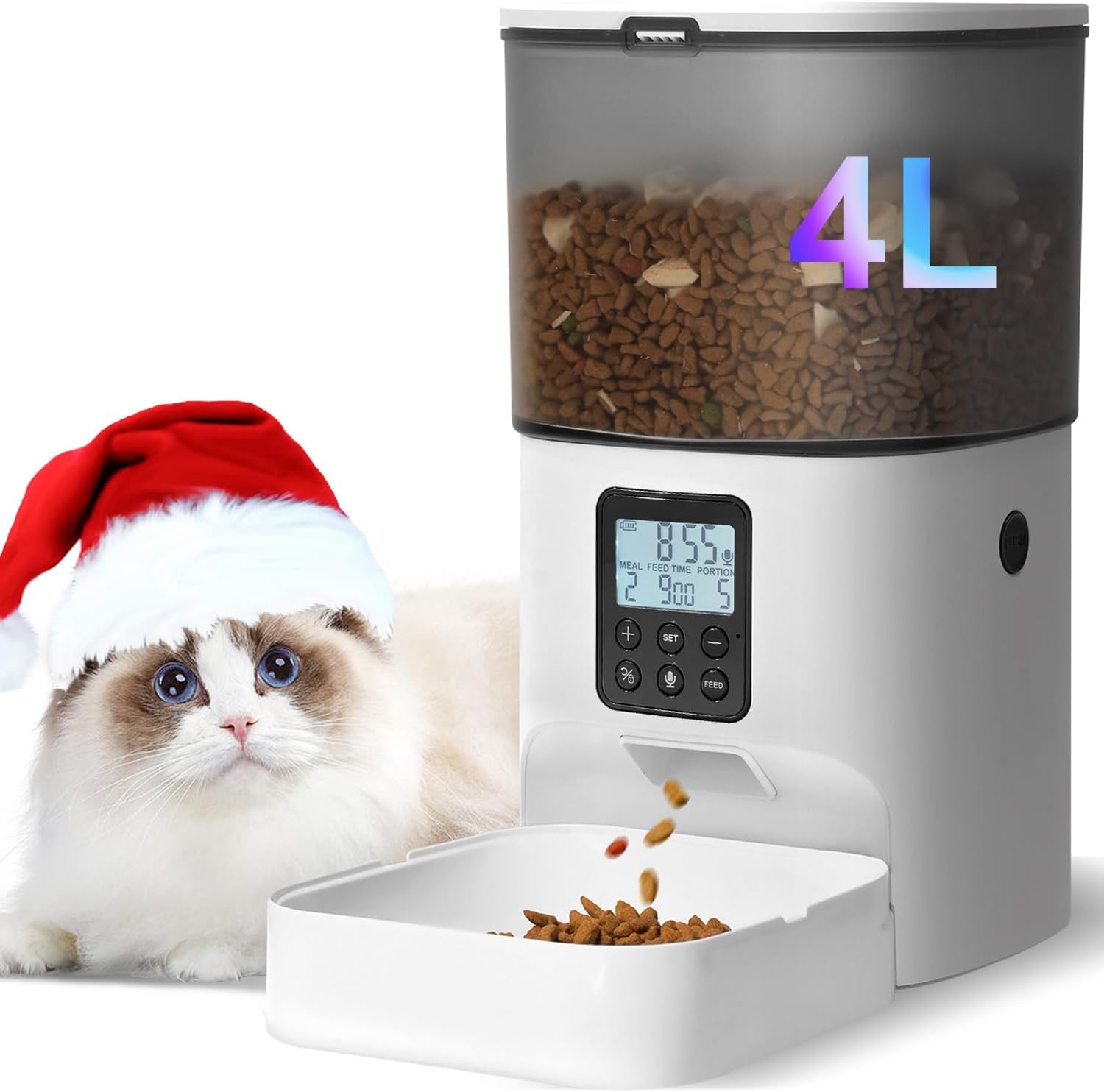
automatic cat feeder smart feeding solutions
A final note on expectations. An automatic feeder changes when food appears, not how much a cat wants to eat. It will not stop a determined cat from asking for more, and it will not fix a weight problem on its own. What it does reliably is deliver a measured portion at a set time, every time, without a person involved. For most households, that is the entire value proposition, and it is a real one.
check the current price on Amazon
Readers who want to compare this model against others should look at the portion range and kibble size limits first, then the power arrangement, then the cleaning design. App features and cameras are the last thing to weigh, not the first.
Summary
An automatic cat feeder is a scheduling and portion-control tool. It is most useful for households with long work hours, cats on managed diets, and owners who want to decouple feeding from human presence. The specifications that predict satisfaction are portion range, kibble size compatibility, power backup, hopper sealing, and ease of cleaning. Connectivity is a convenience, not a requirement, and a feeder that depends on the cloud is a feeder with an extra failure point.
Published veterinary guidance supports measured, scheduled meals as part of weight management and as part of managing several common feline conditions. A feeder can make that schedule easier to keep. It cannot replace veterinary advice, and it should not be the only plan for a cat on medication. Used within those limits, it is one of the more practical purchases a cat owner can make.