Affiliate Disclosure: As an Amazon Associate, PawCritic may earn commissions from qualifying purchases. This does not affect our editorial recommendations.
Cat Window Perches: A Practical Buying Guide for Sunny Spots Your Cat Will Actually Use
Cats are drawn to windows for reasons that go far beyond curiosity. In natural settings, elevated vantage points serve two purposes at once: they keep a cat above potential threats, and they catch the warmest air in the area. Domestic cats carry those same instincts into our homes, which is why so many of them squeeze onto narrow sills, radiator covers, and the back of the sofa nearest the glass. A purpose-built window perch gives your cat that elevated, sun-warmed seat without the improvised balancing act, and it does it without consuming any floor space. Feline behavior resources from the Cornell Feline Health Center consistently describe environmental enrichment, including access to viewing windows and vertical territory, as a core component of indoor cat welfare.
This guide is a reference resource, not a hands-on review. Every point below is drawn from manufacturer specifications, published veterinary and behavior guidance, and recurring patterns in verified owner reports. Rather than ranking a list of products, the goal here is to teach you how to evaluate any window perch you encounter, and to point you toward one concrete, widely reviewed example so you can see how the criteria apply to a real listing.
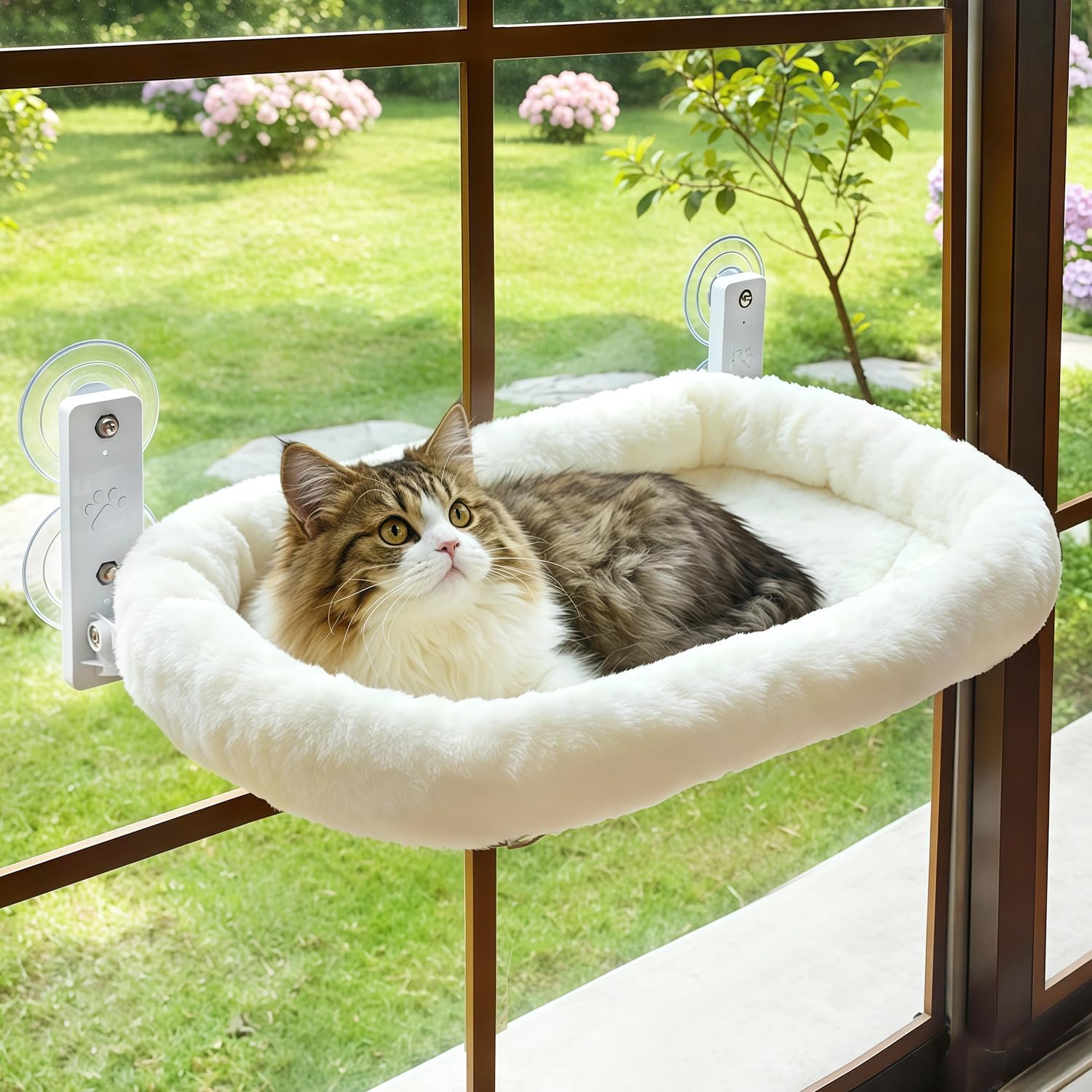
cat window perches sunny spots for your kitty to lounge
Why Indoor Cats Benefit From a Window Perch
The strongest argument for a window perch is behavioral, not aesthetic. Indoor cats live in a territory that never changes, and behaviorists have long linked small, static territories with boredom-related problems: over-grooming, attention-seeking at odd hours, and conflict between housemates. A window adds a moving layer to that territory. Birds landing on a fence, squirrels crossing a yard, pedestrians passing, and seasonal changes in light all give a cat something to observe and categorize, and observation is genuinely tiring work for a predator brain. Owners who add a well-placed perch frequently report that their cats sleep more soundly and pace less in the evening.
Warmth matters too. Cats seek out thermal comfort deliberately, and a sunny window can run several degrees warmer than the rest of the room. Sunbathing supports coat condition and appears to help cats maintain their daily sleep cycle, since light exposure is one of the main signals that anchors feline circadian rhythm. For senior cats, who often sleep more deeply and have less insulating muscle mass, a warm perch near a good view can become the single most-used piece of pet furniture in the home.
There is also a territorial function. In multi-cat households, conflict often flares over prime resources, and a good view counts as one. Providing more than one desirable elevated spot, at different windows or different heights, gives each cat a defensible option and tends to reduce squabbling. The ASPCA Animal Poison Control and the wider ASPCA care resources frame vertical territory and window access as basic enrichment for indoor cats, not luxuries. A perch is one of the cheapest ways to supply both at once.
How This Guide Is Organized
The first half covers how window perches are built and how to match a design to your cat and your windows. The second half covers a single concrete product example drawn from Amazon listings with substantial owner feedback, followed by installation, maintenance, safety, and the mistakes that most often lead to an abandoned or dangerous perch. Because this is a research-based publication, nothing here is based on our own handling of products; where a claim comes from owners or manufacturers, it is labeled as such.
The Three Mounting Systems and Their Real Trade-offs
Suction-Cup Perches
Suction-cup mounts attach directly to the glass, so they need no sill at all and leave no marks. That makes them the default choice for renters and for windows with metal frames or deep trim where nothing clamps on. Their weakness is well documented in owner reviews: grip degrades with dust, humidity, temperature swings, and glass texture. Older press-on cups had a reputation for releasing overnight, which is why newer designs use lever-lock or twist-lock cups that mechanically pull the cup flat against the glass and hold it there. Owner reports on lever-lock models are notably more positive than on older press-on styles, but even the best suction mount should be checked periodically. Manufacturer instructions almost universally require cleaning the glass with alcohol first and pressing each cup firmly until it seals.
Sill-Mount or Clamp Perches
These use hooking arms and thumbscrews or bolts to clamp onto the windowsill itself. Because the load transfers to the sill and often partly to the wall below the window, clamp mounts carry more weight with less drama than suction designs and are the usual recommendation for cats over roughly twelve pounds. The trade-off is fit: sills narrower than about two inches, or very deep or sloped sills, may not give the clamp a solid bite. Measure the sill depth, width, and the clearance under it before ordering, and note whether your window trim is hollow, since hollow vinyl trim can crack under clamp pressure.
Screw-Mounted Shelves
The third category is a shelf that bolts into wall studs or framing beside or under a window. These are the most secure option by a wide margin and the right choice for very heavy cats, multi-cat households where two animals may pile onto one shelf, or homes with energetic young cats who launch themselves at full speed. The trade-off is permanence: you are drilling holes, so they suit owners rather than renters, and relocating one means patching drywall. Some wall-mounted systems are modular, letting you add a second tier later, which is worth considering if you expect your cat population to grow.
Reading a Weight Rating Honestly
Manufacturer weight ratings describe a static load, meaning a cat lying still. They do not necessarily describe a cat jumping onto the platform from a bookshelf, which momentarily multiplies force. A sensible rule drawn from both engineering common sense and owner experience is to buy a perch rated for at least one and a half times your cat's weight, and more if your cat is athletic or if two cats might use it simultaneously. A fifteen-pound cat should be on a perch rated for twenty-five pounds or better; two fifteen-pound cats sharing one platform should have something rated near fifty.
Pay attention to how the rating is achieved. A suction-cup perch rated for forty pounds is relying on clean, smooth, warm glass; the same perch mounted on textured or cold glass may hold far less. Clamp and screw mounts are less sensitive to surface conditions but depend on correct installation. Owner reviews are the best early-warning system here: patterns of complaints about slow leaks, popping cups, or bending arms are far more informative than any single five-star rating.
Sizing: Measure Before You Buy
Three measurements matter. First, sill depth and width if you are clamping, as described above. Second, available clear width along the window; a perch platform typically runs twenty to twenty-six inches wide, and you need to know whether it will crowd blinds, curtain rods, or window cranks. Third, the cat. A healthy adult cat curled asleep needs roughly sixteen by twelve inches of surface, but cats like to stretch, and larger breeds such as Maine Coons and Ragdolls do best on platforms of about twenty-four by fourteen inches or more. A platform that is too small is one of the most common reasons a perch sits unused while the cat lounges on the sill beside it.
Height placement deserves a thought as well. A perch mounted low on the glass gives an easy step-up for kittens and seniors, while a higher placement feels safer and more commanding to the cat. If you have a senior cat with arthritis or mobility loss, choose the lowest workable position and make sure there is a stable intermediate step, such as a chair or shelf, so the cat is not forced to jump down from the full height. Signs of stiffness on dismount are a signal to lower the perch or add a stepping route.
Materials and Cushioning
Platforms are most commonly plastic, engineered wood, or metal over fabric. Plastic is light, cheap, and easy to wipe down, but thin plastic flexes under heavier cats and can crack in direct, sustained sun over years. Wood and wood-composite platforms feel like furniture and hold fasteners well, at the cost of weight and slightly harder cleaning. Metal frames paired with fabric slings are strong and breathable; the fabric eventually stretches or frays and usually cannot be re-tensioned, so check whether replacements are sold.
The cushion determines whether the cat stays. Look for a removable, machine-washable cover, because perch covers collect hair, dander, and the residue of window condensation. Foam-filled cushions hold their shape better than loose polyester stuffing, which flattens and clumps within months of daily use. Self-warming inserts, thin layers that reflect the cat's own body heat back toward it, are a popular low-risk upgrade: they need no power cord, and owner reports describe them as appreciated in cooler rooms and near-differently-received in already-warm climates. Avoid electrically heated perches unless they carry a recognized safety certification and low-voltage supply, and never run a power cord where a cat can chew it.
Safety Checklist Before the First Use
- Verify the mounting surface: clean glass for suction, solid sill or studs for clamps and screws.
- Load-test the empty perch with a stack of books or a bag of flour near your cat's weight before the cat ever uses it.
- Re-check suction mounts weekly for the first month, then monthly, and after any heat wave or cold snap.
- Keep blind cords and curtain pulls clear of the perch area; dangling cords are a strangulation hazard for cats.
- Do not place a perch over a radiator, space heater, or hard furniture edge that a falling cat could strike.
- For kittens, elderly, or wobbly cats, prefer designs with a raised rim or backing on the open side.
- Confirm screens are secure; a determined cat watching a bird can push out a loose window screen.
The screen point deserves emphasis. A perch places a cat's full attention and often its full weight against the weakest part of the window, and every spring shelters and veterinary helplines field calls about cats that pushed through insecure screens. If the perch window opens, make sure the screen is properly seated and rated to resist an adult cat leaning on it.
A Concrete Example Worth Examining
cat window perches sunny spots for your kitty to lounge
Rather than a numbered lineup, here is one specific product you can evaluate against everything above. The check the current price on Amazon listing in question is a suction-mounted, lever-lock style window perch with a plush, removable, machine-washable cover, a design category that suits average-sized cats, renters, and windows without usable sills. When you open the listing, confirm the three things that matter most for this style: the stated weight capacity versus your cat's weight with margin, whether the cups are lever-lock rather than plain press-on, and the platform dimensions versus your cat stretched out. Verified buyer reviews and answered questions on the listing will tell you how the mount behaves over months of seasonal temperature change, which is the single most useful information for this product category.
Who this style suits: cats up to the rated weight, households that cannot or do not want to drill, and windows with smooth glass and decent sun. Its honest trade-off is inherent to the category: even the best suction mount needs occasional re-seating, and it should not be trusted over a hard floor without a load test and periodic checks. If your cat is very large, or if two cats will fight over the platform, a clamp-mount or wall-mounted shelf is the better category to shop in. To see the specific listing, view this option on Amazon and compare its published specs against your measurements.
Species, Age, and Household Considerations
Cats at different life stages use perches differently. Kittens treat any elevated platform as a launchpad and benefit from lower mounting, higher weight margins, and side rails. Healthy adults are the easiest to please and will use nearly any stable, comfortable platform with a view. Seniors still want the view but need easy access; veterinary references such as the Merck Veterinary Manual cat owner section note that arthritis and reduced mobility are common and underrecognized in older cats, so step routes and low mounting matter more than platform size. In multi-cat homes, the general guidance from behavior literature is to provide one prime spot per cat plus one spare, distributed so that no cat has to cross another's core territory to reach a window.
Installation and Maintenance
For suction mounts, clean the glass with rubbing alcohol and let it dry fully, then press each cup and close the locking lever. Warm the cups in your hands first in winter; cold rubber seals poorly. For clamp mounts, protect the sill with the included pads or a folded cloth, tighten gradually and evenly, and check the fit after the first week. For screw mounts, hit studs where possible or use appropriate wall anchors rated well above the expected load.
Maintenance is simple but should be routine. Wash the cover on a gentle cycle and air-dry it, since high heat degrades foam. Wipe frames with mild soap and water only; avoid strong solvents, which leave residues cats then groom off their paws. Inspect fabric slings for fraying along seams and edges, since loose threads can be swallowed. Once or twice a year, fully remove and remount suction models to refresh the seal, and re-check all hardware on clamp and screw models after any heavy use period.
Common Mistakes to Avoid
- Buying a perch rated at your cat's exact weight with no margin, then being surprised when a pounce dislodges it.
- Mounting on cold or dirty glass without cleaning, the leading cause of failed suction mounts in owner reports.
- Choosing a spot overlooking a busy feeder if your cat becomes frustrated by prey it cannot reach; some cats do better with a calmer view.
- Placing the perch over a radiator or heating vent, which overheats the cat and dries out cushions and plastic.
- Squeezing a large cat onto a small platform and concluding the cat dislikes perches, when it dislikes the size.
- Ignoring the screen security of an openable window behind the perch.
- Never re-checking mounts; even screw fittings loosen with seasonal wood and drywall movement.
Frequently Asked Questions
Will my cat actually use it?
Most cats investigate a new perch within a day or two, and luring them with treats, catnip, or a familiar-smelling blanket speeds this up. If a cat ignores the perch for more than a week, the usual culprits are location, platform size, or surface comfort rather than the concept.
Are suction-cup perches safe for heavier cats?
Only if the rated capacity exceeds the cat's weight by a comfortable margin, the cups are lever-lock style, the glass is smooth and clean, and the mount is checked regularly. Above roughly fifteen pounds, or for cats that jump hard, a clamp or screw mount is the safer category.
Can I use a perch on a window without a sill?
Yes; suction-mounted and wall-mounted designs both work on frameless or sill-less windows. Suction designs keep glass intact, while wall shelves beside the window offer the most load capacity.
How do I clean one?
Remove and machine-wash covers gently, wipe frames with mild soap and water, and never soak wooden components, which can warp or grow mold inside.
Where is the best placement?
A window with direct sun for part of the day, a clear view of activity, no loud appliances nearby, and no drafty gaps. In multi-cat homes, distribute perches rather than stacking them all at one window.
Where to Buy
The example perch discussed above is available on Amazon; you can check the current price on Amazon to review its current specifications, weight rating, and verified owner feedback before deciding. As an Amazon Associate, PawCritic earns from qualifying purchases.
Final Thoughts
A window perch is a small purchase with an outsized payoff: it converts sunlight and a view into daily enrichment, gives a cat defensible territory, and costs almost nothing to run. The evaluation process matters more than the brand. Match the mounting system to your window, match the weight rating to your cat with real margin, match the platform size to your cat stretched out, and commit to the small amount of maintenance the mount demands. Do those four things, and the odds are very good that the perch becomes your cat's favorite spot in the house. If you want to start from the example discussed here, view this option on Amazon and measure twice before ordering.