How to Choose a Bird Cage: A Buying Guide Built on Published Guidance
Choosing the right bird cage is one of the most consequential decisions a bird owner makes. The cage functions as your bird's primary habitat: it is where the animal sleeps, eats, climbs, chews, and spends the many hours when you are not able to supervise. Because a well-built cage often lasts for the bird's entire life — macaws and cockatoos can live several decades — the purchase deserves the same deliberation you would give to any long-term housing decision. This guide is a reference resource, not a testing report. Every recommendation below is drawn from published veterinary guidance, manufacturer specifications, and consistently reported owner experiences, and where a claim cannot be traced to one of those sources, it is flagged as a trade-off rather than a verdict.
A useful way to frame the decision is to think of a cage as four separate engineering problems stacked on top of each other: containment (bar spacing and bar strength), safety (materials and coatings), livability (interior volume and perch placement), and maintainability (access, trays, and cleaning). A cage that solves three of these problems and fails the fourth is still a bad cage. A beautifully finished powder-coated model with the wrong bar spacing for a finch is a hazard, and an enormous flight cage with a flimsy tray that never gets cleaned is a health problem waiting to develop. The sections below take each problem in turn, then look at two concrete examples currently sold on Amazon so you can see how the specs translate into a real listing.
Sizing: Why Bigger Is Almost Always Better
Published husbandry guidance is unusually unanimous on cage size: within the limits of your home and budget, larger is better. The Association of Avian Veterinarians, whose bird owner resources cover housing fundamentals, advises that a cage should at minimum allow the bird to fully extend both wings without touching the bars, and strongly favors width and length over height, because most pet birds fly horizontally rather than vertically. A tall narrow cage gives the visual impression of space while actually offering very little usable flight room — one of the most common marketing tricks in the category, where 'extra tall' is used to inflate perceived value.
Practical minimums cited across husbandry literature look roughly like this: budgerigars and cockatiels do best in cages at least 20 to 24 inches wide, and bigger if a pair is housed together; conures and similar mid-sized parakeets need something on the order of 24 to 32 inches of interior width; African greys, Amazons, and similarly sized parrots are generally recommended cages of 32 to 40 inches or more; and macaws and large cockatoos realistically need cages starting around 48 inches wide, with many owners moving to full aviaries. The Merck Veterinary Manual's exotic and laboratory animal chapters make the same point from the clinical side: chronic confinement in undersized housing is associated with muscle wasting, obesity, and feather-destructive behavior. A cage is not a place a bird is stored; it is an environment the bird inhabits.
One honest limitation of any sizing table: published minimums are floors, not targets. If your bird spends most of the day out of the cage with you, a cage near the minimum can work as a sleeping and feeding station. If the bird is caged for long workdays, treating the minimum as adequate is a mistake, and the money is better spent on interior volume than on decorative features like ornate rooflines or included playtops.
Bar Spacing: The Single Most Safety-Critical Spec
Bar spacing determines whether the cage contains the bird safely at all. Spacing that is too wide lets small birds squeeze their heads between bars — a classic cause of fatal strangulation — or escape entirely. Spacing that is too narrow blocks the bird's view out, complicates climbing, and can trap beaks and feet. Consensus species guidance runs: finches and canaries need roughly 1/4 to 3/8 inch spacing; budgerigars and cockatiels around 1/2 inch; conures, quakers, and similar birds 1/2 to 5/8 inch; African greys and Amazons 3/4 to 1 inch; macaws and large cockatoos 1 to 1-1/2 inches. Horizontal versus vertical bar orientation matters less for safety than for enrichment — horizontal bars are easier for hookbills to climb, which most owners and behaviorists consider a plus for parrots, while finches do not care because they fly rather than climb.
An important caveat for anyone buying in the current marketplace era: listing photos and specification sheets frequently disagree, and the stated bar spacing on a marketplace listing is not always the bar spacing in the box. The only reliable practice is to measure the spacing yourself when the cage arrives, before putting a bird in it. A small ruler or tape measure and two minutes at the delivery doorstep will settle the question. If the measured spacing does not match what the listing promised, that is a return, not a compromise — especially with small birds, where an eighth of an inch of error changes the safety calculus completely.
Bar strength is the companion spec. A cockatoo or macaw can bend thin wire, and bent bars create gaps, pinch points, and escape routes that did not exist on day one. For large hookbills, look for heavy-gauge wire (thicker steel) and note the manufacturer's stated suitability for large species. Owner reviews are genuinely useful here: repeated reports of bars bent by a given species within months are a signal no spec sheet will surface.
Materials and Coatings: Where Toxicity Lives
Material safety is the area where veterinary literature is starkest. Birds chew everything within reach, continuously, and their respiratory systems are extraordinarily sensitive to airborne toxins. Avian veterinarians have documented zinc and lead toxicity from birds ingesting flaking cage coatings for decades, and heavy-metal toxicosis remains a routine emergency case in avian practice. The practical rules that follow from the literature: prefer powder-coated steel or stainless steel; reject any cage with chipped, flaking, or corroded coating the moment you notice it; and be skeptical of unbranded galvanized wire cages, because bare galvanizing exposes the bird to zinc every time it mouths the bars — which it will.
Stainless steel is the gold standard: it cannot flake a coating because it has none, it does not rust, and it tolerates aggressive disinfection. Its historical drawback is price, though stainless pricing has come down meaningfully in the last couple of years, and a cage priced at two or three times a powder-coated equivalent starts to look reasonable against a 30-year macaw lifespan. Powder-coated steel is the mainstream choice and is entirely acceptable when the coating is intact and the manufacturer is reputable; the failure mode is time and beak wear, so plan to inspect coatings on a schedule — a monthly look at the bars your bird chews most will catch problems before they become ingestion.
Avoid, full stop: cages with painted (rather than powder-coated) finishes, cages with decorative leaded or unknown-alloy trim, rusted secondhand cages of unknown provenance, and any cage that smells strongly of chemicals on arrival. If a cage's finish is flaking out of the box, it goes back — no exceptions, whatever the discount was.
Shape, Access, and Cleaning
Rectangular cages are preferred over round ones, and the reason is structural rather than aesthetic. Round cages offer corners nowhere — birds seek refuge in corners when stressed, and a curved wall denies them that. Round cages also tend to waste interior volume and frequently have converging bar geometry at the top that can trap feet and wings. The husbandry consensus against round cages is old, consistent, and worth following even when a round cage looks attractive.
For daily life, ease of cleaning matters as much as any glamorous spec, because cleaning is the chore that determines whether the habitat stays hygienic for years. Look for: a removable sliding debris tray at the base; a grate above the tray so the bird does not walk in its own droppings; large access doors that open smoothly one-handed (a bird on your shoulder, a food dish in the other hand); and external feeders that let you swap food and water without opening the main door. Owner reviews reliably surface the failure modes here — doors that jam, trays that warp and stop sliding, latches a clever parrot learns to open. Parrot-proof latch design is a real category of complaint; reviews mentioning a bird letting itself out are not jokes, and they should be read as product defects.
Where to Put the Cage
- Avoid direct sunlight through glass and drafty spots such as hallway gaps and window seams.
- Place the cage at roughly human chest or eye level; floor-level placement leaves birds feeling vulnerable.
- Put at least one solid wall behind the cage so the bird has a defended side.
- Keep the cage well away from the kitchen.
- Leave clearance on all sides so the bird can see approaches and you can clean comfortably.
The kitchen warning deserves its own paragraph, because it is the placement error with the fastest and worst outcome. Overheated nonstick (PTFE) cookware — pans, air fryer liners, some self-cleaning oven cycles — releases fumes that can kill a pet bird within minutes, and there is no cage on the market that protects against it. The cage can be perfect and the placement lethal. Fumes from burnt food, cleaning aerosols, and scented candles are lesser but real respiratory hazards for a species with air sacs and extremely efficient gas exchange. The ASPCA Animal Poison Control resource is the right place to check any household substance you are unsure about.
Accessories That Determine Whether the Cage Works
A cage is a shell until it is furnished, and the furnishings are where foot health and mental health are actually decided. Provide multiple perches of genuinely varying diameters and materials — natural wood branches, rope, and one grooming or cement perch — because uniform-diameter dowel perches force the same foot position for hours and contribute to pressure sores and arthritis. Sandpaper perch covers are discouraged in current guidance; they abrade feet without meaningfully trimming nails. Position food and water dishes away from directly beneath perches so droppings do not contaminate them. Rotate toys on a two-to-three-week cycle rather than permanently filling every spot: birds habituate to static environments, and rotating enrichment is the standard recommendation for preventing boredom-linked feather plucking. A fitted cage cover supports consistent sleep — most species want roughly 10 to 12 hours of dark, quiet sleep, which few household schedules provide without one. Finally, size every accessory to the bird: a perch too narrow causes foot problems in large parrots, one too wide prevents small birds from gripping securely, and small detachable parts on toys are choking and entrapment hazards for a species that tests everything with its beak.
Two Concrete Examples on Amazon
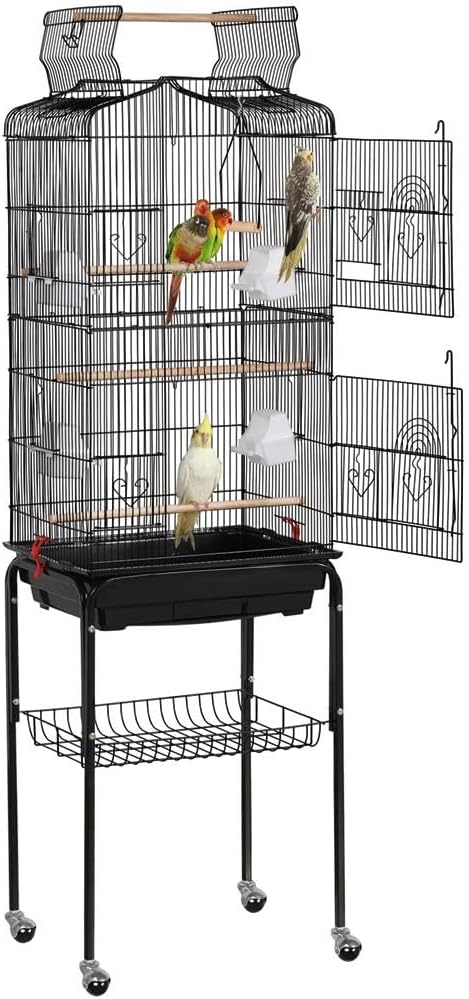
Product review for bird cages top picks for parrots finches and all pet birds
A Large Wrought Iron Standing Cage (Yaheetech)
The Yaheetech wrought iron standing cage, view this option on Amazon, is a widely purchased example of the affordable large-cage tier: a tall standing frame on casters with a pull-out tray, included perches and feeders, and a rolling design that makes repositioning realistic for one person. It suits owners of medium birds — cockatiels, conures, small parakeet flocks — who need interior volume and mobility without committing to a four-figure stainless cage. The honest trade-offs reported by owners and visible in the specification: assembly is required and is a genuine multi-step job; the powder coat is functional rather than premium, so it deserves the monthly flake inspection described above; and the bar spacing as listed is aimed at small-to-medium birds, not large hookbills, so measure on arrival and do not put a strong chewer on thin-gauge bars. As a value benchmark for what a serviceable large cage includes at this price, it is a useful listing to read even if you ultimately buy something else.
A Playtop Cage for Cockatiels and Conures (Prevue Pet Products)
The Prevue Pet Products wrought iron cage, check the current price on Amazon, represents the next tier up: a name-brand manufacturer with a long history in the category, a powder-coated finish from a company whose coatings have a generally favorable track record in owner reports, and a playtop that gives a bird an out-of-cage landing and exercise station built into the cage itself. For cockatiels and conures, the combination of appropriate bar spacing and a playtop is particularly practical, because these are species that benefit from daily out-of-cage time and will use a rooftop perch enthusiastically. The reported trade-offs are modest but real: the main door mechanism takes a practiced hand, and the playtop adds cleanup surface — droppings and seed hulls land on the roof and around the base, so a deep surrounding mat is worth planning for. Compared against the rolling standing cage above, you are trading mobility and floor space for brand pedigree, finish quality, and the integrated play area.
Comparing the Two
| Factor | Standing wrought iron cage | Playtop cage |
|---|---|---|
| Best suited to | Medium birds, small flocks, budget-driven buys | Cockatiels, conures, owners wanting a built-in play area |
| Standout feature | Rolling frame, tall interior, included basics | Manufacturer reputation, playtop, finish quality |
| Main trade-off | Assembly time; budget-grade coating to monitor | Door mechanism; mess radius around the playtop |
Neither is the 'best cage' in any absolute sense — the honest answer is that the right choice depends on your species, your out-of-cage routine, and your tolerance for assembly and cleaning chores. If a playtop duplicates a separate stand you already own, the rolling frame may be the smarter buy; if your bird's out-of-cage time currently happens on your shoulder or a door frame, the integrated playtop solves a real problem. If you want to see how the budget option is spec'd for large birds specifically, check the current price on Amazon and compare the listed bar spacing against the species table earlier — and for repeat comparison shopping, view this option on Amazon alongside the Prevue listing side by side.
Common Mistakes to Avoid
Choosing the wrong size. This remains the most frequent error in the category, usually in the direction of buying too small because the bird looked small in the store. Match the cage to the species' flight pattern and adult size, not to the bird's current fluffiness. A clipped baby budgie in a tall narrow cage becomes a fully flighted adult in the same cage twelve months later.
Trusting the listing's bar spacing. Measure at delivery. Marketplace spec sheets disagree with shipped product often enough that verification is now standard practice rather than paranoia, and for finch-sized birds the margin for error is tiny.
Overlooking material safety. Zinc, lead, and flaking coatings are documented toxicity sources in avian medicine. Any flaking powder coat, rusty wire, or unknown-alloy secondhand cage is a disqualifier, whatever the price.
Ignoring latch and door quality. Parrots in particular are mechanical problem-solvers, and owner reviews across the category contain recurring reports of birds opening simple latches. Read reviews specifically for escape stories before buying.
Neglecting enrichment rotation. A static cage interior is a boredom engine, and boredom in intelligent birds expresses itself as screaming and feather destruction. Rotating toys and perches is cheaper than treating the behavior problems that follow from skipping it.
Bad placement. Kitchens, drafty windowsills, dark corners, and floor-level spots each carry distinct risks — toxic fumes, chills, fear, and stress respectively. The best cage in the wrong location underperforms a mediocre cage in a good one.
The Bottom Line
A quality cage is a years-long investment in your bird's physical and psychological health, and the decision reduces to a short checklist: interior volume matched to species and flight style, bar spacing verified by your own measurement, materials that can survive a beak without poisoning it, doors and trays that make daily cleaning realistic, and a location free of kitchen fumes and drafts. Spend on volume and safety before cosmetics, prefer reputable finishes or stainless where budget allows, and read owner reviews for the failure modes — bent bars, jammed trays, opened latches — that spec sheets never mention. General husbandry reference beyond housing is well covered by the ASPCA pet care library and the avian-veterinary sources cited above.
Disclosure: As an Amazon Associate, we earn from qualifying purchases.