Why Cage Choice Matters More Than Any Other Bird Decision
A bird's cage is not just where they sleep — it is their entire world. Unlike dogs and cats who roam freely through a home, most pet birds spend the majority of their lives inside their enclosure, and for species like budgies and cockatiels that can mean ten to twenty years, while large parrots such as macaws and cockatoos may live fifty years or more in the same habitat. That longevity makes cage selection one of the most consequential decisions a bird owner will make, and one of the most commonly gotten wrong. An enclosure that is too small, has incorrect bar spacing, carries toxic coatings, or sits in a poor location can produce a chronically stressed, physically unhealthy bird, and the signs of that stress — feather plucking, screaming, repetitive pacing — often appear long before an owner connects them to the cage itself.
Published guidance from avian veterinary organizations is consistent on the fundamentals. The Association of Avian Veterinarians' bird owner resources emphasize that a cage must allow a bird to fully spread and flap both wings without touching the bars on any side, and that horizontal space matters more than vertical height for most species because birds fly sideways, not straight up. The Merck Veterinary Manual's exotic animals section reinforces these housing principles for captive birds and documents the health consequences of inadequate enclosures. This guide distills that published guidance, manufacturer specifications, and widely corroborated owner reports into a practical reference for choosing a cage, with special attention to sizing, bar spacing, material safety, and the mistakes that send birds to the vet.
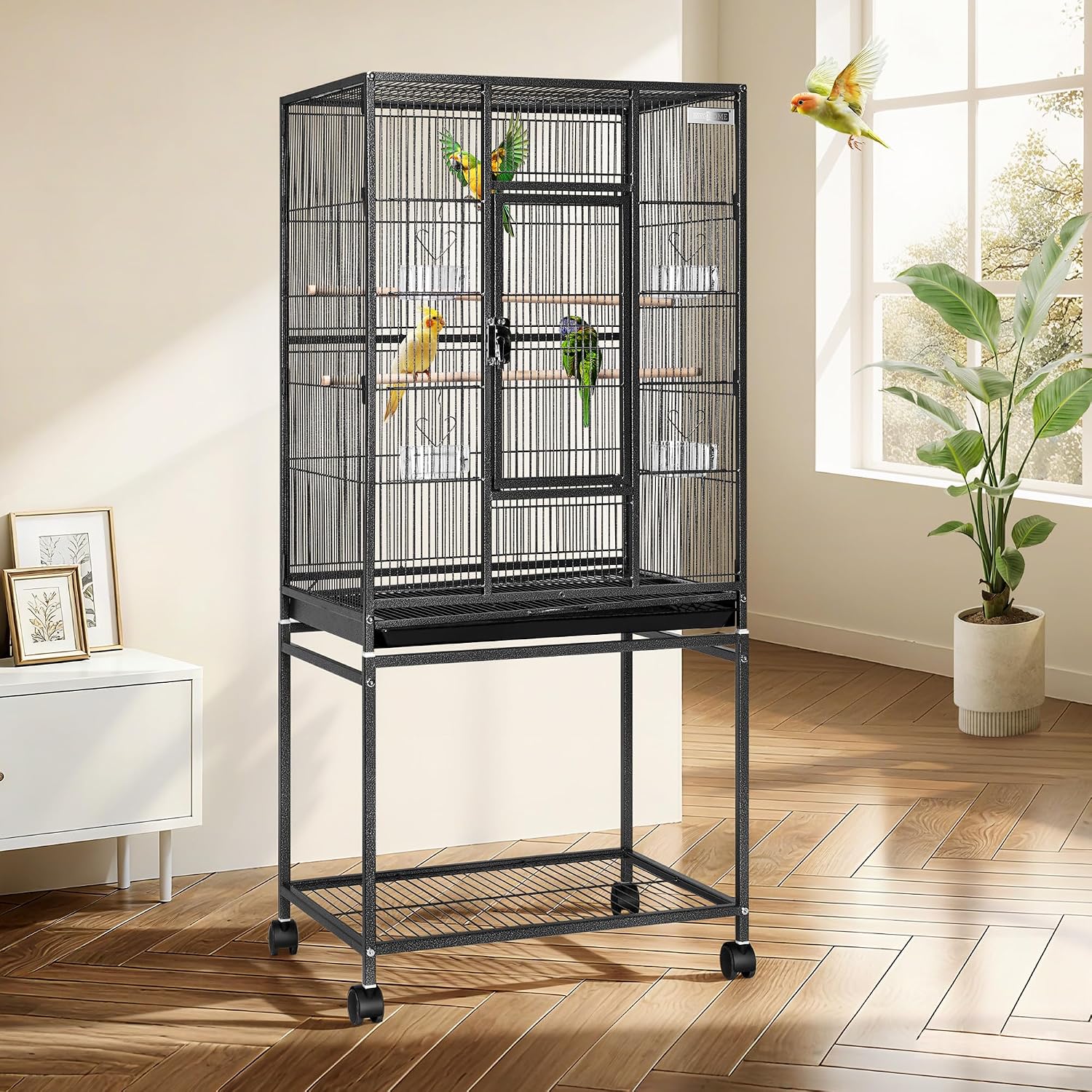
the 6 bird cages for parrots and parakeets in size safety and setup guide
A Note on Marketplace Listings in 2026
Cage specifications on marketplace listings have become noticeably less reliable. Bar spacing stated in the written spec sheet frequently disagrees with what appears in the listing photographs, and dimensions are sometimes quoted for the stand rather than the cage body. Experienced keepers on community forums consistently recommend measuring the actual product at delivery with a physical ruler rather than trusting any screenshot or listing claim, and returning the cage immediately if the bar spacing does not match what your species requires. Because a bird can trap its head in bar spacing that is only a quarter inch too wide, this is one area where verification is not optional. The core sizing rules below have not changed, and they remain the foundation of every good cage decision regardless of price point or brand.
Bar Spacing: The Most Critical Safety Factor
Bar spacing is the single most important safety consideration in bird cage selection, and it is non-negotiable. Spacing that is too wide allows a bird to push its head between the bars and become trapped, which can be fatal if the bird panics or is not discovered quickly. Spacing that is too narrow can restrict ventilation and make it difficult for the bird to climb and grip comfortably. The correct range depends entirely on the species, and the generally accepted guidelines published across avian welfare resources are as follows:
- Finches and canaries: 1/4 to 3/8 inch bar spacing
- Parakeets (budgies) and parrotlets: 3/8 to 1/2 inch bar spacing
- Cockatiels and lovebirds: 1/2 to 5/8 inch bar spacing
- Conures and caiques: 5/8 to 3/4 inch bar spacing
- African Greys and Amazons: 3/4 to 1 inch bar spacing
- Macaws and large cockatoos: 1 to 1.5 inch bar spacing
Two practical caveats apply to this chart. First, when a species falls near a boundary — smaller Amazons, for example, or large conures — always choose the narrower spacing, because a bird that cannot fit its head through is safe while a bird that can is not. Second, bar gauge matters alongside spacing: a macaw can bend thin wire even when the spacing is correct, so large parrots need heavier-gauge bars regardless of spacing. Manufacturer specification sheets list bar gauge, and owners of large cockatoos and macaws frequently report in reviews that thin-gauge cages were destroyed or bent by powerful beaks within months, which is a strong argument for verifying gauge before purchase rather than after.
Cage Size: Bigger Is Always Better, and Wider Beats Taller
The published minimum is that the cage must allow full wing extension and flapping without contact with the bars. In practice, most birds need significantly more space than this minimum, because the minimum describes survival, not wellbeing. A widely used rule of thumb among avian veterinarians and experienced keepers is that cage width should be at least 1.5 times the bird's wingspan, and the enclosure should be tall enough that the bird can climb and hang from the top without its tail touching the floor grate. For a budgie with a roughly ten-inch wingspan, that means a cage at least eighteen inches wide as an absolute floor — and most welfare guidance recommends far more, because budgies are strong fliers that genuinely benefit from flight-capable enclosures.
Height deserves specific mention because marketing exploits it. Many mass-market cages are tall and narrow, which looks impressive in photographs but provides almost no usable flight space, since birds fly horizontally. A tall narrow cage also encourages flightless climbing and tail-dragging, and in extreme cases can produce dominant behavior in some parrot species, since height confers social status in flock dynamics. Veterinary and behavioral guidance consistently recommends prioritizing width and depth over height, and treating height as useful only for climbing enrichment and tail clearance. When comparing two cages at similar prices, the shorter, wider one is almost always the better habitat.
Species-level starting points drawn from published husbandry guidance: a single budgie or parakeet should have an enclosure of at least 18 by 18 by 24 inches as a bare minimum, with flight cages of roughly 37 by 18 inches or larger strongly preferred for pairs. Cockatiels need a minimum around 20 by 20 by 26 inches, again with wider flight-style enclosures recommended for active individuals. Conures do best in cages of 24 by 24 by 30 inches or larger, and African Greys, Amazons, and similar medium-large parrots need enclosures in the range of 32 by 23 by 60 inches and up. Macaws and large cockatoos require cages starting around 48 by 36 inches with heavy-gauge bars, and keepers of these species should budget accordingly from the outset.
Material Safety: Toxic Metals and Coatings
Birds are extremely sensitive to heavy metals, and cage materials are a chronic, daily exposure source because birds chew their environment constantly. Galvanized wire contains zinc and is a documented source of zinc toxicosis in parrots; the ASPCA Animal Poison Control resources cover metal toxicosis among the household hazards pet owners should guard against. Chipping paint is similarly dangerous because ingested flakes of lead- or zinc-based coatings accumulate in a bird's system over months. Any cage showing rust, flaking, or chipped coatings should be replaced rather than repaired, since household paints are themselves unsafe for birds.
- Avoid zinc or lead-based coatings, which historically appeared on cheap imported cages
- Avoid galvanized wire, which contains zinc and is unsafe for chewers
- Avoid any cage with existing rust, which indicates poor-quality steel or coating failure
- Avoid cages with painted decorative trim a bird can reach and chew
The safe materials are well established. Stainless steel is the reference standard — it cannot chip, rust, or leach toxic metals, and it can be sanitized thoroughly — but it carries a price to match, often starting near a thousand dollars and rising for custom configurations. Powder-coated steel is the mainstream choice and is safe when the coating is intact and certified non-toxic; most reputable manufacturers state their coatings are lead- and zinc-free, and it is worth confirming that language on the specification sheet before buying. Wrought iron with a quality powder coat is also acceptable for medium and large parrots, though heavy chewers will eventually compromise any coating, which is why owners of severe chewers — large cockatoos in particular — frequently end up moving to stainless steel after replacing coated cages repeatedly.
Cage Shape, Orientation, and Design Details
Beyond size and spacing, several design features meaningfully affect daily life. Horizontal side bars are preferable to vertical bars for most parrots because birds climb by gripping with their beaks and feet, and vertical bars offer nothing to grip. Round cages are widely discouraged in avian welfare guidance: they provide little usable corner space, can make birds feel insecure without a corner to retreat to, and often have tapered tops that waste volume. Rectangular cages with flat or dome tops use space efficiently and accept standard accessories.
Door design is a common weak point. Owner reports across community forums repeatedly describe escape-artist budgies and cockatoos opening simple spring-latch doors within days, so look for doors with locking mechanisms or clip-compatible latches for clever species. Multiple access doors make food and water changes easier without reaching across the cage, which reduces stress for territorial birds. A removable bottom grate above a sliding tray is a significant maintenance advantage, since droppings fall through the grate away from the bird and the tray slides out for daily cleaning. Seed skirts — flared aprons around the base — reduce hull scatter considerably for messy eaters like cockatiels and conures, though they add width to the cage's footprint. Finally, casters on the stand matter more than owners expect: cages need moving for cleaning behind, and a heavy parrot cage without wheels effectively cannot be moved by one person.
Placement and Household Environment
Where the cage sits is as important as the cage itself. Birds are prey animals and feel safest with at least one solid wall behind the cage and a view of the room's activity without being in the direct traffic path. Kitchens are consistently discouraged in veterinary guidance because of fumes from nonstick cookware — overheated polytetrafluoroethylene coatings release fumes that are rapidly fatal to birds even at exposure levels harmless to humans — plus cooking smoke and aerosolized oils. Drafty doorways, direct sunlight through glass, and heater or air-conditioner vents all create temperature stress. A partial-cover arrangement, where the cage can be covered on three sides at night, supports sleep, and most companion birds benefit from roughly ten to twelve hours of darkness. These placement principles apply to every species from finch to macaw and cost nothing to get right at setup time.
Accessories and Interior Setup
The cage interior deserves the same scrutiny as the shell. Natural-branch perches of varying diameters are strongly preferred over uniform smooth dowels or plastic perches, because constant identical footing contributes to foot problems including pressure sores and arthritis; many cages ship with smooth wooden dowel perches that experienced keepers replace immediately with natural wood of varying texture and thickness. Perch placement should leave clear flight lanes and place food and water cups where droppings cannot fall into them — directly under a perch is the classic mistake. The general care guidance in the ASPCA pet care library and similar welfare resources consistently recommends multiple perch levels, foraging opportunities, and rotating toys to prevent boredom, since a cage that is spacious but barren still produces a psychologically deprived bird. Toy attachment points should be checked for safe quick-link hardware, since split-ring keychain-style connectors can trap beaks and toes.
A Concrete Example to Compare Against
As a single concrete reference point for the small-to-medium bird category, the Prevue Hendryx Flight Cage illustrates how the principles above translate into an actual product. Its listed specifications — roughly 37 by 18 by 60 inches overall with 1/2 inch bar spacing — match the flight-cage format recommended for budgies, cockatiels, and lovebirds, providing genuine horizontal flight room rather than the tall narrow profile of typical starter cages. Manufacturer specifications describe a powder-coated steel construction with a removable bottom grate and tray, two wooden perches, and two food cups included. Owner reports, which are broadly consistent across retail review sections and keeper forums, describe easy cleaning, good value for the footprint, and included dowel perches that most reviewers recommend replacing with natural wood for foot health, along with basic door latches that clever birds can learn to open. It is one widely available example of the format rather than the only option, and readers keeping larger species will need a different category of cage entirely — but it is a useful benchmark for judging whether any listing you encounter meets the sizing and spacing standards described above. You can check the current price on Amazon and verify the listed bar spacing against the species chart before committing.
Cage Categories by Species and Budget
Rather than a ranked list, it helps to think in categories, because the right cage is determined by your species and budget rather than by a universal winner. For finches and canaries, which do not climb and need only to fly, wide flight cages or aviaries with 1/4 to 3/8 inch spacing are the correct category, and decorative tall cages are unsuitable regardless of price. For budgies, parrotlets, and cockatiels, flight-style cages in the 30-to-40-inch width class are the mainstream recommendation, with mess-control designs featuring deep bases available for owners who keep birds in living areas and want to contain seed hull scatter — the trade-off there is somewhat reduced ventilation compared with traditional open wire construction.
For conures, caiques, and small Amazons, mid-size wrought iron or powder-coated cages around 32 to 36 inches wide with 5/8 to 3/4 inch spacing represent the value category, typically including play tops, rolling stands, and multiple access doors; the documented trade-offs in owner reports are complex assembly and coatings that heavy chewers can eventually compromise. For African Greys, Amazons, and large cockatoos, brand-name cages from established manufacturers in the 32 by 23 inch and larger class offer thicker powder coatings and better hardware, at a meaningfully higher price and weight. For macaws and for birds with documented metal sensitivity, stainless steel is the terminal category: expensive, heavy, and sometimes custom-ordered, but the only option that cannot chip or leach, and one that can plausibly last the bird's entire decades-long lifetime. Positioning your need within these categories before shopping filters out most of the noise in the marketplace.
Maintenance and Long-Term Care
A cage is a maintenance commitment, and the best cage in the wrong condition is a health hazard. Daily tasks should include changing cage liner, washing food and water cups with hot soapy water, and spot-cleaning droppings from perches and grates, because accumulated droppings harbor bacteria and fungal spores. Weekly, the grate and tray should be removed and scrubbed, perches wiped or sanded as needed, and toys inspected for frayed ropes or broken components that could entangle a foot. Monthly or quarterly depending on mess level, a full breakdown and wash of the entire cage with a bird-safe disinfectant is the standard routine recommended across husbandry guidance. During every cleaning, inspect the coating: any chip, flake, or rust spot means the cage is on a countdown to replacement, particularly for a bird that chews the bars, since ingested coating material is the primary chronic toxicity route in coated cages. Keeping the cage dry — drying thoroughly after washing, and wiping water-bowl splash promptly — extends coating life considerably.
Common Mistakes to Avoid
- Buying for the bird's current size or appearance: a juvenile or pet-store 'starter' cage is almost always outgrown within months; buy for the adult size of the species.
- Choosing height over width: tall narrow cages waste money on unusable vertical volume and deny the bird flight space.
- Ignoring bar spacing because the cage 'looks big': spacing and overall size are independent requirements, and both must match the species.
- Trusting listing photos for specifications: measure at delivery; mismatched spacing between photos and spec sheets is a recurring marketplace problem.
- Placing the cage in the kitchen: cooking fumes, particularly from overheated nonstick cookware, are a documented acute danger to birds.
- Keeping smooth dowel perches: uniform smooth perches contribute to foot disease; vary diameter and texture with natural wood.
- Repairing chipped coatings with household paint: household paints are themselves toxic to birds; a chipped coated cage is a replacement, not a refinishing project.
- Underestimating weight: large powder-coated and stainless cages routinely require two people to move, which matters for cleaning and relocating.
Honest Limitations of Any Cage
No enclosure substitutes for out-of-cage time and interaction. Published welfare guidance is clear that even a generously sized cage is a home base, not a complete environment, and that companion parrots and even budgies need daily supervised time outside the cage, social interaction, and foraging enrichment to remain physically and psychologically healthy. A buyer who purchases a large, safe, well-placed cage and then leaves the bird confined continuously has solved only part of the welfare problem. Budgeting for the cage should therefore be paired with a realistic plan for daily interaction, and the cage should be chosen partly on how easily it supports that routine — a play-top design, accessible doors, and a stand height that puts the bird at human eye level all make daily handling more natural.
Where to Look
the 6 bird cages for parrots and parakeets in size safety and setup guide
As an Amazon Associate, PawCritic earns from qualifying purchases. This does not affect our reviews or recommendations.
If you are shopping in the small-to-medium flight-cage category described above, you can view this option on Amazon to compare its listed specifications against the sizing and bar-spacing chart below. For other categories — large parrot cages and stainless steel enclosures — established specialty manufacturers sell primarily through their own sites and authorized dealers, and marketplace listings in those classes deserve the same at-delivery verification. Wherever you buy, the checklist is the same: confirm species-appropriate bar spacing with a ruler, confirm non-toxic coating language on the specification sheet, prioritize width over height, and inspect every panel and weld point before the return window closes. You can also check the current price on Amazon periodically, since pricing in this category moves often, and finally view this option on Amazon alongside any local alternatives before deciding.
Summary
The right cage decision reduces to four checks, in order of importance: bar spacing matched to species and verified with a ruler at delivery; interior width of at least 1.5 times the bird's wingspan, prioritized over height; a certified non-toxic powder coat or stainless steel construction with no rust or chipping; and a placement away from kitchen fumes, drafts, and direct sun. Everything else — play tops, seed skirts, accessory packages — is convenience layered on top of those fundamentals. Owners who apply those four checks consistently, whatever their budget, end up with a habitat that supports their bird for decades rather than one that needs replacing after the first year.
Affiliate Disclosure: PawCritic is reader-supported. We may earn a commission when you purchase through links on this page, at no extra cost to you. Our editorial selections are never influenced by commission rates or affiliate partnerships, and our recommendations are based on published guidance, manufacturer specifications, and verified owner reports rather than hands-on product testing.