Bird Cages for Parakeets, Cockatiels and Small Parrots: A Buying Guide for 2026
Choosing a cage is the single most consequential purchase a small-parrot owner makes. Budgies, cockatiels, lovebirds, conures and Quaker parrots spend the majority of their lives inside this enclosure, and its dimensions, bar spacing and construction directly affect their physical health and behavior. Avian veterinary guidance is consistent on this point: undersized or poorly designed cages are linked to muscle atrophy, feather damaging behavior and injury. The Association of Avian Veterinarians' owner resources are a good starting point for species-appropriate husbandry, and this guide draws on that published guidance, manufacturer specifications and verified owner reports rather than hands-on evaluation.
Rather than a long list of ten near-identical cages, this article works as a focused buying guide for the category. The sections below explain what actually matters when shopping: bar spacing, interior dimensions, materials and coatings, door and lock security, cleaning design and accessory quality. Two concrete Amazon examples are used throughout to illustrate how these principles show up in real listings, but the selection criteria apply to any cage you compare.
Why Cage Choice Matters So Much for Small Parrots
Small parrots are not decorative objects that sit still; they are active climbers, chewers and flyers with strong flock instincts. Published husbandry guidance, including the Merck Veterinary Manual's exotic animal chapters, emphasizes environmental enrichment and adequate enclosure size as core components of welfare, not optional extras. A cage that is too small restricts flight and climbing, which contributes to obesity and behavioral problems. A cage with the wrong bar spacing can trap a head, toe or wing, and in the worst case allows an escape into an unbird-proofed room.
There is also a longevity consideration. A well-made wrought iron cage with a properly applied powder coating can last a decade or more, while cheaply coated cages may chip within a year or two of a determined cockatiel's chewing. Because parrots are sensitive to airborne and ingested toxins, coating quality is a safety issue rather than a cosmetic one. Spending appropriately once usually costs less than replacing a failing cage twice.
Bar Spacing: The First Number to Check
Bar spacing is the most common place where well-meaning owners go wrong, because spacing that suits one species can injure another. Published recommendations are fairly consistent across avian sources. For budgies and parakeets, spacing should be no more than about 1/2 inch (12 to 13 mm); wider gaps can let a small head through, and a bird that panics halfway through can strangle or fracture its neck. For cockatiels and lovebirds, roughly 5/8 inch (16 mm) is the usual ceiling. Small conures and Quaker parrots generally do fine with up to 3/4 inch (19 mm).
Spacing that is too narrow carries its own risk: tiny toes and toenails can catch between closely set horizontal bars, especially in finches and young budgies. Horizontal bar orientation is generally preferred over vertical for these species because parrots climb by gripping bars with their beaks and feet, and horizontal bars give them a ladder-like surface. When reading any listing, verify the stated spacing in the manufacturer specifications rather than assuming from the product photo, and measure with a ruler on arrival before introducing the bird.
Cage Dimensions and Shape
Minimum size recommendations vary slightly between sources, but the general consensus for a single budgie starts around 18 by 18 by 18 inches, and a single cockatiel around 20 by 20 by 24 inches, with larger always preferred. Width deserves particular emphasis: budgies and cockatiels fly horizontally, not helicopters-style vertically, so a tall narrow cage wastes much of its height while a wide cage provides usable flight paths. A long, shallow cage is nearly always better for these species than a tall, narrow one of equal volume.
For pairs or small flocks, scale up considerably. Two parakeets should have at least roughly 22 by 18 by 24 inches, and bonded cockatiel pairs do best in flight-style cages with generous horizontal floors. Keep in mind that perches, toys and food bowls consume interior space; a cage that looks adequately sized when empty can become cluttered once furnished. Plan for the bird to be able to flap both wings fully extended without touching the walls in at least one section of the cage.
Materials, Coatings and Toxicity
The prevailing standard for affordable cages is powder-coated wrought iron or steel with a stated non-toxic finish. Powder coating is durable and generally safe when intact, but it is not invulnerable: persistent chewers can flake it off over years, and ingested flakes are a health concern. Owner reports frequently mention paint chipping on trays and lower bars of budget cages after extended use, which is worth weighing if your bird is a determined bar chewer. Inspect coatings regularly and replace a cage when flaking becomes significant.
Stainless steel is the safest and longest-lasting material, and it is the standard recommendation for large parrots; however, it carries a substantial price premium that most small-parrot owners find hard to justify. Avoid galvanized wire with exposed zinc, lead-based paints, and any cage that does not state its coating is bird-safe. If you suspect your bird has ingested coating or another toxic material, contact a veterinarian or a poison control service such as the ASPCA Animal Poison Control center promptly.
Doors, Locks and Escape Prevention
Small parrots are persistent and mechanically clever, and escape stories are among the most common themes in verified owner reviews. Look for doors that latch securely rather than simply swinging shut, and be skeptical of simple friction-fit feeding doors, which budgies in particular have been known to nudge open. Some owners add small clips or carabiners to feeding-port doors as inexpensive insurance; this is a widely reported practice in owner communities.
Check that the main door is large enough to comfortably remove perches and bowls for cleaning, and that any play-top access opening can be secured. Rounded edges and smooth welds matter too, since sharp wire ends can scratch or cut a bird that rubs against them. When the cage arrives, run a hand along all interior surfaces and file or cover any rough spots before use.
Cleaning Design and Daily Maintenance
A cage that is inconvenient to clean will be cleaned less often, and unsanitary cages contribute to bacterial and fungal problems. The features that matter most are a slide-out bottom tray, a removable grate above the tray, and adequate door access to every interior section. Deep trays catch more debris, and seed guards around the lower perimeter meaningfully reduce scatter onto floors, a point that shows up repeatedly in owner feedback on larger cages.
A sensible routine drawn from standard husbandry guidance: replace food and water daily and wipe soiled perches; change tray liner every two to three days; and perform a full cleaning weekly, scrubbing bars, washing toys and bowls with mild soap and hot water, and rinsing thoroughly. Avoid harsh chemicals such as ammonia or strong bleach solutions without complete rinsing; residue and fumes are hazardous to birds, whose respiratory systems are far more sensitive than ours.
Accessories: What to Keep and What to Replace
Most cages in this category ship with dowel perches, plastic feeders and sometimes a swing or play top. The feeders are usually serviceable, especially stainless steel ones, but the dowel perches deserve replacement. Uniform-diameter dowels force the feet into the same grip position for hours, which contributes to foot sores and arthritis over time. Natural branch perches of varying diameter and texture are the standard recommendation, and they also provide chewing enrichment.
Skip sandpaper perch covers entirely; veterinary guidance consistently discourages them because the abrasive surface abrades the soles of the feet and does not meaningfully trim nails. A cuttlebone or mineral block, a rotation of destructible and foraging toys, and stainless steel food and water cups round out a basic setup. When adding toys, position them so they do not block flight paths or sit directly above food bowls where droppings can contaminate them.
Two Concrete Examples from Amazon
Example one: a 64-inch open play-top cage
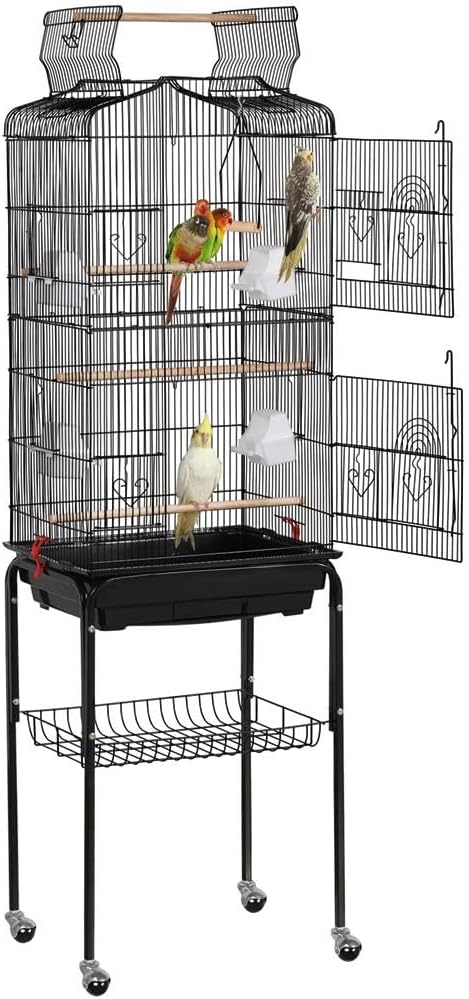
One cage that illustrates most of the principles above is the Yaheetech 64-inch open play top model, which has accumulated thousands of Amazon ratings with a high average score. Its specifications list a roughly 0.6-inch bar spacing with a non-toxic powder-coated wrought iron frame, which positions it best for cockatiels, lovebirds and small conures rather than the smallest budgies. The play top converts the roof into a supervised out-of-cage perch area, and the rolling stand with locking casters makes it practical in a living room. check the current price on Amazon to confirm the current bar spacing and dimensions before buying, since manufacturers occasionally revise hardware.
Verified owner feedback on this style of cage converges on a few consistent points: assembly is easier with two people, the included dowel perches are worth upgrading to natural wood, and the plastic tray, while functional, is less durable than a metal one would be. These are ordinary trade-offs for the price tier rather than defects, but they set fair expectations. For an owner with one to three small parrots who wants vertical space and an integrated play area without a premium price, this configuration is a reasonable starting comparison point.
Example two: a wrought iron flight-style cage
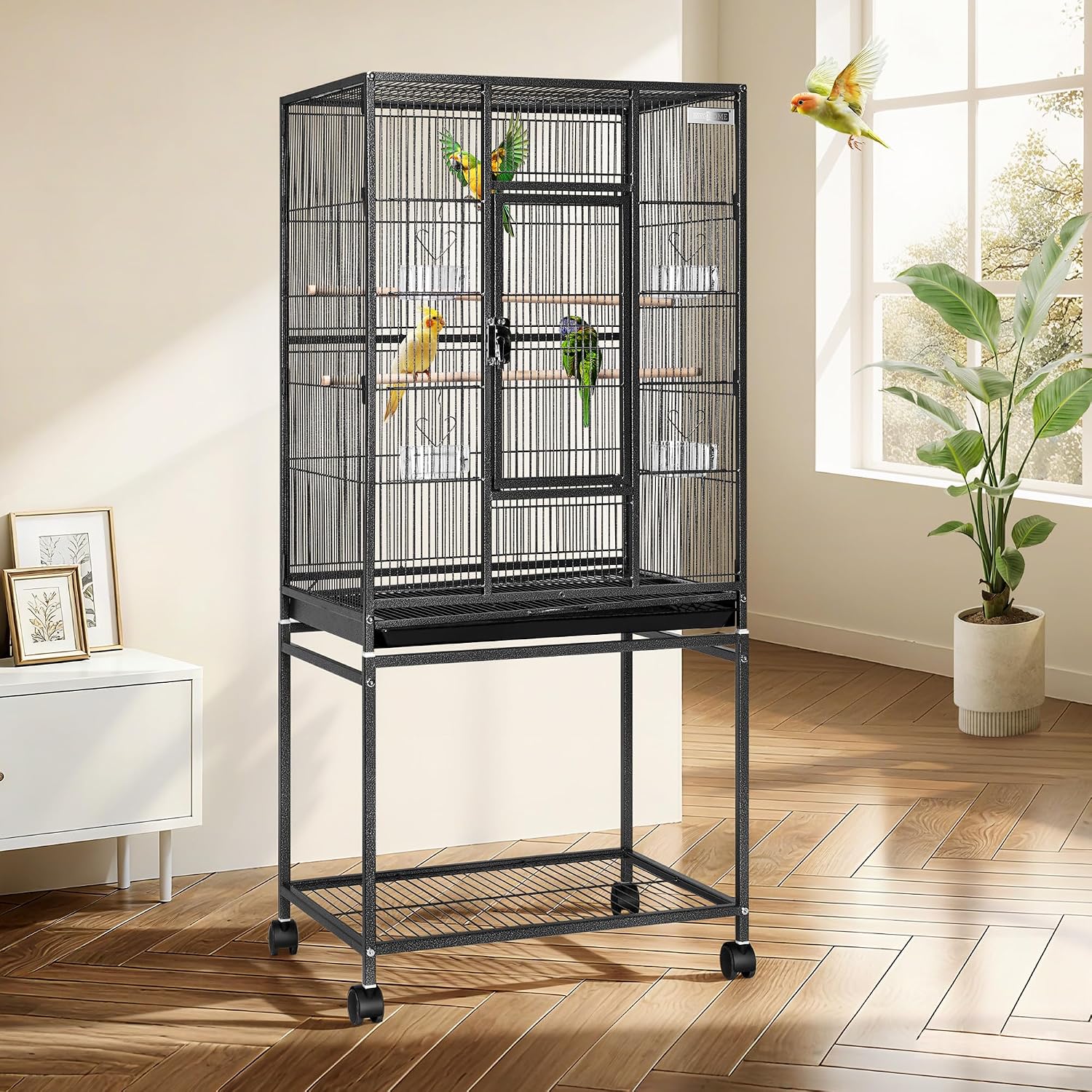
The second useful example is a wrought iron flight cage such as the Yaheetech 54-inch model, which prioritizes horizontal floor space over height and play-top features. This shape suits active species like green cheek conures, Quaker parrots and pairs of cockatiels or lovebirds, since horizontal room enables actual short flights between perches. The listed construction is heavy-duty wrought iron with a rust-resistant, non-toxic black powder coating, multiple access doors and a pull-out tray. view this option on Amazon to compare the exact interior dimensions against the minimums described earlier.
The trade-off against a play-top cage is straightforward: you gain flight space and a flat roof on which you can mount a separate play stand, but you lose the built-in rooftop play area. Owner reviews of this format note assembly takes patience and that included accessories are basic, so budget for better perches regardless. Flight cages are generally the better choice for birds that actually fly a lot, while play-top cages suit birds that prefer climbing and perching near their owner.
Species-Specific Considerations
Budgies are small, agile and enthusiastic fliers that do best in wide cages with 1/2-inch or narrower bar spacing, ideally with horizontal bars for climbing. A compact 18-by-18 cage is a frequently cited minimum for one bird, but pairs or birds that get limited out-of-cage time should have considerably more room. Cockatiels need taller and wider quarters with 5/8-inch maximum spacing, plus long perches because of their tails; a cage that is too shallow forces the tail against bars and frays feathers.
Lovebirds are strong chewers for their size, so coating durability matters more than it does for budgies. Green cheek and sun conures are active and playful and benefit from flight-style dimensions plus plentiful toy mounting points. Quaker parrots are noted builders and escape artists, so door security deserves extra scrutiny. Whatever the species, the same checklist applies: correct spacing, generous interior, safe materials and easy cleaning.
Common Mistakes to Avoid
- Buying a round cage. Circular and tall cylindrical cages waste corner space and can make birds feel insecure; rectangular is the standard guidance.
- Sizing to the bird's body rather than its wingspan. The cage must permit full wing extension and ideally short flights.
- Placing the cage in a drafty hallway, the kitchen, or direct sun. Fumes from nonstick cookware are acutely toxic to birds, and constant drafts invite illness.
- Overcrowding with toys. Enrichment matters, but cluttered cages block movement; rotate toys instead of installing everything at once.
- Ignoring bar orientation. Vertical-only bars are hard for small parrots to climb.
- Trusting friction-fit doors. Add clips where latches feel loose.
- Keeping sandpaper covers and uniform dowels as the only perches.
Frequently Asked Questions
Can I keep two parakeets in one cage?
Yes, parakeets are social and often do well in pairs, but the cage must be larger than a single-bird minimum, around 22 by 18 by 24 inches at minimum and bigger if possible. Introduce birds gradually and monitor for aggression, especially with lovebirds, which can be territorial. A larger flight-style enclosure such as the wrought iron example linked above reduces tension by giving each bird space.
How often should I clean the cage?
Daily food and water changes and perch wiping, tray liner changes every two to three days, and a weekly deep clean of bars, grate and accessories is the widely recommended rhythm. Cages with slide-out trays and removable grates make this routine far more sustainable, which is why those features should be non-negotiable in any purchase.
Are powder-coated cages safe?
Yes, when the coating is explicitly non-toxic and intact. The concern is chronic chewing that flakes the coating over time; inspect regularly and replace the cage if flaking becomes significant. Stainless steel eliminates this concern at a much higher price, which most small-parrot owners decide is unnecessary given moderate chewing habits.
Is a play top worth it?
If you plan supervised out-of-cage time and do not own a separate play stand, a play top adds real value by giving the bird a familiar landing spot above its territory. If you already have a play gym, a flat-top flight cage uses the same footprint for more interior space. The play-top example discussed earlier is a common way to get both functions in one purchase; you can view this option on Amazon alongside it to compare the two formats directly.
Where should the cage be located?
Against a wall in an active family room, at roughly chest height, away from kitchen fumes, drafts, radiators and direct sunlight. Birds are prey animals and feel safer with at least one solid wall behind the cage. Partial cage coverage at night supports sleep, which most small parrots need for around ten to twelve hours.
Final Thoughts
There is no single best cage, only the right cage for your species, your space and your budget. Start with the non-negotiables: correct bar spacing for your bird, interior dimensions that allow full wing extension and horizontal movement, a non-toxic coating, secure latches and a design you will actually keep clean. From there, choose between the two dominant formats based on your bird's behavior: a play-top cage for climbing, hands-on birds, or a flight cage for strong fliers. The two Amazon examples below are useful reference points because their specifications and thousands of owner reviews let you pressure-test every claim; if you are leaning toward the flight format, check the current price on Amazon and confirm the measurements yourself before committing. Your bird's cage is its world for the next decade or more, and a careful choice now is the most important thing you can do for its welfare.
Affiliate Disclosure: PawCritic is a participant in the Amazon Services LLC Associates Program, an affiliate advertising program designed to provide a means for sites to earn advertising fees by advertising and linking to Amazon.com. As an Amazon Associate, we earn from qualifying purchases. This means that if you click on one of our affiliate links and make a purchase, we may receive a small commission at no extra cost to you. This helps us continue creating helpful, in-depth guides for pet owners like you. We only recommend products we genuinely believe in after thorough research and evaluation. Thank you for your support!