Why Your Bird Needs a Play Gym Beyond the Cage
Most companion birds spend 20 to 22 hours per day inside a cage. Parrots are widely described in avian behavior literature as having the cognitive capacity of a young human child, and long confinement without stimulation is repeatedly linked to screaming, feather plucking, aggression, and cage-bound territorial behavior. A play gym, which is a perch-and-toy station placed outside the cage, provides supervised out-of-cage enrichment that gives a bird room to climb, chew, forage, and socialize. It is not a luxury accessory. For many species it is the difference between a settled, interactive companion and a bird that spends its life frustrated inside a wire box.
Bird respiratory anatomy is a key reason environmental quality matters so much. The Association of Avian Veterinarians bird owner resources note that avian lungs and air sacs are unusually efficient at absorbing gases, which also makes them unusually vulnerable to airborne toxins. Non-stick cookware fumes, scented candles, aerosol sprays, and smoke can harm or kill a bird within minutes. A play gym placed in a living area keeps a bird out of the kitchen zone and away from the highest-risk air in the home.
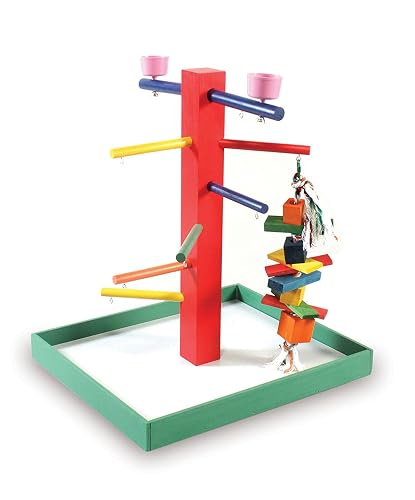
A good gym is more than a single perch. It is a multi-level activity center with perches at different heights and diameters, attachment points for toys and foraging cups, dishes for food and water during long out-of-cage sessions, and climbing surfaces that engage natural curiosity. This guide covers what to look for across species and budgets, how to set a gym up safely, and where owners most often go wrong. If you want to see one concrete example of the category while you read, you can check the current price on Amazon for a representative play gym and compare its specifications against the criteria below.
Key Factors in Choosing a Bird Play Gym
Species-Appropriate Size and Perch Diameter
Perch diameter is the single most common sizing mistake. A budgie or parrotlet needs perches roughly the diameter of a pencil, around 0.5 to 0.75 inches, so its toes can wrap around most of the circumference. A cockatiel or conure is comfortable on 0.75 to 1 inch perches. An African grey or Amazon typically does best on 1 to 1.5 inches, and a macaw or cockatoo needs 1.5 to 2.5 inches or more depending on foot size. A bird forced to stand on a perch that is too thick cannot grip properly, which leads to slipping, hesitation, and in some cases pressure sores on the foot pads.
The reverse problem matters too. A large macaw on a small-bird gym will destroy thin dowels and flimsy bases within days, and the instability can cause a fall. Match the gym's rated size class to your species rather than estimating by eye. Manufacturer size charts, which typically list small for budgies and lovebirds, medium for cockatiels and conures, large for Amazons and greys, and extra-large for macaws and cockatoos, are the most reliable starting point because they reflect the load the stand is engineered to carry.
Perch Variety and Foot Health
Foot health depends on variety. A bird that stands on one uniform dowel all day puts pressure on the same points of the foot, and over months that can contribute to bumblefoot, a bacterial infection of the foot pad that is painful and sometimes requires veterinary treatment. Avian veterinarians generally recommend offering several perch diameters, textures, and angles so different muscles and contact points are used through the day. Natural branch perches such as manzanita, dragonwood, java wood, and grapewood have irregular surfaces that mimic what a bird would grip in the wild.
Material hardness is a trade-off worth understanding. Manzanita is extremely dense and long lasting, which makes it excellent for grip and for birds that are not heavy chewers, but it offers little to a bird that wants to destroy its perch. Softer woods such as java and grapewood wear faster, which some birds find far more satisfying to chew. Rope perches made from cotton or sisal add a soft option and are useful for birds with existing foot sensitivity, but they fray over time and need inspection so loose threads do not become entanglement hazards.
Toy Attachment Points and Foraging
Attachment points determine how much enrichment a gym can actually deliver. Eye hooks, quick links, and carabiners let you hang shreddable toys, foraging cups, swings, and chew blocks, and you can rotate them to keep the station novel. A gym with only one or two hanging points becomes boring within a week. Look for a frame that accepts hardware at multiple heights, because placing a foraging cup low and a shreddable toy high encourages a bird to move around the structure rather than parking in one spot.
Foraging is one of the most effective forms of enrichment for parrots. Simple paper cups, woven palm leaf pockets, and slotted wood blocks that hold a few seeds or pellets turn a passive perch into a puzzle. Published avian behavior guidance consistently describes foraging as a natural behavior that occupies a large share of a wild bird's day, and captive birds given foraging opportunities show fewer stereotyped behaviors such as repetitive pacing or feather chewing.
Base Stability and Weight
A gym that rocks when a bird lands on it will be refused, and a gym that tips can injure a bird. Stability comes from base weight, base footprint, and where the center of mass sits. Tabletop stands for small birds can be surprisingly light, and an energetic conure can shove one off a counter. Floor stands for medium and large birds generally need a wide, heavy base. Owner reports frequently describe stands in the 15 to 25 pound range as the minimum for a grey or Amazon, with 40 pounds and up for large cockatoos and macaws.
Placement matters as much as the base itself. Pushing a stand into a corner or against a wall reduces the use a bird can apply when it lunges or flaps. Non-slip pads under the feet help on tile and hardwood. If a stand includes casters, confirm that the wheels lock, because a rolling stand plus a startled bird is a fall waiting to happen.
Hardware and Material Safety
Hardware safety is not optional. Zinc toxicity is a well documented and frequently fatal problem in companion birds, and it is most often traced to galvanized or zinc-plated hardware, cheap metal clips, and certain imported cage components. Stainless steel hardware is the standard recommendation because it resists corrosion and contains no zinc coating to chip or leach. Inspect every quick link, eye hook, and bolt on a new gym, and replace anything that is plated, pitted, or painted.
Wood must be untreated and unpainted. Avoid pressure-treated lumber, stained wood, and soft pine that splinters easily. Natural, bird-safe woods and food-grade stainless steel are the safest combination. The ASPCA Animal Poison Control maintains guidance on household substances that are toxic to pets, and it is a useful reference when evaluating finishes, adhesives, and anything a bird might chew off a stand. The Merck Veterinary Manual section on exotic and laboratory animals is another reliable source for species-specific health information when a bird shows signs of illness after chewing on a questionable material.
Food and Water Dishes
Dishes matter more than most buyers expect. If a bird will stay on the gym for an hour or more, having food and water within reach keeps it from treating the gym as a temporary stop before returning to the cage. Stainless steel cups are the easiest to sanitize and the least likely to be chewed. Plastic cups are common and inexpensive but scratch over time, and scratched plastic harbors bacteria. Whichever material you choose, plan to wash cups daily with hot water and a bird-safe cleaner.
Play Gym Options and What Each One Suits
The category spans a wide range of designs, and the right choice depends on species, floor space, budget, and how much customization you want. The notes below describe the design types most commonly available and the trade-offs owners report, so you can match a stand to your situation rather than chasing a single best answer.
bird playgrounds play gyms
Hardwood Playground Stands
Hardwood playgrounds built around manzanita or similar dense branches are the premium end of the category. They typically include three or more perch heights, a ladder or climbing net, built-in food and water cups, and stainless steel hardware. They suit medium to large birds such as greys, Amazons, and smaller cockatoos, and they hold up well in a permanent spot in a living room. The trade-off is cost, weight, and footprint. These stands are difficult to move between rooms, and the dense wood offers limited chewing satisfaction for birds that want to destroy something. A representative option in this style can be viewed through this listing, where you can view this option on Amazon and check its stated dimensions and weight rating against your species.
Wrought Iron and Powder-Coated Stands
Wrought iron stands with powder coating are the workhorse of the mid-range market. They are stable, durable, and available in sizes from small birds up to macaws. Most include natural wood dowel perches and food cups. The trade-off is perch quality. Uniform dowels do not provide the diameter variation that supports foot health, so owners often replace or wrap them with sisal rope, or add a natural branch perch alongside. Powder coating resists chipping, and the underlying iron is not a zinc concern, which makes these stands a reasonable choice for owners who want stability without a premium price.
Tabletop Stands for Small Birds
Tabletop stands are compact stations that sit on a counter, desk, or table rather than occupying floor space. They are well suited to budgies, lovebirds, parrotlets, cockatiels, and small conures, and they are the practical choice for apartments or for owners who want supervised play in the room where they spend their own time. The trade-off is stability. Lightweight tabletop stands can be pushed off a surface by an enthusiastic bird, and the small frame limits how many toys and perches you can attach. Heavier bases and a non-slip mat reduce the risk considerably.
Stainless Steel Floor Stands for Large Birds
Stainless steel floor stands are built for the strongest chewers. A macaw or cockatoo can destroy wood perches quickly, but a stainless frame resists bending and cannot be chewed through. Stainless steel is also non-toxic, chip-proof, and easy to wipe down with a bird-safe disinfectant. The trade-offs are price and weight, with large models often exceeding 40 pounds, plus an industrial look that some owners find less attractive than natural wood. Cold metal can also make some birds hesitant at first, and adding a wooden perch or rope wrap to the frame usually resolves that within a few days.
Natural Branch Stands
Stands built from real branches such as dragonwood or grapewood mounted on a wooden base offer the most natural perching surface available. Irregular bark gives feet a genuine workout and offers beak-wear opportunities. They suit owners who want a stand that looks intentional in a living space, and they work well for medium birds. The trade-offs are variability, debris, and moisture. Branch diameter and angle vary from unit to unit, some birds prefer consistency, bark sheds onto the floor, and natural wood in a very humid room can develop surface mold if it is not kept dry.
Toy-Integrated Gyms
Toy-integrated gyms arrive with foraging cups, chewable wood, rope ladders, and shreddable materials already attached. They are the easiest starting point for a new bird owner who does not yet know what a bird prefers, because the station is immediately usable. The trade-off is that pre-attached toys are consumables. Shreddable materials are destroyed within weeks, and replacing the exact components can require some searching. Toy-integrated gyms are generally available for small and medium birds rather than large macaws.
DIY PVC Stands
A do-it-yourself stand built from PVC pipe, fittings, natural bird-safe branches, and stainless quick links is the most customizable and least expensive route. Materials typically run well under what a comparable commercial stand costs, and the frame can be rebuilt as a bird's needs change. The trade-offs are real: PVC is smooth and unnatural, so perches should be wrapped in sisal or replaced with branches; the base must be weighted so the stand does not tip; and the finished product looks utilitarian rather than decorative. Use uncoated schedule 40 PVC rather than vinyl-wrapped pipe, and avoid any adhesive that could be chewed.
Comparison of Play Gym Design Types
| Design Type | Typical Materials | Size Range | Food Cups | Relative Cost | Best Suited To |
|---|---|---|---|---|---|
| Hardwood playground | Manzanita, stainless hardware | Small to large | Usually included | High | Permanent setup, medium to large birds |
| Wrought iron stand | Powder-coated iron, wood dowels | Small to extra-large | Usually included | Moderate | Value buyers, medium to large birds |
| Tabletop stand | Java wood or mixed | Small only | Often included | Low | Apartments, small birds |
| Stainless steel floor stand | Stainless steel, wood perches | Medium to extra-large | Usually included | High | Heavy chewers, large birds |
| Natural branch stand | Dragonwood or grapewood | Small to large | Often included | Moderate | Owners who want a natural look |
| Toy-integrated gym | Mixed with pre-attached toys | Small to medium | Often included | Moderate | New owners, quick setup |
| DIY PVC stand | PVC, natural branches, stainless links | Custom | Custom | Low | Budget builders, unusual species needs |
Setting Up a Play Gym Safely
Placement is the first safety decision. Keep the gym out of the kitchen entirely. Overheated non-stick cookware releases fumes that can kill a bird in seconds, and no amount of ventilation makes a kitchen a safe room for a parrot. A spot near a window with blinds or sheer curtains gives visual stimulation without the overheating risk of direct sun through glass. Avoid drafty spots near exterior doors and air conditioning vents, since birds can chill quickly when they are wet from a bath.
Secure the base before the bird ever steps on the stand. Push floor stands into a corner or against a wall, add non-slip pads on hard flooring, and lock any casters. Check that the stand cannot be pulled over by a bird leaning off the edge toward something interesting. For heavy birds, consider anchoring the base or choosing a model whose footprint is wide relative to its height.
Inspect hardware on arrival and then on a regular schedule. Every quick link, eye hook, and bolt should be stainless steel. Replace anything that is plated, rusty, bent, or painted. Check rope perches and toys for loose threads and frayed ends that could tangle a toe or a leg. Check wood perches for splinters and for chewed sections that have become sharp. A five-minute inspection once a week prevents most of the injuries associated with play stands.
Supervision is the rule. Birds are curious and destructive, and they can dismantle toy parts, hardware, and wood splinters in minutes. Being in the same room and actually watching is the standard. A bird left alone on a stand is a bird that can chew through a rope, swallow a metal fragment, or fall.
Maintenance and Cleaning
Play gyms collect droppings, food debris, dander, and chewed wood, and they need cleaning on a schedule rather than when they look bad. Wipe down perches and the frame daily or every other day with a bird-safe cleaner, and do a deeper clean weekly. Dishes should be washed daily with hot water and soap or a bird-safe disinfectant, then rinsed thoroughly, because dried food residue supports bacterial growth.
Choose cleaners carefully. Diluted white vinegar is a widely used household option, and there are veterinary disinfectants formulated for bird environments. Whatever you use, rinse and allow surfaces to dry completely before returning a bird to the stand. Birds investigate surfaces with their beaks and tongues, so residues matter.
Expect to replace components. Wood perches wear down and become unsanitary over time, rope perches fray, and toys are destroyed. Budget for periodic replacement rather than treating the stand as a one-time purchase. A gym that is rebuilt and refreshed every few months stays interesting and stays safe.
bird playgrounds play gyms
Common Mistakes Owners Make
The most common mistake is buying a gym that is the wrong size for the species. A small bird on an oversized stand cannot grip the perches and will avoid the station. A large bird on an undersized stand will destroy it or tip it. Check the manufacturer's size rating and the stated weight capacity before buying, and measure the floor or table space you actually have available.
A second mistake is treating the gym as a static object. A stand that never changes becomes boring within weeks. Rotate toys, move foraging cups, and introduce new shreddable materials on a schedule. Removing a toy for a few weeks and reintroducing it later often re-engages a bird as effectively as a brand new toy.
Another frequent error is skipping the transition period. Cage-bound birds often fly straight back to the cage the first time they are placed on a stand. Short sessions, high-value treats offered only on the gym, and a stand positioned close to or on top of the cage make the transition easier. Forcing a bird to stay, or blocking its return to the cage, damages trust and makes the problem worse.
Finally, owners underestimate how much out-of-cage time a bird actually needs. Two hours of supervised time per day is a reasonable minimum for most companion parrots, and four or more is better for highly social species. The more time a bird spends on a stimulating stand, the less likely it is to develop the screaming, plucking, and aggression problems that stem from boredom.
Frequently Asked Questions
My bird will not stay on the play gym and flies back to the cage immediately.
This is very common with cage-bound birds. Start with sessions of about five minutes and place the stand touching or very close to the cage. Offer a high-value treat only on the gym, never in the cage during training, so the stand becomes associated with something the bird wants. Increase the time gradually over two to three weeks. Most birds will eventually stay for thirty minutes or more. Never force a bird onto the stand or prevent it from returning to the cage, because that undermines trust and increases anxiety.
Can I put the play gym on top of the cage?
Cage-top gyms exist and can be a good transition for a hesitant bird because the bird is out of the cage but still on familiar territory. Confirm that the cage top can support the stand plus the bird, and that the stand is stable. Cage-top setups suit small and medium birds best. Large macaws and cockatoos are generally too heavy for most cage tops. Supervise cage-top play the same way you would supervise any out-of-cage time.
How much out-of-cage time does my bird need?
Aim for at least two hours per day of supervised time outside the cage, with four or more being better for social species. Build up gradually if your bird has spent most of its life in a cage. Out-of-cage time on a well-equipped stand is when a bird can exercise, explore, chew, and relax, and it is the single most effective way to reduce boredom-related behavior problems.
What wood is safe for a bird play gym?
Untreated, unpainted natural woods such as manzanita, java wood, dragonwood, grapewood, and apple or willow branches from untreated trees are commonly used. Avoid pressure-treated lumber, stained or painted wood, and soft pine that splinters. If you collect branches outdoors, wash them and confirm the species is bird-safe and free of pesticide exposure before using them.
Is zinc really a problem in play gym hardware?
Yes. Zinc toxicity is a well documented and often fatal condition in companion birds, and it is most often linked to galvanized or zinc-plated hardware, cheap metal clips, and certain imported components. Choose stainless steel hardware and inspect every clip, hook, and bolt. Replace anything plated, pitted, or painted.
What to Avoid
Avoid stands with painted or stained wood, plated hardware, or glued joints that a bird can pick apart. Avoid soft pine dowels for large birds, since they splinter and can cause foot injuries. Avoid stands with narrow bases relative to their height, because they tip. Avoid rope perches that are already frayed, and avoid any toy with small parts that can be swallowed. Avoid placing a stand anywhere near the kitchen, near a drafty door, or in direct sun through glass. Finally, avoid leaving a bird unattended on any stand, no matter how stable it seems.
Final Thoughts
A play gym is one of the most useful pieces of equipment a bird owner can buy, because it turns out-of-cage time into genuine enrichment rather than a supervised wander. Match the stand to your species, choose stainless steel hardware and untreated wood, give the base enough weight to stay put, and add attachment points so you can keep the station interesting. Then commit to the daily routine that makes it work: at least two hours of supervised time, weekly toy rotation, and regular cleaning and inspection.
If you want a starting point to compare against the criteria below, you can check the current price on Amazon and review its listed dimensions, materials, and weight capacity before deciding whether it fits your bird. Whether you buy a finished stand or build one yourself, the goal is the same: a safe, varied, and interesting place your bird chooses to spend time.
Affiliate Disclosure: PawCritic.com participates in the Amazon Services LLC Associates Program. We may earn commissions from qualifying purchases at no extra cost to you.
Where to Buy
As an Amazon Associate, PawCritic earns from qualifying purchases. This does not affect our reviews or recommendations.