Bird Toys: A Research-Based Buying Guide
Bird toys are not accessories. For a captive parrot, finch, or canary, they are the difference between a mentally engaged animal and one that develops stereotypic behaviors such as feather plucking, screaming, bar-biting, and pacing. The Association of Avian Veterinarians notes that environmental enrichment is a core part of preventive avian care, not an optional extra. This guide explains what published guidance and verified owner reports say about choosing safe, useful toys for pet birds, and it includes one concrete example you can look at if you want a starting point.
Most pet birds spend the majority of their lives inside a cage or a single room. In the wild, a parrot may spend six to eight hours a day foraging, manipulating objects, and solving problems. When that drive has no outlet, it redirects into destructive or self-destructive behavior. The Merck Veterinary Manual lists environmental enrichment as a standard component of husbandry for exotic and laboratory animals, and the same principle applies to companion birds. Toys are the most practical enrichment tool an owner has.
Why Birds Need Toys: The Behavioral Case
The three functional reasons to provide toys are mental stimulation, physical exercise, and beak and nail wear. A bird that has nothing to chew will chew cage bars, furniture, or its own feathers. A bird that has nothing to shred will shred its perches. A bird that has nothing to solve will often develop repetitive pacing along the cage floor. None of these outcomes are inevitable, but they are common in under-enriched environments, and they are far easier to prevent than to reverse.
Foraging is the single most important category. Published avian behavior guidance consistently ranks foraging as the highest-value enrichment because it occupies the most time and mimics the natural search-and-extract cycle. A parrot that must work for a portion of its food is calmer, more predictable, and less likely to scream for attention. Shredding and chewing come second, because they satisfy the urge to manipulate and destroy, which is normal and healthy for parrots. Mechanical puzzles, bells, and climbing structures come third, useful mainly for variety and for birds that are already well-enriched.
There is also a safety case. Bored birds are more likely to investigate things they should not: electrical cords, toxic houseplants, and household chemicals. The ASPCA Animal Poison Control maintains a list of common household toxins, and birds are unusually sensitive to inhaled fumes and ingested metals. A well-stocked cage keeps a bird occupied with safe objects instead of unsafe ones.
What to Look For When Buying Bird Toys
Bird toy marketing is loud and often uninformative. The specifications that actually matter are material safety, size relative to the bird, attachment hardware, and destructibility. Work through these four categories before you look at price.
Material Safety
Look for untreated wood, vegetable-tanned leather, untreated cotton or sisal rope, stainless steel hardware, and food-grade dyes. Avoid zinc-coated hardware, lead solder, and any toy that smells strongly of chemicals or solvent. Zinc and lead are both documented causes of heavy-metal toxicosis in birds, and the symptoms can be subtle for weeks before they become severe. If a toy does not state its hardware material, assume it is zinc-plated unless the seller confirms otherwise.
Colored wooden blocks are generally fine if the dye is food-grade or vegetable-based. Natural, undyed wood is the safer default, especially for birds that chew aggressively and swallow small fragments. Rope toys should be inspected constantly, because loose threads can wrap around a toe or tongue and cut off circulation. Any rope toy that has begun to fray into long strands should be trimmed or retired.
Size and Bird-Appropriate Scale
Size is where most owners get it wrong, and usually in the direction of too small. A toy that is too small for a bird is a choking hazard and gets destroyed in minutes. A toy that is too large is intimidating and gets ignored. As a general rule, the toy should be roughly the same length as the bird's body, or slightly longer for climbing and swinging toys. Small birds such as budgies and finches do best with toys in the 4 to 8 inch range. Medium birds such as cockatiels and conures do best with toys in the 8 to 12 inch range. Large birds such as African greys, amazons, and cockatoos need toys 12 inches and up, often much larger.
Chew hardness should also match the bird. Budgies and cockatiels need soft woods such as balsa, pine, and sola. Larger parrots need harder woods such as manzanita, maple, and coconut shell. A macaw given balsa will destroy the toy in a day and learn nothing. A budgie given manzanita will ignore it entirely.
Attachment Hardware and Cage Fit
The attachment is the weakest point on most toys. Quick links, C-clips, and pear links are the standard. Look for stainless steel or nickel-plated steel, and check that the closure is tight enough that a beak cannot pry it open. Spring-loaded clips are convenient but can pinch toes and tongues, so many avian veterinarians prefer screw-closure quick links for medium and large birds. Whatever hardware you use, check it every time you clean the cage. A clip that has bent open is a bird that will eventually escape or get a toe caught.
Consider where the toy will hang. Toys hung directly over food and water dishes get soiled quickly and discourage eating. Toys hung in the center of the cage restrict flight and movement. The best placement is along the sides and back of the cage, with at least one toy reachable from the main perch and one that requires the bird to climb or stretch to reach.
Destructibility and Rotation
Destructible toys are not defective. They are doing their job. A bird that shreds a toy in two days has received two days of enrichment, which is exactly what you paid for. The mistake is buying only indestructible toys, which are usually acrylic or hard plastic and offer almost no chewing value. A balanced cage has some destructible toys that will be consumed and some durable toys that will last months.
Rotation is what makes a small collection behave like a large one. Published enrichment guidance recommends rotating toys on a schedule, typically every one to two weeks, so that each toy feels new when it returns. A bird with eight toys and a four-toy rotation is better enriched than a bird with twenty toys all left in the cage at once. Novelty, not volume, is what drives engagement.
A Concrete Example: Super Bird Creations Foraging Wheel
If you want a single starting point, the Super Bird Creations foraging wheel is a widely available option that appears in many owner discussions and retailer listings. It is a foraging-style toy, which is the category that avian behavior guidance ranks highest for time-on-task. It suits small to medium parrots, including budgies, cockatiels, and conures, and it works best for birds that already understand that food can be hidden inside objects. You can check the current price on Amazon to see the current listing.
The trade-off is that foraging toys require a learning curve. Some birds figure out a wheel-style feeder in an afternoon. Others ignore it for a week and need the food placed on the outside first, then just inside the opening, then fully hidden. If your bird has never used a foraging toy, expect to teach the behavior rather than assume it will happen on its own. The other limitation is that plastic foraging toys are not chew toys. They occupy a bird mentally but do not satisfy the urge to shred, so pair one with a destructible wood or paper toy.
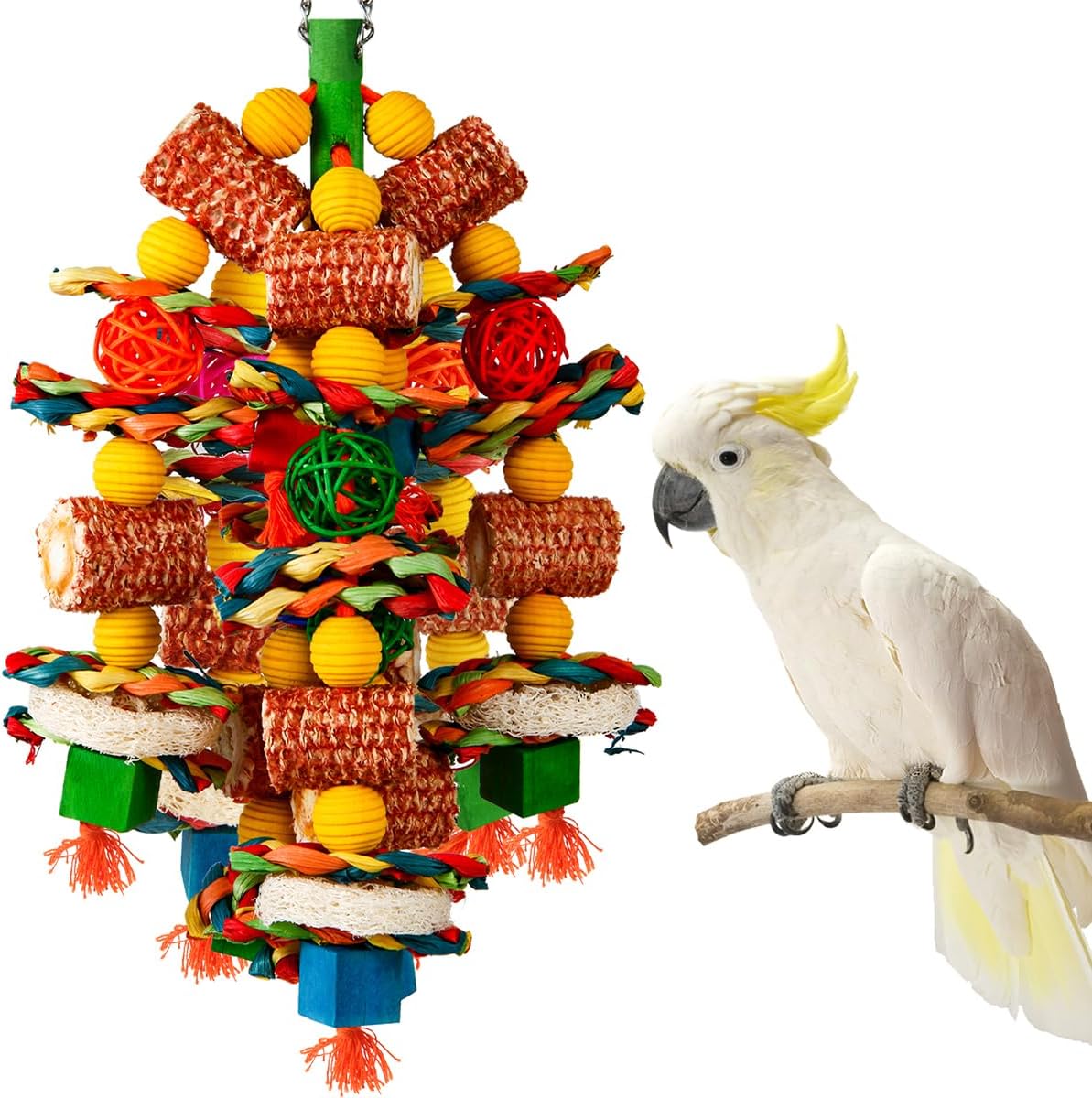
Foraging toys are the highest-value enrichment category for most pet birds.
Toy Categories and What Each One Does
Rather than thinking in terms of individual products, think in terms of categories. Each category serves a different behavioral need, and a complete cage setup includes at least three of them.
Foraging Toys
Foraging toys hide food behind doors, inside drawers, under cups, or inside destructible paper. They are the closest thing to natural foraging behavior and the best investment for any bird that is food-motivated. They work for nearly every species, from budgies to macaws, though the size and difficulty must match the bird. The main drawback is that they need to be restocked with food, which means daily or every-other-day maintenance.
Shredding and Chewing Toys
Shredding toys are made from soft wood, paper, cardboard, palm leaf, or sola. They exist to be destroyed. They are essential for parrots, which have a biological drive to chew, and they are the category most often under-supplied in pet homes. The trade-off is cost, because a heavy chewer can go through a shredding toy in a day. Buying in bulk, or making your own from untreated cardboard and paper, is the standard workaround.
Puzzle and Mechanical Toys
Puzzle toys require the bird to manipulate a lever, slide a panel, or open a compartment. They are excellent for larger parrots and for birds that have already mastered simple foraging toys. They are less useful for finches and canaries, which are not built for that kind of manipulation. The main limitation is that once a bird has solved a puzzle, it may lose interest, so puzzle toys benefit most from rotation.
Climbing and Swinging Toys
Ladders, swings, ropes, and bridges provide physical exercise and foot variety. They are especially valuable for birds that spend most of the day in a cage and need a reason to move. Swings are almost universally popular with parakeets, cockatiels, and lovebirds. The trade-off is space, because climbing structures take up cage volume that could otherwise hold perches or food dishes.
Bells, Mirrors, and Acrylic Toys
Bells and acrylic toys are popular because they are durable and eye-catching. They are also the category with the most caveats. Bells with open clappers can trap beaks and toes, so closed-bell designs are safer. Mirrors are controversial: some birds become hormonally attached to their reflection and develop regurgitation or aggression issues, while others ignore them entirely. For single birds, a mirror is often recommended only under supervision, and many avian behavior specialists advise against permanent mirror access.
Species-Specific Considerations
The right toy for a budgie is not the right toy for a cockatoo. Matching the toy to the species is more important than matching it to the cage.
Budgerigars and Small Parakeets
Budgies are active, social, and surprisingly destructive for their size. They do well with small shredding toys, swings, bells, and lightweight foraging cups. They are also prone to obesity and foot problems, so toys that encourage climbing and movement matter more than puzzle complexity. Avoid anything with gaps between 0.2 and 0.4 inches, which is roughly the range where a budgie toe or tongue can get trapped.
Cockatiels
Cockatiels are gentle chewers and enthusiastic shredders. They particularly enjoy paper, palm leaf, and soft wood. They are also prone to night frights, so toys that rattle or swing loudly against the cage at night should be placed away from the sleeping perch. Foraging toys work well for cockatiels but should start easy, because they give up quickly if a puzzle is too hard.
Conures, Quakers, and Small Parrots
These birds are the sweet spot for foraging and puzzle toys. They are smart enough to solve multi-step puzzles and destructive enough to need a steady supply of wood. They also benefit from rope and swing toys, because they are physically active. This group is where a foraging wheel or drawer-style toy gives the most return per dollar.
African Greys, Amazons, and Cockatoos
Large parrots need large, hard toys and a lot of them. African greys are notoriously prone to feather plucking and benefit most from foraging and shredding. Cockatoos are extreme chewers and can destroy a softwood toy in minutes, so hardwood, coconut shell, and thick leather are more appropriate. Amazons are strong and often territorial around toys, so placement and rotation matter. All three groups benefit from toys that can be taken apart, because the challenge is the point.
Finches and Canaries
Finches and canaries are not parrots and do not manipulate objects the way parrots do. They benefit most from swings, nesting materials, and live or artificial plants for cover. Foraging toys are less useful for them, but scattering food across a tray or hiding it in shallow dishes can still provide some enrichment. Avoid anything with small moving parts that could trap a tiny foot.
Safety: What to Avoid
Bird toy safety is mostly about materials and hardware. The following are the most common hazards reported by owners and avian veterinarians.
- Zinc-coated or lead-containing hardware. Both metals cause toxicosis in birds. Look for stainless steel or nickel-plated steel and ask the seller if the listing is unclear.
- Loose rope strands. Long threads can wrap around a toe or tongue and cut off circulation. Trim frayed rope or retire the toy.
- Open-clapper bells. A beak or toe can become trapped in the gap. Closed bells are safer.
- Small removable parts. Beads, bells, and plastic pieces that can be pried off are choking hazards, especially for small birds.
- Untreated or unknown wood. Some woods, including cedar, are toxic or irritating. Stick to known-safe species such as pine, balsa, maple, and manzanita.
- Mirrors left in permanently. Some birds develop hormonal or behavioral problems from constant mirror access.
- Toys with sharp edges or exposed wire. Inspect every new toy before it goes in the cage.
If you suspect your bird has ingested a toxic metal or a household toxin, contact your avian veterinarian or an animal poison control service immediately. The ASPCA pet care library also maintains general guidance on pet-safe practices and household hazards.
Maintenance and Rotation
Toys need maintenance, not just purchase. Establish a cleaning routine and a rotation schedule, and inspect every toy at least weekly.
Cleaning
Wood, rope, and paper toys generally cannot be washed. Once they are soiled with droppings or food, they should be discarded, because they harbor bacteria that can cause respiratory or digestive illness. Plastic, acrylic, and stainless steel toys can be washed with warm water and a bird-safe detergent, then rinsed thoroughly and dried. Avoid bleach and harsh solvents, which leave residues that birds can ingest when they chew.
Inspection
Check every toy for loose hardware, frayed rope, splintered wood, and cracked plastic. A splintered wooden toy can cut a bird's mouth or foot. A loose quick link can be unscrewed and swallowed. A cracked acrylic toy can produce sharp edges. Remove and repair or discard anything that fails inspection. This takes two minutes a week and prevents most toy-related injuries.
Rotation
Rotate toys on a one- to two-week cycle. Keep four to six toys in the cage at a time and store the rest out of sight. When a toy returns after a few weeks away, it reads as new. This is the single cheapest way to increase enrichment without buying anything else. It also lets you monitor which toys your bird actually uses, so you can buy more of what works and stop buying what does not.
Common Mistakes Owners Make
The most frequent mistake is buying too few toys and leaving them in the cage permanently. A static cage becomes invisible to a bird within a week. The second most frequent mistake is buying only indestructible toys, which offer no chewing value and often become perches rather than play objects. The third is buying toys that are too small, which are destroyed instantly or become choking hazards.
Other common errors include ignoring species differences, placing toys over food and water dishes, and failing to inspect hardware. Owners also tend to over-invest in a single expensive toy rather than a rotation of inexpensive ones. A ten-dollar shredding toy that lasts two days provides more enrichment than a fifty-dollar acrylic toy that lasts two years and is ignored. Finally, owners often forget that foraging toys need to be restocked. A foraging toy that has been empty for a week is just a plastic object.
Frequently Asked Questions
How many toys should a bird have?
Four to six toys in the cage at a time is a reasonable target for most small and medium birds, with a larger total collection that rotates in and out. Large parrots often need more, partly because they destroy toys quickly. The exact number matters less than the rotation schedule and the mix of categories.
How often should I rotate toys?
Every one to two weeks is the standard recommendation in published enrichment guidance. Some birds do better with weekly rotation, especially if they are heavy chewers or easily bored. Watch your bird's behavior: if it stops using a toy after a few days, that toy is due for rotation.
Are mirrors safe for birds?
Mirrors are safe in the sense that they are not toxic, but they can cause behavioral problems in single birds, including regurgitation, hormonal attachment, and aggression. Many avian behavior specialists recommend limiting mirror access or avoiding it entirely for birds that show these behaviors.
Can I make my own bird toys?
Yes, and many owners do. Untreated cardboard, plain paper, paper towel rolls, and untreated pine blocks are common DIY materials. Avoid anything with glue, ink, or chemical treatment. DIY toys are a good way to reduce cost for heavy chewers, but they still need the same safety inspection as commercial toys.
What if my bird ignores its toys?
Ignoring a toy usually means it is the wrong size, the wrong hardness, or the wrong category for that species. Try a different category, start with something easier, or place the toy near a food dish so the bird encounters it while eating. Some birds need to see an owner manipulate the toy before they will investigate it.
How do I know if a toy is safe?
Check the hardware material, the wood species, the dye type, and the size relative to your bird. Inspect for sharp edges, loose parts, and frayed rope. If the listing does not state the materials, treat that as a warning sign and look for a toy that does.
Where to Buy
As an Amazon Associate, PawCritic earns from qualifying purchases. This does not affect our reviews or recommendations.
If you want a concrete starting point, the Super Bird Creations foraging wheel is a widely available foraging toy that suits small to medium parrots. It is one option among many, and it works best alongside a rotation of shredding and climbing toys rather than as a standalone purchase. You can view this option on Amazon to check the current listing and specifications.
For owners who prefer to compare before buying, the same listing can be reviewed alongside owner reports and manufacturer specifications. You can check the current price on Amazon and confirm the size, materials, and hardware before ordering.
Remember that no single toy solves enrichment. The goal is a rotating collection that covers foraging, shredding, climbing, and puzzle play, matched to your bird's species and size. If you are unsure what suits your bird, start with one foraging toy and one shredding toy, rotate them weekly, and adjust from there. You can view this option on Amazon as a first foraging toy while you build out the rest of the rotation.
Finally, if your bird shows signs of feather plucking, screaming, or other behavior that suggests under-stimulation, treat the cage setup as a starting point rather than a cure. Persistent behavior problems warrant a veterinary exam, because medical causes and behavioral causes can look identical. For general pet care guidance and household safety information, the ASPCA pet care library is a useful reference.