Disclosure: PawCritic is reader-supported. A few links below are Amazon affiliate links, and we may earn a small commission if you purchase through them at no extra cost to you.
Why Perches Are a Health Decision, Not an Accessory
A parrot stands on its feet for roughly its entire life. In the wild, that life involves dozens of different branch diameters, textures, and angles every day. In a cage with two identical wooden dowels, it involves one diameter and one grip, repeated thousands of times a week -- and that repetition is precisely what causes pressure sores, bumblefoot, and overgrown nails in captive parrots. Perch selection is foot care, respiratory care (for the materials you avoid), and behavioral care all at once.
Published guidance from avian veterinarians consistently identifies perch selection as one of the most overlooked aspects of captive parrot husbandry. The Association of Avian Veterinarians recommends that bird owners provide a variety of perch diameters and textures, noting that uniform perches contribute to foot problems. The Merck Veterinary Manual similarly documents bumblefoot (pododermatitis) as a common and often preventable condition in captive psittacines, with improper perch surfaces listed among the primary environmental risk factors.
This guide covers the perch types every parrot cage actually needs, the specific products worth buying in 2026, and the sizing rules that prevent the most common foot injuries.
The Sizing Rule That Prevents Most Problems
A parrot's foot should wrap roughly two-thirds to three-quarters of the way around a perch. Too narrow, and the toes overlap and press on the same contact points all day. Too wide, and the bird cannot grip securely and avoids the perch entirely. Practical ranges by species:
- Budgies and parakeets: 3/8 to 1/2 inch
- Cockatiels and lovebirds: 1/2 to 3/4 inch
- Conures and small parrots: 3/4 to 1 inch
- African greys, Amazons: 1 to 1.5 inches
- Macaws and cockatoos: 1.5 to 2 inches or more
The real fix is not one perfect diameter but several different ones. Variety of grip is what keeps joints and foot pads healthy over a 20-to-60-year lifespan.
It is worth understanding why diameter variety matters at the anatomical level. A parrot's foot is a zygodactyl arrangement -- two toes forward, two back -- and the tendons that close the grip lock the foot in place when the bird settles onto a perch. On a uniform surface, the same skin contact points bear the bird's weight night after night, which is exactly how calluses form and then break down into ulcers. Rotating through different diameters changes which contact points bear load, effectively redistributing pressure across the foot over time.
The Five Perch Types Every Cage Needs
1. Natural Wood Branch Perch -- The Daily Default
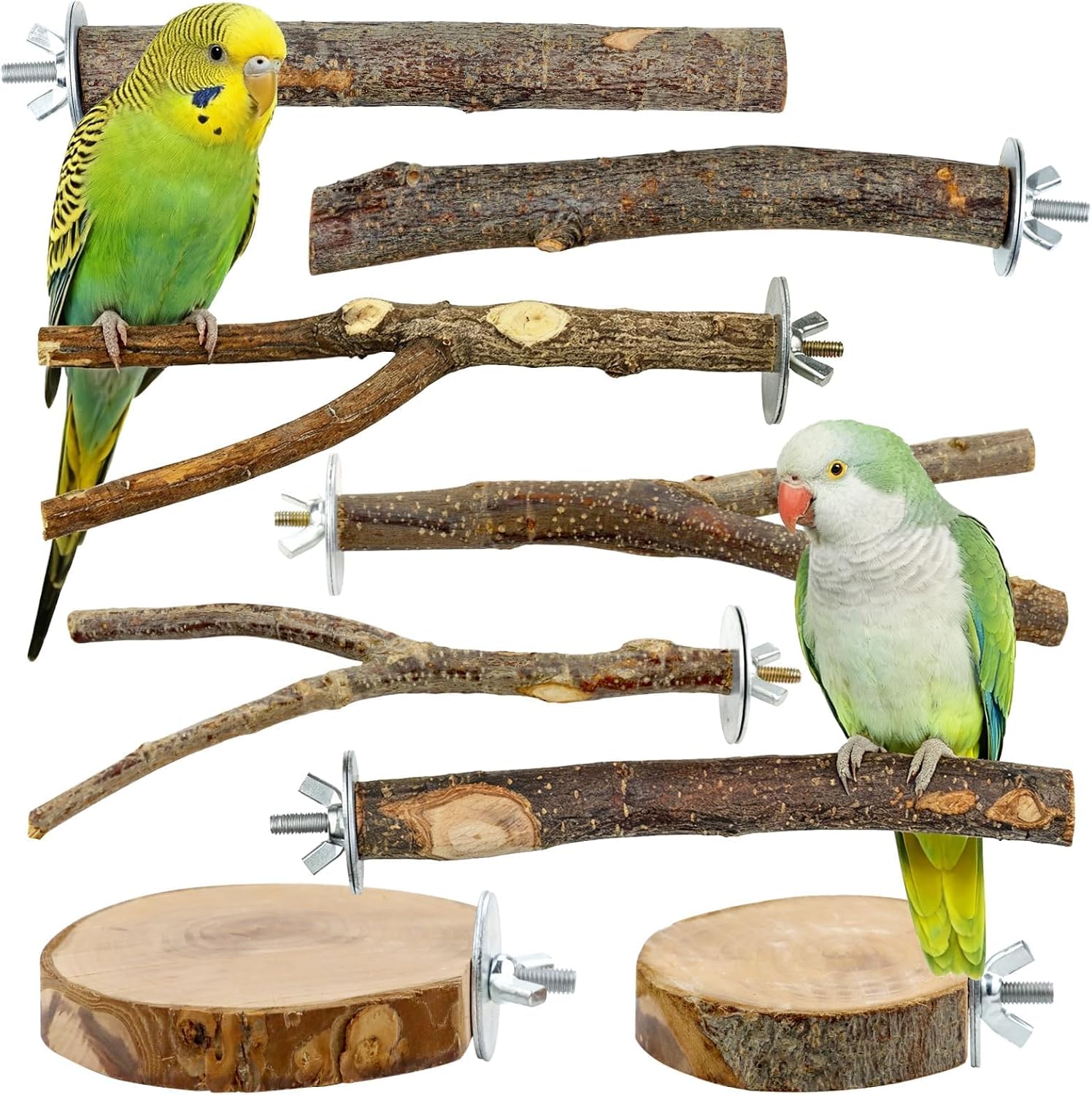
Natural branches replace the dowel rods that ship with most cages, and the difference is immediate: irregular diameter means the foot shifts grip positions constantly instead of wearing one spot. Safe woods include manzanita, java, dragonwood, apple, and willow, sourced specifically for bird use so you avoid pesticide residue and toxic species (cherry, oak, and red maple are common mistakes). Manzanita is hard and smooth, which makes it last for years but also slippery for older birds -- pair it with a softer wood perch elsewhere in the cage. The natural variation in a single branch -- thicker at the base, tapering toward the tips, with side branches at odd angles -- is the point. A bird that shifts its grip while walking a branch is exercising its feet the way a wild bird would.
2. Sandy or Textured Pedicure Perch -- Positioned, Not Everywhere
A textured perch trims nails and conditions foot pads as the bird grips it, and it genuinely reduces claw-trimming frequency when placed correctly. The critical detail is placement: put one at a mid-cage position the bird crosses for food or water, never the highest perch (birds prefer high roosts, and a favorite perch wears the same foot points all day) and never more than one per cage. Overuse abrades foot pads, which is the failure mode behind half the negative reviews of these products. Think of a textured perch as a tool with a specific job -- nail conditioning -- rather than a general-purpose surface. The manufacturers of these perches typically specify that they are intended for intermittent use, and the veterinary literature on pododermatitis supports that limitation.
3. Rope Perch -- Comfort and Flexibility
Cotton or sisal rope perches bend into loops, ramps, and tunnels, giving older birds, recently clipped birds, and chicks something soft and forgiving to grip. They are also the perch of choice for birds recovering from foot injuries because the surface yields to pressure instead of concentrating it. Check them weekly: loose threads are a genuine entanglement risk, and a fray that catches a nail once will catch it every night. Trim frayed sections or retire the perch. Rope perches also have a behavioral advantage: because they can be shaped, they can be positioned to create a comfortable sleeping spot at a height the bird prefers, which matters for birds that are anxious about roosting.
4. Platform or Corner Perch -- Rest for Aging Feet
A flat platform lets a parrot stand with flat feet, which older birds, birds with arthritis, and heavy-bodied species (Amazons especially) appreciate more every year. It also doubles as a sleeping surface for birds that sprawl. Platforms collect droppings fast, so plan to scrape and wipe them during every cage clean. The flat surface is also easier on birds recovering from foot surgery or those with bandages, since there is no edge pressing into the foot. A platform placed in a corner at mid-height gives a bird a place to rest that does not require gripping at all.
5. Shower and Window Perches -- Life Outside the Cage
Suction-cup shower perches turn bath time into something many parrots eventually look forward to, and a window perch gives a caged bird a destination outside its cage during supervised hours. Check suction mounts before every use and never trust them for an unsupervised bird -- a falling perch with a startled bird attached is how wings and windows both lose. Suction cups degrade over time, especially in humid bathrooms, so a perch that held firmly six months ago may not hold today. Test the suction by pressing firmly and tugging before letting the bird step on.
Top Perch Picks for 2026
Java Wood Multi-Branch Perch -- Best Overall
Price: $45-90 depending on size | Rating: 4.8/5
Java wood perches are cut from coffee trees past productive age, with multiple branch points at varied diameters on a single unit -- essentially a natural foot gym in one purchase. The hardwood core lasts years, the coffee-wood origin is a genuinely sustainable sourcing story, and parrots use every fork of the branch. The main cost is weight: the larger models need a solid stand or a heavy-duty cage mount. This is the perch to buy if you are replacing dowels and want one purchase to cover the daily default role. Its trade-off is that the smooth, dense surface offers less nail conditioning than a textured perch, so it works best alongside a separate pedicure perch rather than as the only surface.
Polly's Pet Products Sandy Perch -- Best Pedicure Perch
Price: $15-30 | Rating: 4.6/5
Polly's textured perches have been the reference product in this category for years, with a grit surface that conditions nails without the extreme abrasion of the cheapest imitations. Available in sizes matched to species. Placement discipline (mid-cage, one per bird) is what separates the owners who love these from the ones whose birds end up with sore pads. The trade-off is that the grit surface smooths over time and eventually needs replacement, and the perch is not suitable as a primary sleeping surface because of the constant abrasion it applies to the same contact points.
Prevue Pet Products Rope Bungee Perch -- Best Comfort Perch
Price: $12-25 | Rating: 4.5/5
The coiled rope design bends into custom shapes and covers the comfort role better than any rigid perch. For senior birds and birds recovering from bumblefoot, a rope loop at sleeping height is the kindest surface in the cage. Inspect weekly for frays as with all rope products. The trade-off is durability: rope perches wear out faster than wood, and a perch that looks fine at a glance can hide a frayed strand that has already caught a nail once. Owners report that rotating two rope perches -- one in the cage, one being washed -- extends the life of both.
KandH Pet Products Thermo-Perch -- Best for Cool Homes
Price: $40-60 | Rating: 4.7/5
The Thermo-Perch is a heated perch that holds a bird-safe surface warmth, and it has become a standard recommendation for homes that run cool in winter, for African greys that pluck, and for older birds with stiff joints. It plugs in with a safe low-voltage design and the surface never gets hot enough to burn. It is not a substitute for proper room temperature, but as targeted comfort it has no real competitor. Birds with feather-destructive behavior often settle noticeably on a warm perch at night. The trade-off is that the perch requires an outlet near the cage and adds a cord that must be routed away from chewing beaks. For birds that do not seek warmth, the Thermo-Perch offers little advantage over an unheated perch of the same shape.
Natural Corner Shelf Perch -- Best Budget Addition
Price: $10-18 | Rating: 4.4/5
A simple pine or birch corner platform costs little and fills the resting role that round perches cannot. Screw it into a rear corner above the food station and it becomes both a rest spot and a vantage point. Plan on replacing it annually, because chewed edges are a feature, not a defect. The trade-off is that the platform is not adjustable and its position is fixed once mounted, so measure the corner and the bird's preferred height before drilling. For a bird that has never used a platform, expect a few days of suspicion before it steps on.
Comparison Table
| Perch | Type | Best For |
|---|---|---|
| Java Wood Multi-Branch | Natural hardwood | Daily default grip variety |
| Polly's Sandy Perch | Textured | Nail conditioning, mid-cage |
| Prevue Rope Bungee | Soft rope | Seniors, recovery, sleep |
| KandH Thermo-Perch | Heated | Cool homes, pluckers, arthritis |
| Corner Shelf Perch | Platform | Flat-foot rest on a budget |
Placement: Where Perches Go and Why
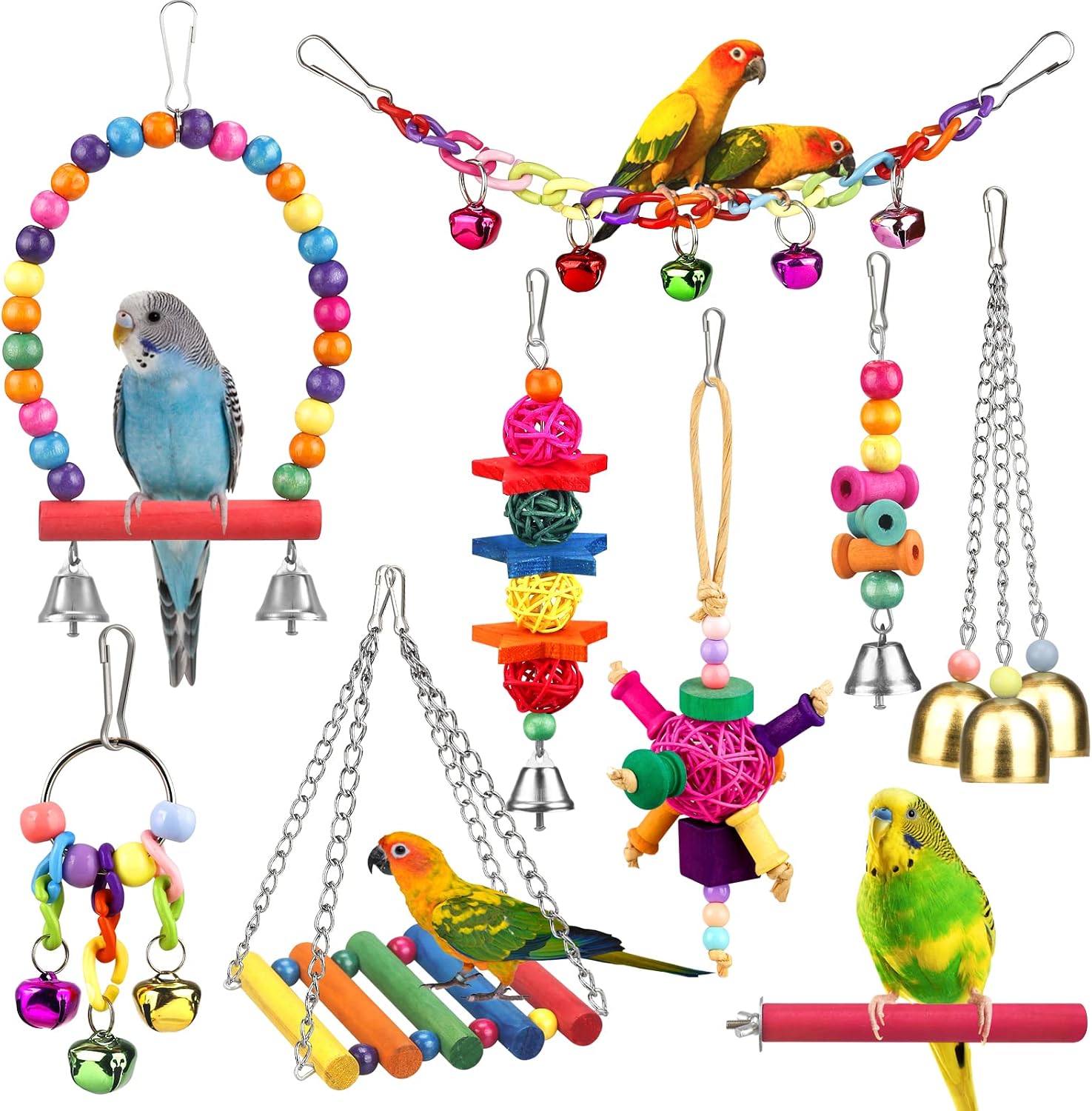
Placement decisions matter as much as the perches themselves:
- Never directly over food or water. Droppings contaminate both within hours.
- Do not block full wing extension. A bird should be able to flap without hitting anything; crowded cages cause broken tail and wing feathers.
- Keep the highest perch in the middle of the cage, not by the door. Birds guard the highest roost, and a guard bird at the door becomes a bite risk every time you reach in.
- Leave one perch length of gap between neighboring perches. Overlapping perches put the tail in the neighbor's drop zone and the head in the neighbor's beak zone.
- Away from drafts and kitchen fumes. Nonstick cookware fumes are lethal to birds. The ASPCA Animal Poison Control maintains guidance on household toxins, and the ASPCA pet care library covers bird-specific hazards including airborne toxins.
Common Mistakes
All-dowel cages. The uniform grip is the underlying cause of most captive parrot foot problems. Swap even one dowel for a natural branch and the foot load starts redistributing immediately. Dowels are not inherently dangerous, but they become a problem when they are the only surface a bird stands on, because the same contact points bear weight indefinitely.
Grit perches everywhere. One textured perch, mid-cage. A wall of sandpaper surfaces does not trim nails faster; it abrades foot pads and creates the very sores it was bought to prevent. The veterinary guidance on pododermatitis is clear that abrasive surfaces should be a small fraction of the perch inventory, not the majority.
Ignoring perch wear. Rope frays, wood cracks, textured surfaces smooth out. A 30-second perch check during weekly cleaning catches all of it before it becomes an injury. The check should include the mounting hardware as well as the perch surface, since a perch that shifts underfoot is both a fall risk and a reason a bird avoids that perch entirely.
Toys and perches competing for space. A cage full of equipment restricts movement worse than a sparse one. Two to three well-placed perches plus two or three rotated toys beat a cage packed with both. The goal is a cage that a bird can move through with full wings partly extended, not a cage in which every surface is occupied.
Buying the wrong diameter. A perch that is too wide for a budgie or too narrow for a macaw will be avoided or will cause grip problems. Measure the bird's foot before ordering, and when in doubt, buy two diameters and let the bird show which one it prefers.
Cleaning and Maintenance
Perches are the most hygienically neglected part of most cages, which is backwards, because the bird stands on them all day. Droppings dry onto wood and rope within hours, and the perch next to the sleeping spot accumulates the most. Build the routine around the weekly cage clean: wood and rope perches come out and go through a scrub with bird-safe disinfectant or a vinegar solution, textured perches get a stiff brush, and platforms get scraped flat. Anything that cannot come fully clean -- rope soaked through with droppings, wood with deep gnaw grooves that hold grime -- gets retired rather than disinfected forever.
Metal hardware deserves its own check. The wing nuts and washers that hold perches loosen with daily vibration, and a perch that shifts underfoot is both a fall risk and a reason a bird avoids that perch entirely. A 10-second wiggle test on each mount during the weekly clean catches every loose fitting. Stainless steel hardware outlasts zinc-plated versions, and the zinc question is not cosmetic -- zinc toxicity from chewed galvanized hardware is a documented parrot emergency.
Wood perches that have been chewed can be sanded lightly to remove rough edges, but deep grooves that hold organic matter should be retired rather than sanded indefinitely. Rope perches can sometimes be washed and dried, but a rope that has been soaked through with droppings is difficult to sanitize fully and is best replaced. Textured perches lose their grip over time; when the surface feels smooth to the touch, the perch has stopped doing its job and should be replaced.
Frequently Asked Questions
How many perches does a parrot cage need?
Three to five, of different types and diameters, in a cage big enough that the bird can move between all of them with full wings partly extended. More perches in a small cage is worse than fewer in a large one. The number matters less than the variety: a cage with three different perch types is better than a cage with six identical dowels.
Are sandpaper perch covers safe?
The flat covers that wrap around existing dowels are the worst version of the idea: uniform grit pressure on the same foot points all day, which causes sores. A shaped textured perch used once per cage is the safe implementation. Skip the covers.
What wood is unsafe for parrot perches?
Avoid cherry, red maple, oak, box elder, and anything collected from roadsides or treated with pesticides. Buy bird-specific branches, or verify species and preparation from a reliable safe-wood list before using anything you cut yourself. The wood does not have to be a named commercial product to be safe, but the species and the absence of chemical treatment both need to be verified.
Why does my parrot avoid the new perch?
Fear of novelty is normal. Place the new perch below the favorite one for a few days, let the bird investigate on its own schedule, then raise it. Forcing the issue -- or removing the familiar perch too fast -- backfires almost every time. Reading body language helps here; a bird that leans away or raises a foot defensively is not ready to step onto a new surface.
How often should I replace perches?
Rope perches when frayed, wood perches when cracked or stripped to splinters, textured perches when the surface smooths. Natural wood can last years; rope often needs replacing within months. There is no fixed schedule, only inspection.
Can I use a perch from outside?
Only if you can identify the wood species with certainty, confirm it is not on a toxic list, and know the branch has not been treated with pesticides or exposed to vehicle exhaust. For most owners, buying bird-specific branches is the safer and simpler choice.
Do perches need to be different sizes in the same cage?
Yes. A cage with a single diameter, even a correct one, still concentrates pressure on the same contact points. Two or three diameters in rotation keep the foot working through a range of positions.
Final Thoughts
Build the cage around grip variety: one natural branch as the daily default, one textured perch for nails, one soft rope for comfort and sleep, and a platform if your bird is older or heavy-bodied. Match diameters to the species, place them where droppings and wingbeats cannot cause trouble, and inspect everything weekly. Foot problems in parrots are almost entirely preventable, and prevention costs less than one vet visit. Small setup decisions, made early, eliminate most of the predictable emergencies. For diet, pair the perch setup with a nutrition plan that supports overall condition, since foot health and overall condition rise and fall together.
Late 2026: Seasonal Perch Notes
Cold weather is heated-perch season, and it is worth revisiting the heated-perch category each winter rather than leaving one plugged in year-round. A heated perch earns its outlet space when the room genuinely runs cool or when a specific bird, often an older African grey or an Amazon with stiff joints, uses it every night. It stops earning that space the moment central heating brings the room up to temperature. If yours has been plugged in since last winter, unplug it for a week in a warm room and see whether the bird misses it; the answer tells you whether it is equipment or furniture.
Window perches also need a winter check. Suction mounts that held through a warm, dry summer can fail in a cold snap as the glass contracts and the cup stiffens, and a perch that detaches with a bird on it is the exact accident this product category exists to avoid. Press, twist, and tug-test every mount before each supervised session through winter, and retire any cup that has hardened or cracked at the edge. In cold climates, a window perch also puts a bird against the coldest surface in the room, so watch where the bird actually chooses to sit and move the perch if it stops using it.
The other seasonal shift is indoor air. Fireplaces, space heaters, and heavier cooking all raise the stakes on the nonstick-fume and smoke rules that already apply year-round, and dry winter air is rough on foot pads and feathers alike. A perch inventory that includes one soft rope surface and one platform gives a bird options when its feet feel the season; some birds shift most of their roosting onto softer surfaces in winter and back onto natural branches in summer, and that rotation is normal.
Use the heating season as the annual reminder it already is: pull every perch, scrub, inspect the hardware, and retighten the wing nuts. The winter cage spends more hours occupied and fewer hours aired out, so a clean perch set matters more now than it did in July.
Where to Buy: Our Top Picks
As an Amazon Associate, PawCritic earns from qualifying purchases. This does not affect our reviews or recommendations.
- Natural Wood Branch Perch: Check price on Amazon
- kathson Grapestick Wood Perch (natural chewing branch): Check price on Amazon
- Multi-Branch Wood Stand: Check price on Amazon
- Bird Perch Stand with Ladder and Hammock Toys (conure size): Check price on Amazon
Related Reading
bird cage interior layout and perch placement, the best bird perches and swings, and how to clean a bird cage step by step.